
How a Deliberately Destroyed Transit Network Shaped the Isolation of Over the Mountain Communities and What It Teaches Us About Inherited Loss
Every day, thousands of Birmingham residents drive down Highland Avenue, through Five Points South, along First Avenue North, and out toward Homewood and beyond. They navigate these routes in climate controlled isolation, sealed inside metal and glass, separated from the city and from each other. Most have no idea that they are tracing the ghosts of something that was deliberately taken from them.
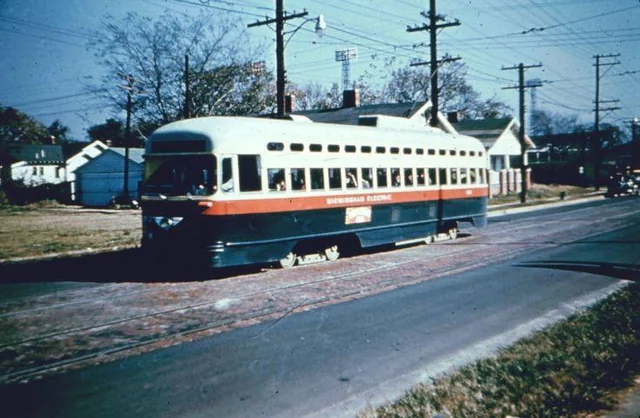
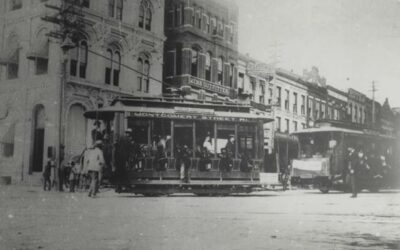
From the 1890s through the early 1950s, Birmingham possessed an extensive streetcar network that connected downtown to neighborhoods throughout Jefferson County. Electric trolleys ran along the very streets that now serve as commuter corridors. Residents of what would become Mountain Brook, Vestavia Hills, and Homewood could travel into the city without owning a car, without burning gasoline, and most importantly, without the peculiar isolation that defines contemporary Birmingham life.
Then it was destroyed. Not because it stopped working. Not because people stopped using it. It was deliberately dismantled by the Birmingham Electric Company and affiliated interests who recognized that their profits depended on automobile dependency. The tracks were ripped up. The trolleys were sold or scrapped. And within a generation, Birmingham forgot that any of this had ever existed.
This history matters for reasons that extend far beyond transportation policy. It offers a window into the psychology of collective forgetting, the mental health consequences of car dependent urban design, and the ways that we inherit losses we never knew we suffered.
The Streetcar City That Birmingham Used to Be
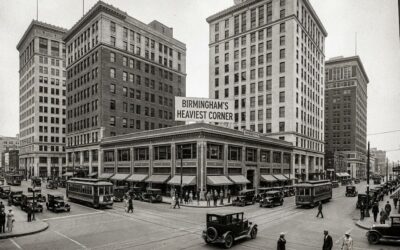
To understand what was lost, you have to imagine a Birmingham that most current residents have never seen. In the early twentieth century, the streetcar was not a novelty or a tourist attraction. It was the circulatory system of the city, the infrastructure that made urban life possible.
The Birmingham Railway, Light and Power Company operated dozens of streetcar lines radiating outward from downtown. You could board a trolley at the corner of First Avenue and Twentieth Street and travel to Avondale, to East Lake, to Ensley, to Woodlawn. The system connected working class neighborhoods to middle class ones, Black communities to white ones, residential areas to commercial districts.
The streetcar lines did not just transport people. They shaped the physical development of Birmingham. The neighborhoods that emerged along trolley routes were designed for walking. Houses sat close to the street. Front porches faced sidewalks. Commercial districts clustered around streetcar stops. The assumption was that residents would walk to the trolley, ride to their destination, and walk again at the other end.
This design had psychological consequences that we are only now beginning to understand. Streetcar neighborhoods fostered what urban planners call “passive social contact,” the casual encounters with neighbors and strangers that build community without requiring deliberate effort. You saw the same faces on your morning commute. You nodded to the shopkeeper as you walked to the stop. You overheard conversations and participated in the ambient social life of the street.
The streetcar suburbs that would later become Homewood, Mountain Brook, and parts of Vestavia Hills were developed with this model in mind. The original plans assumed trolley access. The street layouts, the commercial nodes, the relationship between residential and retail space all presumed that residents would travel by streetcar and on foot.
The Deliberate Destruction
What happened next is a story that most Birmingham residents have never heard, and the forgetting itself is part of the story.
By the 1930s and 1940s, a coalition of automobile manufacturers, oil companies, and tire producers had recognized that their profits depended on eliminating alternatives to car ownership. Streetcar systems across America were systematically acquired and dismantled, often by holding companies with direct ties to the automobile industry. The most famous of these was National City Lines, which was later convicted of conspiring to monopolize the sale of buses and supplies to local transit companies.
Birmingham’s streetcar system met a similar fate. The Birmingham Electric Company, which operated the trolley network, faced pressure from multiple directions. Automobile interests promoted the narrative that streetcars were outdated, inefficient, and incompatible with progress. City officials, many of whom had financial ties to real estate development in car dependent suburbs, supported the transition to buses and private automobiles.
By the early 1950s, the last streetcars had been removed from Birmingham’s streets. The tracks were paved over. The overhead wires came down. The trolley barns were converted to other uses or demolished. And within a remarkably short time, Birmingham residents began to forget that any of this had ever existed.
The forgetting was not accidental. It was cultivated. The automobile was marketed as freedom, as progress, as the American way. The streetcar was reframed as a relic of a cramped and limited past. People who had grown up riding trolleys raised children who grew up in cars, and those children grew up with no memory of any alternative.
The Psychology of Manufactured Forgetting
This history raises uncomfortable questions about how we know what we have lost. The residents of Birmingham did not vote to destroy their streetcar system. They were not asked whether they preferred car dependency to transit access. The decision was made for them by corporate interests, and then the very memory of the alternative was systematically erased.
Psychologists who study trauma recognize a phenomenon called dissociation, where unbearable experiences are walled off from conscious awareness. Something similar can happen at a collective level. When a community loses something essential but lacks the framework to understand or grieve that loss, the loss itself can disappear from collective memory.
Birmingham’s relationship to its streetcar history has this quality. The loss was significant. It reshaped the physical and social structure of the entire metropolitan area. But because the loss was framed as progress rather than deprivation, there was no space for grief. You cannot mourn what you have been told was an improvement.
This creates a peculiar psychological situation for contemporary Birmingham residents. Many people feel that something is wrong with the way the city is organized. They sense the isolation, the car dependency, the difficulty of moving through space without a personal vehicle. But they lack the historical framework to understand this feeling as loss. They experience the symptoms without knowing the cause.
For residents of Mountain Brook, Vestavia Hills, and Homewood, this dynamic is particularly acute. These communities were designed as streetcar suburbs and then retrofitted for automobile dependency. The walkable commercial districts, the grid street patterns, the relationship between residential and retail space all reflect the original streetcar oriented design. But the transit infrastructure that made sense of this design was removed, leaving communities that feel almost but not quite right, that gesture toward a walkability they can no longer deliver.
Car Dependency and the Isolated Self
The mental health consequences of car dependent urban design have become a significant area of research in recent decades. Architects like Leon Krier have critiqued this phenomenon. Studies consistently show that people who live in walkable, transit rich neighborhoods report higher levels of social connection, lower rates of depression and anxiety, and greater overall life satisfaction than those who live in car dependent suburbs.
The reasons are not mysterious. Cars isolate. When you travel by car, you move through a privatized bubble, sealed off from the environment and from other people. You do not make eye contact with strangers. You do not overhear conversations. You do not experience the passive social contact that builds community and reminds you that you are part of a larger social world.
This isolation compounds over time. Children who grow up in car dependent suburbs often have difficulty developing independent mobility. They cannot walk to a friend’s house or ride a bike to a store. Their social lives depend entirely on parental chauffeuring, which means their social development depends on adult schedules and adult willingness to drive. This dependency can persist into adolescence and beyond, delaying the development of autonomy and self efficacy.
For adults, car dependency means that every errand, every social engagement, every trip outside the home requires the activation of a two ton machine. The friction of travel increases. Spontaneous connection decreases. People begin to calculate whether seeing a friend is worth the drive, whether attending an event justifies the gas and the parking. Slowly, almost imperceptibly, social networks contract.
The suburbs of Birmingham illustrate these dynamics clearly. Mountain Brook, Vestavia Hills, and Homewood are affluent communities with excellent schools and beautiful homes. They are also communities where getting anywhere requires a car, where children cannot safely walk or bike to most destinations, where social isolation is built into the infrastructure.
This is not because the residents of these communities chose isolation. It is because decisions made seventy years ago, decisions that current residents had no part in, eliminated the alternatives. The streetcar system that would have provided connection was deliberately destroyed. What remains is a landscape that looks like freedom but functions as a beautifully landscaped trap.
The Routes We Drive Without Knowing
There is something almost ghostly about driving Birmingham’s streets with knowledge of the streetcar history. The routes have not changed. Highland Avenue, which now carries thousands of cars daily between downtown and the over the mountain suburbs, was a major streetcar corridor. First Avenue North, Twentieth Street, the roads through Five Points South, all of these were designed around trolley lines.
When you drive these routes today, you are tracing paths that were laid out for a completely different mode of transportation. Your car follows the logic of the streetcar, but without the streetcar’s social infrastructure. You pass the same landmarks that trolley passengers passed a century ago, but you pass them in isolation, sealed in your private vehicle, unaware that you are haunting a transit network that was taken from you before you were born.
This unconscious inheritance extends beyond transportation routes. The shopping districts of Homewood, the village center of Mountain Brook, the commercial areas along major corridors throughout Birmingham were all designed around streetcar stops. They assumed pedestrian access from trolley lines. The parking lots that now dominate these areas are afterthoughts, retrofitted adaptations to a car dependent reality that the original designers never anticipated.
Living in these communities means constantly navigating a built environment that does not quite make sense. The distances are too far for comfortable walking but too short to justify the infrastructure devoted to cars. The commercial areas feel like they should be walkable but are not. The residential streets gesture toward a neighborly sociability that the transportation infrastructure cannot support.
Many Birmingham residents experience this dissonance without being able to name it. They feel that something about their community is not working, that connection is harder than it should be, that they are more isolated than they want to be. They often blame themselves for this isolation, assuming that they are simply not trying hard enough to build community. But the truth is that they are struggling against infrastructure that was designed, deliberately and for profit, to produce exactly the isolation they experience.
Grief for What We Never Knew
One of the most challenging aspects of Birmingham’s streetcar history is the difficulty of grieving something you never experienced. Current residents of Homewood, Mountain Brook, and Vestavia Hills did not ride the trolleys. They have no personal memories of streetcar commutes or the social life that accompanied them. How do you mourn the loss of something you only know through photographs and historical accounts?
This is a question that therapists encounter in many contexts. Clients often struggle with losses that are real but difficult to name. The loss of a childhood that should have been different. The loss of a family structure that might have provided more support. The loss of cultural connections severed by immigration or assimilation. These are genuine losses, but they are losses of possibility rather than losses of concrete experience.
Birmingham’s streetcar history belongs to this category. What was lost was not just a transportation system but a possible way of living. A more connected city. A more walkable community. A social infrastructure that would have supported different kinds of relationships and different ways of moving through space. Current residents inherit the absence of these possibilities without having experienced their presence.
Grieving this kind of loss requires first acknowledging that it is real. The isolation that many Birmingham residents feel is not a personal failure. It is the predictable result of infrastructure decisions made decades ago by people who prioritized profit over community. Recognizing this can shift the emotional weight from self blame to appropriate anger, from personal inadequacy to systemic critique.
This recognition can also open space for imagination. If the current arrangement is not natural or inevitable but is rather the result of specific historical choices, then different choices might be possible. Other cities have rebuilt streetcar systems. Other communities have redesigned car dependent suburbs to support walking and transit. The future does not have to replicate the past.
Rebuilding Connection in a Car Dependent Landscape
For those who currently live in Birmingham’s over the mountain suburbs, the streetcar history cannot be undone. The tracks are gone. The infrastructure would cost billions to rebuild. The immediate reality is that Homewood, Mountain Brook, and Vestavia Hills will remain car dependent for the foreseeable future.
But understanding the history changes the psychological relationship to that reality. Instead of experiencing isolation as a personal failing, residents can understand it as a structural condition. Instead of blaming themselves for not building more community, they can recognize that they are working against infrastructure specifically designed to prevent the kind of passive social contact that builds community organically.
This recognition can inform more intentional approaches to connection. If spontaneous community is difficult in car dependent suburbs, then deliberate community becomes more important. This might mean joining organizations that provide regular social contact. It might mean establishing walking routines that create opportunities for neighbor interaction despite the car centric design. It might mean choosing to live in the more walkable pockets that still exist within these communities, even if that means smaller lots or older homes.
It might also mean advocating for change. Birmingham has begun exploring transit improvements, including potential streetcar lines that would reconnect some of the routes that were dismantled seventy years ago. Supporting these efforts is a way of working against the isolation that was deliberately engineered into the region.
And it might mean bringing this awareness into therapy. For clients in Birmingham who struggle with isolation, loneliness, or disconnection, understanding the structural dimensions of these experiences can be genuinely therapeutic. The problem is not that you are failing to connect. The problem is that you are living in a landscape that was designed to prevent connection and then sold to you as freedom.
The Hidden Curriculum of the Built Environment
Every city teaches its residents how to live. The lessons are not explicit. They are embedded in the built environment, in the distances between things, in the infrastructure that makes some activities easy and others difficult. Birmingham’s car dependent suburbs teach a particular set of lessons about isolation, independence, and the privatization of daily life.
These lessons are so pervasive that they become invisible. Children growing up in Mountain Brook or Vestavia Hills do not consciously learn that adult life means sitting alone in a car for hours each week. They simply absorb this reality as normal. They do not learn that community requires deliberate effort in ways it might not elsewhere. They simply experience the difficulty of connection as a natural feature of existence.
The streetcar history reveals that none of this is natural. Birmingham’s current arrangement is the product of specific decisions made by specific people for specific reasons. Those reasons had nothing to do with the wellbeing of Birmingham residents and everything to do with the profits of automobile manufacturers and oil companies.
Knowing this history does not change the physical reality of Birmingham’s streets. But it changes the psychological reality. It transforms a seemingly inevitable isolation into a contestable condition. It shifts the question from “why can’t I connect?” to “what would it take to rebuild what was taken?”
For residents of Birmingham, Homewood, Mountain Brook, and Vestavia Hills who feel the weight of isolation without understanding its source, this history offers something valuable. Not a solution, but an explanation. Not a way out, but a way of understanding how we got here. And perhaps, in that understanding, the beginning of imagining somewhere else to go.
Taproot Therapy Collective provides psychotherapy for individuals and families throughout greater Birmingham, including Homewood, Vestavia Hills, and Mountain Brook. Our clinicians understand that personal struggles often have structural dimensions, and that healing sometimes requires understanding the historical and environmental contexts that shape our lives. If isolation, disconnection, or difficulty building community are affecting your wellbeing, therapy can help you navigate these challenges with greater understanding and intentionality.












0 Comments