The Vagus Nerve: Your Body’s “Off Switch” for Anxiety

by | Dec 26, 2025 | 0 comments

If you have ever felt your heart race during a stressful meeting, or felt your stomach knot up before a difficult conversation, you have experienced your nervous system shifting gears. For decades, traditional psychology treated anxiety as a “thinking” problem—a flaw in your mindset that could be fixed with logic. However, modern somatic psychology reveals that anxiety is often a physiological state, not a mental one. The key to unlocking this state isn’t in your brain; it’s in your neck. It is the Vagus Nerve, the longest nerve in the body, and learning to regulate it is the single most effective tool for managing stress without medication.

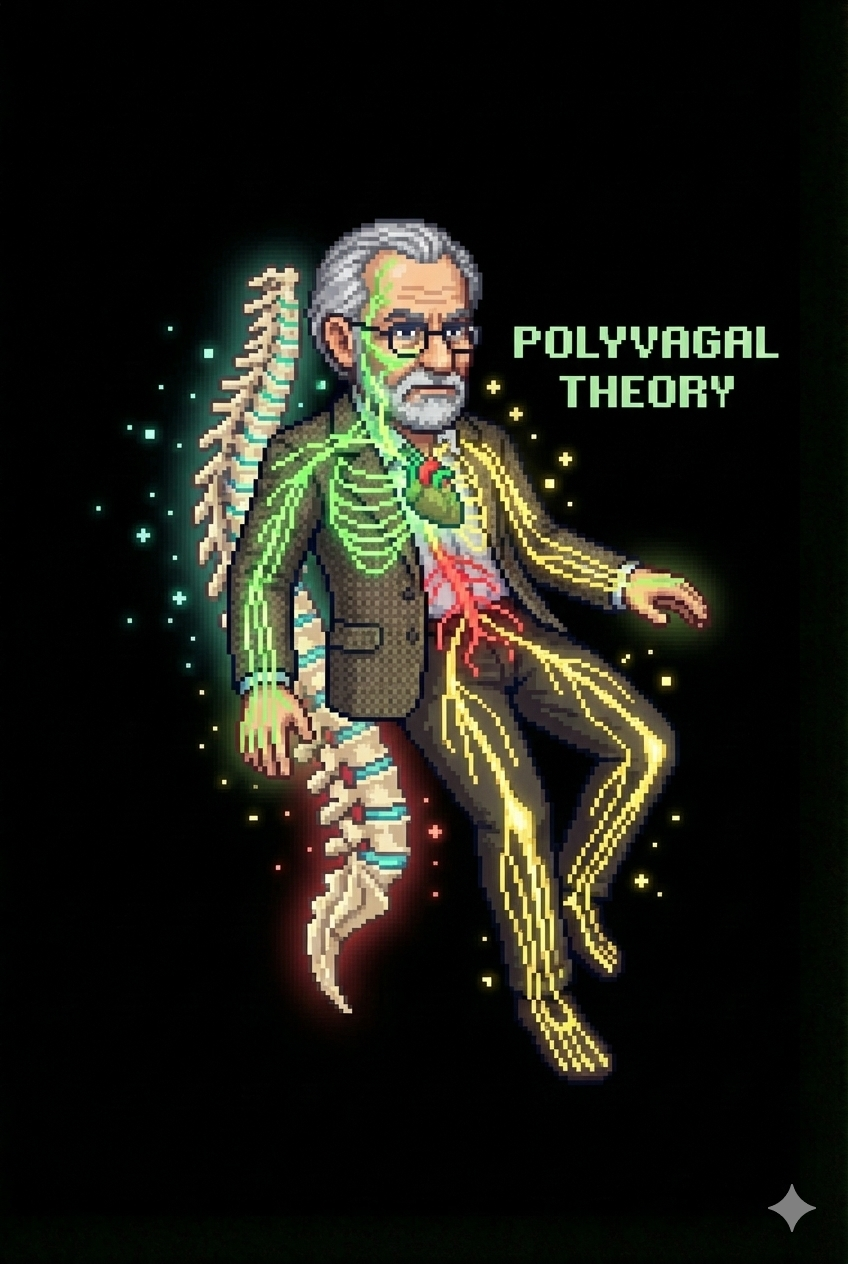
The Vagus Nerve (from the Latin for “wandering”) travels from the brainstem down into the chest and abdomen, connecting your brain to your heart, lungs, and gut. It is the command center of the Parasympathetic Nervous System—the “rest and digest” mode that counteracts the “fight or flight” response. According to Polyvagal Theory, developed by Dr. Stephen Porges, the Vagus Nerve is what allows us to feel safe, social, and connected. When it is functioning well (high “vagal tone”), we can bounce back from stress quickly. When it is dormant (low vagal tone), we get stuck in chronic defensive states: either the high-energy panic of anxiety or the low-energy collapse of depression.

For many of our clients in Birmingham, “talk therapy” hits a wall because you cannot think your way out of a survival response. If your body thinks it is being hunted by a tiger, no amount of rationalizing will lower your heart rate. You have to speak the body’s language. Below are five evidence-based somatic exercises that manually stimulate the Vagus Nerve, sending a direct signal to your brain that it is safe to relax.

1. The “Voo” Sound (Vocal Toning)

The Vagus Nerve passes right through the vocal cords. Vibration in the throat is one of the fastest ways to stimulate it. This exercise, often used in Somatic Experiencing, uses sound to vibrate the chest and neck.

  • Take a deep breath into your belly, not your chest.
  • On the exhale, make a low, deep, foghorn sound: “Voooooo.”
  • Focus on feeling the vibration rumble in your chest and belly.
  • Repeat for 1-2 minutes until you feel a “shift” (often a yawn or a sigh).

2. The Oculocardiac Reflex (Eye Movements)

The muscles of the eyes are directly connected to the suboccipital muscles at the base of the skull, which sits right over the Vagus Nerve. Stiff eyes often mean a stiff neck and a locked nervous system.

  • Lie on your back with your hands interlocked behind your head.
  • Keep your head perfectly still.
  • Move only your eyes to look as far to the right as you can (without pain).
  • Hold this gaze for 30-60 seconds.
  • Wait for a sign of relaxation: a swallow, a yawn, or a deep sigh.
  • Repeat on the left side.

3. Cold Water Immersion (The Diving Reflex)

Exposure to cold water triggers an ancient mammalian reflex known as the “diving response,” which instantly slows the heart rate to conserve oxygen. It is a biological “hard reset” for panic.

  • Fill a large bowl with icy water, or grab an ice pack wrapped in a thin towel.
  • Lean forward and submerge your face (or hold the pack to your eyes and cheekbones) for 30 seconds.
  • Hold your breath while you do this.
  • This is particularly effective for halting a panic attack in progress.

4. Ear Massage

The ear is the only place where the Vagus Nerve reaches the surface of the skin (specifically the cymba conchae, the hollow just above the ear canal). Research suggests that stimulating this area can reduce heart rate variability.

  • Place your index finger in the hollow of your ear, just above the opening.
  • Gently massage in a circular motion.
  • You can also gently pull the ear down and back to open the ear canal.
  • Do this for 30 seconds on each side while breathing slowly.

5. Diaphragmatic Breathing with a Long Exhale

The Vagus Nerve is most active during the exhale. By slowing down your exhalation, you physically force your heart rate to drop (a phenomenon called respiratory sinus arrhythmia).

  • Inhale through your nose for a count of 4.
  • Hold for a count of 4.
  • Exhale through pursed lips (like you are blowing through a straw) for a count of 8.
  • The key is making the exhale longer than the inhale.

Incorporating these tools into your daily routine can gradually increase your vagal tone, making you more resilient to stress over time. However, for those with a history of complex trauma, these exercises are just the beginning. At our clinic, we combine these physiological tools with deep processing work to help the nervous system relearn safety permanently. If you are stuck in a loop of fight-or-flight, consider reaching out for anxiety therapy that includes the body, not just the mind.

Explore the Other Articles by Categories on Our Blog 

The Neuroscience and Phenomenology of Brainspotting

The Neuroscience and Phenomenology of Brainspotting

 An In-Depth Exploration of What Brainspotting Does in the Brain Brainspotting is a relatively new psychotherapy approach that combines elements of psychodynamic, somatic, and mindfulness-based therapies to facilitate deep emotional healing and trauma resolution [1]....

Why We Recommend Hardy Nutritionals: A Clinical Perspective on the Research That Changed How We Think About Treatment Resistance

Why We Recommend Hardy Nutritionals: A Clinical Perspective on the Research That Changed How We Think About Treatment Resistance

Why Taproot Therapy Collective recommends Hardy Nutritionals Daily Essential Nutrients for treatment-resistant mood disorders, ADHD, and emotional dysregulation. Discovered not through advertising but through patients whose bipolar disorder and other conditions finally responded. Over 40 peer-reviewed studies support the NutraTek chelation technology. Use code TAPROOT at gethardy.com for 15% off for life.

The Ethical Advantage: Why Autistic Minds Are Built for Justice

The Ethical Advantage: Why Autistic Minds Are Built for Justice

Here is a pattern I see constantly in clinical practice: an autistic client accurately identifies an injustice at work, in their family, or in society. They name it clearly. They expect others to recognize the obvious problem and act accordingly. Instead, they're...

Why You Know Your Patient Is About to Cry Before They Do

Why You Know Your Patient Is About to Cry Before They Do

You're sitting across from a patient. They're talking about something ordinary. Scheduling conflicts. Work stress. Nothing obviously emotional. And then you feel it. A heaviness in your chest. A tightness in your throat. Something is coming. Thirty seconds later,...

What is Dopamine Detox: Social Media Pseudoscience or Self Help?

What is Dopamine Detox: Social Media Pseudoscience or Self Help?

Your feed is full of it: influencers claiming they "detoxed their dopamine" and now feel amazing. Tech bros swearing that 24 hours without screens reset their brain chemistry. Wellness gurus selling dopamine fasting protocols that promise mental clarity, focus, and...

A short History Of All Types of Family Therapy

A short History Of All Types of Family Therapy

A comprehensive analysis of family systems therapy models from Bowen to Narrative, including clinical applications, techniques, evidence base, and modern integrative approaches for conduct disorders, eating disorders, and trauma.

Who Is Gerald Edelman?

Who Is Gerald Edelman?

Discover Nobel Laureate Gerald Edelman’s Neural Darwinism, a revolutionary theory applying evolutionary principles to the brain’s development and consciousness.

Who Is Johnjoe McFadden?

Who Is Johnjoe McFadden?

Explore Johnjoe McFadden’s CEMI field theory, which proposes that consciousness arises from the brain’s electromagnetic field, solving the binding problem and explaining free will.

Who Is Michael Graziano?

Who Is Michael Graziano?

The Neuroscientist Who Proposed That Consciousness Is the Brain’s Model of Its Own Attention By The Clinical Team at GetTherapyBirmingham.com You know exactly where your arm is right now, even with your eyes closed. This automatic knowledge comes from what...

Who Is Hakwan Lau?

Who Is Hakwan Lau?

Explore Hakwan Lau’s Perceptual Reality Monitoring theory, which explains consciousness as the brain’s mechanism for distinguishing reality from noise, and its implications for treating anxiety.

Who Is Giulio Tononi?

Who Is Giulio Tononi?

Discover Giulio Tononi’s Integrated Information Theory, which quantifies consciousness as integration and offers new perspectives on treating trauma and dissociation.

Who Is Roger Penrose?

Who Is Roger Penrose?

Explore Roger Penrose’s revolutionary Orch OR theory of consciousness, linking quantum physics to the mind and offering new perspectives on trauma therapy.

Who Is David Rosenthal?

Who Is David Rosenthal?

The Philosopher Who Argued You Are Only Conscious of What You Think You Are Conscious Of What makes a mental state conscious rather than unconscious? This question, which has puzzled philosophers and scientists for centuries, received a provocative answer from David...

Who Is Anil Seth?

Who Is Anil Seth?

The Neuroscientist Who Showed That Reality Is a Controlled Hallucination Your brain is not a passive receiver of information from the world. It is a prediction machine, constantly generating guesses about what is out there and updating those guesses based on sensory...

0 Comments

Submit a Comment

Your email address will not be published. Required fields are marked *