
Gilbert Simondon’s modes of existence are the phases of the human relation to the world that he set out in Part III of On the Mode of Existence of Technical Objects (1958). An original magical unity splits into technics, which keeps the figure, and religion, which keeps the ground. Aesthetic thought sits at the neutral point between them and holds the memory of the lost unity.1
Read as psychology, the scheme suggests that much distress is a phase split rather than a broken part: technique cut off from any ground on one side, meaning cut off from any concrete place on the other. It does not resolve by going back to a lost wholeness or by picking a side. When it resolves, it does so the way Simondon thought every living individuation proceeds, by inventing a new structure in which both terms keep their reality. He adds a point therapists learn the slow way: the psyche, he argued, cannot finish that work alone.
What Simondon meant by modes of existence
The book was Simondon’s complementary doctoral thesis, mostly about engines, electronic tubes and other machines. Its third part asks where technicity comes from at all, and answers with the physicist’s idea of a phase: “not a temporal moment replaced by another, but an aspect that results from a splitting in two of being and in opposition to another aspect.” No phase is complete: “it is the actual system of all phases taken together that is the complete reality.”2 It is not a dialectic: no necessary succession, no negativity acting as the motor of progress.
The starting point is the magical mode, a relation to the world older than the split between subject and object. Magic here is not spells but the first way the world gets organized, as “a network of privileged points of exchange between the being and the milieu”: summits, mountain passes, thresholds, the heart of a forest. Time has key-points too, in beginnings, holidays and remarkable dates. Simondon calls superstition “merely a degraded vestige of magical thought” and points instead to “high, noble, and sacred forms of thought,” such as the climber’s ascent toward a summit. Even vacations “are in fact a search for old or new key-points.”2
Then the network breaks and figure separates from ground. The key-points lose their place and become tools, “transportable and abstracted from the milieu,” acting “point by point, instant by instant.” The qualities of the ground float free in the other direction as “detached powers and forces, above the world,” personified in the divine and the sacred: God, heroes, priests. Technics is the objective phase of the split, religion the subjective one. “Religion is not more magical than technics,” and each, “considered on their own,” is “impoverished with respect to the magic from which they come.”2
Aesthetic thought is the hinge, and plainly not a third phase: “it is not a phase, but rather a permanent reminder of the rupture of unity of the magical mode of being, as well as a reminder of the search for its future unity.” A work of art “re-establishes a reticular universe at least for perception,” but it does not bring magic back. His examples are technical. Sails are not beautiful at rest “but when the wind billows and inclines the entire mast,” and a line of pylons is beautiful crossing a valley, not lying on the trucks that deliver it.2
Technics and religion each then divide into a theoretical and a practical mode. Science arises between the two theoretical modes, ethics between the two practical ones. If science and ethics could converge they would give a second, complete analogue of the magical unity; Simondon calls that search philosophical research, while allowing it may be “nothing more than a mere tendency playing a normative role.”2 So the familiar summary of “three modes, technical, religious and aesthetic” is wrong: there is one relation to the world, split into two phases, with aesthetics marking where they met.

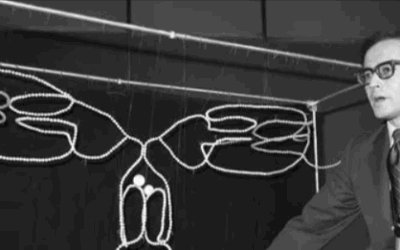
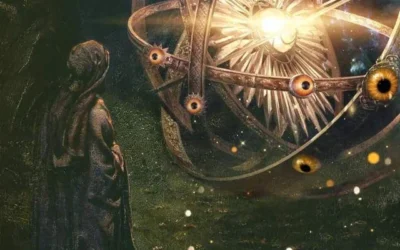
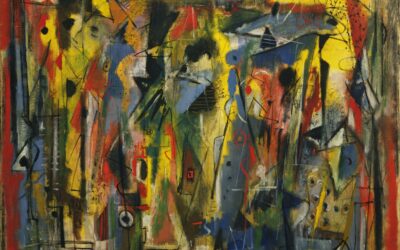
Earlier versions of this page called the drawing above “Simondon’s diagram.” It is not his. It comes from the art theorist Simon O’Sullivan, whose essay in postmedieval (online in 2018) asks how earlier modes of existence, magical thinking among them, might serve as a residual resource against the impasses of the present.3 O’Sullivan and David Burrows returned to the theme in Fictioning (2019), whose fifth chapter is titled “Residual Culture and the Magical Mode of Existence.”4
Individuation: the theory underneath the modes
The modes rest on Simondon’s main thesis. Philosophers had sought a “principle of individuation” by working back from the finished individual. Simondon reversed this, proposing “to know the individual through the individuation, rather than the individuation through the individual.”5
His model is a crystal. A supersaturated solution is metastable, holding more potential than its present form expresses. “A crystal that, from a very small seed, grows and expands in all directions in its supersaturated mother liquid provides the most simple image” of transduction, a structuring that spreads step by step, each layer the basis for the next.5 A stable equilibrium, by contrast, “in which all potential would be actualized, would correspond to the death of any possibility of further transformation.” A living system finds structure without using up its tension; it “continues to live and evolve.”2
Three claims carry the psychological weight. No individual is finished: “the constituted individual transports with itself a certain associated charge of preindividual reality.” The living do not only adapt, “which a machine can do,” but modify themselves “by inventing new internal structures.” And the psychic begins where a being “must itself intervene as an element of the problem by its action, as a subject.” Even so, “the psychic being cannot resolve its own problematic within itself.” It needs the collective, and Simondon names the category that joins psychic and collective individuation the transindividual.5
He also borrows a word from vision. The two eyes deliver images that cannot be laid on top of each other. They are disparate, “in the sense this word takes in the theory of depth perception,” and the brain resolves them by producing depth, a dimension neither image held. A real resolution orders the terms “without loss, without reduction.”5 Simondon set this against the pairing of form and matter that runs back to Aristotle’s account of substance, the hylomorphic schema he criticized at length.
Readers of Jung will notice the word. Jung used “individuation” for the process by which a person becomes a differentiated psychological whole. The Jungian analyst Mark Saban argues that Simondon’s idea was influenced by Jung’s, and that Simondon’s stress on relationship, affect, collective participation and problem-solving can give the Jungian concept firmer ground for clinical work.6 Pascal Chabot’s introduction to Simondon gives a chapter to Simondon and depth psychology.7
Simondon’s life and work, briefly
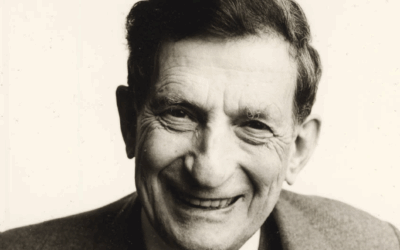
Simondon was born in Saint-Étienne on 2 October 1924. He entered the École normale supérieure in 1944, passed the agrégation in philosophy in 1948 and also took a degree in psychology. He taught at the lycée Descartes in Tours from 1948 to 1955, setting up a technology workshop for his pupils, then moved to the University of Poitiers. In 1958 he defended both theses: the main one on individuation, directed by Jean Hyppolite, and the complementary one on technical objects, directed by Georges Canguilhem.8 The same year Hannah Arendt published The Human Condition, with its distinction between labor, work and action.
The technical-objects book came out from Aubier in 1958 and found readers quickly. The main thesis appeared in pieces, in 1964 and in 1989, the year of his death, and complete in French only in 2005. Full English translations followed in 2017 and 2020.1,9
Simondon also had a second career in psychology. From 1963 he taught psychology at the Sorbonne, and from 1969 he directed general psychology teaching at the University of Paris V, where he founded a laboratory of psychology and technology. His courses on perception, sensibility, and imagination and invention ran in the Bulletin de psychologie in the mid-1960s.10 The imagination course, which follows the mental image from a bundle of motor anticipations through perception and symbolic memory to invention, is now in English.11 He retired in 1983 and died in Palaiseau on 7 February 1989.
Gilles Deleuze reviewed the 1964 volume in 1966, calling internal resonance a concept “susceptible to all sorts of applications, even and above all in psychology, in the domain of affect,”12 and drew on Simondon in Difference and Repetition (1968), four years before he and Félix Guattari published Anti-Oedipus. Bernard Stiegler later put Simondon’s individuation at the center of his philosophy of technics. Claims that Simondon “predicted” social media go too far.
Figure without ground, ground without figure
Simondon moved easily between machines and minds. In Part I of the same book he compared a machine’s dependence on its “associated milieu,” the surrounding conditions that regulate it, to the way explicit thoughts depend on a psychic ground. Freud, he argued, saw that ground’s influence but described it as hidden forms acting on visible ones, hence repression; for Simondon the ground is not a second set of forms. He defined alienation in psychic life as a rupture between ground and forms, when the ground no longer regulates what happens on the surface.1 That licenses reading the modes as a description of people as well as cultures.
Some people live almost entirely in the figural, technical phase. Their strategies, schedules and skills work anywhere and belong nowhere, acting, like Simondon’s detached tool, “point by point, instant by instant.”2 When such a person says that life works but means nothing, they are describing figure without ground with some precision.
Others live in the opposite phase. Meaning hovers above them as a totality no job, relationship or place can match, the religious phase in which every particular is “grasped as less than unity, dominated by a sensed totality that infinitely surpasses them.”2 Augustine’s restless heart is the classic statement: “Thou madest us for Thyself, and our heart is restless, until it repose in Thee.”13 Whatever one believes, ground without figure is a recognizable clinical picture: longing with nowhere to land.
Neither phase is the illness. Technics and religion inherit the original unity only as a pair, and each alone is impoverished. The trouble is the gap, and mistaking one phase for the whole. It also explains a kind of stuckness. In a passage Deleuze quotes, Simondon describes the wavering before decisive action, the fluctuatio animi, as “not a hesitation between several objects, or even between several paths, but the mobile superimposition of incompatible sets, sets that are alike but nonetheless disparate.”12 Someone who cannot decide whether to leave a career is often not weighing two options; two whole versions of the world overlap, and neither is visible from inside the other.
What this looks like in therapy
Simondon wrote no theory of psychotherapy, and nothing here is a technique with his name on it. As a lens, though, his ideas suggest four things.
Look for the new dimension, not the winning side. If a dilemma is disparation, the question is less “which one?” than “what would let both be seen at once?” In therapy that can mean giving the ambitious part and the exhausted part an equal hearing until a frame appears that neither could produce alone, a move clinicians who work with parts or in the Jungian tradition will recognize.
Do not aim at stable equilibrium. For Simondon a fully stable state is the end of further change. The goal is a structure that holds tension and stays capable of transformation. Existential therapy starts from a similar premise: some anxiety belongs to being alive and free, and the work is to live with it well rather than remove it.
Rebuild key-points. Aesthetic thought keeps alive the structure of privileged places and moments, and “any act, any thing, any moment has in itself the ability to become an outstanding point of a new reticulation of the universe.”2 Grief work often turns on these: the anniversary, the grave, the first holiday without someone. Jacob Burckhardt saw something similar in Renaissance festivals, which “in their best form mark the point of transition from real life into the world of art.”14 The therapy hour is itself a key-point, the same room at the same time each week. Simondon used the Greek temenos, a sacred enclosure, for such a place; Jung, in Psychology and Alchemy, used the same word for a protected space where unconscious material can surface safely. A life like that of the weaver-poet Kabir, trade and devotion in one person, shows what reconnection can look like.
Do not expect to finish it alone. Simondon’s claim that the psychic being cannot resolve its problematic within itself has an empirical cousin. A meta-analysis of 295 studies covering more than 30,000 patients found a consistent association between the strength of the therapeutic alliance and outcome, a correlation of about .28 across treatment types.15 Correlation is not causation, and the transindividual is wider than any two-person bond. But the evidence points the same way.
One correction is owed. Earlier versions of this article paired each mode with a therapy, the aesthetic mode with art therapy and the magical mode with mindfulness and transpersonal work, as if Simondon had drawn that map and its benefits were settled. Neither is true. A systematic review of art therapy for non-psychotic conditions found 15 randomized trials with 777 participants; ten favored art therapy over control, but the trials were generally of low quality and too varied to pool.16 Art can be a key-point in a life. That is a different claim from calling it a proven treatment.
Where to start reading Simondon
Begin with “The Genesis of Technicity,” a long excerpt from Part III that e-flux journal published in the Malaspina and Rogove translation in 2017, free to read.2 Then read “The Position of the Problem of Ontogenesis,” the opening of the main thesis, also free in Parrhesia.5 Muriel Combes’s book on the transindividual is a careful guide to psychic and collective individuation.17
One caution: he writes of “man” and the “primitive,” and his genealogy of magic is a speculative reconstruction, not anthropology. His key-points sit close to what Mircea Eliade described as sacred space, places that orient an otherwise uniform world.
If you recognize this split, a life that works without meaning much or a meaning with nowhere to land, it can be talked through. Taproot’s clinicians bring existential and Jungian depth therapy to questions like these, in Hoover and by teletherapy across Alabama. You can reach us here when you are ready.
References
- Simondon, G. (2017). On the mode of existence of technical objects (C. Malaspina & J. Rogove, Trans.). Univocal Publishing. (Original work published 1958)
- Simondon, G. (2017, May). The genesis of technicity (C. Malaspina & J. Rogove, Trans.). e-flux journal, 82. https://www.e-flux.com/journal/82/133160/the-genesis-of-technicity/
- O’Sullivan, S. (2020). Myth-science as residual culture and magical thinking. postmedieval, 11(1), 119–136. https://doi.org/10.1057/s41280-018-0086-2
- Burrows, D., & O’Sullivan, S. (2019). Fictioning: The myth-functions of contemporary art and philosophy. Edinburgh University Press. https://doi.org/10.1515/9781474432412
- Simondon, G. (2009). The position of the problem of ontogenesis (G. Flanders, Trans.). Parrhesia, 7, 4–16. https://www.parrhesiajournal.org/parrhesia07/parrhesia07_simondon1.pdf
- Saban, M. (2019). Simondon and Jung: Re-thinking individuation. In C. McMillan, R. Main, & D. Henderson (Eds.), Holism: Possibilities and problems (pp. 91–98). Routledge. https://doi.org/10.4324/9780367824389-11
- Chabot, P. (2013). Simondon and depth psychology. In The philosophy of Simondon: Between technology and individuation (A. Krefetz & G. Kirkpatrick, Trans.). Bloomsbury Academic. https://doi.org/10.5040/9781780930961.ch-010
- Bardin, A., Carrozzini, G., & Rodríguez, P. (2019). The work of Simondon: Introduction to the special issue. Philosophy Today, 63(3), 567–570. https://doi.org/10.5840/philtoday2019633281
- Simondon, G. (2020). Individuation in light of notions of form and information (T. Adkins, Trans.). University of Minnesota Press. (Original work published 2005)
- Simondon, G. (1965). L’imagination et l’invention. Bulletin de psychologie, 19(245), 230–237. https://doi.org/10.3406/bupsy.1965.7597
- Simondon, G. (2023). Imagination and invention (J. Hughes & C. Wall-Romana, Trans.). University of Minnesota Press. (Original work published 2008)
- Deleuze, G. (2001). Review of Gilbert Simondon’s L’individu et sa genèse physico-biologique (1966) (I. Ramirez, Trans.). Pli, 12, 43–49. https://plijournal.com/papers/gilles-deleuze-review-of-simondon-1966/
- Augustine. (2002). The confessions of St. Augustine (E. B. Pusey, Trans.). Project Gutenberg. (Original work written ca. 397–401). https://www.gutenberg.org/ebooks/3296
- Burckhardt, J. (2000). The civilisation of the Renaissance in Italy (S. G. C. Middlemore, Trans.). Project Gutenberg. (Original work published 1860). https://www.gutenberg.org/ebooks/2074
- Flückiger, C., Del Re, A. C., Wampold, B. E., & Horvath, A. O. (2018). The alliance in adult psychotherapy: A meta-analytic synthesis. Psychotherapy, 55(4), 316–340. https://doi.org/10.1037/pst0000172
- Uttley, L., Scope, A., Stevenson, M., Rawdin, A., Taylor Buck, E., Sutton, A., Stevens, J., Kaltenthaler, E., Dent-Brown, K., & Wood, C. (2015). Systematic review and economic modelling of the clinical effectiveness and cost-effectiveness of art therapy among people with non-psychotic mental health disorders. Health Technology Assessment, 19(18), 1–120. https://doi.org/10.3310/hta19180
- Combes, M. (2013). Gilbert Simondon and the philosophy of the transindividual (T. LaMarre, Trans.). MIT Press. (Original work published 1999)











0 Comments