
Updated November 2026 · By Joel Blackstock, LICSW-S
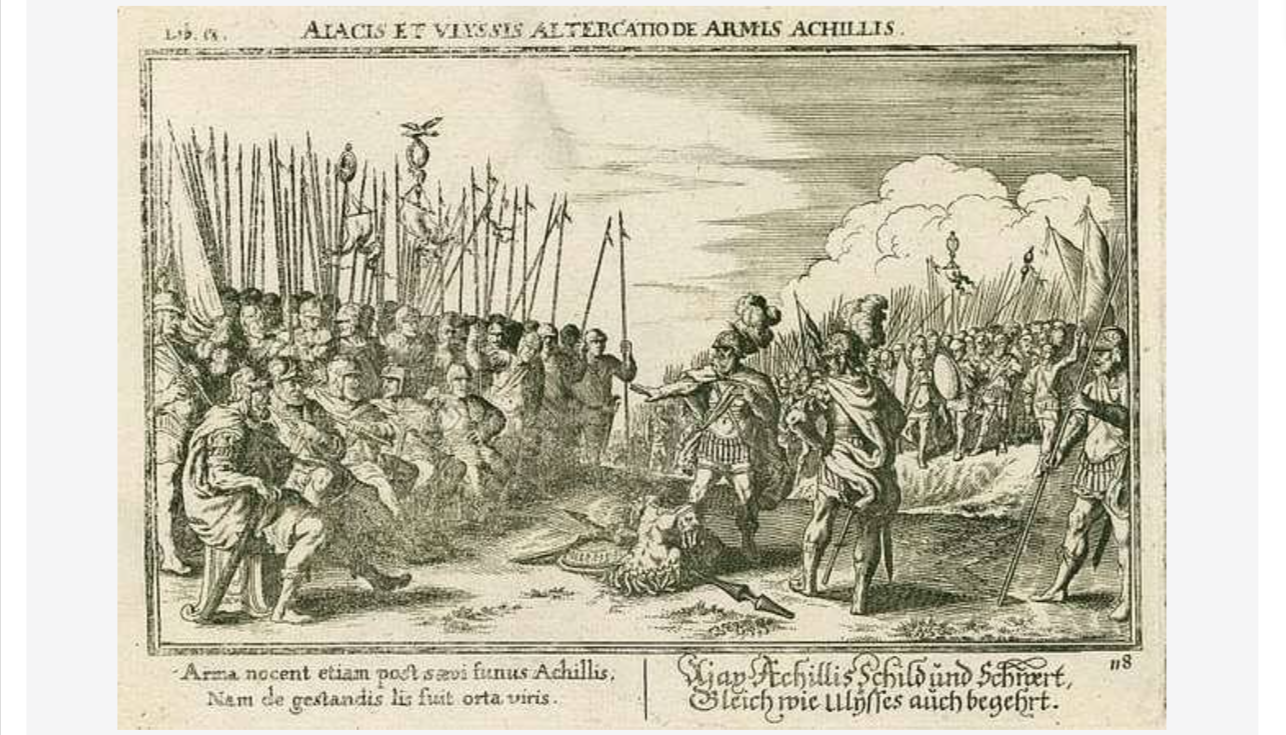
Sophocles’ Ajax follows the strongest Greek fighter after Achilles through a single day. He loses Achilles’ armor to Odysseus in a vote he believes was rigged, sets out at night to kill the commanders, is deluded by Athena into butchering the army’s livestock instead, wakes to the camp’s ridicule, and dies by suicide. The final third of the play is a fight over whether he may be buried.
Read as psychology, the play is about shame rather than guilt. Ajax never regrets trying to murder Agamemnon and Menelaus. What he cannot survive is being seen as a failure by the men he despises. Guilt points at an act and looks for repair; shame indicts the whole self and wants to disappear. Ajax is a man whose identity has fused with one role, the warrior, and who meets what we would now call a moral injury, a betrayal by those in command, with a shame he cannot share. The play also shows what might have reached him: company, and someone who refuses to look away.

What happens in Ajax
Achilles is dead, and his armor was to go to the best of the Greeks. It went to Odysseus. In Sophocles’ version the Greek chiefs voted, and Ajax’s half-brother Teucer later accuses Menelaus of rigging the votes; Menelaus answers, “At the hands of the judges, not at mine, he had that fall” (lines 1135–1136).1 In Homer’s Odyssey the judges were “the sons of the Trojans and Pallas Athena.”2
Ajax’s revenge never lands. Athena tells Odysseus she “cast upon his eyes the tyrannous fancies of his baneful joy” at the generals’ doors and turned his fury onto the army’s herds (lines 49–55). He slaughtered cattle and sheep, abusing some in their bonds as if they were men (lines 296–300). Athena calls the raving Ajax out and offers Odysseus the spectacle: “And to mock at foes—is not that the sweetest mockery?” (line 79). Odysseus declines: “I pity him in his misery, for all that he is my foe, because he is bound fast to a dread doom: I think of mine own lot no less than his. For I see that we are but phantoms, all we who live, or fleeting shadows” (lines 121–126).1
Sane again, Ajax puns on his own name, which sounds like the Greek cry of grief, aiai (line 430). He cannot sail home, for “what face shall I show to my father,” who had won the army’s prize for valor himself (lines 434–436, 462)? Dying in battle might please the Atreidae. “One of generous strain should nobly live, or forthwith nobly die” (lines 479–480). Tecmessa, a Phrygian taken in war and the mother of his son Eurysaces, begs him not to leave them to his enemies (lines 485–524). He prays that the boy will “prove happier than thy sire, but in all else like him,” and gives him the “broad shield from which thou hast thy name” (lines 550, 574–575).1
Then comes the speech the play leaves open: “All things the long and countless years first draw from darkness, then bury from light” (line 646). Ajax says he will yield to the gods and the Atreidae, cleanse himself at the shore, and bury Hector’s sword “where none shall see.” The chorus hears only the hopeful meaning and dances. Then the prophet Calchas’s warning arrives: “This day alone will the wrath of divine Athena vex him” (line 756). Ajax has already gone, and he dies alone on the shore. Menelaus and Agamemnon forbid his burial; Odysseus talks Agamemnon out of it.1
Shame, not guilt
Look at what Ajax regrets. Not the plan to kill his commanders: his complaint is that Athena “foiled me at the instant when I was making ready my hand against them,” and that his enemies now “exult to have escaped me” (lines 450–455).1 Every option he weighs has an audience: his father’s face, the Atreidae’s satisfaction, the camp’s laughter. Homer gives him the same silence after death. When Odysseus meets his shade in the underworld and speaks “with soothing words,” Ajax “answered me not a word, but went his way to Erebus” (Odyssey 11.552–564).2
Psychologists draw the line exactly where Ajax cannot. In the research June Tangney and colleagues reviewed, guilt is a negative judgment about a specific act and shame a negative judgment about the whole self; the usual shorthand is “I did a bad thing” versus “I am bad.”3 A meta-analysis of 108 studies found shame more strongly associated with depressive symptoms (r = .43) than guilt (r = .28), though two maladaptive forms of guilt, exaggerated responsibility for uncontrollable events and free-floating guilt, were about as strongly associated as shame. “External shame,” defined as “negative views of self as seen through the eyes of others,” showed a larger association (r = .56) than internal shame (r = .42).4 These are correlations, as the authors say. External shame is still Ajax’s condition exactly.
Classicists have their own version of the contrast: E. R. Dodds titled a chapter of The Greeks and the Irrational (1951) “From Shame-Culture to Guilt-Culture.”5 Bernard Williams’s Shame and Necessity (1993) questioned the progress story such contrasts invite, arguing that we are more like the ancients than we admit.6 Ajax’s shame is not an emotion modern people outgrew.
Sophocles chose the version of the myth that sharpens it. Richard Jebb, whose 1896 translation is quoted throughout, thought it “highly probable” that the older, simpler form of the story knew nothing of the attack on the cattle, so that Ajax’s motive there was resentment at the award, “not that feeling combined with a sense of disgrace incurred by his own action.” The mad assault on the herds belongs, Jebb notes, to the Little Iliad, a lost epic of the Trojan cycle known from a later summary by Proclus.1 Sophocles built his play on that version, which turns a story about injustice into a story about humiliation.
The mask that cannot come off
Jung took the word persona from “the mask worn by the actors of antiquity” and used it for the face a person adopts to meet the requirements and opinions of their surroundings (p. 590). A persona is necessary. Trouble starts when a person cannot tell where the role ends. Jung’s description could summarize this play: “The man who is unconditionally his outer rôle therewith delivers himself over unquestioningly to the inner processes, i.e. he will even frustrate his outer rôle by absolute inner necessity, reducing it ad absurdum” (p. 596). He called that reversal enantiodromia, “the emergence of the unconscious opposite,” which occurs “wherever an extreme, onesided tendency dominates the conscious life” (p. 542).7
Ajax is unconditionally his outer role. His name is a cry of grief, his son is named for his shield, and his worth is measured against his father’s prize. Withholding the armor does not just insult him; it removes the only proof of a self he has. And Jung’s reversal happens literally: the greatest living fighter at Troy spends his night of vengeance killing sheep.
The play gives the one-sidedness a history. Calchas reports that Ajax told his father, “with the help of gods e’en a man of nought might win the mastery; but I, even without their aid, trust to bring that glory within my grasp,” and later told Athena that “where Ajax stands, battle will never break our line” (lines 762–775).1 In Greek terms this is pride the gods punish. In Jung’s terms, a strength that admits no need for help builds its own counterweight.
Even the sword is a story of exchange. In the Iliad, Hector and Ajax end a drawn duel by trading gifts, Hector’s sword for Ajax’s belt (7.299–305).8 Ajax calls the sword the gift of “my worst foe” (line 662), and Teucer notes that Hector was bound to Achilles’ chariot by that belt, so that “Hector, though dead, was to destroy thee at the last” (lines 1026–1033).1 In Ajax’s world even courtesy between enemies turns lethal.
Achilles nearly did what Ajax tried. In the first book of the Iliad, when Agamemnon announces he will take Achilles’ prize, Briseis, Achilles begins to draw his sword on his commander, and Athena seizes him by the hair and stops him (1.188–198).8 The Epic of Gilgamesh, too, begins with an overbearing warrior-king who has to learn grief and limits. The warrior archetype is not the problem; competence, boundaries and the capacity to fight are goods. The problem is a warrior with nothing else to be.
Ajax and moral injury
The term moral injury is usually credited to Jonathan Shay, a psychiatrist at the VA outpatient clinic in Boston who was struck by how closely Vietnam veterans’ experiences matched Homer’s account of Achilles.9 His book Achilles in Vietnam (1994) reads those veterans alongside the Iliad.10 Earlier versions of this page said Shay built the concept on Ajax; he built it on Achilles. His definition has three parts: a betrayal of what is right, by someone who holds legitimate authority, in a high-stakes situation.11 Brett Litz and colleagues widened it to include “perpetrating, failing to prevent, or bearing witness to acts that transgress deeply held moral beliefs and expectations.”12
Ajax fits both. From where he stands, the award is a betrayal by the men in command, and his brother says the votes were rigged. Then his own night raid turns the injury inward: the wronged man becomes the man who did something monstrous and ridiculous, and the disgrace makes the betrayal impossible to speak about. Sophocles returns to commanders failing their own men in Philoctetes, whose wounded hero is marooned on Lemnos on the commanders’ orders.13
The research supports the link, with limits. A 2019 review of 116 studies tied moral injury to a wide range of harms but found no consensus definition, no gold-standard measure, and small clinical studies.14 A 2023 systematic review of 12 military studies, two rated high quality, found a consistent association between morally injurious experiences and suicidal behavior.15 Among 336 Israeli combat veterans, trauma-related shame statistically mediated the association between morally injurious acts they had committed and suicidal ideation: the Ajax pattern in survey form, though a cross-sectional design cannot show cause.16 A 2019 meta-analysis linked most forms of shame to non-suicidal self-injury but found research on shame and suicidal behavior specifically sparse.17
The stakes are not literary. The Department of Veterans Affairs counted 6,488 veteran suicides in 2024, an average of 17.7 a day; adjusted for age, the rate for male veterans was 56.5% higher than for non-veteran men, and the rate for female veterans 99.9% higher than for non-veteran women.18 Alabama recorded 142 veteran suicides that year; its age-adjusted veteran rate was not significantly different from the national veteran rate but was significantly higher than the national rate for the general population.19 Theater of War Productions, co-founded in 2009 by Bryan Doerries and Phyllis Kaufman, stages readings of plays including Ajax and Philoctetes, often for military and veteran audiences, followed by town hall-style discussion; at the U.S. Naval Academy in 2023 that discussion covered mental health and suicide prevention.20 The point is not that an ancient play treats anything, but that a room watching Ajax together can say what one veteran alone usually cannot.
What the play gets right about suicide risk
The National Institute of Mental Health lists, among warning signs, talking about “great guilt or shame” and “withdrawing from friends, saying goodbye, giving away important items, or making a will.”21 Ajax does nearly all of these before he leaves for the shore. He speaks of disgrace, sends Tecmessa and the boy inside, gives his son the shield, leaves instructions for his brother and parents, and then grows calm. The calm is what the chorus believes.
Calchas’s warning is the other thing the play gets right: the danger is concentrated in “this day alone.” In one study of 82 people interviewed within three days of a suicide attempt, 47.6% said ten minutes or less had passed between the first thought of suicide in that episode and the attempt; most were alone, but 76.8% had some contact with another person during that time.22 The window was often short, and someone was often within reach. That is the logic of crisis lines, safety planning and the VA’s emphasis on lethal means safety. In Ajax, everyone holds a piece of the warning, and no one stays with him through the day.
What this looks like in therapy
Many people in therapy have built a self on a single role, soldier, surgeon, athlete, provider or executive, and then lost it to a discharge, an injury, a lawsuit or a public failure. The first task is to hear whether guilt or shame is speaking. “I did something I can’t undo” opens toward grief and repair. “I can’t face anyone” or “what would my father think” is Ajax’s speech, and it needs slower work, because shame hides from the therapist too.
Risk assessment comes first, and an absence of depression is not an absence of risk. Ronningstam and Maltsberger described three young men admitted after near-fatal self-injury who denied depression and any wish to die and showed signs of pathological narcissism; it is a case series of three, but its point about assessment holds.23 A meta-analysis of 45 studies found small-to-moderate associations between perfectionistic concerns and suicidal ideation, and socially prescribed perfectionism, the belief that others demand perfection of you, predicted increases in ideation over time.24
Ajax’s rule, nobly live or nobly die, is what cognitive therapists call all-or-nothing thinking, one of the common cognitive distortions, and naming it can loosen it. In parts-based therapy, the voice that insists on death before dishonor can be approached as a protector, trying in the worst possible way to end an unbearable exposure. The Jungian question is what the person was before the role swallowed them, and what its collapse is asking them to become.
For moral injury in particular, treatment research is young and its trials small.14 What the play offers is a stance, the one Odysseus takes over the body. He neither excuses what Ajax did nor lets it erase who Ajax was: “Yon man was erst my foe, yet noble,” and “His worth weighs with me far more than his enmity” (lines 1355, 1357).1 That stance usually has to come from someone else before a person can take it toward themselves. Shame does not give way to argument. It gives way slowly to being seen by someone who does not look away.
Why the play ends with a burial
The last third of Ajax can feel like a quarrel over a corpse, but it is the point. Menelaus argues that an army runs on fear (lines 1052–1090). Odysseus, who beat Ajax for the armor, tells Agamemnon he has seen no Greek at Troy who was Ajax’s peer “save Achilles,” and that dishonoring him would hurt “the law of Heaven” (lines 1340–1343). Pressed on why he defends an enemy, he says, “‘Tis not my wont to approve a stubborn soul,” and finally, “for I too shall come to that need” (lines 1361, 1365).1 It is the same recognition he voiced in the first scene.
For Sophocles’ audience this mattered. Ajax was a hero from Salamis, the island off Athens. Herodotus reports that Cleisthenes made him the namesake of one of the ten Athenian tribes, the only one not native to Attica, and that before the battle of Salamis the Greeks called on Ajax and Telamon to come to their aid.25 The play gives the last word on Ajax’s worth to the people who knew him, not to the worst night of his life. That is what moral repair tries to do while a person is still alive to hear it.
If you recognize Ajax’s arithmetic in yourself, the sense that one failure has cancelled everything you were, therapy can work with that, and you do not have to arrive with it sorted out. Taproot’s clinicians in Hoover offer Jungian depth therapy and counseling for men dealing with career loss, anger and the things they don’t say. If you are thinking about suicide, call or text 988; veterans can dial 988 and press 1, or text 838255. Our crisis resources page for Birmingham has more options.
References
- Sophocles. (1896). The Ajax (R. C. Jebb, Ed. & Trans.; Sophocles: The plays and fragments, Part 7). Cambridge University Press. https://archive.org/details/ajaxsoph00soph
- Homer. (1919). The Odyssey (A. T. Murray, Trans.; Book 11, lines 538–566). Harvard University Press; William Heinemann. Perseus Digital Library
- Tangney, J. P., Stuewig, J., & Mashek, D. J. (2007). Moral emotions and moral behavior. Annual Review of Psychology, 58, 345–372. https://doi.org/10.1146/annurev.psych.56.091103.070145
- Kim, S., Thibodeau, R., & Jorgensen, R. S. (2011). Shame, guilt, and depressive symptoms: A meta-analytic review. Psychological Bulletin, 137(1), 68–96. https://doi.org/10.1037/a0021466
- Dodds, E. R. (1951). The Greeks and the irrational (Sather Classical Lectures, Vol. 25). University of California Press.
- Williams, B. (1993). Shame and necessity (Sather Classical Lectures, Vol. 57). University of California Press.
- Jung, C. G. (1933). Psychological types; or, The psychology of individuation (H. G. Baynes, Trans.). Harcourt, Brace. (Original work published 1921) https://archive.org/details/psychologicaltyp00jung_1
- Homer. (1924). The Iliad (A. T. Murray, Trans.; Book 1, lines 172–205; Book 2, lines 768–769; Book 7, lines 299–305). Harvard University Press; William Heinemann. Perseus Digital Library
- Walter, J. A. (1995). “Achilles in Vietnam” and the humanities classroom (ERIC Document Reproduction Service No. ED396979). https://files.eric.ed.gov/fulltext/ED396979.pdf
- Shay, J. (1994). Achilles in Vietnam: Combat trauma and the undoing of character. Atheneum.
- Shay, J. (2014). Moral injury. Psychoanalytic Psychology, 31(2), 182–191. https://doi.org/10.1037/a0036090
- Litz, B. T., Stein, N., Delaney, E., Lebowitz, L., Nash, W. P., Silva, C., & Maguen, S. (2009). Moral injury and moral repair in war veterans: A preliminary model and intervention strategy. Clinical Psychology Review, 29(8), 695–706. https://doi.org/10.1016/j.cpr.2009.07.003
- Sophocles. (1898). The Philoctetes (R. C. Jebb, Ed. & Trans.; lines 1–11). Cambridge University Press. Perseus Digital Library
- Griffin, B. J., Purcell, N., Burkman, K., Litz, B. T., Bryan, C. J., Schmitz, M., Villierme, C., Walsh, J., & Maguen, S. (2019). Moral injury: An integrative review. Journal of Traumatic Stress, 32(3), 350–362. https://doi.org/10.1002/jts.22362
- Jamieson, N., Carey, L. B., Jamieson, A., & Maple, M. (2023). Examining the association between moral injury and suicidal behavior in military populations: A systematic review. Journal of Religion and Health, 62(6), 3904–3925. https://doi.org/10.1007/s10943-023-01885-6
- Schwartz, G., Halperin, E., & Levi-Belz, Y. (2022). Moral injury and suicide ideation among combat veterans: The role of trauma-related shame and collective hatred. Journal of Interpersonal Violence, 37(15–16), NP13952–NP13977. https://doi.org/10.1177/08862605211007932
- Sheehy, K., Noureen, A., Khaliq, A., Dhingra, K., Husain, N., Pontin, E. E., Cawley, R., & Taylor, P. J. (2019). An examination of the relationship between shame, guilt and self-harm: A systematic review and meta-analysis. Clinical Psychology Review, 73, 101779. https://doi.org/10.1016/j.cpr.2019.101779
- U.S. Department of Veterans Affairs. (2026). 2026 national veteran suicide prevention annual report. https://www.mentalhealth.va.gov/suicide_prevention/data.asp
- U.S. Department of Veterans Affairs. (2026). Alabama veteran suicide data sheet, 2024. https://www.mentalhealth.va.gov/docs/data-sheets/2026/State_Data_Sheets_2026_Alabama.pdf
- Theater of War Productions. (n.d.). About. Retrieved November 8, 2026, from https://theaterofwar.com/about
- National Institute of Mental Health. (2025). Warning signs of suicide (NIMH Identifier No. OM 25-4316). https://www.nimh.nih.gov/health/publications/warning-signs-of-suicide
- Deisenhammer, E. A., Ing, C.-M., Strauss, R., Kemmler, G., Hinterhuber, H., & Weiss, E. M. (2009). The duration of the suicidal process: How much time is left for intervention between consideration and accomplishment of a suicide attempt? Journal of Clinical Psychiatry, 70(1), 19–24. https://doi.org/10.4088/JCP.07m03904
- Ronningstam, E. F., & Maltsberger, J. T. (1998). Pathological narcissism and sudden suicide-related collapse. Suicide and Life-Threatening Behavior, 28(3), 261–271. https://doi.org/10.1111/j.1943-278X.1998.tb00856.x
- Smith, M. M., Sherry, S. B., Chen, S., Saklofske, D. H., Mushquash, C., Flett, G. L., & Hewitt, P. L. (2018). The perniciousness of perfectionism: A meta-analytic review of the perfectionism–suicide relationship. Journal of Personality, 86(3), 522–542. https://doi.org/10.1111/jopy.12333
- Herodotus. (1920). The histories (A. D. Godley, Trans.; Book 5, ch. 66; Book 8, ch. 64). Harvard University Press; William Heinemann. Perseus Digital Library




















0 Comments