
Key Takeaways: Prometheus Bound & Jungian Psychology
- The Archetype of Rebellion: Prometheus represents the emerging Ego that steals “Fire” (Consciousness) from the Unconscious (The Gods) to give it to humanity.
- The Negative Senex (Zeus): Zeus embodies the tyrannical, rigid aspect of the psyche that punishes growth and demands total submission.
- The Cost of Consciousness: The play illustrates that expanding awareness (Fire) always comes with suffering (The Rock). Anxiety is the price of freedom.
- Trauma & The Body: Prometheus is “bound” to the rock, symbolizing how psychological conflict often manifests as somatic tension or paralysis in the body.
What Happens in Prometheus Bound? A Jungian Analysis of Rebellion and Consciousness

Aeschylus’ Prometheus Bound is not just a play about a god on a rock; it is the foundational myth of Western Consciousness. It tells the story of the Titan who defied the King of the Gods to bring fire to humanity. From the perspective of Depth Psychology, this is the story of how the human Ego separated itself from the collective unconscious to gain self-awareness.
It explores the “Promethean Debt”—the suffering we endure because we are conscious beings. We know we will die (unlike animals), and we know we are free to disobey. This knowledge is both our “Fire” and our “Chains.”
Summary: The God Who Said “No”
The play is static, taking place entirely in one location, yet it vibrates with intense psychological conflict.
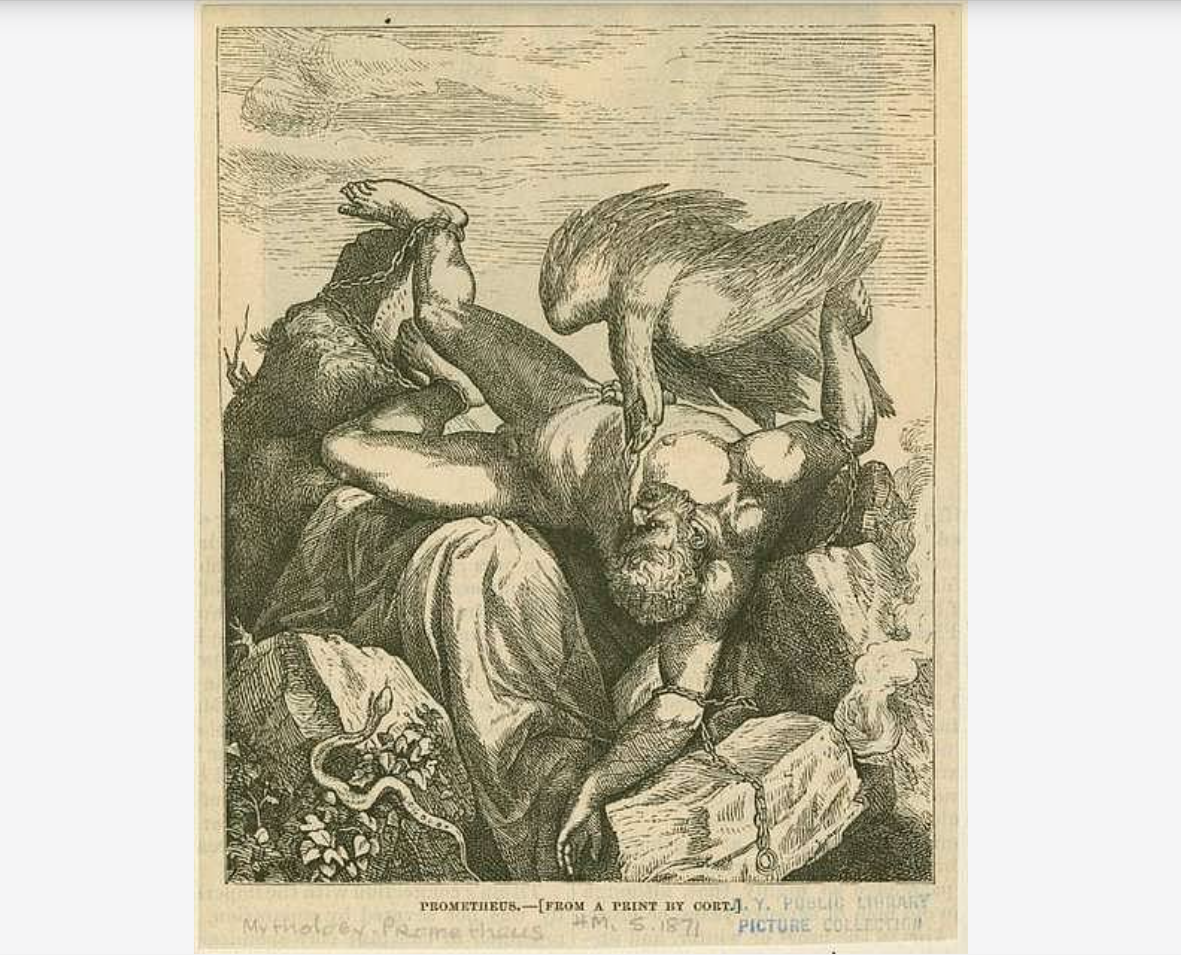
- The Binding: The play opens with Kratos (Power) and Bia (Violence) forcing the smith-god Hephaestus to chain Prometheus to a desolate cliff in Scythia. This is his punishment for stealing fire from Mount Olympus and giving it to mortals.
- The Silence and the Scream: Prometheus remains silent until his captors leave. Then, he cries out to the elements (Earth, Sky, Sea) to witness his unjust suffering. He reveals he has the gift of Prophecy (Forethought).
- The Visitors: Various figures visit him to offer sympathy or advice:
- Oceanus: The conformist who advises Prometheus to apologize and submit to Zeus.
- Io: A mortal woman turned into a cow by Zeus’s lust and Hera’s jealousy. She is tormented by a stinging gadfly. Prometheus predicts her future restoration.
- Hermes: The messenger of Zeus, who demands Prometheus reveal a secret prophecy (which of Zeus’s sons will overthrow him).
- The Catastrophe: Prometheus refuses to yield. He chooses suffering over submission. In response, Zeus strikes the cliff with a thunderbolt, casting Prometheus into the abyss (Tartarus).
Archetypal Figures: The Architecture of the Psyche
Prometheus: The Light-Bringer (Lucifer)
Prometheus means “Forethought.” He represents the Ego and the Intellect that dares to look ahead and plan. He is the archetype of the Culture Hero and the Trickster who outwits the established order.
In therapy, the “Promethean Spirit” is the part of the client that wants to break free from family curses, addiction, or societal expectations. It is the drive for Autonomy. However, this drive often leads to Inflation (thinking one is godlike), which inevitably leads to a fall.
Zeus: The Negative Senex
In this play, Zeus is not the wise father; he is a raw tyrant. He represents the Negative Senex (The Old Man) or the Tyrannical Superego.
He rules through “Bia” (Violence) and “Kratos” (Power). He represents the rigid, crushing weight of authority—whether that be a totalitarian government, an abusive parent, or the inner critical voice that says, “You must obey or be destroyed.”
Io: The Traumatized Soul
Io is the Anima in distress. She has been transformed into a beast (dehumanized) and is stung by a gadfly (anxiety/intrusive thoughts) that forces her to wander aimlessly.
She represents the Somatic side of trauma. While Prometheus suffers in his mind (he is chained by principles), Io suffers in her body (she is chased by pain). Their meeting is crucial: The Mind (Prometheus) must witness the suffering of the Body (Io) to find wholeness.
Deep Psychological Themes
1. Fire as Consciousness
What is the “Fire” that Prometheus stole? It is not just heat; it is Techne (technology, art, science). Psychologically, it is Consciousness.
Before Prometheus, humans lived like ants in caves (unconscious). Fire allowed them to master nature. But this consciousness alienated them from the gods (nature).
The Clinical Insight: Consciousness hurts. When a client “wakes up” to the reality of their abusive childhood or their addiction, it burns. They often wish they could give the fire back (return to denial), but they cannot.
2. The Rock: The State of “Stuckness”
Prometheus is immortal; he cannot die. He is chained to a rock where an eagle eats his liver every day, only for it to grow back at night.
This is a perfect metaphor for Neurosis or Chronic Trauma. The liver (the seat of emotion in Greek medicine) is damaged and regenerated in an endless loop of suffering. The client feels “bound” to their symptoms, unable to move forward or backward.
The “Eagle” represents the Intrusive Thought or the Flashback that descends daily to consume the person’s vitality.
3. Forethought vs. Afterthought
Prometheus has a brother, Epimetheus (“Afterthought”). In myth, Epimetheus is the one who accepts Pandora (and her jar of evils) after Prometheus warned him not to.
We need both functions.
* Prometheus (Forethought): Anxiety, planning, worry about the future.
* Epimetheus (Afterthought): Regret, reflection, learning from the past.
Mental health is the balance between these two. Too much Prometheus leads to anxiety disorders (living in the future). Too much Epimetheus leads to depressive rumination (living in the past).
Conclusion: The Necessary Rebellion
Prometheus Bound ends in chaos, but it is not a hopeless ending. Prometheus refuses to submit. He holds onto his truth even as the world collapses.
For the modern individual, the play teaches that Individuation is an act of rebellion. To become yourself, you must steal the fire from the gods (the parents, the culture, the collective) and claim it as your own. You will be punished for this. You will suffer guilt and isolation (the rock). But this suffering is not meaningless; it is the forge of the Soul.
Read About Other Classical Greek Plays and Their Influence on Depth Psychology
Taproot Therapy Collective Podcast
Rebellion and the Gods
Prometheus Bound: The Psychology of the Rebel
The Bacchae: The Madness of the Gods
Hippolytus: The Rejection of the Divine Feminine
The Tragic Heroes
Ajax: The Fragility of Strength
Philoctetes: The Wound as Power
Oedipus at Colonus: The Redemption of the Exile
Oedipus Rex: The Encounter with the Self
The Feminine & The Shadow
The Oresteia: Justice and the Furies
Medea: The Shadow of Motherhood
Antigone: The Law of the Heart
Iphigenia in Tauris: Exile and Return
Seven Against Thebes: The Fratricidal Shadow
The Suppliants: The Refugee Soul
Greek Tragedies Influence on Jung
The Psychology of the Peloponesian War
Bibliography
- Aeschylus. Prometheus Bound. (Various Translations).
- Kerényi, K. (1963). Prometheus: Archetypal Image of Human Existence. Princeton University Press.
- Jung, C. G. (1956). Symbols of Transformation. Princeton University Press.
- Edinger, E. F. (1972). Ego and Archetype: Individuation and the Religious Function of the Psyche. Shambhala.







0 Comments