

The Scapegoat’s Burden: Why Toxic Families Target the Truth-Teller
In the intricate and often perilous ecosystem of the dysfunctional family, roles are assigned not by individual choice or merit, but by the unconscious, survival-driven dictates of the family system itself. Among the various roles that emerge to manage systemic anxiety—the Golden Child, the Enabler, the Mascot, the Lost Child—one stands apart in its profound complexity and its unique capacity for suffering: the Scapegoat.
Clinically referred to as the Identified Patient (IP), this individual is frequently dismissed in family lore as the “black sheep,” the “problem child,” or the “rebel.” However, a rigorous depth psychological analysis reveals a far more nuanced reality: the scapegoat is often the family’s designated Truth-Teller. They are the conscious or unconscious vessel into which the collective shadow of the family unit is poured to preserve a fragile and often delusional homeostasis.
This report provides an exhaustive examination of why toxic families target the Truth-Teller. By synthesizing Bowen Family Systems Theory, Jungian Depth Psychology, and the latest neurobiological research on complex trauma, we will dissect the mechanisms of this abuse.
Part I: The Clinical Reality of Family Scapegoating Abuse (FSA)
Defining the Systemic Distortion
Family Scapegoating Abuse (FSA) must be understood not merely as a pattern of favoritism or sibling rivalry, but as a structural necessity within a disordered system. It is a systemic distortion designed to manage and bind overwhelming anxiety that the parents or the collective unit cannot metabolize.
In a functional family system, conflict and anxiety are managed through direct communication, emotional regulation, and mutual accountability. In a scapegoating system, these mechanisms are absent or atrophied. Conflict is instead managed through displacement. The anxiety generated by marital discord, financial instability, personality disorders, or addiction is too great for the emotionally immature parents to bear. Lacking the “differentiation of self” required to process these affects, the parents unconsciously project this anxiety onto a specific child, who becomes the “lightning rod” for the family’s emotional storm.
The Topology of Toxic Systems
While often associated with narcissistic parenting, FSA manifests across various types of dysfunctional family structures. It is crucial to distinguish between the intent and the impact within these different systems, although the damage to the scapegoat often remains consistent—manifesting as Complex PTSD (C-PTSD), betrayal trauma, and identity fragmentation.
- The Narcissistic System: Here, the scapegoat serves as a shield for the parent’s fragile ego. The parent uses Projective Identification to induce feelings of worthlessness into the child to maintain their own sense of superiority.
- The Addiction System: The scapegoat is often the “Whistleblower” who refuses to ignore the substance abuse or its consequences. The family focuses on the scapegoat’s “behavioral issues” to avoid confronting the addict’s behavior. For more on this dynamic, read Breaking the Cycle: Understanding and Healing as an Adult Child of an Alcoholic.
- The Rigid/Authoritarian System: This system demands absolute conformity. The scapegoat is often the “Divergent” who differs in temperament, belief, or neurotype (e.g., ADHD, Autism). The system attempts to “purify” itself by expelling or breaking the non-conformist element. Learn more about Unmasking Neurodiversity.
The “Identified Patient” as Symptom Bearer
In clinical practice, the scapegoat frequently presents as the Identified Patient (IP). This term refers to the family member who carries the overt symptoms of the family’s underlying distress and is often the individual brought into therapy to be “fixed”.
Research supports the view that the IP is often the most sensitive and perceptively honest member of the family—a “thermometer” that accurately reads the emotional temperature of the home. However, this sensitivity makes them vulnerable to the Family Projection Process, where they absorb the systemic anxiety that others deflect. Paradoxically, the IP may be the healthiest member of the system in terms of their potential for authenticity, yet they are the one labeled as “sick” or “crazy”.
Part II: The Truth-Teller Archetype and the Threat of Reality
To understand why the Truth-Teller is targeted, one must analyze the psychological threat they pose to a toxic system. In families governed by narcissism or addiction, reality is not an objective fact but a shared fantasy constructed to ward off shame. The Truth-Teller, by virtue of their authenticity, threatens to puncture this fantasy.
The Narcissistic Injury of Seeing
For a narcissistic parent, a child who sees them clearly causes a profound narcissistic injury. The parent’s psychological survival depends on a delusion of perfection, superiority, or victimhood. A child who notices discrepancies—who asks “Why is Daddy sleeping in the garage?” or “Why did you say that mean thing?”—is not merely asking a question; they are attacking the parent’s false self. To understand these personality structures, explore The 3 Neurotic Personality Styles: Insights from Psychoanalyst Karen Horney.
The Cassandra Complex: The Curse of Unbelieved Truth
The Truth-Teller often embodies the Cassandra archetype. In Greek mythology, Cassandra was a princess of Troy who was gifted the power of prophecy by Apollo but cursed so that no one would ever believe her warnings. Similarly, the family scapegoat often possesses a prescient clarity about the family’s trajectory. They foresee the consequences of the addiction, the financial ruin, or the emotional devastation caused by the narcissistic parent. Yet, like Cassandra, their warnings are dismissed, and they are marginalized as hysterical or malicious.
Part III: Archetypal Perspectives: The Scapegoat in Myth and History
To fully grasp the burden of the Truth-Teller, we must look beyond the clinical to the archetypal. Depth psychology reveals that the scapegoat is an ancient, fundamental human phenomenon, deeply embedded in our collective unconscious.
Antigone: The Conscience of the Family
The Greek tragedy of Antigone offers a powerful archetype for the Truth-Teller. Antigone defies the edict of King Creon, who forbids the burial of her brother Polynices. She chooses to honor the “higher law” of family duty and love over the tyrannical law of the state.
In toxic families, the Truth-Teller is the Antigone figure who refuses to capitulate to the “law of silence” imposed by the narcissistic patriarch or matriarch. Like Antigone, the Truth-Teller acts out of a deep fidelity to conscience and truth, even when it leads to being symbolically “buried alive” (ostracized or disowned) by the family. For a complete analysis of this archetype, read The Heroine’s Sacrifice: A Depth Psychological Analysis of Sophocles’ Antigone.
Iphigenia: The Sacrificial Daughter
Euripides’ Iphigenia in Aulis presents another vital archetype. Iphigenia is sacrificed by her father, Agamemnon, to secure fair winds for his fleet to sail to Troy. This myth illuminates the dynamic where a child is sacrificed for the parent’s ambition, reputation, or success. The Scapegoat is often the “Iphigenia” whose well-being is traded for the family’s social standing or the parent’s career. Explore this dynamic further in Iphigenia in Aulis: A Depth Psychological Perspective.
The Shadow and the Golden Shadow
Jungian psychology posits that the Scapegoat carries the Shadow of the family—the rejected, shameful, and inferior traits the parents cannot accept in themselves. By projecting these traits onto the child, the parents can feel “good” and “pure”.
However, the Scapegoat also carries the Golden Shadow. This consists of the family’s unclaimed positive potential—creativity, vitality, authenticity, and emotional depth. In emotionally repressed or deadened families, a child who is vibrant, artistic, or deeply feeling is threatening. Their “light” casts a shadow on the parents’ mediocrity or emptiness. Thus, the Truth-Teller is attacked not just for their alleged faults, but for their gifts.
Part IV: Neurobiological Impact: The Cost of Being the Target
The role of the Scapegoat is not merely a social label; it is a physiological state. Growing up as the target of systemic abuse fundamentally alters the developing brain and nervous system, leading to distinct neurobiological consequences.
Complex PTSD and the Hypervigilant Brain
The Truth-Teller lives in a perpetual state of threat. The constant anticipation of attack—whether verbal, emotional, or physical—keeps their nervous system in chronic hyperarousal. This results in Complex PTSD (C-PTSD), characterized by emotional dysregulation, a negative self-concept, and interpersonal difficulties.
Neurobiologically, the scapegoated child’s brain adapts to survive this hostile environment:
- Amygdala Hijack: The amygdala (threat detection center) becomes enlarged and overactive, constantly scanning for danger cues like a sigh, a slammed door, or a shift in tone.
- Vagus Nerve Dysregulation: The chronic mobilization of the fight/flight system creates low vagal tone, leading to difficulties in self-soothing and social engagement. See our guide on The Biology of Safety: A Somatic Guide to Polyvagal Theory.
Part V: The Path to Recovery: Differentiation and Reclaiming Self
Differentiation of Self: The Antidote to Projection
Murray Bowen’s concept of Differentiation of Self is the cornerstone of recovery. Differentiation is the ability to separate one’s own intellectual and emotional functioning from that of the family group. It is the capacity to maintain a solid sense of self while in close proximity to others.
For the Truth-Teller, differentiation involves observing the “family dance” without participating in it. It means recognizing that the projection (“You are selfish”) is a statement about the sender’s internal state, not the receiver’s character.
Breaking the Multigenerational Transmission Process
Bowen observed that trauma and low differentiation are transmitted down generations. The parent who scapegoats was likely scapegoated themselves or served a specific function in their own parents’ drama. The Truth-Teller has the unique potential to be the cycle breaker. By stepping out of the role, the Truth-Teller disrupts the multigenerational transmission process.
Part VI: Somatic and Therapeutic Interventions
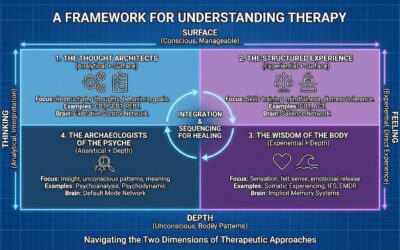
Because the trauma of scapegoating is stored in the body and the subcortical brain, cognitive “talk therapy” alone is often insufficient. Effective treatment must address the neurobiological imprint of the abuse.
Brainspotting and Trauma Mapping
Brainspotting Therapy is a powerful somatic modality that locates points in the client’s visual field that correlate to deep-seated trauma in the midbrain and brainstem (“body brain”). For the Scapegoat, Brainspotting can help access and process the pre-verbal terror of rejection and the visceral shame of being “the bad one” without requiring extensive verbalization, which can be re-traumatizing.
Internal Family Systems (IFS)
Internal Family Systems (IFS) helps the survivor unburden these parts, distinguishing their true “Self” (calm, curious, compassionate) from the protective roles they were forced to play in the family system.
The Truth-Teller as the Wounded Healer
The burden of the Scapegoat is heavy, but it carries a hidden, transformative gift. The very sensitivity, integrity, and perceptiveness that made the Truth-Teller a target are also their greatest strengths. In Jungian psychology, this figures as the Wounded Healer—the individual who, having traversed the darkness of their own suffering, gains the capacity to bring light to others.


















0 Comments