

We live in a paradox. Look around you. Objectively, the world is functioning. The lights are on, the internet is working, and the grocery stores have food. Yet, subjectively, more and more of us feel like we are going insane. We feel a profound sense of alienation, as if the world we are looking at is a copy of something that no longer exists.
This is what Jean Baudrillard called the simulacra—a copy without an original. We are surrounded by institutions, social rituals, and political performances that look like the real thing but feel hollow. We see politicians who don’t seem to believe their own lies. We engage in “social” media that feels profoundly anti-social. We are told by every metric of our hyper-rational, empirical culture that we should be happy, or at least functional. And when we aren’t, we assume the problem is us.
But what if the problem isn’t you? What if the problem is that we are trying to solve a crisis of meaning with tools that were designed to measure objects?
The Gaslighting of Objectivity
We are obsessed with objectivity. We want data, metrics, and evidence-based protocols for everything. But as the philosopher Friedrich Nietzsche pointed out, an obsession with logic is often a form of insecurity. It is a desperate attempt to build a fortress of certainty in a world that is fundamentally uncertain.
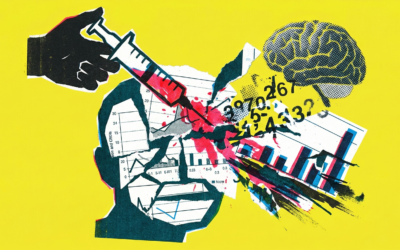
When we try to apply this hyper-rational lens to the human soul, we end up gaslighting ourselves. We look at our internal experience—our anxiety, our dread, our intuition that something is wrong—and we check it against the “data.” The data says the economy is fine. The data says we have more connectivity than ever. So, we conclude that our internal reality must be broken.
This is the crisis of the modern soul. We are drifting in a world of symbols that have lost their referents. The old myths that used to ground us—religion, nationalism, the American Dream—have been deconstructed or commercialized until they feel like cheap parodies of themselves. And in their absence, we are left with a raw, uncontained anxiety.
The Failure of the “Robot” Model
Psychology, largely, has failed to address this. In our desperate bid to be taken seriously as a “hard” science, we have adopted a model of the self that is dangerously reductive. We have moved toward models like strict Cognitive Behavioral Therapy (CBT) or, even worse, Applied Behavior Analysis (ABA), which essentially view the human being as a machine to be programmed.
These models assume that the “self” is just a collection of behaviors and cognitions. If we can change the input (the thought), we can change the output (the behavior). It is a computational model of the soul. It assumes that if we just find the right code, we can fix the bug.
But humans aren’t computers. We don’t just process information; we feel meaning. We have an implicit, somatic, and intuitive experience of the world that exists beneath the level of language and logic. When we try to treat human suffering by just changing the “code,” we are ignoring the hardware. We are ignoring the brain stem, the body, and the deep, ancient parts of us that are screaming in a language that logic cannot understand.
The Return of the Repressed
When we suppress the irrational, the intuitive, and the subjective, they don’t go away. They just go underground. They return as symptoms.
We see this in the rise of conspiracy theories, which are essentially a form of folk mythology. People are feeling a profound sense of chaos and malevolence in the world, but they have no language for it. So, they create a story. They invent a secret cabal, a hidden plot, a grand narrative that explains why everything feels so wrong. It is a desperate attempt to make meaning in a world that refuses to provide it.
We see it in the rise of “wellness” culture and the return of magical thinking. People are flocking to crystals, astrology, and influencers who promise secret knowledge because they are starving for a connection to something transcendent. They are looking for a sense of self that goes beyond the biological machine.
Reclaiming the Subjective
If therapy is going to be relevant in this new world, it has to change. It has to stop trying to be a “hard” science and embrace its role as a “soft” one. It has to be willing to engage with the subjective, the intuitive, and the metaphorical.
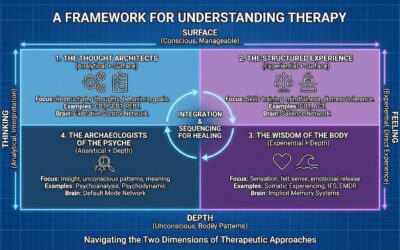
This doesn’t mean abandoning science. It means recognizing the limits of science. It means using tools like QEEG brain mapping and polyvagal theory to understand the biology of trauma, but using art, myth, and narrative to understand the meaning of trauma.
We need a psychology that can hold both. We need to be able to look at a patient and see the neural networks firing in their brain, but also see the soul that is trying to speak through them. We need to help people navigate the “simulacra” not by giving them more data, but by helping them find the one thing that is still real: their own internal experience.

















0 Comments