
Jungian Therapy & Depth Psychology in Birmingham, AL
Get to the Root of Your Story. Heal the Whole Self.
Most modern therapy focuses on symptom reduction—fixing the “check engine light” without looking under the hood. At Taproot Therapy Collective in Hoover, AL, we practice Jungian Depth Psychology. This approach goes beyond surface-level symptoms to explore the unconscious drives, dreams, and archetypes that shape your life.
Whether you are in Mountain Brook, Vestavia Hills, or Birmingham, our depth-oriented approach helps you integrate the hidden parts of your personality (the Shadow) so you can move from merely “functioning” to truly flourishing.
The Power of Depth Psychology

Unconscious Awareness
Shadow Work
Reconnect with Yourself

Become Who You’re Supposed To Be
Unleash your full creative potential. As the name implies, depth psychology can help you get to the root of your issues. From there, you can mold yourself into who you were always meant to be. Deep knowledge of your inner desires and drives is simply the first step.
Personalized Jungian Analysis: Beyond the “Cookie Cutter”
If your therapy isn’t tailored to the unique architecture of your soul, it cannot reach the roots of your suffering. Standardized manuals and worksheets work for machines, not human beings. At Taproot Therapy Collective in Birmingham, we reject the “one-size-fits-all” approach.
Your trauma, your dreams, and your internal symbols are unique to you. Therefore, your path to healing must be equally unique. We don’t just treat symptoms; we help you engage with the specific unconscious forces driving your life.
What is “The Shadow”?
The Shadow is the “blind spot” of your personality. It contains everything you had to hide, repress, or deny in order to be “good” or “accepted” while growing up.
It is not just negative traits. The Shadow often holds your:
- 🔥 Repressed Power: Assertiveness you were told was “too much.”
- 🎨 Latent Creativity: Artistic drives you were told were “impractical.”
- 🗣️ Authentic Voice: The ability to say “No” without guilt.
In Jungian therapy, we don’t try to get rid of the Shadow. We analyze it so you can reclaim the energy trapped inside it. This is how you become whole.
By integrating these lost parts of yourself, you stop fighting internal wars and start living with a unified sense of purpose. This is the process of Individuation—becoming who you were always meant to be.
Shadow Integration: Reclaiming the “Lost” Parts of You
We all have a “Shadow”—the invisible bag we drag behind us containing every trait, desire, or emotion we were told was unacceptable growing up. Spending your life trying to hide these parts is exhausting. It drains the vital energy you need to thrive.
At Taproot Therapy Collective, we help you stop the internal war. Instead of denying these parts, we help you unite them into a consolidated whole. This process, known as Individuation, allows you to:
- 🔓 Unlock Stagnant Energy: When you stop suppressing, you release blocked creativity.
- 🛡️ Overcome Internal Conflict: Break free from the deep-seated fear that you are “broken” or “bad.”
- 🌿 Live Authentically: Move from performing for others to living from your own center.
With radical acceptance comes radical change. You don’t have to be “perfect”—you just have to be whole.
The Acorn Theory: Discovering Your Innate Destiny
James Hillman, a renowned post-Jungian, proposed the “Acorn Theory”: the idea that just as an oak tree is already contained within the acorn, your unique character and destiny are already contained within you. You are not a blank slate waiting to be written on by society; you are a seed waiting to unfold.
Many of us spend our lives trying to be pine trees when we are actually oaks. This causes neurosis, depression, and a sense of “wrongness.” Through depth work, we help you listen to the demands of your own acorn. Once you discern what your soul actually wants to become, the struggle ends, and true growth begins.
The Unconscious, Archetypes, and the Shadow: The Path to Wholeness
Depth psychology is not just about fixing what is “wrong” with you; it is about discovering who you actually are. At Taproot Therapy Collective, we help you explore the hidden architecture of your mind to uncover the source of your suffering—and your power.
1. The Shadow: Your Hidden Potential
The Shadow contains everything you have repressed, denied, or ignored. It is not just “evil”; it is the repository of your unlived life.
- The Personal Shadow: Represents the specific traits you were told were unacceptable (e.g., anger, sexuality, ambition).
- The Golden Shadow: Often, we repress our best qualities—talent, leadership, and intuition—because we are afraid to shine.
Through Jungian Shadow Work, we help you stop projecting these traits onto others (e.g., “I hate that person because they are so arrogant”) and reclaim that energy for yourself.
2. Archetypes: The Universal Characters
Just as your DNA structures your body, Archetypes structure your mind. These are universal patterns found in myths, movies, and dreams across every culture.
We use concepts from James Hillman’s Archetypal Psychology to help you identify which characters are driving the bus of your life:
- 🦸 The Hero: The part of you that seeks to conquer and achieve.
- 🧙 The Wise Old Man/Woman: The part of you that holds deep intuition.
- 🃏 The Trickster: The chaotic agent of change that disrupts your plans to force growth.
Techniques like Active Imagination allow you to have a dialogue with these inner figures, turning internal conflict into a council of advisors.
3. Collective Trauma & The Cultural Unconscious
You do not exist in a vacuum. You are shaped by the history of your family, your city (Birmingham), and your culture. Jung called this the Collective Unconscious.
We address Collective Trauma—the wounds passed down through generations. Whether it is the legacy of racial trauma, religious fundamentalism, or poverty, we help you separate your story from the story of your ancestors.
4. Spirituality & The “Self”
The goal of Jungian therapy is Individuation—the process of becoming a unified whole. This is inherently spiritual work. Whether you are religious, agnostic, or exploring mysticism, we help you connect with the “Self” (the God-image within) to find meaning that transcends simple happiness.
The Hero’s Journey: Your Roadmap
Joseph Campbell, a student of Jung, mapped the Hero’s Journey. Therapy is your “Call to Adventure.” You enter the “Special World” of the unconscious, face your dragons (The Shadow), and return to your daily life transformed.
Alabama Statewide Access to Depth Psychology
Finding a therapist trained in **Jungian Analysis** and **Dream Work** is rare in the South. You do not have to drive to **Birmingham or Hoover** to access this transformative care. We provide secure, HIPAA-compliant telehealth to clients across **Huntsville, Mobile, Tuscaloosa**, and the entire state of Alabama.
Student Mental Health
Regional Service Areas
What You Need to Know About Jungian Analysis
Jungian Therapy is not about “fixing” you because you are not broken. It is about becoming who you actually are. Unlike medical models that view anxiety or depression as diseases to be cured, we view them as blocked creative energy demanding to be released.
Your Symptoms Are Messengers
In Depth Psychology, a panic attack isn’t just a misfiring neuron; it’s a message from your unconscious saying, “The way you are living is too small for your soul.” We help you decode these messages so you can make the changes your psyche is begging for.
A Creative & Collaborative Process
Carl Jung resisted the urge to be the “expert” pushing a diagnosis onto a patient. Instead, he saw therapy as a collaborative art form. Through methods like Dream Analysis and Shadow Work, we act as guides to help you explore the uncharted territory of your own mind.
Dream Work
Self Discovery
Personality Development
Motherhood & Parenting
Shadow Work
Art & Creativity
Aging
Grief & Shame
Jungian Therapy FAQs

How Does Depth Psychology Work?
Why Choose Jungian Therapy?
Where Does Depth Psychology Come From?
Where Does Depth Psychology Fit in to Treatment?
Why Taproot Therapy Depth Psychology?
“There is no coming to consciousness without pain. People will do anything, no matter how absurd, in order to avoid facing their own Soul. One does not become enlightened by imagining figures of light, but by making the darkness conscious.”
– Carl Jung
Is Jungian Analysis Evidence-Based?
While rooted in philosophy, Jungian analysis is supported by rigorous clinical research. Unlike short-term therapies that focus on quick symptom relief, Jungian analysis aims for structural personality change. Research shows that the benefits of this depth work often continue to grow long after therapy has ended—a phenomenon known as the “Sleeper Effect.”
1. Long-Term Outcomes & Efficacy
The Finding: Depth therapy creates lasting change.
A major meta-analysis in JAMA (2008) by Leichsenring & Rabung found that long-term psychodynamic therapy (like Jungian analysis) was highly effective for complex mental disorders. Crucially, the “effect sizes” (measure of improvement) continued to increase after therapy terminated, suggesting that patients internalized the tools for self-healing.
The Finding: Effective for severe conditions.
The “Berlin Study” (2005) tracked 84 patients over an average of 240 sessions. It found statistically significant reductions in symptoms for severe depression, anxiety, and personality disorders, demonstrating that depth work is effective for complex comorbidity, not just “personal growth.”
The Finding: High real-world effectiveness.
A foundational 2013 review in Behavioral Sciences concluded that Jungian therapy is as effective as other modalities in real-world settings (“naturalistic studies”). It highlighted that positive changes in personality structure continued for years after treatment ended.
The Finding: Improvements in life satisfaction.
A 2022 long-term outcome study from the International Association for Analytical Psychology (IAAP) followed 156 analysands over 3 years. It confirmed significant improvements in psychological well-being and interpersonal relationships, validating the Jungian goal of holistic “Individuation.”
2. The Neuroscience of Jungian Techniques
The Finding: Rewiring the brain’s self-reflection network.
A 2018 study in the Journal of Analytical Psychology used fMRI neuroimaging to study Active Imagination. Results suggest this technique activates the Default Mode Network (DMN), the brain system responsible for meaning-making and autobiographical memory. This provides a biological basis for how Jungian techniques help integrate trauma and reshape identity.
The Finding: Dreams are functional, not random.
Research in Psychotherapy (2017) confirmed that working with dreams in therapy was significantly associated with greater client insight and a stronger therapeutic alliance. This validates the Jungian view that dreams are purposeful communications from the unconscious designed to guide the psyche toward wholeness.
The Finding: Non-verbal processing for trauma.
A 2017 review in Frontiers in Psychology highlighted the strong evidence base for Sandplay Therapy. The symbolic, “hands-on” nature of Sandplay allows for pre-verbal processing of trauma, making it highly effective for reducing behavioral and emotional problems in both children and adults.
The Finding: Balance equals health.
A 2011 study in Psychological Assessment validated the connection between Jung’s archetypal theory and mental health. It found that a “balanced” archetypal profile (accessing a wide range of energies like Warrior, Sage, Caregiver) strongly correlated with higher well-being, supporting the goal of moving beyond rigid complexes.
Summary: Jungian Analysis is not just “talk.” It is a scientifically valid method for treating the whole person, leading to improvements in well-being, interpersonal relationships, and overall life satisfaction that persist for years.
Core Techniques of Jungian Therapy
Jungian analysis is not just about talking; it is about *doing* the work of the soul. We use specific techniques to bypass the defenses of the conscious mind and access the wisdom of the unconscious.
1. Dream Analysis: Decoding the Night
Your dreams are not random. They are the unconscious mind attempting to balance your conscious attitude.
How We Use It: We don’t use a generic “dream dictionary.” We use Amplification to explore what specific symbols mean to you. If you dream of a house with a hidden room, we explore what part of your psyche you have locked away.
2. Active Imagination: Dialogue with the Soul
This is Jung’s most powerful technique. It involves entering a meditative state to have a conscious dialogue with inner figures (like the Shadow or the Inner Child).
The Benefit: Instead of being “possessed” by an emotion (e.g., overwhelming rage), you give the rage a voice and ask it what it needs. This turns inner conflict into a constructive negotiation.
3. Shadow Work: Integrating the “Dark” Side
The Shadow is everything you have rejected about yourself.
The Process: We create a safe space to face your envy, aggression, and shame. Paradoxically, when you accept these “dark” traits, they often transform into strength, boundaries, and creativity.
4. Sandplay & Symbolism
Sometimes words are not enough. We may use images, art, or mythology to help you express feelings that are too deep for language. By externalizing the psyche, you can observe it, understand it, and change it.
Comprehensive Jungian Psychology Resource Library
This library contains a complete catalog of articles exploring Jungian psychology, from its foundational concepts to contemporary applications.
Jungian Innovators & Primary Contributors
Carl Jung and His Legacy
Carl Jung – Introduction to the founder.
The Trial of Carl Jung’s Legacy
Carl Jung’s Work with The CIA
The Major Influences on Carl Jung
Early Innovators & Collaborators
Emma Jung
Sabina Spielrein
Marie-Louise von Franz
Jolande Jacobi
Barbara Hannah
Second Generation Innovators
James Hillman (Archetypal Psychology)
Erich Neumann
Edward Edinger
June Singer
Esther Harding
Gerhard Adler
Contemporary Innovators & Analysts
Henry Corbin
David Tacey
Robert Moore
Sidra and Hal Stone
John Beebe
Anthony Stevens
Thomas Moore
Sonu Shamdasani
Arnold Mindell
James Hollis
Jean Shinoda Bolen
Robert A Johnson
Robert Bly
Murray Stein
John Ryan Haule
Clarissa Pinkola Estés
Nathan Schwartz-Salant
Joseph Henderson
Adolf Guggenbühl-Craig
Ginette Paris
Michael Fordham
Marion Woodman
Steven T Richards
Core Concepts & Methods
Fundamental Understanding
How to Understand Carl Jung
Jung’s Empirical Phenomenological Method
How to Read The Red Book
The Future of Jungian Thought
The Shadow Complex
The Shadow
The Golden Shadow
The Shadow in Relationships
How the Shadow Shows up in Dreams
Dreams and Symbolism
Animals in Dreams
The Symbolism of Color in Dreams
The Psychology of Color
The Dreamtime
Archetypal Psychology
Archetypes
Archetypes in Relationships
The Hero’s Journey
Labyrinths
Psychology of Mythology & Culture
Theoretical Foundations
Literalism in Mythology
How to Apply Myth to Therapy
Pantheons in Therapy
Bio of Joseph Campbell
Cultural Mythologies
Tracing the Malta Burret Culture
Norse Mythology
Egyptian Mythology
Greek Mythology
Hindu Mythology
Gilgamesh
Ritual and Practice
Clinical Applications & Practical Tools
Therapeutic Practice
Jungian Analysis
How Psychotherapy Lost Its Way
Tensions in Modern Therapy
Using Jung to Combat Addiction
Practical Tools & Exercises
Free Shadow Work Group Exercise
Jungian Shadow Work Meditation
Jungian Exercises from Greek Myth
Integration & Contemporary Perspectives
Scientific Integration
Science and Mysticism
Subcortical Brain
The Neuroscience of Trauma and Psychology
J.B. Rhine and Eugene Osty
Cultural Perspectives
Micro and Macro Blindspots
Anthropological Perspectives on Trauma
Stages of Grief as Deflection
Spiritual and Mystical Perspectives
Jung and the New Age
Therapy, Mysticism and Spirituality
Ritual and Animism
The Left and Right Hand Path in Myth
Creative and Cultural Applications
How to Use Jungian Psychology for Screenwriting
The Symbolism of the Bollingen Stone
The Unconscious as a Game
Historical & Philosophical Perspectives
Historical Development
What Can the Origins of Religion Teach us about Psychology
The Origins and History of Consciousness
Contemporary Philosophy
Post Post-Modernism and Post Secular Sacred
Mysticism and Epilepsy
Healing and Integration
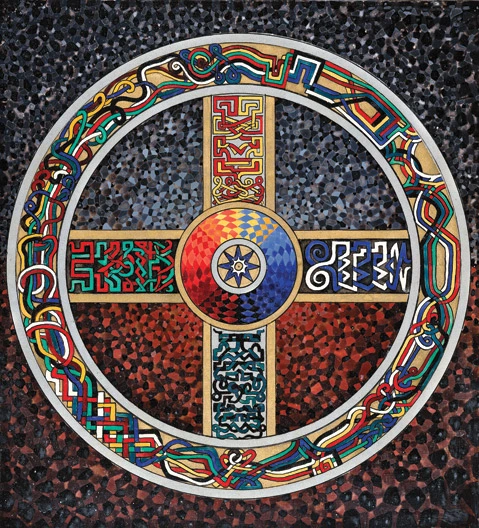
Concepts in Jungian Psychology
Carl Jung believed that our personalities are not random. They are shaped by universal patterns called Archetypes that exist in the Collective Unconscious—a shared reservoir of human experience found in our DNA.
What Are Archetypes?
Archetypes are the “characters” that live within your psyche. They influence how you love, fight, work, and dream. When you understand which archetypes are active in your life, you stop being a puppet to your unconscious drives and start becoming the author of your own story.
The Major Archetypes
👑 The Self (The Center)
The Goal: Wholeness and integration.
The Self represents the unified consciousness and unconsciousness of an individual. It is often symbolized by the Mandala or circle. The goal of therapy is to shift your center from the Ego (who you think you are) to the Self (who you actually are).
🌑 The Shadow (The Rejected)
The Challenge: Acceptance.
The Shadow contains everything you have denied about yourself—rage, jealousy, sexuality, but also creativity and power. Until you make the Shadow conscious, it will direct your life and you will call it “fate.”
🎭 The Persona (The Mask)
The Function: Social survival.
The face you show the world to be liked, hired, or admired. The danger lies in identifying with your mask so completely that you forget who is behind it.
☯️ Anima / Animus
The Bridge: Connection to the soul.
The contra-sexual aspect of your psyche (the inner feminine in men, the inner masculine in women). It acts as the guide to the inner world.
🧙 The Wise Old Man / Woman
The Gift: Guidance.
Represents deep intuition and knowledge. In therapy, this archetype often appears in dreams to offer a solution when the conscious mind is stuck.
🃏 The Trickster
The Role: Disruption.
The agent of chaos that breaks rules to force growth. If your life feels stagnant, the Trickster will likely appear to shake things up.
For a deeper dive into your specific personality type, explore our guide on the John Beebe 8-Function Model.

Carl Jung’s Lasting Influence on Modern Therapy Modalities:
Influence on Culture:
Archetypes have also been influential in shaping religious beliefs and practices. For instance, the concept of the Messiah or the Savior in Christianity can be seen as an archetypal figure representing the hero who rescues humanity from suffering and evil. Similarly, the idea of the Wise Old Man, representing wisdom and guidance, appears in various religious and spiritual traditions.
Jung’s Influence on the New Age Movement:
The New Age movement, which emerged in the 20th century as a spiritual and philosophical movement, has also been influenced by the concept of archetypes. Many New Age teachings and practices draw on Jungian archetypes as a way to understand and transform the self. For example, the concept of the Inner Child, representing the innocent and vulnerable part of the self, has been widely embraced in New Age therapies and self-help techniques. The concept of the Shadow, representing the unconscious and rejected aspects of the self, has also been explored in New Age practices as a way to integrate and heal unresolved psychological wounds.
The idea of archetypes has been incorporated into various New Age tools, such as tarot cards, astrology, and divination practices, where archetypal symbols are used to gain insight and guidance. The use of archetypes in New Age practices is often associated with the belief in the interconnectedness of all beings and the idea of a collective consciousness that transcends individual identities.
These concepts are not seen as ways to do magic or see the future. They ar seen as metaphors with wich we could gain an outsider perspective to undertand ourselves.
Jung’s Influence on Alcoholics Anonymous:
Carl Jung’s influence on Alcoholics Anonymous (AA) cannot be overstated. Jung, a Swiss psychiatrist and psychoanalyst, introduced the concepts of the unconscious mind, archetypes, and the collective unconscious. His ideas on the importance of spirituality and the need for self-examination have been instrumental in the treatment of addiction, and his influence can be seen in the principles of AA.
AA was founded in 1935 by two recovering alcoholics, Bill Wilson and Dr. Bob Smith. Both men had struggled for years with alcoholism and had tried numerous treatments without success. However, they found that by supporting each other through the AA program, they were able to achieve a lasting recovery.
Jung’s letter to Bill W, dated January 30, 1961, began by acknowledging the importance of AA in helping individuals struggling with alcoholism. He praised the spiritual principles and practices of AA, particularly its emphasis on surrender to a higher power and the importance of spiritual experiences in the process of recovery.
Jung then went on to express his views on the psychological aspects of addiction and recovery. He wrote about his belief that alcoholism was not merely a physical or moral problem, but a complex psychological and spiritual issue that required a holistic approach to treatment. He noted that alcoholism often stemmed from deep-seated emotional and psychological conflicts, and that the solution required addressing the underlying psychological and spiritual aspects of the individual.
One of the most significant contributions of Jung’s letter was his concept of the “spiritual malady” in addiction. He proposed that alcoholism was not just a physical craving for alcohol, but also a deeper spiritual longing and a psychological disconnection from the self and others. He suggested that true recovery required not only abstinence from alcohol, but also a spiritual awakening, a reconnection with the self, and a transformation of one’s inner being.
Jung also highlighted the importance of the individual’s relationship with a higher power or a higher spiritual principle in the process of recovery. He emphasized the need for individuals to have a personal experience of a higher power, which he believed could provide a sense of meaning, purpose, and guidance in life. He saw the concept of a higher power as a psychological and spiritual anchor that could help individuals navigate the challenges of recovery and find meaning in their lives beyond addiction.
Jung’s letter to Bill W concluded with a heartfelt appreciation for the work of AA and the transformative power of its program. He expressed his support for the spiritual and psychological principles of AA and his hope that his insights would contribute to the understanding and treatment of alcoholism.
Jung’s letter to Bill W had a profound impact on the development of AA and its 12-step program. It helped solidify the spiritual and psychological aspects of AA’s approach to recovery, and it continues to be considered an important historical document in the field of addiction treatment. Jung’s insights on the psychological and spiritual aspects of addiction and recovery have been integrated into the philosophy and practices of AA, and his concepts of the “spiritual malady” and the importance of a personal relationship with a higher power have become core principles of the 12-step program. Today, AA continues to be a widely recognized and respected approach to addiction recovery, and Jung’s letter to Bill W remains a significant landmark in the history of AA and the understanding of addiction as a complex psychological and spiritual issue.
Jung’s concept of the “collective unconscious” was also influential in the development of AA. According to Jung, the collective unconscious is a shared heritage of human knowledge and experience. In AA, this concept is used to connect recovering alcoholics with a community of people who have experienced similar struggles, and it provides a source of support and understanding.
In addition, Jung’s concept of the “archetype” has been incorporated into the AA program. The archetype is a universal symbol or pattern that exists in the collective unconscious and reflects the fundamental characteristics of human experience. In AA, the archetype of the “higher power” is used to help individuals recognize their need to rely on a power greater than themselves to achieve and maintain sobriety.
Overall, Jung’s influence on AA provided a new perspective on addiction and recovery, emphasizing the importance of addressing the spiritual and psychological factors contributing to addiction. Through integrating Jung’s ideas into its program, AA has become one of the most widely recognized and effective approaches to addiction recovery.
Car Jung’s Influence on Politics:
Jung’s ideas on the human psyche, collective unconscious, and archetypes have been applied to politics, shaping the understanding of how individuals and groups behave in the political arena. Jungian concepts have been used to analyze the psychological dynamics of political leaders, their motivations, and the collective psyche of societies. For example, Jung’s theory of archetypes has been employed to understand the recurring themes and symbols in political discourse, as well as the appeal of populist movements and ideologies.
Jung’s Influence on Creatives:
In the realm of creativity, Jung’s concepts of the shadow, anima/animus, and individuation have influenced artists, writers, musicians, urban planners, architects, and other creative individuals. Jung argued that the creative process involves tapping into the unconscious and integrating the diverse aspects of one’s personality, including the shadow or darker elements. Many artists and musicians have found inspiration in Jung’s ideas, using them to explore the depths of the human experience and create meaningful works of art.
Jung’s theories have also been employed in advertising and marketing. His ideas on the collective unconscious and archetypes have been used to understand consumer behavior, brand symbolism, and the emotional appeal of advertising campaigns. Advertisers often use Jungian concepts to tap into the universal symbols and motifs that resonate with the human psyche, creating ads that evoke powerful emotional responses.
In the field of psychology, Jung’s theories have been influential in the treatment of PTSD (Post-Traumatic Stress Disorder) and addiction, particularly in the context of Alcoholics Anonymous (AA). Jung’s concept of the shadow and the need for individuation has been incorporated into the 12-step program of AA, which emphasizes self-awareness, acceptance of one’s flaws, and the integration of the shadow as part of the recovery process.
Jung’s ideas have also influenced web design, with the concept of user experience (UX) drawing on his theories of the collective unconscious and archetypes. Web designers often use Jungian concepts to create websites that resonate with users at a deep psychological level, evoking emotions and engaging the unconscious mind.
Jung’s theories have also had an impact on evolutionary psychology (EvoPsych), which explores how the human mind has evolved over time. Jung’s ideas on the collective unconscious and archetypes have been used to understand how certain psychological patterns and behaviors may have emerged in humans as a result of evolution.
Additionally, Jung’s concepts of individuation, self-help, and personal growth have been influential in the self-help and personal development movements. Many self-help authors and practitioners draw on Jung’s ideas to help individuals explore their inner selves, confront their shadows, and strive towards self-realization.
Finally, Jung’s theories have been employed in cult deprogramming, where individuals are helped to recover from the psychological effects of being involved in a cult. Jung’s concepts of the shadow, persona, and individuation have been used to help individuals confront and integrate the psychological trauma of being part of a cult and regain their sense of self.
In conclusion, Carl Jung’s theories have had a significant influence on various fields, including politics, creativity, art, music, culture, psychology, advertising, addiction treatment, web design, evolutionary psychology, self-help, and cult deprogramming. His ideas continue to shape our understanding of the human psyche and influence.
Jung’s Influence on Religious Studies and Comparative Religion:
Carl Jung, one of the most influential psychologists of the 20th century, had a significant impact on the field of comparative religion and religious studies. Jung was interested in the study of religion and spirituality throughout his career and integrated many religious concepts into his psychological theories. His work on archetypes, symbols, and the collective unconscious has become essential for the study of religion and comparative mythology.
Jung’s understanding of the collective unconscious provided a new framework for the study of religion. He believed that the collective unconscious contained archetypes, or universal symbols and images that are present in all human cultures. These archetypes help to explain the similarities between different religious traditions and their underlying psychological structures.
Jung’s work on archetypes also influenced the study of myth and mythology. He saw myths as expressions of the collective unconscious and argued that they served to connect the individual with the universal human experience. By studying myths and symbols, Jung believed that individuals could gain a deeper understanding of themselves and their place in the world.
Jung’s influence on the field of comparative religion can also be seen in his concept of the numinous. The numinous refers to a feeling of awe or reverence in the face of something greater than oneself, often associated with religious or spiritual experiences. Jung argued that the numinous was a fundamental part of human experience and was present in all religions, making it a useful tool for understanding the similarities and differences between different religious traditions.
Jung’s work has also had a significant impact on the study of spirituality. He believed that spirituality was a natural aspect of human experience and was not limited to any particular religion. Jung argued that individuals could develop their spiritual lives by exploring their own psyches and connecting with their deeper selves.
Carl Jung’s ideas have had a profound influence on the field of comparative religion and religious studies. His work on archetypes, the collective unconscious, and the numinous has provided a new framework for understanding the similarities and differences between different religious traditions. His emphasis on the importance of spirituality as a natural aspect of human experience has also had a lasting impact on the study of religion and psychology.
The Concept of the Ego-Self Axis:
Edward Edinger, a prominent Jungian analyst, expanded on Jung’s theory of the ego-self axis. He argued that the ego’s primary role was to serve the self, which he saw as a divine force that was greater than any individual. The self was the guiding force of an individual’s life, and the ego was responsible for connecting with it and acting on its behalf.
This concept is essential for both psychology and religion. In psychology, understanding the ego-self axis can help individuals develop a more profound sense of self-awareness and personal growth. By recognizing the connection between the ego and the self, individuals can work to integrate their conscious and unconscious selves and live a more authentic life.
In religion, the concept of the ego-self axis has been seen in many traditions, such as Hinduism and Buddhism, which emphasize the importance of transcending the ego and connecting with a greater spiritual force. It also plays a role in Christian mysticism, where the individual seeks to unite with God and transcend the limitations of the ego.
We can observe the concept of the ego-self axis in culture in many ways. For example, in literature and art, we see characters struggling to integrate their conscious and unconscious selves, such as in the works of James Joyce or Virginia Woolf. In mythology, we see heroes going on a journey of self-discovery and encountering archetypes that represent aspects of the self.
The concept of the ego and archetype of the ego-self axis is a crucial idea in Jungian psychology and has implications for both psychology and religion. By understanding the connection between the ego and the self, individuals can work towards personal growth and spiritual development. This concept can be observed in various cultural works, from literature to mythology, and offers insight into the human experience.
Joseph Campbells Idea of The Heroes Journey:
Campbell’s map for mythology is based on the idea that the hero’s journey is a common thread that runs through all mythological stories. According to Campbell, the hero’s journey consists of several stages, including the call to adventure, crossing the threshold, facing trials and tribulations, and ultimately achieving a goal or boon. Campbell argued that by understanding the hero’s journey, we could gain a deeper understanding of ourselves and our place in the world.
Jung’s work on the collective unconscious also influenced Campbell’s understanding of myth. Campbell believed that myths were not just stories, but also expressions of the collective unconscious. He argued that myths serve to connect the individual with the universal human experience and provide a way to access the deeper aspects of our psyche.
Campbell’s map for mythology has had a profound influence on popular culture, as well as the study of mythology and religion. His theory of the hero’s journey has been used as a template for storytelling in movies and television shows, and his work on myth has inspired scholars in a wide range of fields.
In conclusion, Carl Jung’s work on archetypes and the collective unconscious inspired Joseph Campbell’s map for mythology and his theory of the hero’s journey. Campbell’s ideas have had a significant impact on our understanding of myth, storytelling, and human experience, and continue to influence scholars and artists to this day.
The Myers-Briggs Type Indicator (MBTI):
The MBTI is a personality assessment tool that was developed by Isabel Briggs Myers and her mother, Katharine Briggs, based on Jung’s theory of psychological types. The MBTI assesses a person’s preferences for certain attitudes (extraversion vs. introversion) and functions (sensing, intuition, thinking, and feeling), and is widely used in organizational development, career counseling, and personal development.
The Personality types of the MBTI:
The MBTI, or Myers-Briggs Type Indicator, is a widely used personality assessment tool that is based on a set of assumptions about human personality. The MBTI was developed by Isabel Briggs Myers and her mother, Katharine Briggs, based on the work of Swiss psychologist Carl Jung. Here are the main assumptions of the MBTI:
Personality is innate:
The MBTI assumes that personality is inherent to individuals and is shaped by their inherent traits, preferences, and tendencies. It suggests that individuals are born with certain predispositions towards specific ways of thinking, feeling, and behaving, which remain relatively stable throughout their lives.
Personality is dichotomous: The MBTI proposes that individuals fall into one of two opposing preferences for each of the four dichotomous pairs of personality dimensions, which are extraversion (E) vs. introversion (I), sensing (S) vs. intuition (N), thinking (T) vs. feeling (F), and judging (J) vs. perceiving (P). This leads to the identification of 16 possible personality types based on the combinations of these preferences.
Personality types are complementary:
The MBTI suggests that each personality type has unique strengths and limitations, and no one type is inherently better or worse than another. It emphasizes the importance of recognizing and appreciating the differences in personality types and how they complement each other in different contexts and situations.
Personality is adaptive:
The MBTI assumes that individuals adapt their personality behaviors based on the demands of the environment and the situation they are in. It suggests that individuals may display different behaviors and preferences in different situations, which can be influenced by factors such as upbringing, culture, and life experiences.
Personality impacts behavior and decision-making:
The MBTI suggests that an individual’s personality type influences their behaviors, decision-making, and communication styles. It proposes that individuals have preferred ways of perceiving information, making decisions, and interacting with others, which can impact their choices and behaviors.
How the MBTI works:
The MBTI is typically administered through a questionnaire or assessment that asks individuals to indicate their preferences on a series of statements or questions related to the four dichotomous pairs of personality dimensions (extraversion vs. introversion, sensing vs. intuition, thinking vs. feeling, and judging vs. perceiving). Based on their responses, individuals are assigned a four-letter code that represents their MBTI type.
The MBTI then provides a profile of the individual’s personality type, including descriptions of their preferences, strengths, potential areas for growth, and suggestions for how they may interact with others. It is commonly used in various settings, such as workplaces, educational institutions, and personal development, to increase self-awareness, improve communication, and enhance interpersonal relationships.
It’s important to note that while the MBTI can provide insights into an individual’s personality preferences, it is not a comprehensive measure of personality and has been subject to criticism and debate in the field of psychology. It is best used as a tool for self-reflection and understanding, and should not be used for making major life decisions or as a sole determinant of an individual’s capabilities or potential. Consulting a qualified professional and using the MBTI in conjunction with other valid and reliable assessments can help ensure a more accurate and holistic understanding of an individual’s personality.
MBTI Types:
The MBTI, or Myers-Briggs Type Indicator, is a personality assessment tool that categorizes individuals into one of 16 possible personality types based on their preferences on four dichotomous pairs of cognitive functions. These cognitive functions, also known as function types, are organized into four pairs: extraversion (E) vs. introversion (I), sensing (S) vs. intuition (N), thinking (T) vs. feeling (F), and judging (J) vs. perceiving (P). Here is an overview of the eight function types in the MBTI:
Extraverted Thinking (Te):
Individuals with a preference for Te tend to focus on logical reasoning, objective analysis, and practical decision-making. They are often decisive, efficient, and assertive in their approach to problem-solving and decision-making. They may excel in roles that require strategic planning, organizing, and executing tasks in a systematic manner.
Introverted Thinking (Ti):
Individuals with a preference for Ti tend to focus on logical analysis, critical thinking, and creating internal frameworks for understanding the world. They are often reflective, precise, and analytical in their thinking, and may excel in roles that require in-depth analysis, problem-solving, and conceptual understanding.
Extraverted Feeling (Fe):
Individuals with a preference for Fe tend to focus on building harmonious relationships, empathizing with others, and maintaining social harmony. They are often warm, considerate, and empathetic in their interactions with others, and may excel in roles that require interpersonal skills, such as counseling, customer service, or team leadership.
Introverted Feeling (Fi):
Individuals with a preference for Fi tend to focus on their internal values, emotions, and personal authenticity. They are often empathetic, compassionate, and deeply connected to their own emotions and the emotions of others. They may excel in roles that require understanding and navigating complex emotions, such as counseling, artistic expression, or social activism.
Extraverted Sensing (Se):
Individuals with a preference for Se tend to focus on the immediate sensory experiences of the world, such as sight, sound, touch, and taste. They are often action-oriented, adventurous, and present-focused, and may excel in roles that require quick decision-making, physical coordination, or engaging with the external environment, such as sports, event planning, or emergency response.
Introverted Sensing (Si):
Individuals with a preference for Si tend to focus on past experiences, memories, and established routines. They are often detail-oriented, organized, and cautious in their approach to new situations, and may excel in roles that require attention to detail, process-oriented work, or quality control.
Extraverted Intuition (Ne):
Individuals with a preference for Ne tend to focus on generating new possibilities, making connections between seemingly unrelated concepts, and exploring multiple perspectives. They are often creative, curious, and open-minded in their approach to problem-solving and innovation. They may excel in roles that require brainstorming, strategic planning, or trend analysis.
Introverted Intuition (Ni):
Individuals with a preference for Ni tend to focus on internal insights, deep understanding, and future-oriented visions. They are often insightful, intuitive, and strategic in their thinking, and may excel in roles that require long-term planning, forecasting, or strategic leadership.
Insights
It’s important to note that everyone uses all eight cognitive functions to varying degrees, but individuals have preferences for certain functions that they naturally rely on more often and feel more comfortable with. The MBTI provides insights into an individual’s preferred functions and can help individuals understand their strengths, potential areas for growth, and how they may interact with others in different situations. It’s important to use the MBTI as a tool for self-reflection
John Beebees Shadow Type Model:
The Beebe model suggests that each MBTI type has a dominant function, which is the most conscious and well-developed function, and an auxiliary function, which supports the dominant function. These two functions are typically considered the “ego” functions, as they form the conscious part of an individual’s personality. In addition to the dominant and auxiliary functions, the Beebe model proposes that individuals also have tertiary and inferior functions, which are typically in the unconscious or shadow.
According to the Beebe model, the order of the eight cognitive functions for each MBTI type is as follows:
Dominant function (Hero):
This is the most conscious and well-developed function for an individual, representing their primary mode of perception or decision-making.
Auxiliary function (Good Parent):
This function supports the dominant function and typically acts as a complementary or balancing force.
Tertiary function (Child):
This function is typically in the unconscious or shadow and can manifest in a more childlike or naive way, often providing a sense of playfulness or innocence.
Inferior function (Opposing Personality):
This is the least conscious and least developed function, often representing an individual’s weak or vulnerable area.
In addition to the four ego functions, the Beebe model also proposes four shadow functions, which are typically the opposite or less preferred functions of an individual’s dominant, auxiliary, tertiary, and inferior functions. These shadow functions may be less developed and less conscious, but they can still influence an individual’s thoughts, feelings, and behaviors.
The Beebe model suggests that the interaction between the ego functions and the shadow functions can play a significant role in an individual’s personality development, behavior, and self-awareness. It emphasizes the importance of integrating and balancing all eight functions for an individual to achieve psychological wholeness and growth.
It’s important to note that the Beebe model is one of several interpretations and models of the MBTI, and not all practitioners or experts in the field may subscribe to this particular framework. As with any psychological model, it’s essential to approach it with a critical and discerning mindset, and consult reliable sources or experts in the field for accurate and up-to-date information.
List of Notable Jungian Scholars and Writers:
John Beebe:
Clarissa Pinkola Estés:
Clarissa Pinkola Estés is a Jungian analyst, poet, and storyteller, best known for her book “Women Who Run With the Wolves.” This critically acclaimed book explores the psychological and spiritual aspects of feminine development and has been widely regarded as a classic in the field of women’s psychology. Estés has also written numerous other books and articles on Jungian psychology, trauma, and healing, drawing on her background in Jungian psychology and her expertise as a storyteller.
David Tacey:
Marion Woodman:
Marion Woodman was a Canadian Jungian analyst, author, and teacher known for her pioneering work on the embodiment of the feminine in psychology and spirituality. Her books, such as “Addiction to Perfection” and “The Pregnant Virgin,” explore the psychological, spiritual, and cultural aspects of the feminine psyche, focusing on issues related to body image, eating disorders, and feminine identity. Woodman’s work has been widely regarded as groundbreaking in the field of Jungian psychology and has had a significant influence on feminist psychology and spirituality.
James Hollis:
James Hollis is a Jungian analyst, author, and lecturer who has written extensively on the topics of individuation, psychological development, and spirituality. His books, including “Finding Meaning in the Second Half of Life” and “What Matters Most,” offer practical guidance on navigating the challenges and opportunities of midlife and beyond, drawing on Jungian concepts and insights from his clinical practice. Hollis’s work has been recognized for its depth and wisdom in addressing the existential and psychological aspects of the human journey.
Jean Shinoda Bolen:
Jean Shinoda Bolen is a Jungian analyst, psychiatrist, and author known for her work on the psychology of women and the feminine in mythology and culture. Her books, such as “Goddesses in Everywoman” and “The Tao of Psychology,” explore the archetypal dimensions of feminine development, drawing on Jungian concepts, mythology, and spirituality. Bolen’s work has been widely regarded as influential in feminist psychology and has contributed to a deeper understanding of the psychological and spiritual aspects of the feminine psyche.
Edward Edinger:
Thomas Moore:
Thomas Moore is an American author, psychotherapist, and former Catholic monk who has written extensively on the interface of spirituality, psychology, and mythology. His book “Care of the Soul” is a best-selling work that explores the importance of soulful living, drawing on Jungian concepts, depth psychology, and Eastern wisdom traditions. Moore’s other notable works include “Soul Mates,” “Dark Nights of the Soul,” and “A Religion of One’s Own,” which have gained recognition for their profound insights into the human psyche and spirituality.
Marie-Louise von Franz:
Marie-Louise von Franz was a Swiss Jungian analyst and author who made significant contributions to the field of analytical psychology. She was a close collaborator and disciple of Carl Jung and authored numerous books, including “Man and His Symbols,” “The Interpretation of Fairy Tales,” and “Shadow and Evil in Fairy Tales,” which are considered seminal works in the field of Jungian psychology. Von Franz’s writings explore a wide range of topics, including dream analysis, symbolism, mythology, and the psychology of fairy tales, and have been recognized for their depth and breadth of insights into the human psyche.
James Hillman:
James Hillman was an American psychologist, author, and Jungian analyst who is considered one of the most influential Jungian thinkers of the 20th century. His works, including “Re-Visioning Psychology,” “The Soul’s Code,” and “The Force of Character,” challenge conventional views of psychology and spirituality, offering a unique perspective that emphasizes the importance of soul, imagination, and myth in understanding the human psyche. Hillman’s writings have been regarded as groundbreaking in the field of Jungian psychology and have influenced a wide range of disciplines, including psychology, mythology, and philosophy.
Robert A. Johnson:
Robert A. Johnson was an American Jungian analyst and author known for his works on mythology, symbolism, and spirituality. His books, such as “He,” “She,” and “We,” explore the psychological dynamics of masculine and feminine development, drawing on Jungian concepts, mythology, and personal experiences. Johnson’s works have been recognized for their poetic and profound insights into the human psyche and have been widely regarded as influential in the field of Jungian psychology and men’s psychology.
Esther Harding:
Esther Harding was a British Jungian analyst and author who was one of the first female members of the C.G. Jung Institute in Zurich. Her books, including “Psychic Energy,” “Women’s Mysteries,” and “The Way of All Women,” explore the psychological, spiritual, and cultural aspects of feminine development, drawing on Jungian concepts, mythology, and her own clinical experience. Harding’s work has been recognized for its pioneering insights into the psychology of women and has contributed to a deeper understanding of feminine identity, sexuality, and spirituality.
Robert Moore
Murray Stein:
Murray Stein is a prominent Jungian analyst and author who has made significant contributions to the field of Jungian psychology. He has written extensively on topics such as individuation, dreams, spirituality, and the integration of Jungian psychology into contemporary culture. Stein’s work often focuses on the practical application of Jungian concepts in everyday life and modern challenges, offering insights and guidance for psychological growth and self-awareness. He has authored numerous books, including “Jung’s Map of the Soul,” “Transformation: Emergence of the Self,” and “In Midlife: A Jungian Perspective,” which are widely recognized for their depth, clarity, and relevance to modern psychological and spiritual exploration. Stein’s work has been influential in advancing the understanding and application of Jungian psychology in contemporary contexts.
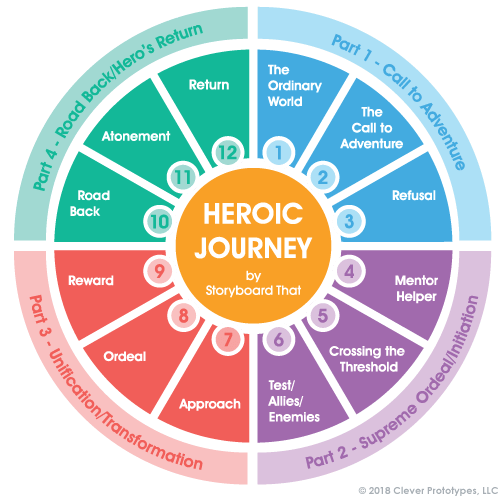
Joseph Campbell & The Hero’s Journey
Joseph Campbell, a student of Jung, discovered that all great myths share the same structure: The Monomyth or “Hero’s Journey.” This isn’t just a structure for movies like Star Wars; it is the map of your own psychological development.
Therapy as the “Call to Adventure”
At Taproot Therapy Collective, we use the Hero’s Journey as a framework to understand where you are in your healing process. You are not “sick”; you are in the middle of a story.
Stage 1: The Departure (The Crisis)
Every journey begins with a disruption—a breakup, a panic attack, a loss of meaning. This is the Call to Adventure. You may try to refuse the call (denial), but eventually, the pain becomes too great, and you must cross the threshold into the unknown world of therapy.
Stage 2: The Initiation (The Work)
This is the “belly of the whale.” In therapy, you face your dragons (trauma), navigate the labyrinth (the unconscious), and meet allies (inner resources). It is a time of trial, but it is the only way to find the treasure.
Stage 3: The Return (The Integration)
The hero returns home, but they are changed. They bring back the “Elixir”—new wisdom, strength, or peace. The goal of Jungian therapy is not just to survive the journey, but to integrate what you learned so you can live with a new sense of purpose.
“The cave you fear to enter holds the treasure you seek.” — Joseph Campbell

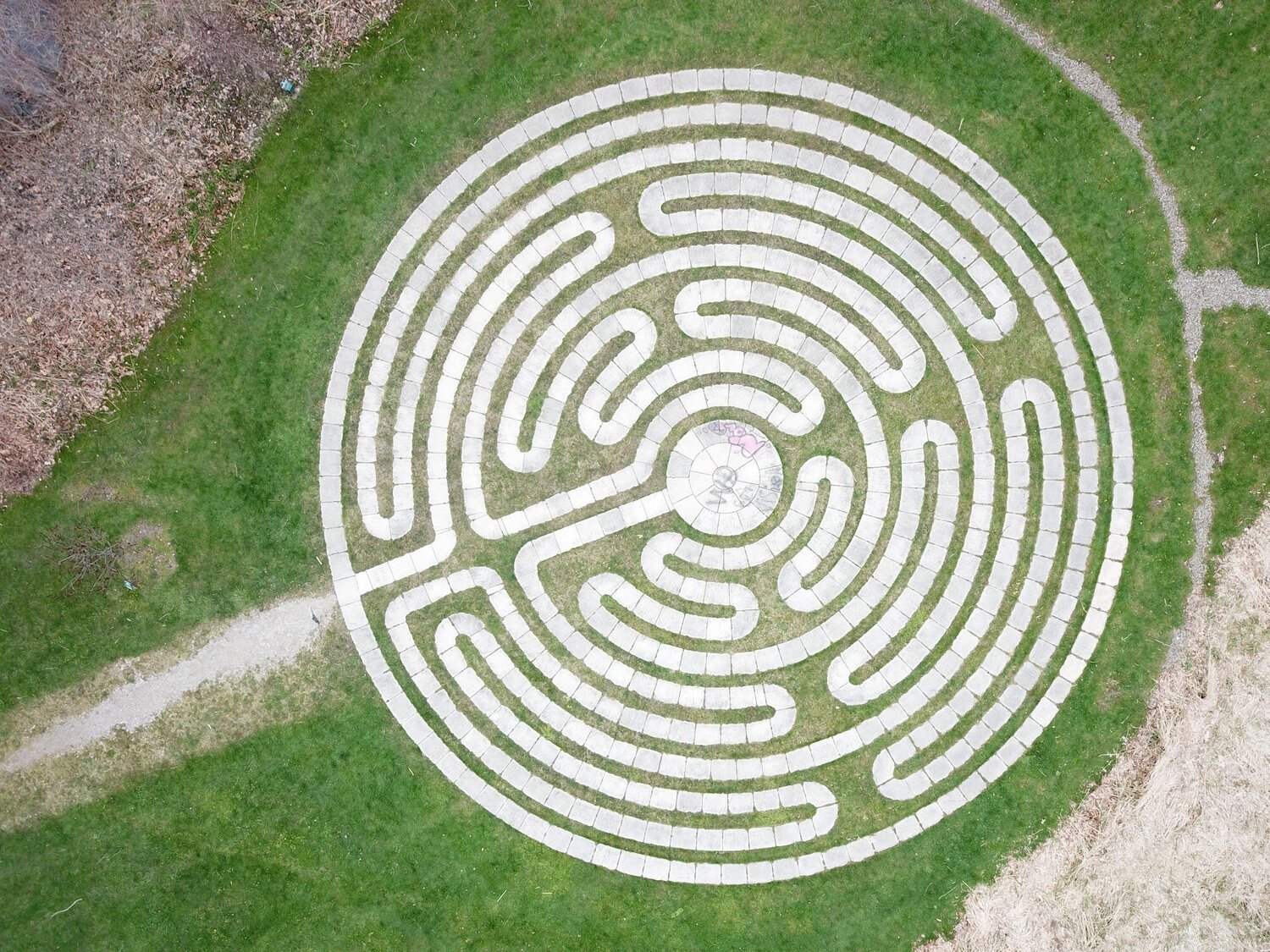
The Labyrinth: A Map for the Soul
In our practice, we often use the image of the Labyrinth. It is important not to confuse a Labyrinth with a Maze.
- A Maze has dead ends, wrong turns, and is designed to make you lose your way.
- A Labyrinth has only one path. It winds, turns, and sometimes feels like you are moving away from the center, but every step takes you closer to the goal.
Walking the Path of Individuation
In Christian Mysticism, the labyrinth represented the pilgrimage to the holy center. In Jungian psychology, it symbolizes the journey inward to the Self.
Therapy is often a labyrinthine process. You may feel like you are walking in circles, revisiting the same trauma or relationship issues. However, in a labyrinth, you are never actually backtracking; you are viewing the center from a new angle. This is the process of Individuation—the long, winding, unicursal path toward becoming whole.
The Science of the Soul: Neurobiology & Jungian Psychology
For decades, Jungian psychology was dismissed as “mystical.” Today, modern neuroscience is proving Jung right. We now know that the “Unconscious” is not just a metaphor; it is a biological reality rooted in specific neural networks.
1. The Unconscious & The Default Mode Network (DMN)
Neuroscience has identified the Default Mode Network—a system in the brain that is active when we are not focused on the outside world. This network is the home of daydreaming, self-reflection, and the autobiographical self.
When Jung talked about “Active Imagination,” he was essentially developing a protocol to consciously access the DMN, allowing you to rewrite the neural pathways of your own identity.
2. Archetypes as “Neural Templates”
Jung believed we are born with innate patterns called Archetypes. Neurobiology supports this via the concept of Innate Releasing Mechanisms.
Just as a baby is born with the neural circuitry to recognize a face, we are born with the circuitry to recognize “The Mother,” “The Hero,” or “The Threat.” Archetypes are simply the psychological experience of these biological instincts.
3. Individuation & Neuroplasticity
The goal of Jungian therapy is Individuation (wholeness). Biologically, this is Neuroplasticity.
Trauma fragments the brain, disconnecting the emotional centers (Limbic System) from the logic centers (Prefrontal Cortex). Jungian techniques like symbol work and dream analysis force these disconnected regions to communicate, physically growing new neural bridges that integrate the brain.
4. Dreams: The Brain’s Data Processing
Dream analysis is not fortune-telling; it is data processing.
During REM sleep, the brain’s logic centers shut down, but the visual and emotional centers light up. This allows the brain to process complex emotions in symbolic form. By analyzing these symbols, we get a direct read-out of what your emotional brain is trying to resolve.
The Origins of Depth Psychology: Jung’s Break from Freud
Carl Jung began his career as Sigmund Freud’s “Crown Prince,” the man chosen to lead the psychoanalytic movement. However, their relationship collapsed over a fundamental disagreement about the nature of the human soul.
The Great Divide
- Freud’s View: The unconscious is a “trash can” for repressed sexual urges. Religion is a delusion. The goal of therapy is to uncover childhood trauma.
- Jung’s View: The unconscious is a source of infinite creativity and wisdom. Religion is a psychological reality. The goal of therapy is not just to heal the past, but to find meaning for the future.
A Bridge Between Science & Spirituality
Jung was unique among psychiatrists. He was a scientist who studied quantum physics, but he also studied Gnosticism, Alchemy, and Eastern philosophy. He did not see these as contradictions.
To Jung, a “spiritual experience” was not proof of God, but a psychological fact that could heal trauma. Whether you view these experiences as coming from the brain or the divine, Jungian therapy provides a bridge where you don’t have to choose between your intellect and your soul.
Jung’s Modern Legacy
You already know Jungian psychology, even if you don’t realize it. His concepts of the Collective Unconscious and the Hero’s Journey have shaped:
- 🎬 Movies: Star Wars, The Matrix, Lord of the Rings
- 🎵 Music: Tool, BTS (Map of the Soul)
- 🤝 Recovery: The 12 Steps of Alcoholics Anonymous were directly inspired by a letter from Jung to Bill W.
Recommended Reading on Depth Psychology
Whether you are a beginner or a clinician, these texts are essential for understanding the landscape of the psyche.
Start Here: The Essentials
- The Best Intro: Man and His Symbols by Carl G. Jung
- Biography: Memories, Dreams, Reflections by Carl G. Jung
- Practical Guide: Inner Work: Using Dreams and Active Imagination by Robert A. Johnson
- Overview: Jung’s Map of the Soul by Murray Stein
- Jung: A Very Short Introduction by Anthony Stevens
Advanced Source Texts (By Jung)
- The Masterpiece: The Red Book: Liber Novus
- On the Collective Unconscious: The Archetypes and The Collective Unconscious
- On the Self: Aion: Researches into the Phenomenology of the Self
- Modern Man in Search of a Soul
- The Undiscovered Self
- Jung on Active Imagination
- The Psychology of Kundalini Yoga
Trauma, Shadow & Dream Work
- Trauma: The Inner World of Trauma by Donald Kalsched
- Shadow Work: Meeting the Shadow edited by Connie Zweig
- Dreams: The Way of the Dream by Marie-Louise von Franz
- Archetypal Patterns in Fairy Tales by Marie-Louise von Franz
- Jung and Tarot: An Archetypal Journey by Sallie Nichols
- The Alchemy of Healing by Edward C. Whitmont
Mythology, Culture & The Feminine
- Mythology: The Power of Myth by Joseph Campbell
- Feminine Psychology: The Pregnant Virgin by Marion Woodman
- Archetypal Psychology: The Myth of Analysis by James Hillman
- Goddesses: Mysteries of the Feminine Divine by Joseph Campbell
- The Life and Ideas of James Hillman
- Jung’s Treatment of Christianity by Murray Stein


