
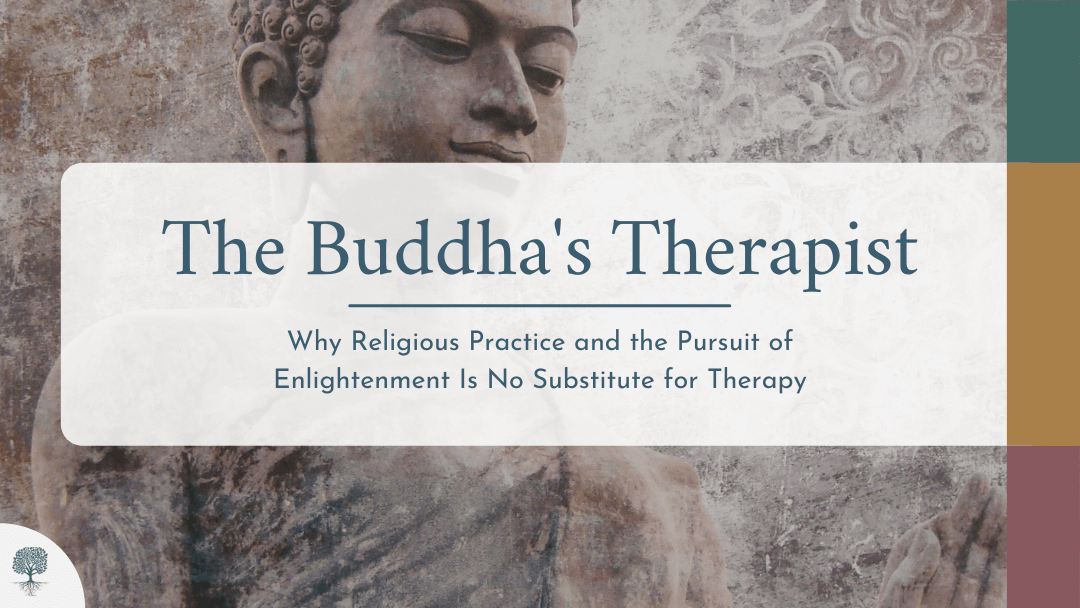
Executive Summary: The Peril of the un-Psychologized Saint
The Core Paradox: How can a spiritual teacher who meditates for 10 hours a day abuse their students? The answer lies in the critical distinction between Transcendence (leaving the ego) and Integration (healing the ego).
Key Concepts:
- Spiritual Bypassing: Coined by John Welwood, this is the use of spiritual practices (meditation, yoga, prayer) to avoid facing unresolved emotional pain or Shadow material.
- The Guru Complex: The psychological dynamic where followers project their own “Divine Self” onto a leader, creating a dependency that prevents true individuation.
- State vs. Trait: You can access a high spiritual “state” temporarily without possessing the emotional “traits” of maturity. Healing requires doing the psychological “dirty work” (the laundry) before seeking the spiritual high.
The Buddha’s Therapist: Why Spirituality Cannot Heal the Shadow Without Psychology

“Perhaps all the dragons in our lives are princesses who are only waiting to see us act, just once, with beauty and courage. Perhaps everything that frightens us is, in its deepest essence, something helpless that wants our love.”
― Rainer Maria Rilke, Letters to a Young Poet
In the realm of personal growth and self-discovery, we often encounter a puzzling paradox that defies our expectations of holiness: individuals who appear to have reached spiritual heights—Gurus, Pastors, Yogis—yet struggle with profoundly human, and often sordid, flaws. We see the Zen master who is a raging alcoholic, the Pastor who commits adultery, or the Yoga teacher who is a malignant narcissist.
This phenomenon is not an anomaly; it is a structural feature of how we have separated the spirit from the psyche. It raises critical questions about the relationship between Spirituality (the vertical connection to the divine) and Psychology (the horizontal connection to the self and others). Why does enlightenment not cure neurosis? Why can you be “awake” to the universe but asleep to your own behavior?
The Illusion of Enlightenment: The 1970s Crisis
The 1970s saw a massive influx of Eastern religious traditions into the United States. Disillusioned by Western materialism and the rigidity of the church, a generation sought answers in Zen Buddhism, Hinduism, and Transcendental Meditation. These practices promised a path to peace that bypassed the guilt and dogma of their parents’ religion.
However, by the 1990s, a wave of scandals rocked these communities. Numerous “enlightened” masters—men who could sit in stillness for days—were found to be engaging in sexual abuse, massive financial fraud, and emotional manipulation of their devotees. The followers were left in a state of shattered dissonance. How could someone who has dissolved their ego in meditation be so deeply egocentric in their daily life?
The answer is simple but terrifying: Meditation does not heal the Shadow. In fact, without psychological containment, meditation can inflate the Shadow.
Transcendence vs. Integration (State vs. Trait)
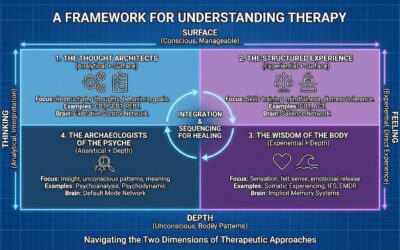
Eastern practices are excellent at teaching Transcendence—the ability to step out of the ego and experience the oneness of existence. This is a “State” experience. It is temporary, euphoric, and expansive.
However, Psychotherapy focuses on Integration—the ability to clean up the ego so that it functions healthily in relationships. This is a “Trait” development. It is permanent, often boring, and stabilizing.
You can have a peak spiritual experience (State) on a retreat and still have the emotional maturity of a toddler (Trait) when you return home to your spouse. The danger arises when we mistake the peak experience for character development. As the psychologist Jack Kornfield noted, we often use the spiritual high to avoid the “low” of our own unresolved trauma.
The Persistence of the Shadow
Carl Jung warned that you cannot get rid of the Shadow; you can only acknowledge it. Many spiritual traditions promise the opposite: that if you pray enough, chant enough, or fast enough, you will “purify” yourself of anger, lust, or greed.
This is a dangerous lie. When we try to “starve” the Shadow with spirituality, it simply goes into the basement of the psyche and lifts weights. It comes back stronger, often disguised as “Spiritual Pride” or “Righteous Indignation.”
* The Paradox: The person who claims to have “transcended anger” is often the most passive-aggressive person in the room. They have not transcended anger; they have simply dissociated from it, meaning they act it out without knowing they are doing it.
Spiritual Bypassing: The “God Drug”
Psychologist John Welwood coined the term “Spiritual Bypassing” to describe the use of spiritual practices to avoid facing unresolved emotional pain. It is the tendency to use God (or the Universe) as a drug to numb the pain of being human.
In my practice, I see this constantly:
- The “Love and Light” Patient: Refuses to set boundaries because “we are all one,” leading to a history of abusive relationships. They confuse codependency with compassion.
- The “Karma” Patient: Believes their depression is a “past life debt” rather than a result of current childhood trauma. This allows them to avoid the hard work of attachment repair in the here and now.
- The Psychedelic Patient: Uses Ayahuasca to “blow open” their consciousness every weekend but cannot hold a job or a conversation on Monday. They are addicted to the “ascent” but refuse the “descent.”
As I once told a parishioner who claimed teenagers only needed Jesus to be safe online: “It’s been my experience that teenagers who have Jesus in their heart can still have a lot of stupid ideas in their brain.” Faith is a compass, not a map. It gives you a direction, but it does not tell you where the cliffs are.
The Guru Complex: Projecting the Golden Shadow
Why do we fall for these flawed leaders? Because of the Guru Complex.
In Jungian terms, we often project our “Golden Shadow”—our own potential for greatness, divinity, and wisdom—onto a leader. We feel small and empty, and we look at the Guru and see them as full and divine.
This projection relieves us of the burden of our own development. If the Guru is perfect, I just have to follow him. I don’t have to grow up.
The scandal happens when the Guru inevitably acts like a human. When the projection shatters, the follower feels betrayed. But the betrayal was inevitable because the perfection was an illusion from the start. We must learn to withdraw these projections and realize that the divinity we see in the teacher is actually a reflection of the divinity dormant in ourselves.
The Solution: “Jack Kornfield’s Laundry”
Buddhist teacher Jack Kornfield famously wrote a book titled After the Ecstasy, the Laundry. The premise is profound in its simplicity: after you have your enlightenment experience on the mountain, you still have to come down and wash your underwear.
Integrating the Shadow involves specific work:
1. Accepting Humanity: Realizing that being “spiritual” does not mean being perfect. It means being whole. It means accepting that you can be a meditator and still get jealous.
2. Ritualizing the Shadow: Like the Amish Rumspringa or the Zen monks who ritually acknowledge their gluttony, we must create safe spaces to express our darker impulses so they don’t possess us.
3. Psychological Work: Using therapy to understand why we are triggered, rather than just using meditation to calm down after the trigger fires.
The Buddha may have found enlightenment under the Bodhi tree, but even he might have benefited from a good therapist to help him navigate the politics of his sangha. We need both the sky (Spirit) and the earth (Soul) to be fully human. Enlightenment is not an escape from the self; it is the final, loving embrace of it.
Explore the Intersection of Spirit and Psyche
Taproot Therapy Collective Podcast
Shadow Work & Spirituality
Practical Shadow Work Exercises
David Tacey on Mysticism and Politics
Bibliography
- Kornfield, J. (1993). A Path with Heart: A Guide Through the Perils and Promises of Spiritual Life. Bantam Books.
- Epstein, M. (1995). Thoughts Without a Thinker: Psychotherapy from a Buddhist Perspective. Basic Books.
- Welwood, J. (2000). Toward a Psychology of Awakening. Shambhala.
- Trungpa, C. (1973). Cutting Through Spiritual Materialism. Shambhala.
- Zweig, C., & Abrams, J. (1991). Meeting the Shadow. Tarcher.
















0 Comments