
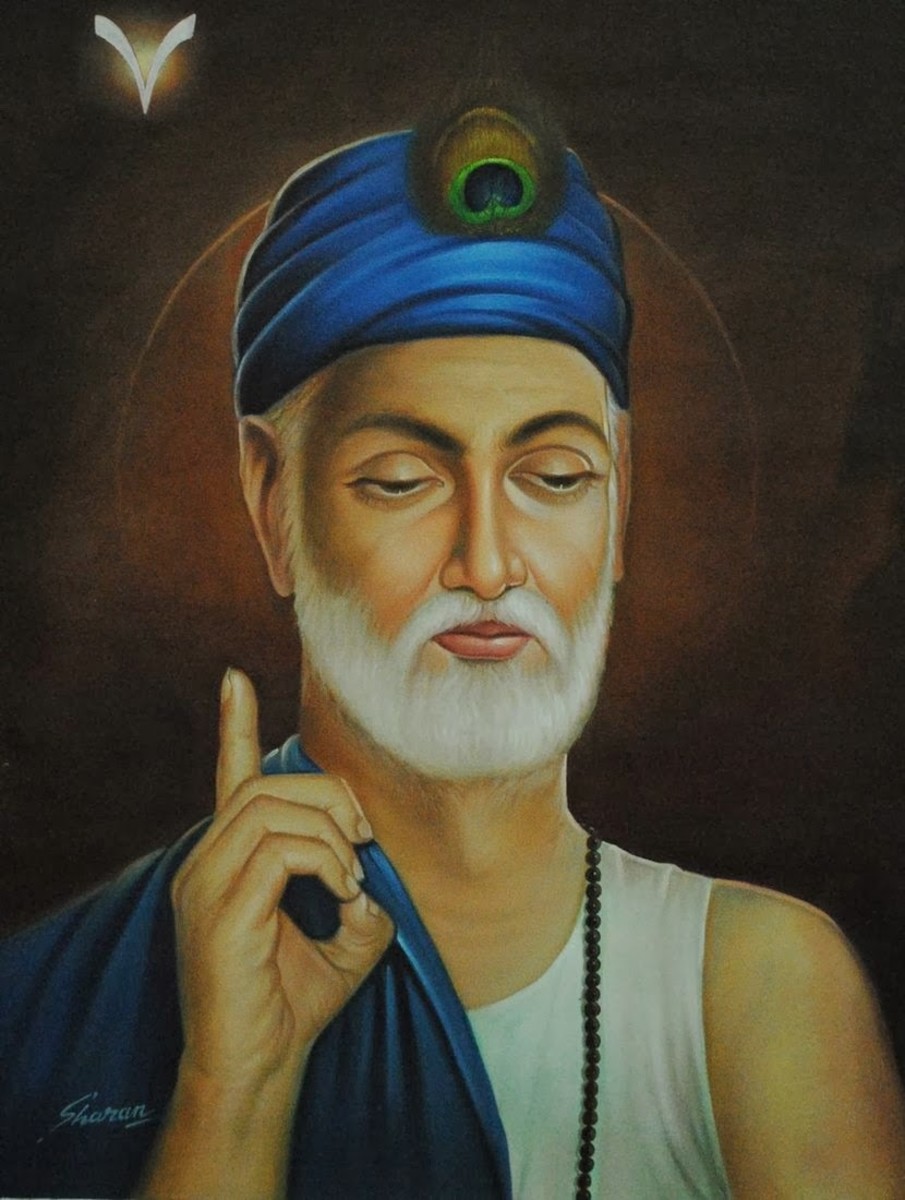
“If God be within the mosque, then to whom shall I call the adhan? If Rahman be not apart, whom shall I then go to name?”
– Kabir
Who was Kabir?
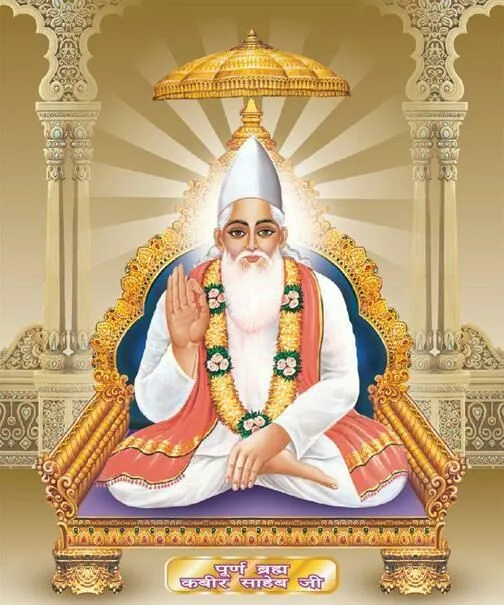
Kabir (1440-1518 CE) was a legendary mystic poet of India whose writings have deeply influenced the Bhakti movement and various spiritual traditions of the East. A religious reformer who transcended orthodox boundaries, Kabir wove verses of sublime wisdom using the metaphors of everyday life. His poems celebrated a sacred unity beyond outer identities and organized religions. Centuries later, Kabir’s universal teachings on realizing the Divine within and living authentically from that truth remain profoundly relevant to principles of modern psychology.
 Life of the Weaver-Sage:
Though details of Kabir’s birth and early years are obscure, hagiographies describe him being raised by a Muslim family but deeply studying Hindu spirituality as well. Working as a weaver to subsist, Kabir mastered the wordsmith’s craft of transmuting simple images into conduits of illumination. He renounced all formalisms of ritual and caste, embracing a vision of the entire cosmos as manifestations of the Formless One.
Amassing crowds of devotees from all castes and creeds, Kabir faced persecution from orthodox authorities for his unconventional, iconoclastic ways. Yet he remained undeterred in conveying his revelations on the soul’s innate unity with the Divine ground and the illusory nature of perceived separations. Kabir’s poetry, passed down orally for generations, continues to inspire diverse spiritual seekers and social reformers even today.
Doctrines for Self-Realization:
Look Within: The Divine Essence Resides in Consciousness
For Kabir, the ultimate truth and divine essence is not to be found externally in rites, institutions, or dogmas, but rather in the depths of one’s own consciousness. He urges seekers to turn their gaze inward to directly experience the formless, immutable reality pervading all existence:
“Why go to the forest in search of the Beloved? He dwells in your own soul.”
This echoes the philosophical understanding that the answers to humanity’s most profound questions lie within, not in external authorities or constructs. Kabir insists the divine light illuminating all of creation is ever-present within each individual if they simply remove the veils of delusion and attachment that obscure it.
Simple Living: Embracing Humility and Non-Attachment
Kabir preached a life of radical simplicity, humility, and non-attachment as the path to enlightenment. He rejected outer riches, pretenses, and societal divisions based on labels or identities as transitory illusions that veil the soul’s true nature:
“If God could be found through rosaries of woods,
Then all trees would attain salvation.”
For Kabir, true spirituality arises through embracing poverty of spirit – returning to a state of wonder like a child, free from conceptual baggage. Letting go of ego-driven attachments, he taught, allows one to awaken to the rootless, pristine state of pure presence and being.
One Supreme Reality: Seeing the Unified Oneness
Central to Kabir’s message is the understanding that beneath the myriad names, forms, and religious paths, there is one supreme, unitive reality acting as the ground of all manifestation:
“The formless substance of the world is the living
stream; from it arise all created beings.”
He insisted that by transcending superficial divisions and conceptual dualities, one could directly realize and merge with this non-dual essence suffusing the entire cosmos – the ultimate “supreme attainment.” Kabir saw the experience of separation and individuality as a limited human construct, with enlightenment being the dissolution of all such boundaries.
Religious Iconoclasm: Dismantling Dogmas
Kabir fiercely challenged institutionalized religion and ritualistic dogma, seeing these as human fabrications obscuring the universally shared truth at the heart of all mystical traditions. He had no patience for outer displays of piety devoid of inner realization:
“The Hindu grinds for the sake of the idol
While the Muslim turns the stone for a mosque
But they both remain empty-handed.”
For Kabir, blind adherence to religious formalities, without the direct experience of unity, was a futile effort. He urged dismantling identification with exoteric doctrines and rigidities to directly encounter the boundless, indefinable divine within.
Ahimsa: Non-Violence and Universal Compassion
Kabir extolled the virtues of ahimsa (non-violence) and compassion as essential expressions of one’s intrinsic divine nature. He saw cruelty or harm inflicted on any being, human or non-human, as a transgression of the fundamental truth of oneness:
“If you cannot find truth within yourself,
Where else do you expect to find it?
The blind worship the blind.”
True enlightenment, he taught, blossomed into a state of embodied compassion and reverence for all life as a holistic manifestation of the singular divine principle. Violence stemmed from the delusion of separation and ignorance of one’s true self.
Parallels with Modern Psychology:
Psychoanalytic Thought
Kabir’s emphasis on introspection and looking within to illuminate the depths of human consciousness prefigured core psychoanalytic principles. His poems often describe the mind as a vast, layered inner realm where the brilliance of one’s innate divinity outshines the ego’s narrow chambers. This metaphor evokes Freudian imagery of an unconscious wellspring below the surface of the ego.
Just as psychoanalysis urges probing the unconscious roots underlying human thought and behavior, Kabir extolled diving into the submerged territory of one’s own awareness to encounter the divine ground. His verses urge dismantling the habitual sense of separate selfhood to merge into the oceanic experience of unbounded awareness – an experience akin to experiences
 Kabir’s Eternal Relevance:
In an age of increasing polarization across religions and identities, Kabir’s call for recognizing the essential oneness that underlies all fragments of existence provides an illuminating balm. His poems urge rising above sectarian divisions to directly realize the unitive truth pulsating through all creation.
By embracing radical simplicity and seeing the Divine in each moment and being, Kabir embodied living authentically from one’s innate, sacred nature – a core ideal of humanistic and existential psychologies. Contemporary mindfulness practices aiming to cultivate present-moment awareness have roots in Kabir’s wisdom on transcending cravings and aversions to abide in unconditioned consciousness.
Relevance to Psychotherapy and Carl Jung:
Kabir’s insights into humanity’s universal quest for self-realization and union with the Absolute Ground finds deep resonance with Carl Jung’s pioneering depth psychology. Both visionaries mapped the journey of individuation – the process of shedding collective identities, dismantling the ego’s attachments, and revealing one’s true Self.
Jung saw this individuation process as a profoundly archetypal, symbolic path echoed in myths, dreams and mystic teachings across cultures. Kabir’s verses overflowing with evocative metaphors of oceans, birds, and human experiences capture this primordial realm of symbolic consciousness that Jung so valued.
According to Jung, engaging these archetypal patterns and symbols activates humanity’s innate, latent wholeness and illuminates the path to realizing the divine essence within. Kabir’s poetry acts as an experiential guide into these mystical depths of unified being beyond the limited ego-mind.
Furthermore, Jung believed spiritual experiences and numinous symbols arising from humanity’s collective unconscious represent expressions of the psyche’s intrinsic religious function – the driving towards greater self-transcendence and integration. Kabir exemplified an individual who actualized this innate capacity, achieving non-dual consciousness and the embodiment of enlightened virtues like compassion and equanimity.
In many ways, Kabir was the quintessential realized “Whole Human Being” that Jung saw as the goal of the individuation journey. By fully living from one’s authentic, sacred core beyond all socio-cultural conditionings, Kabir demonstrated the human potential for integrating the universal and particular, transcendence and embodiment.
Thus in Kabir’s wisdom and realization, psychotherapists can find a universal wellspring of inspiration for guiding individuals to awaken to their true, undivided nature. His timeless, poetic maps of the human journey provide a vital reference point for the perennial work of nurturing holistic self-actualization.
Relevance to Trauma Healing and Recovery:
Kabir’s mystical teachings also hold profound implications for understanding and facilitating healing from psychological trauma. At their core, his insights point to the innate wholeness and divinity within each individual that transcends any wounds or fragmentation. This affirmation of an unbroken, sacred essence can serve as a vital anchor and resource for trauma survivors.
Trauma involves a shattering of an individual’s fundamental sense of trust, safety, and wholeness. It can lead to a profound disconnection from one’s body, emotions, and spiritual ground. In this context, Kabir’s call to journey within and uncover the eternal, unitive core beneath the layers of conditioning and separation holds immense therapeutic power.
His emphasis on stripping away false identities and attachments to realize one’s true nature mirrors the psychotherapeutic process of gradually peeling back the protective defenses and adaptations formed in response to trauma. As individuals slowly befriend and reintegrate the wounded, exiled parts of their psyche, they move closer to the preexisting wholeness that Kabir describes.
Moreover, Kabir’s vision of an all-pervasive, non-dual reality can help recontextualize the trauma survivor’s experiences within a larger transpersonal framework. By recognizing that their pain and struggles are held within an infinitely compassionate, divine ground, individuals can begin to find meaning and redemption in their suffering. This realization can soften shame and foster self-compassion.
Kabir’s deeply embodied, experiential approach to spirituality also aligns with somatic and body-based trauma therapies. His vivid poetry celebrates the divine within the raw textures of sensory life – the breath, the heartbeat, the pulse of creation. For many trauma survivors, fully inhabiting the body and senses is a critical component of healing. Kabir’s words can guide them in embracing their incarnate self as a sacred vessel.
Ultimately, Kabir conveys that the deepest healing and enlightenment arises through surrender to the Divine within and without. For trauma survivors, this may initially evoke fear and resistance, as relinquishing control feels threatening. Yet his poems gently assure that by entrusting oneself to a loving, all-embracing Presence, one can find true safety and peace. Therapeutically, this points to the centrality of secure attachment and resting in a greater holding to resolve trauma.
As trauma expert Dr. Peter Levine writes, “Trauma is a fact of life. It does not, however, have to be a life sentence.” Kabir’s timeless wisdom affirms that even in the depths of traumatic wounding, an unbroken, radiant wholeness awaits – the soul’s true home. His poetic vision can uplift and accompany survivors in their brave journey of reclaiming that birthright. In Kabir’s words:
“There is nothing lost or hidden in this world
That cannot be found again…
What is found inside you, O seeker
Will never be lost to you.”
If you enjoyed this article, check out the podcast: https://gettherapybirmingham.podbean.com/
Bibliography:
- Kabir. (Various editions). Dohas (Couplets).
- Kabir. (Various editions). Bijak.
- Kabir. (Various editions). Sakhi (Witness).
Further Reading:
- Hess, L. & Singh, S. (2002). The Bijak of Kabir. Oxford University Press.
- Tagore, R. (1915). Songs of Kabir. Macmillan and Co.
- Vaudeville, C. (1993). A Weaver Named Kabir: Selected Verses with a Detailed Biographical and Historical Introduction. Oxford University Press.
- Dharwadker, V. (2003). Kabir: The Weaver’s Songs. Penguin Books.
- Sethi, V.K. (1984). Kabir: The Weaver of God’s Name. Radha Soami Satsang Beas.
- Mehrotra, A.K. (2011). Songs of Kabir. NYRB Classics.
- Jung, C.G. (1958). Psychology and Religion: West and East. Routledge.
- Wilber, K. (2000). Integral Psychology: Consciousness, Spirit, Psychology, Therapy. Shambhala.
- Levine, P.A. (1997). Waking the Tiger: Healing Trauma. North Atlantic Books.
- Van der Kolk, B. (2014). The Body Keeps the Score: Brain, Mind, and Body in the Healing of Trauma. Viking.
- Loevinger, J. (1976). Ego Development: Conceptions and Theories. Jossey-Bass.
- Maslow, A.H. (1968). Toward a Psychology of Being. Van Nostrand Reinhold.
- Grof, S. (1985). Beyond the Brain: Birth, Death, and Transcendence in Psychotherapy. State University of New York Press.
- Assagioli, R. (1965). Psychosynthesis: A Manual of Principles and Techniques. Hobbs, Dorman & Company.
- Washburn, M. (1988). The Ego and the Dynamic Ground: A Transpersonal Theory of Human Development. State University of New York Press.
Read More Depth Psychology Articles:
Taproot Therapy Collective Podcast
Mystics and Gurus












0 Comments