
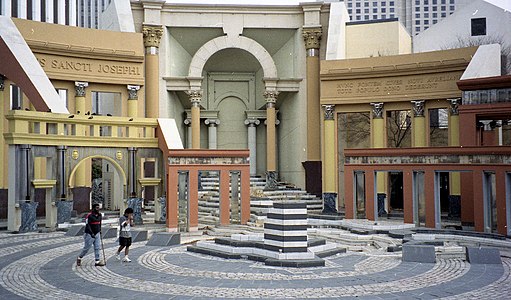
Postmodern Classicism: The Architecture of Irony, Rebellion, and Cultural Insecurity
To understand Postmodern Classicism, one must first confront the profound psychological exhaustion that gripped the Western world in the late 1960s and 1970s. The movement did not emerge merely as an aesthetic shift; it was a radical, cynical, and deeply theatrical response to the perceived failures of Modernist architecture. For decades, the International Style—characterized by sterile glass boxes, exposed steel, and an uncompromising obsession with hyper-rationality—had dominated the globe. Modernism had promised a utopian future engineered by logic, but to the people actually living and working within these structures, the environment felt cold, alienating, and entirely devoid of human meaning. Postmodern Classicism became the architectural equivalent of a countercultural rebellion. Yet, instead of protesting with folk music and sit-ins, architects protested with neon columns, oversized keystones, pastel pediments, and a heavy dose of sarcasm. It sought to create a more expressive and contextually responsive built environment by digging up the corpses of classical architecture and reanimating them with a sense of playful irony.
The Material Conditions of the Countercultural Turn
Architecture is never born in a vacuum; it is entirely dependent on the brute realities of capital and material. The rise of Postmodern Classicism coincided with a period of intense global instability. The post-war economic boom had sputtered out, giving way to stagflation, deindustrialization, and the profound shock of the 1970s energy crisis. This severe material constraint simultaneously birthed the passive solar movement as architecture was forced to respond to energy concerns. As the old hierarchies collapsed in the wake of the civil rights movement and anti-war protests, the austere, uniform glass towers of corporate Modernism suddenly stopped looking like beacons of progress and started looking like the menacing, panoptic fortresses of an out-of-touch establishment.
Technologically, Postmodern Classicism benefited from advances in cheap, highly malleable construction materials. Architects no longer needed master stonemasons or vast reserves of capital to carve a Roman column or a Greek pediment. They could fashion a non-load-bearing, purely decorative facade out of fiberglass, drywall, or Exterior Insulation and Finish Systems (EIFS). This material liberation meant that classical forms, which had once been the exclusive domain of empires and the ultra-wealthy, could be slapped onto the front of a suburban strip mall, a fast-food restaurant, or a municipal building for pennies on the dollar. The architecture was no longer structural; it became an applied signifier, operating much like a billboard.
The Psychology of Insecurity and the Loss of Narrative
Why did a culture suddenly crave cartoonish, exaggerated versions of Greek and Roman architecture? The answer lies in a deep collective insecurity. High Modernism had violently stripped the built environment of its historical narrative, asserting an arrogant belief that humanity could live purely in the “now,” completely severed from the past. But as we see when analyzing the psychological forces that move our buildings, human beings cannot psychologically survive in environments entirely devoid of narrative, symbol, and historical continuity.
The culture of the 1970s and 1980s was experiencing a massive identity crisis. The utopian promises of the mid-century had failed, cities were decaying, and faith in institutions had evaporated following Vietnam and Watergate. In response, Postmodern Classicism asserted a desperate, albeit ironic, belief in the enduring value of classical principles. It projected a mask of cultural literacy and historical awareness to cover up an underlying anxiety about the loss of identity in a rapidly globalizing, deindustrializing world.
Through the lens of Carl Jung’s analytical psychology, Postmodern Classicism can be interpreted as a massive, concrete expression of conflicting architectural archetypes. As explored in the theories of Leon Krier and the architecture of the archetype, buildings often act as a canvas for the collective unconscious. Postmodernism is primarily driven by the Trickster archetype. The Trickster manifests in the movement’s playful, subversive, and heavily ironic use of historical references. When an architect places a bright pink, non-functional keystone over a modern glass door, it is the Trickster mocking the rigid, fatherly seriousness of the Modernist establishment. Simultaneously, the movement’s compulsive return to traditional Roman and Greek proportions reflects the Wise Old Man archetype—a desperate, unconscious reaching backward for the stability and wisdom of the ancestors in an era of terrifying cultural chaos.
Rebelling Against the Utopian Machine: Why the Style Became Huge
The movement was theorized into existence by brilliant architectural provocateurs who famously declared war on the Modernist establishment. When Modernist pioneer Mies van der Rohe famously stated “Less is more,” architect Robert Venturi shot back with the defining battle cry of the era: “Less is a bore.” Venturi and Denise Scott Brown published the seminal text Learning from Las Vegas, radically suggesting that architects should study the neon signs and vernacular commercial architecture of the Vegas strip rather than European monuments. This intellectual foundation paved the way for designers like Michael Graves, whose iconic Portland Building in 1982—featuring oversized keystones, pilasters, and a heavily colored facade—looked more like a giant pop-art painting than a civic center.
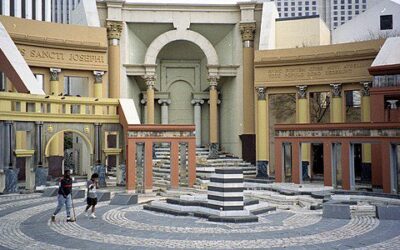
Another master of this psychological subversion was Charles Moore, known for the Piazza d’Italia in New Orleans, an absurdly joyful public plaza that combined traditional Roman columns with neon lighting and stainless steel. The ultimate betrayal of the Modernist old guard came when Philip Johnson, a former die-hard Modernist who had helped introduce the International Style to America, shocked the world by designing the AT&T Building in New York. Currently recognized by institutions like the Museum of Modern Art (MoMA) as a turning point in postmodernism, Johnson’s massive skyscraper was topped with a gigantic, decorative “Chippendale” broken pediment, resembling a massive piece of antique furniture rather than a rational office tower.
The Fusion with New Urbanism: From Irony to Authenticity in Seaside and Poundbury
As the initial shock value of Postmodern Classicism began to wear off, the movement bifurcated. While commercial developers were busy slapping cheap pediments onto strip malls, a more serious faction of architects realized that classical forms could be used for something deeper than irony: they could resurrect the lost art of community building. This realization birthed a direct fusion between Postmodern Classicism and the emerging New Urbanism movement, moving the aesthetic away from cynical pastiche and toward the genuine recreation of human-scaled, walkable towns.
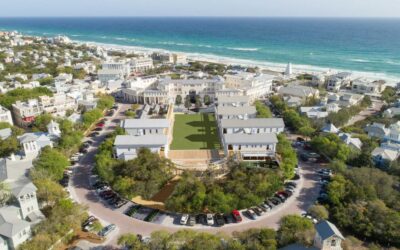
The most famous American example of this transition is Seaside, Florida, designed in the 1980s by architects Andres Duany and Elizabeth Plater-Zyberk. Exploring the psychology of urban planning with Andres Duany reveals how Seaside utilized the pastel palette and classical vernacular of Postmodernism, but applied it to a strict, highly regulated master plan that prioritized pedestrians over cars. The architecture was nostalgic, but the urbanism was revolutionary. It proved that the public desperately craved the psychological comfort of porches, pitched roofs, and dense, village-like connectivity.
Across the Atlantic, this desire for classical continuity and New Urbanist principles culminated in Poundbury, England, an experimental town championed by King Charles III (then Prince of Wales) and master-planned by Leon Krier. Poundbury stripped away the winking irony of American Postmodernism, opting instead for a deeply sincere revival of traditional European urbanism and classical building techniques. It integrated affordable housing with commercial spaces in a walkable grid, proving that the classical forms Postmodernism had resurrected as a joke could, in fact, be utilized to solve modern housing and community crises with absolute sincerity.
Why the Joke Got Old: The Fall of Postmodern Classicism
The brief, blinding reign of pure Postmodern Classicism began to collapse under its own weight by the early 1990s. The exact irony that made it brilliant and subversive in 1980 made it completely unbearable a decade later. The aesthetic was hijacked by the very corporate forces it initially sought to critique. What started as a high-intellectual rebellion was quickly commodified into a cheap, default uniform for the postmodern corporate headquarters, chain restaurants, and sprawling suburban retail parks. Developers realized that applying a styrofoam Doric column to a cheap cinderblock box allowed them to market the space as “upscale.” The style devolved into Disneyfication—a hollow pastiche devoid of its original meaning.
Psychologically, a culture can only sustain irony for so long before it becomes exhausted and craves sincerity again. The public grew tired of buildings that felt like inside jokes or cynical marketing ploys. As the millennium approached, architecture pivoted away from historical pastiche. The field moved toward the gravity-defying, algorithmically generated sincerity of Parametricism and a return to refined, serious forms through Neo-Modernism.
While pure, flamboyant examples of Postmodern Classicism are rarely built today, its underlying philosophy won a lasting victory. It permanently shattered the dogmatic, one-size-fits-all arrogance of high Modernism. Because of the Postmodernists, it is no longer considered an architectural crime to use ornament, color, or historical reference. As the modern world grapples with the cold, algorithmic realities of artificial intelligence and digital homogenization, the lessons of Postmodern Classicism—its desperate, messy, and vibrant demand for human meaning, humor, and historical connection—remain incredibly relevant to the psychology of how we build.







0 Comments