
Updated November 2026 · By Joel Blackstock, LICSW-S
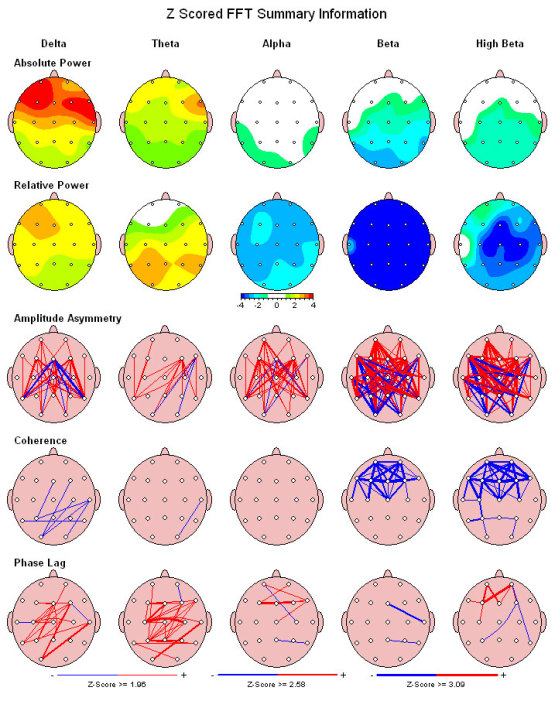
qEEG brain mapping in the Birmingham area is offered at Taproot Therapy Collective's Hoover office, where Peak Neuroscience records your brain's resting electrical activity through a cap of electrodes and compares it with a database of people your age. The map can make a neurofeedback or neurostimulation plan more specific. It is not a diagnostic test, and it cannot tell you what is wrong with you.
That distinction is the argument of this page. A brain map is a measurement, not a verdict. Used as a measurement, it is a sensible way to choose and track a training protocol. Used as a verdict, it promises a certainty that decades of research have not delivered. The word "neurostimulation" needs the same care, because it covers treatments whose evidence runs from strong and FDA-cleared, as with magnetic stimulation for depression, to a handful of small trials.
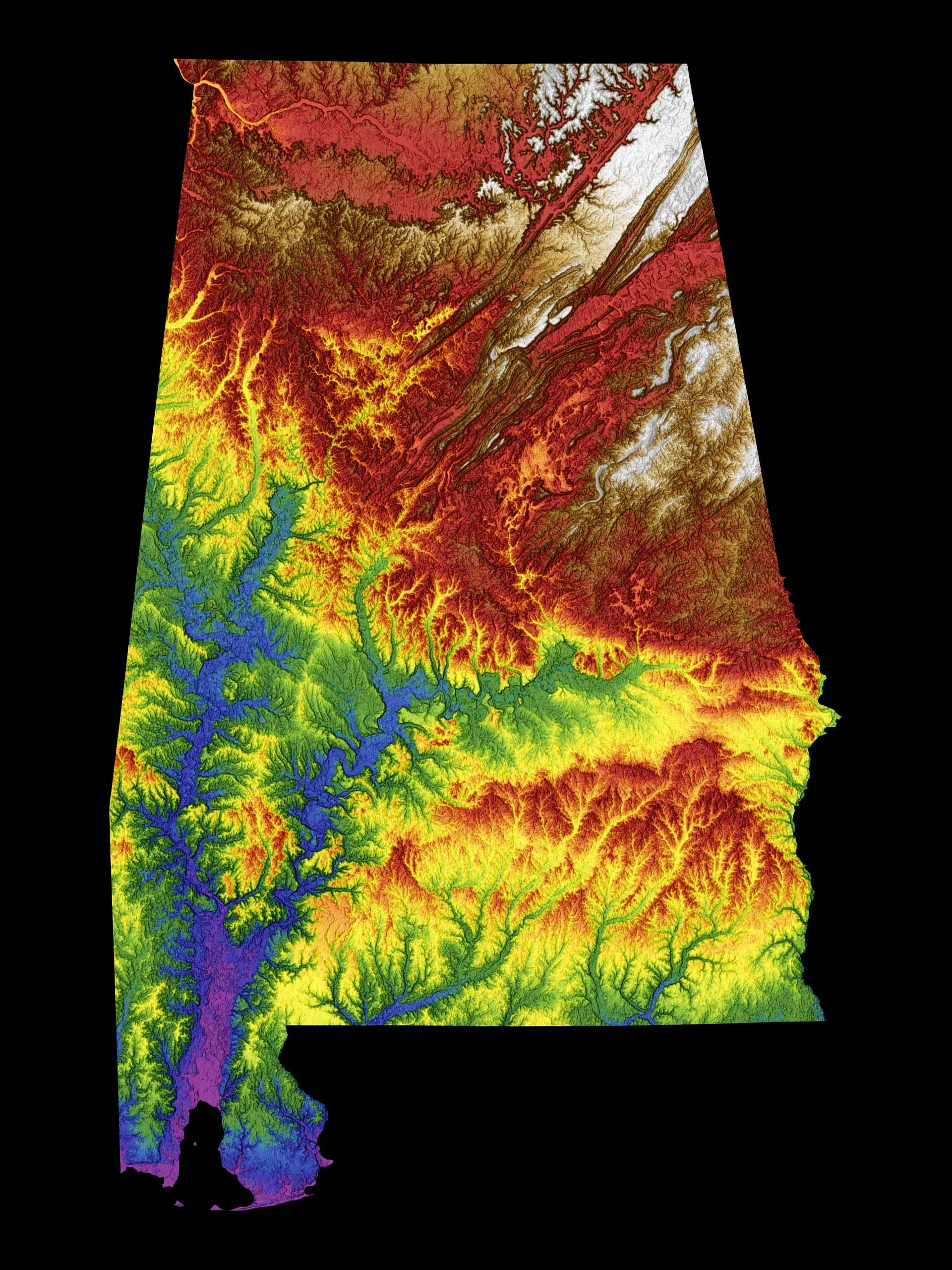
The image above is a relief map of Alabama. It shows elevation and says nothing about what it is like to live in Gadsden or Dothan. Alfred Korzybski put the general point into a phrase in a 1931 lecture, reprinted in his 1933 book Science and Sanity: a map is not the territory.1 A qEEG map has the same limits. It shows where electrical activity at your scalp departs from a statistical average. It does not show your history, your relationships, or why you came in.
What a qEEG actually measures
A quantitative EEG starts as an ordinary EEG. At our Hoover office the recording takes about an hour: a cap of electrodes, a stretch with eyes open, then a stretch with eyes closed. Nothing is sent into the brain during mapping. The recording is cleaned of artifacts such as blinks and muscle tension, broken down into frequency bands (delta, theta, alpha and beta), and compared with an age-matched normative database. The colors on the finished map show where your activity sits above or below that norm and how closely different regions move together.
The earlier version of this post called qEEG a neuroimaging technique. That oversells it. EEG records voltage changes at the scalp, produced by the summed activity of large populations of cortical neurons working in sync. It has excellent timing and poor spatial resolution, and it shows nothing about brain structure. A "deviation" on the map is a statistical statement: your number is unusual compared with the database. Unusual is not the same as disordered. Medication and drowsiness both change the picture, which is why our brain mapping and neurofeedback service page asks people to tell us what they take and never to stop a medication on their own.
Why a brain map cannot diagnose you
The old post said qEEG data "aids in accurate diagnosis." The professional bodies that study EEG have not said that. In 1997 the American Academy of Neurology and the American Clinical Neurophysiology Society reviewed the field and concluded that qEEG remained investigational for attention disorders, learning disability, depression, schizophrenia, head injury, alcoholism and drug abuse, and that brain mapping should be used only as an adjunct to traditional EEG reading by physicians highly skilled in it.2 That report is now marked as retired, so treat it as history rather than current policy. A 2006 committee of the American Neuropsychiatric Association was more open, recommending "cautious use" of qEEG as a clinical laboratory test in childhood attention and learning disorders and in adult mood and dementing disorders.3 A laboratory test used cautiously is a long way from a map that diagnoses on its own.
ADHD is the best-studied case. For years the signature finding was a high ratio of slow theta activity to faster beta activity. A 2013 meta-analysis of nine studies, covering 1,253 children and adolescents with ADHD and 517 without, found that the gap between groups had been shrinking over the years and concluded that the theta/beta ratio cannot be considered a reliable diagnostic measure, though it may carry prognostic value for the subgroup who show it.4 When the FDA allowed a theta/beta device, the NEBA system, onto the market in 2013 for ages 6 to 17, it did so as an aid to be used alongside a clinician's full evaluation, not as a stand-alone test.
Depression tells the same story from another angle. Companies market qEEG for predicting which antidepressant will work. A 2019 meta-analysis in the American Journal of Psychiatry pooled 76 articles reporting 81 proposed EEG biomarkers, found substantial publication bias and little out-of-sample validation, and concluded that qEEG is not recommended for guiding the selection of psychiatric treatment.5
This has a practical side. Several Blue Cross plans in other states, including Mississippi's and Massachusetts's, publish medical policies that classify neurofeedback as investigational, and Blue Cross NC gives qEEG as a diagnostic aid for ADHD the same label. We could not find Blue Cross Blue Shield of Alabama's own policy, so check with your plan before assuming it will pay. At Taproot, mapping and neurotherapy are billed separately from psychotherapy and quoted on the intake call.
What neurofeedback can and cannot do
Neurofeedback, or EEG biofeedback, is the main thing a map is used to plan. Sensors read your brain activity in real time, and a screen or a sound rewards you when the signal moves toward a target pattern. The principle is operant learning. It is low-risk. Whether it works beyond expectation, attention and an hour of calm in a quiet room is the hard question.
For ADHD, two meta-analyses nine years apart give the same answer. Cortese and colleagues found in 2016 that neurofeedback improved symptom ratings made by the least blinded raters, those closest to the treatment setting, but not probably blinded ratings and not in trials with active or sham controls.6 Westwood and colleagues, pooling 38 randomized trials and 2,472 participants in 2025, found no significant improvement on probably blinded ratings of total ADHD symptoms, with a small effect only when the analysis was limited to standard protocols.7 One of the most rigorous single trials randomized 144 children aged 7 to 10 to real theta/beta training or a convincing sham. Both groups improved a great deal, and they did not differ at the end of treatment or at 13 months.8
The qEEG-guided version, where the protocol is chosen from the individual map, has encouraging uncontrolled data. A 2012 open-label pilot treated 21 people with ADHD using qEEG-informed protocols and reported large improvements; its authors wrote that the results needed replication in controlled studies.9 That is a reasonable rationale for mapping first. It is not yet proof that mapping first produces better outcomes. If attention is your main question, our post on qEEG and neurostimulation for ADHD in Birmingham goes further, and our page on ADHD and AuDHD therapy covers ADHD when it overlaps with autism.
For PTSD the evidence is thinner. Bessel van der Kolk's group randomized 52 people with chronic PTSD to neurofeedback or a waitlist, and after twelve weeks of twice-weekly sessions far fewer people in the neurofeedback group still met PTSD criteria.10 A waitlist does not control for attention or expectation, though. A 2020 systematic review found four randomized trials with 123 participants, all favorable, and rated the certainty of the evidence as very low.11
Peak Neuroscience also offers LENS, the Low Energy Neurofeedback System, which delivers a very weak electromagnetic signal instead of asking you to learn anything. Its research base is small. The one double-blind, sham-controlled trial we found, in 34 people with fibromyalgia, saw both groups improve with no significant difference between them.12
Neurostimulation is several treatments, not one
The earlier post named transcranial magnetic stimulation (TMS) and transcranial direct current stimulation (tDCS) side by side, as if they were interchangeable and both on offer in Hoover. They are different technologies with different evidence, and Taproot does not provide TMS.
TMS uses a magnetic coil to induce currents strong enough to make cortical neurons fire. It has been FDA-cleared for depression since 2008 and has the most established evidence base of any noninvasive brain stimulation in psychiatry. A 2017 network meta-analysis of 81 trials and 4,233 patients found that several standard protocols, including high-frequency, low-frequency, bilateral and theta-burst stimulation, outperformed sham for major depression.13 Deep TMS was authorized for OCD in 2018, backed by a 99-patient sham-controlled trial.14 TMS is prescribed and supervised by a physician, usually in daily weekday sessions for four to six weeks, and in Birmingham it is available through psychiatric programs, including a TMS clinic that UAB Psychiatry opened in 2025. If TMS is what you want, that is a conversation for a psychiatrist.
Transcranial electrical stimulation is the family Peak Neuroscience works with: weak currents, a few milliamps at most, delivered through scalp electrodes. The practice has described its methods as tDCS (a steady direct current), tACS (an alternating current at a chosen frequency) and tRNS (random noise). These currents do not make neurons fire on their own. They shift how easily neurons fire.
For depression, tDCS has a modest and inconsistent signal. An individual-patient meta-analysis of nine sham-controlled trials found response rates of 30.9 percent with active tDCS against 18.9 percent with sham.15 Single trials disagree. One large Brazilian trial of 245 adults found tDCS better than placebo but less effective than the antidepressant escitalopram, with more side effects.16 Another found that fully unsupervised home tDCS did no better than sham,17 while a remotely supervised ten-week home trial of 174 adults found a significant benefit.18 In December 2025 the FDA approved the first at-home tDCS headset, Flow Neuroscience's FL-100, as a prescription treatment for adults with moderate to severe major depression. That approval covers one device and one condition.
tACS and tRNS are at an earlier stage. A 2025 meta-analysis in JAMA Network Open pooled 88 randomized trials of electrical stimulation for depression: 79 tested tDCS, six tested tACS and three tested tRNS.19 The tACS trials pointed toward benefit for major depression, but six trials is a starting point, not a settled answer. In the same analysis, tDCS on its own was not significantly associated with improvement in major depression without another illness, though it was when depression came with another psychiatric or medical condition. tDCS combined with medication helped, tDCS combined with psychotherapy did not, and tRNS had too little evidence to judge. For anxiety, ADHD and PTSD we could not find enough sham-controlled evidence to call any of these electrical methods an established treatment.
What about using the map to aim the stimulation? The idea is sensible, and it is how Peak Neuroscience chooses protocols, but the trials are thin. One large test of EEG-personalized stimulation, synchronized TMS tuned to each person's own alpha frequency, did not separate from sham in its 202-person intention-to-treat sample, only in a per-protocol subgroup,20 and the 2017 network meta-analysis counted synchronized TMS among the newer approaches that were not more effective than sham.13 The old claim that "numerous studies" prove qEEG-guided neurostimulation for depression, anxiety, ADHD and PTSD does not hold up, and we have removed it.
Low-intensity electrical stimulation has a good safety record when standard limits are kept. A 2017 international consensus review counted no serious adverse events across more than 18,000 sessions of tDCS, tACS and tRNS. Prickling or burning sensations under the electrodes, headache and fatigue were the usual complaints; skin burns from poor electrode contact were uncommon; and mania or hypomania was documented very rarely in people with depression.21 Tell whoever stimulates you about any history of bipolar disorder, seizures or implanted devices.
What this looks like in therapy
People rarely ask for a brain map out of technical curiosity. Often they have spent years being told their problem is attitude, effort or character, and they want something that proves the problem is real. A colorful map can do that work. Seeing that your frontal activity really does differ from the average can loosen a shame that no amount of reassurance touched.
The same picture can harden into a new story: my brain is broken, and this is what I am. Depth psychology has a long habit of treating any single image of the self as partial, and a qEEG deserves that treatment. In therapy we hold the map as one source of information alongside your history, your body's responses and the patterns that keep repeating in your relationships. It can open questions. Why does activity run fast in someone who describes themselves as calm? What happens in the body when the eyes close? It should not close them.
Neurofeedback sessions can become material too. The feedback responds to shifts in state, and noticing those shifts (bracing, drifting, effortful focus that tips into strain) is ordinary therapeutic work. That work is useful whether or not the brainwave target turns out to be the active ingredient. We have written critically about the limits of research-driven care in When Evidence-Based Practice Goes Wrong. Those limits cut both ways: a blinded trial that finds no effect is still information, and a new technology deserves the same scrutiny as an old one.
At Taproot the pieces fit together this way. The map and a clinical interview happen in one visit to the Hoover office with Dr. Jason Mishalanie, a licensed psychologist who is board certified in neurofeedback. Diana Pizarro, an electrical engineer and EEG analyst who worked in UAB's epilepsy research program, analyzes the recording. Psychotherapy can then run by video from anywhere in Alabama, with office visits only for neurofeedback or neurostimulation. Our page on one trip to Hoover for a brain map, then teletherapy lays out that arrangement for people who live outside the metro.
Some questions belong elsewhere. If you are worried about seizures, see a neurologist; a qEEG is not a clinical EEG read for epilepsy. If you are thinking about changing a medication, talk to your prescriber first. If you are in crisis, call or text 988, or use our list of crisis resources in Birmingham.
Questions to ask before you book a brain map
Whether you come to us or go elsewhere in Birmingham, these questions separate careful practice from marketing:
- Who records the map, who analyzes it, and what are their credentials? Board certification in neurofeedback comes from the Biofeedback Certification International Alliance.
- Which normative database is your recording compared with, and does it include people your age?
- Will the provider tell you plainly that the map does not diagnose ADHD, depression, PTSD or anything else?
- What will you track besides the map itself, such as symptom ratings, sleep, or reports from school or work?
- Will they re-map partway through, and what happens if nothing has changed?
- Is the proposed stimulation TMS, which needs a physician, or low-intensity electrical stimulation, and what is the evidence for your specific problem?
- What will the whole course cost? If you are uninsured or paying out of pocket, you are entitled to a written Good Faith Estimate before your first session.
Be wary of anyone who diagnoses from a map, promises a set number of sessions to a cure, or suggests stopping medication. The same caution applies to supplements sold as brain optimizers; NAD+ precursors, discussed in our post on NAD+ for mental health, are one example, and any supplement decision belongs with your prescriber. And a map is not the only way to support a dysregulated nervous system. Our list of mental wellness resources and self-care spaces in the Birmingham-Hoover metro covers lower-cost options.
If you want to know what your own map would show, and what it could and could not tell you, start with our brain mapping, neurofeedback and neurostimulation page, or contact us to set up a free 15-minute intake call. We can talk through whether a map is likely to help with the question you are bringing.
References
- Korzybski, A. (1933). Science and sanity: An introduction to non-Aristotelian systems and general semantics. International Non-Aristotelian Library Publishing Company.
- Nuwer, M. (1997). Assessment of digital EEG, quantitative EEG, and EEG brain mapping: Report of the American Academy of Neurology and the American Clinical Neurophysiology Society. Neurology, 49(1), 277–292. https://doi.org/10.1212/wnl.49.1.277
- Coburn, K. L., Lauterbach, E. C., Boutros, N. N., Black, K. J., Arciniegas, D. B., & Coffey, C. E. (2006). The value of quantitative electroencephalography in clinical psychiatry: A report by the Committee on Research of the American Neuropsychiatric Association. The Journal of Neuropsychiatry and Clinical Neurosciences, 18(4), 460–500. https://doi.org/10.1176/jnp.2006.18.4.460
- Arns, M., Conners, C. K., & Kraemer, H. C. (2013). A decade of EEG theta/beta ratio research in ADHD: A meta-analysis. Journal of Attention Disorders, 17(5), 374–383. https://doi.org/10.1177/1087054712460087
- Widge, A. S., Bilge, M. T., Montana, R., Chang, W., Rodriguez, C. I., Deckersbach, T., Carpenter, L. L., Kalin, N. H., & Nemeroff, C. B. (2019). Electroencephalographic biomarkers for treatment response prediction in major depressive illness: A meta-analysis. American Journal of Psychiatry, 176(1), 44–56. https://doi.org/10.1176/appi.ajp.2018.17121358
- Cortese, S., Ferrin, M., Brandeis, D., Holtmann, M., Aggensteiner, P., Daley, D., Santosh, P., Simonoff, E., Stevenson, J., Stringaris, A., Sonuga-Barke, E. J. S., & European ADHD Guidelines Group. (2016). Neurofeedback for attention-deficit/hyperactivity disorder: Meta-analysis of clinical and neuropsychological outcomes from randomized controlled trials. Journal of the American Academy of Child & Adolescent Psychiatry, 55(6), 444–455. https://doi.org/10.1016/j.jaac.2016.03.007
- Westwood, S. J., Aggensteiner, P.-M., Kaiser, A., Nagy, P., Donno, F., Merkl, D., Balia, C., Goujon, A., Bousquet, E., Capodiferro, A. M., Derks, L., Purper-Ouakil, D., Carucci, S., Holtmann, M., Brandeis, D., Cortese, S., Sonuga-Barke, E. J. S., & European ADHD Guidelines Group. (2025). Neurofeedback for attention-deficit/hyperactivity disorder: A systematic review and meta-analysis. JAMA Psychiatry, 82(2), 118–129. https://doi.org/10.1001/jamapsychiatry.2024.3702
- Neurofeedback Collaborative Group. (2021). Double-blind placebo-controlled randomized clinical trial of neurofeedback for attention-deficit/hyperactivity disorder with 13-month follow-up. Journal of the American Academy of Child & Adolescent Psychiatry, 60(7), 841–855. https://doi.org/10.1016/j.jaac.2020.07.906
- Arns, M., Drinkenburg, W., & Kenemans, J. L. (2012). The effects of QEEG-informed neurofeedback in ADHD: An open-label pilot study. Applied Psychophysiology and Biofeedback, 37(3), 171–180. https://doi.org/10.1007/s10484-012-9191-4
- van der Kolk, B. A., Hodgdon, H., Gapen, M., Musicaro, R., Suvak, M. K., Hamlin, E., & Spinazzola, J. (2016). A randomized controlled study of neurofeedback for chronic PTSD. PLOS ONE, 11(12), e0166752. https://doi.org/10.1371/journal.pone.0166752
- Steingrimsson, S., Bilonic, G., Ekelund, A.-C., Larson, T., Stadig, I., Svensson, M., Vukovic, I. S., Wartenberg, C., Wrede, O., & Bernhardsson, S. (2020). Electroencephalography-based neurofeedback as treatment for post-traumatic stress disorder: A systematic review and meta-analysis. European Psychiatry, 63(1), e7. https://doi.org/10.1192/j.eurpsy.2019.7
- Nelson, D. V., Bennett, R. M., Barkhuizen, A., Sexton, G. J., Jones, K. D., Esty, M. L., Ochs, L., & Donaldson, C. C. S. (2010). Neurotherapy of fibromyalgia? Pain Medicine, 11(6), 912–919. https://doi.org/10.1111/j.1526-4637.2010.00862.x
- Brunoni, A. R., Chaimani, A., Moffa, A. H., Razza, L. B., Gattaz, W. F., Daskalakis, Z. J., & Carvalho, A. F. (2017). Repetitive transcranial magnetic stimulation for the acute treatment of major depressive episodes: A systematic review with network meta-analysis. JAMA Psychiatry, 74(2), 143–152. https://doi.org/10.1001/jamapsychiatry.2016.3644
- Carmi, L., Tendler, A., Bystritsky, A., Hollander, E., Blumberger, D. M., Daskalakis, J., Ward, H., Lapidus, K., Goodman, W., Casuto, L., Feifel, D., Barnea-Ygael, N., Roth, Y., Zangen, A., & Zohar, J. (2019). Efficacy and safety of deep transcranial magnetic stimulation for obsessive-compulsive disorder: A prospective multicenter randomized double-blind placebo-controlled trial. American Journal of Psychiatry, 176(11), 931–938. https://doi.org/10.1176/appi.ajp.2019.18101180
- Moffa, A. H., Martin, D., Alonzo, A., Bennabi, D., Blumberger, D. M., Benseñor, I. M., Daskalakis, Z., Fregni, F., Haffen, E., Lisanby, S. H., Padberg, F., Palm, U., Razza, L. B., Sampaio-Jr, B., Loo, C., & Brunoni, A. R. (2020). Efficacy and acceptability of transcranial direct current stimulation (tDCS) for major depressive disorder: An individual patient data meta-analysis. Progress in Neuro-Psychopharmacology and Biological Psychiatry, 99, 109836. https://doi.org/10.1016/j.pnpbp.2019.109836
- Brunoni, A. R., Moffa, A. H., Sampaio-Junior, B., Borrione, L., Moreno, M. L., Fernandes, R. A., Veronezi, B. P., Nogueira, B. S., Aparicio, L. V. M., Razza, L. B., Chamorro, R., Tort, L. C., Fraguas, R., Lotufo, P. A., Gattaz, W. F., Fregni, F., & Benseñor, I. M. (2017). Trial of electrical direct-current therapy versus escitalopram for depression. New England Journal of Medicine, 376(26), 2523–2533. https://doi.org/10.1056/NEJMoa1612999
- Borrione, L., Cavendish, B. A., Aparicio, L. V. M., Luethi, M. S., Goerigk, S., Ramos, M. R. F., Moran, N. K. S., Carneiro, A. M., Valiengo, L., Moura, D. O., de Souza, J. P., Batista, M. P., Aparecida da Silva, V., Klein, I., Suen, P., Gallucci-Neto, J., Padberg, F., Razza, L. B., Vanderhasselt, M.-A., . . . Brunoni, A. R. (2024). Home-use transcranial direct current stimulation for the treatment of a major depressive episode: A randomized clinical trial. JAMA Psychiatry, 81(4), 329–337. https://doi.org/10.1001/jamapsychiatry.2023.4948
- Woodham, R. D., Selvaraj, S., Lajmi, N., Hobday, H., Sheehan, G., Ghazi-Noori, A.-R., Lagerberg, P. J., Rizvi, M., Kwon, S. S., Orhii, P., Maislin, D., Hernandez, L., Machado-Vieira, R., Soares, J. C., Young, A. H., & Fu, C. H. Y. (2025). Home-based transcranial direct current stimulation treatment for major depressive disorder: A fully remote phase 2 randomized sham-controlled trial. Nature Medicine, 31(1), 87–95. https://doi.org/10.1038/s41591-024-03305-y
- Ren, C., Pagali, S. R., Wang, Z., Kung, S., Boyapati, R. B., Islam, K., Li, J. W., Shelton, K. M., Waniger, A., Rydberg, A. M., Hassett, L. C., Croarkin, P. E., Lundstrom, B. N., Pascual-Leone, A., & Lapid, M. I. (2025). Transcranial electrical stimulation in treatment of depression: A systematic review and meta-analysis. JAMA Network Open, 8(6), e2516459. https://doi.org/10.1001/jamanetworkopen.2025.16459
- Leuchter, A. F., Cook, I. A., Feifel, D., Goethe, J. W., Husain, M., Carpenter, L. L., Thase, M. E., Krystal, A. D., Philip, N. S., Bhati, M. T., Burke, W. J., Howland, R. H., Sheline, Y. I., Aaronson, S. T., Iosifescu, D. V., O'Reardon, J. P., Gilmer, W. S., Jain, R., Burgoyne, K. S., . . . George, M. S. (2015). Efficacy and safety of low-field synchronized transcranial magnetic stimulation (sTMS) for treatment of major depression. Brain Stimulation, 8(4), 787–794. https://doi.org/10.1016/j.brs.2015.05.005
- Antal, A., Alekseichuk, I., Bikson, M., Brockmöller, J., Brunoni, A. R., Chen, R., Cohen, L. G., Dowthwaite, G., Ellrich, J., Flöel, A., Fregni, F., George, M. S., Hamilton, R., Haueisen, J., Herrmann, C. S., Hummel, F. C., Lefaucheur, J. P., Liebetanz, D., Loo, C. K., . . . Paulus, W. (2017). Low intensity transcranial electric stimulation: Safety, ethical, legal regulatory and application guidelines. Clinical Neurophysiology, 128(9), 1774–1809. https://doi.org/10.1016/j.clinph.2017.06.001














0 Comments