
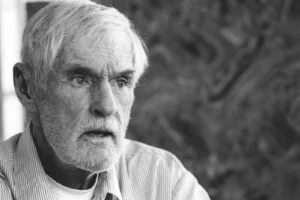
Timothy Leary’s personality typology is the interpersonal circle he built with colleagues in Berkeley and Oakland between 1948 and 1956 and published in Interpersonal Diagnosis of Personality (1957). It maps every way of relating to others on two axes, dominance and love, and reads a person on five levels, from public behavior to private fantasy and ideals. It still underlies interpersonal assessment and therapy today.
Key takeaways
- Timothy Leary built his personality system at Berkeley and the Kaiser Foundation Hospital between 1948 and 1956, years before his Harvard psychedelic work.
- The interpersonal circle places every way of relating on two axes, dominance versus submission and love versus hostility, with adaptive and extreme forms of eight octants.
- Leary read personality on five levels: public behavior, conscious self-description, private fantasy, significant omissions and the ego ideal, and treated gaps between levels as clinically meaningful.
- His principle of reciprocal relations holds that our interpersonal reflexes pull responses from others that confirm the original pattern, which later theorists called complementarity.
- In therapy the circle helps clients see repeating relationship patterns and widen their range of responses, which fits depth, parts-based and somatic work.
Most people know Leary as the Harvard psychologist turned psychedelic evangelist of the 1960s. Fewer know that a decade earlier he was a careful clinical researcher whose model of personality became one of the most durable structures in the field. The circle he helped draw outlived his reputation, and it still has a lot to teach therapists and clients about why the same relationship problems keep coming back.
Who was Timothy Leary before the psychedelic years?
Timothy Francis Leary was born in Springfield, Massachusetts, on 22 October 1920. He drifted through the College of the Holy Cross and the United States Military Academy at West Point before finding psychology at the University of Alabama, served in the army during the Second World War, took a master’s degree at Washington State University and completed a PhD in clinical psychology at the University of California, Berkeley, in 1950.8 Alabama readers sometimes forget that one of the best known psychologists of the twentieth century did his undergraduate work in Tuscaloosa.
His real research home in the early 1950s was the Kaiser Foundation Hospital in Oakland, California, where he became director of psychology research. The project there, funded by the United States Public Health Service from 1950 and later by the Kaiser Foundation itself, studied patients in group psychotherapy and asked a plain question: what are people actually doing to one another when they talk?1 By the time Leary wrote it up, the team had diagnosed more than 5,000 psychiatric patients, medical patients and normal controls with the system.1
Leary did not develop the system alone, and he said so. In the acknowledgments to the 1957 book he credits the basic idea of the interpersonal circle to a 1948 and 1949 working group of Hubert Coffey, Mervin Freedman, Abel Ossorio and himself, and he gives Rolfe LaForge credit for the statistical work and the testing program.1 The group’s first public statement of the model, “The interpersonal dimension of personality,” appeared in the Journal of Personality in 1951.2
Only after this work was finished did Leary move east. In 1959 he joined Harvard’s Center for Research in Personality as a lecturer, not a professor, and within a year he had eaten psilocybin mushrooms in Mexico and started the Harvard Psilocybin Project with the young psychologist Richard Alpert. Harvard dismissed both men in 1963.8 The personality system, in other words, belongs to Leary’s Berkeley and Kaiser years, not to his Harvard period.
Why was Leary’s personality work overshadowed?
The public story of Leary after 1963 is dramatic enough to bury anything. He ran a psychedelic community at Millbrook, New York, coined the slogan “turn on, tune in, drop out,” and was arrested repeatedly on marijuana charges. In 1970 he was sent to the California Men’s Colony at San Luis Obispo. On arrival he was given the psychological tests used to classify inmates, several of them built on the interpersonal research he had helped create, and he answered them so that he looked like a conforming, low-risk prisoner. He was placed in minimum security, and in September 1970 he climbed a fence and escaped with help from the Weather Underground.8
He spent the next years in Algeria, Switzerland and elsewhere before American agents arrested him in Kabul, Afghanistan, in January 1973. Back in prison, he cooperated with the FBI, a decision that cost him friends in the counterculture, and he was released in 1976.8 Rumors that he worked for the CIA have circulated for decades; what the record shows is the FBI cooperation after his recapture. Leary spent his last two decades as a writer, lecturer and futurist, and he died in Los Angeles on 31 May 1996.
With a life like that, it is easy to see why the general reader forgot the 1957 book. The forgetting was never complete inside psychology. The circle was taken up by personality assessment researchers in the 1960s and has been refined ever since. What was lost was the link in public memory between the man on the magazine covers and the clinician who had spent eight years coding group therapy transcripts. Reading Leary’s early work with fresh eyes means restoring that link and seeing how fluid, relational and clinically grounded his picture of personality was.
What influenced Leary’s personality system?
Harry Stack Sullivan and the interpersonal school
The main root of the circle is the interpersonal psychiatry of Harry Stack Sullivan. Sullivan defined personality, in the wording Leary quoted, as the “relatively enduring pattern of recurring interpersonal situations which characterize a human life,” and argued that much of what people do with one another is a set of security operations meant to keep anxiety down.41 Leary’s preface follows Sullivan almost word for word when it says that “the aim of the interpersonal machinery of personality is to ward off anxiety and preserve self-esteem.”1
Leary also named the other socially minded revisers of Freud. He discussed Karen Horney’s neurotic trends, which describe moving toward, against and away from people, and Erich Fromm, who located the cause of neurosis in the family’s way of handing culture to the child.1 Most strikingly, he wrote that his classification “leaned heavily upon the conceptions of Erik H. Erikson” and “bears the unmistakable mark of Erikson’s theory.”1
Carl Jung’s view of neurosis
The circle was not derived from Carl Jung‘s typology, but Jung mattered to Leary in a more interesting way. In a section of the 1957 book titled “Jung’s Emphasis on Adaptive Behavior,” Leary praised the Jungian habit of treating a neurotic pattern as “a partial solution to life’s dilemmas” rather than a fixation, and he called “perhaps the greatest” advantage of the Jungian system “the conception of unconscious motivations as valuable, undiscovered potentials of the self, rather than as destructive impulses.”1
That attitude runs through the whole interpersonal system. In Leary’s scheme every style on the circle has a healthy, adaptive form and a rigid, extreme form. Being blunt or modest or managerial is not a disease; it becomes a problem when it is the only move a person can make. This is a Jungian way of thinking about character, even though the geometry came from Sullivan.
Richard Alpert, Ram Dass and the turn to consciousness
Richard Alpert, who later became the spiritual teacher Ram Dass, was Leary’s closest collaborator at Harvard from 1960. Together they ran the psilocybin research, wrote with Ralph Metzner The Psychedelic Experience (1964), a guide to psychedelic sessions modeled on the Tibetan Book of the Dead, and lived through the Millbrook years.5 Alpert went to India in 1967, met the teacher Neem Karoli Baba, and returned as Ram Dass; his book Be Here Now appeared in 1971.
Alpert had no part in the 1957 circle, which was finished before the two men met. His influence shows instead in the second half of Leary’s career, when Leary moved from mapping interpersonal behavior to mapping states of consciousness. Indian and Tibetan ideas about levels of mind, filtered through W. Y. Evans-Wentz’s translation of the Bardo Thödol, which carried a psychological commentary by Jung, gave that later work its spiritual vocabulary.5 Readers interested in this side of the story will find more in our piece on psychedelic therapy and shamanism.
How does Leary’s system compare with the MBTI and the Enneagram?
The Myers-Briggs Type Indicator
The Myers-Briggs Type Indicator (MBTI), developed by Katharine Cook Briggs and Isabel Briggs Myers from Jung’s Psychological Types (1921), sorts people on four dichotomies: Extraversion or Introversion, Sensing or Intuition, Thinking or Feeling, and Judging or Perceiving. The result is one of sixteen four-letter types. Jungian clinicians who work with typology tend to prefer richer readings of Jung’s functions, such as the Beebe model, to the bare four letters.
Leary’s circle differs in two basic ways. First, it is continuous rather than categorical: a person is a point or a profile somewhere in a circle, not a box. Second, it describes what people do with each other rather than how they take in information or make decisions. An MBTI type tells you something about how a person thinks. A Leary profile tells you what that person tends to pull out of the people around them.
The Enneagram
The Enneagram of personality, developed in its modern form by Oscar Ichazo and Claudio Naranjo in the 1960s and 1970s, describes nine types, each organized around a core fear and desire, with lines of movement between them under stress and growth. It shares with Leary an interest in motivation and in the way a strength becomes a trap. It differs in starting from fixed types and in drawing on spiritual teaching rather than coded observation.
Leary’s model started from data. His team rated what patients said and did in group therapy, collected their self-descriptions, scored their fantasies, and then looked at the patterns. The circle was the shape the data took. That is why it handles mixtures, intensities and conflicts between levels better than a list of types does.
Strengths and limits compared with simpler typologies
The price of that richness is complexity. Leary wrote that his full diagnosis involved “thousands of individual measurements” summarized in sixteen diagnostic circles and a set of variability indices, so that it was “almost impossible that any two patients would ever show exactly the same kind of multilevel profile.”1 The full multilevel method was too elaborate for most clinics, and the MBTI’s four letters spread far more easily in schools and workplaces. The circle itself survived because researchers could keep its geometry and simplify the scoring.
What problem was Leary trying to solve?
The limits of rigid categories
In the early 1950s personality psychology was split between several camps. Trait psychologists such as Gordon Allport catalogued stable dispositions inside the individual. Behaviorists such as B. F. Skinner set inner life aside and studied reinforcement. Psychiatry used diagnostic labels that said little about how a patient would behave toward the next person in the room. Leary thought each of these missed the social core of personality. You can read the wider background in our history of personality psychology.
His alternative was to make the relationship the unit of study. “Everyone tends to make his own interpersonal world,” he wrote in the preface. Neurosis, in his account, is “the limiting of one’s interpersonal apparatus and the compulsive use of certain inflexible, inappropriate interpersonal operations,” while adjustment means having mechanisms “flexible enough to deal with a variety of environmental pressures.”1 Health is range; illness is rigidity.
Capturing the complexity and fluidity of personality
Leary also insisted that any statement about a person is meaningless unless you say which level of behavior it refers to. A man may be domineering in a meeting, describe himself as easygoing, dream of being crushed, and admire saints. All four facts are true. A typology that forces them into one label throws most of the information away. Leary’s system kept them apart, scored each on the same circle, and then measured the gaps between them.1
That is the sense in which the system is fluid. It does not deny that people have stable patterns; Leary’s whole point was that patterns repeat. It denies that a single score captures them, and it treats the tension between what a person does, says, imagines and values as the most clinically useful thing to know.
Personality as a function of interpersonal interaction
At the heart of the system is the idea that personality is largely formed and maintained between people. Each person develops a repertoire of interpersonal strategies shaped by what has reduced anxiety in the past. Those strategies pull particular responses from others, and the responses confirm the original strategy. Kurt Lewin’s formula that behavior is a function of the person and the environment, which you can read about in our piece on Kurt Lewin, points in the same direction, though Leary added that each of us is busy building the very environment we then react to.
What is the interpersonal circumplex?
The interpersonal circumplex is a circle defined by two axes. The vertical axis runs from dominance to submission. The horizontal axis runs from hostility to love, often called affiliation. Leary’s summary scores for these axes were literally abbreviated “Dom” and “Lov.”1 Any interpersonal act or trait can be placed somewhere around the circle according to how much control it expresses and how much warmth.
Leary divided the circle into sixteen segments, lettered A to P, which he grouped into eight octants. Each octant has an adaptive, moderate form and a maladaptive, extreme form; in the 1957 scoring, the extreme types were those more than one standard deviation above the mean.1 In Leary’s own names, moving around the circle:
- Managerial-Autocratic (AP): executive, forceful and managing in its adaptive form; autocratic and power-oriented at the extreme.
- Competitive-Narcissistic (BC): independent and competitive; narcissistic and exploitive at the extreme.
- Aggressive-Sadistic (DE): blunt, frank and critical; aggressive and sadistic at the extreme.
- Rebellious-Distrustful (FG): realistic and skeptical; passively resistant, bitter and distrustful at the extreme.
- Self-effacing-Masochistic (HI): modest and sensitive; passive, submissive and self-punishing at the extreme.
- Docile-Dependent (JK): respectful and trustful; docile and clinging at the extreme.
- Cooperative-Overconventional (LM): cooperative and agreeable; overconventional and approval-seeking at the extreme.
- Responsible-Hypernormal (NO): responsible and generous; overgenerous and hypernormal at the extreme.
Later writers often relabel the octants in plainer terms: dominant, dominant-friendly, friendly, friendly-submissive, submissive, submissive-hostile, hostile and hostile-dominant. The underlying geometry is the same. Styles next to each other on the circle resemble each other, styles opposite each other are psychological opposites, and the distance from the center shows how intense and inflexible a style is.12
Leary’s own data showed that this was more than a metaphor. In the appendix to the 1957 book, the correlations between check-list scales fall off as the scales get farther apart around the circle, which is exactly what a true circular structure predicts.1 Wiggins later gave this the name circumplex and tested it far more rigorously, but the pattern is already in Leary’s tables.
What are Leary’s five levels of personality?
Leary’s second major idea was that personality data come from different sources and must be kept on separate levels. He defined the levels by the operations that produce the data, so that the source of an observation decides its level.1 In the book’s own terms the five levels are:
- Level I, Public Communication. What a person actually does to others, as rated by observers or fellow group members. Leary called this behavior the interpersonal reflex and stressed that it is often involuntary: “Level I is what the subject does. Level II is what he says he does.”1 Symptom patterns on the MMPI were also scored here.
- Level II, Conscious Description. How people describe themselves and the important people in their lives, mainly on the Interpersonal Check List. Leary had patients describe self, mother, father, spouse and therapist, which let him compare a person’s picture of self with the picture of others.
- Level III, Private Symbolization. The interpersonal themes in dreams, fantasies, artistic productions and projective tests, above all the Thematic Apperception Test. Leary sometimes called this the “preconscious” level.
- Level IV, the Unexpressed Unconscious. Not a hidden layer that can be measured directly but a pattern of significant omissions: themes that a person consistently fails to express at any other level. A patient whose stories, self-descriptions and behavior never contain any rebellion has, at Level IV, a rigid avoidance of rebelliousness.
- Level V, Values. The ego ideal: the interpersonal traits and actions a person holds to be good and right, “his picture of how he should be and would like to be.”1 This is moral and interpersonal, not a general philosophy of life, and it was measured by having patients check the Interpersonal Check List for their ideal self.
The real power of the levels lies in the comparisons between them. Leary built “indices of variability” that measured conflict between levels, and he noted that some of them work like the traditional defense mechanisms. A person who is docile in behavior and powerful in fantasy has a conflict between power and weakness; a person who presents strength publicly but describes the self as weak shows a facade.1 Leary even diagnosed James Thurber’s daydreamer Walter Mitty to show how a meek Level I and a heroic Level III fit together. These are depth-psychological ideas such as repression, idealization and identification, turned into numbers that could be compared across patients. Level IV in particular will remind Jungian readers of the shadow: what never appears is as telling as what does.
What are interpersonal reflexes and complementarity?
The interpersonal reflex
For Leary, an interpersonal reflex is the automatic, usually unexamined way a person acts on others. It is called a reflex because it happens faster than reflection and is often outside awareness. The key claim is that these reflexes are purposeful even when they are painful: each one trains other people to respond in a way that keeps the person’s anxiety at a familiar, manageable level.1
The principle of reciprocal interpersonal relations
Leary’s illustration is memorable. If you walk up to a stranger and shove him, he will probably shove you back. A few people will placate you and a rare one will embrace you, but most will mirror the aggression, and their response then confirms your sense that the world is hostile.1 He called this the principle of reciprocal interpersonal relations: our actions pull reciprocal responses, and the responses strengthen the original action. He described how relationships settle into stable, interlocking pairs, with self-effacing people drawn to exploitive partners and dependent people seeking nurturing authorities.
Later interpersonal theorists made the rule precise and named it complementarity. Robert Carson in 1969 and Donald Kiesler in 1983 proposed that interpersonal acts invite similarity on the affiliation axis and reciprocity on the control axis: warmth invites warmth and hostility invites hostility, while dominance invites submission and submission invites dominance.913 Kiesler mapped this onto a revised 1982 circle and showed how a therapist can be pulled into complementary responses that keep a client’s pattern going.
The principle of self-determination
Leary drew a hard but freeing conclusion. If our reflexes help create the reactions we get, then we carry part of the responsibility for our own interpersonal world. He called this “a terrible power” that many patients do not want to accept, because it takes away the comfort of blaming others, but he also called it “a priceless, but often unwelcome gift of personal power.”1 At the same time he warned against blaming the patient: in any relationship “both partners share the responsibility for its development,” and the mother and child, for instance, are “engaged in a most intricate reciprocal process.”1
Flexibility and rigidity
Because every octant has an adaptive and an extreme form, the circle measures flexibility as well as style. A flexible person can be firm in one setting, yielding in another and warm in a third. A rigid person uses a narrow band of the circle regardless of context, and that narrowness, not the style itself, is what Leary called maladjustment.1 Assessing range is therefore as important as finding a person’s center of gravity.
Situational factors
Leary knew that roles shape behavior. He noted that institutional relationships such as boss and secretary, prisoner and guard, or student and teacher are more stereotyped than friendships, yet still leave room for variation: some secretaries mother, nag or even boss their nominal superiors.1 Culture, social norms and the particular partner all move the point on the circle. Personality, in this view, shows up as the pattern that persists across settings and the way a person bends, or fails to bend, when the setting changes.
How was Leary’s system measured?
The central instrument of Leary’s program was the Interpersonal Check List (ICL), developed with LaForge and Robert Suczek and published in 1955. In the form Leary used it contains 128 adjectives and phrases, eight for each of the sixteen segments, calibrated in four degrees of intensity from mild to extreme, such as “can be obedient,” “easily led,” “obeys too willingly” and “spineless” in the self-effacing octant.31 The same list could be filled out by a patient about the self, about family members, about the ideal self, or by observers and fellow patients about the patient, which is what let one vocabulary cover several levels.
Leary’s team also scored the Minnesota Multiphasic Personality Inventory for interpersonal meaning at Level I, rated live group therapy interactions, and scored Thematic Apperception Test stories for Level III themes.1 The output was a multilevel profile, written up in an “interpersonal diagnostic report” by trained technicians.
Two instruments often attributed to Leary came from his successors. The Interpersonal Adjective Scales were developed by Jerry Wiggins, beginning with his 1979 taxonomy of interpersonal trait words, to measure the circle with better psychometric properties.12 The Interpersonal Behavior Inventory was developed by Maurice Lorr and Douglas McNair, who extended the circle in the 1960s with their own rating scales.10 Both instruments belong to the line Leary started, and both are used in the ways the original instruments were: self-report, observer rating and comparison of the two.
How do you apply Leary’s model step by step?
Whether the setting is a therapy room, a consulting engagement or a person’s own reflection, Leary’s framework can be used as a sequence of steps. The steps below follow the logic of the 1957 method, simplified for practical use.
Step 1: Learn the interpersonal circle
Start with the two axes, dominance against submission and love against hostility, and the eight octants they produce. Learn both forms of each octant. The goal is to see, for example, that “responsible” and “hypernormal” are the same move at different intensities, and that the opposite of competitive is not lazy but self-effacing.
Step 2: Assess interpersonal style from more than one angle
Collect a self-description and, where possible, a description by others. In Leary’s day that meant the ICL filled out by the patient and by observers; today a clinician might use Wiggins’s Interpersonal Adjective Scales, Lorr and McNair’s inventory, or the Inventory of Interpersonal Problems.14 Ask about specific relationships, because people behave differently with a boss, a partner and a parent, and gather information from more than one context.
Step 3: Identify patterns and complementarity
Look for what the person’s style pulls from others. A person who constantly defers will tend to be surrounded by people who decide; a person who is chronically critical will tend to meet coldness and then feel confirmed. Naming these loops helps people see that the painful responses they receive are partly invited, which is the first step toward changing them.
Step 4: Explore the five levels
Compare what the person does with what they say they do, what shows up in their dreams and fantasies, what never shows up at all, and what they believe they ought to be. The gaps are where the work lies. A self-described easygoing person who is experienced by everyone else as controlling has a Level I and Level II discrepancy worth exploring with curiosity rather than accusation.
Step 5: Consider situation and flexibility
Ask where the pattern is strongest and where it relaxes. Notice the social norms, family roles and cultural expectations that shape it. Map the person’s range: which octants they can occupy comfortably, which they can reach under pressure, and which they never enter.
Step 6: Develop interventions for growth
In therapy, the aim is not to move a person to a different octant but to widen their range, so that a habitually submissive person can sometimes say no and a habitually dominant person can sometimes follow. This involves noticing the reflex as it happens, understanding the anxiety it guards against, and practicing new responses in a safe relationship. In organizations, the same map can inform team building, leadership development and conflict resolution, by showing how a manager’s style pulls certain behaviors from a team.
Step 7: Monitor progress and adapt
Reassess over time. Leary’s own book describes measuring change in behavior across psychotherapy.1 If the person’s profile becomes less extreme, their range wider, and the gaps between levels smaller, the work is moving in the right direction.
Mapping interpersonal patterns and their meaning
Throughout these steps, the patterns being mapped are not surface habits. Leary saw them as security operations: the ways each person has learned to keep anxiety bearable and self-esteem intact.1 Understanding a pattern therefore means understanding the need it serves, which is why the circle fits so naturally with depth psychology.
Did Leary combine depth psychology with empirical science?
Emotion and cognition inside the interpersonal frame
Leary’s circle is often described as purely behavioral, but the five levels carry emotion and thought into it. Level II is a person’s conscious appraisal of self and others. Level III captures the emotional themes of fantasy, such as rage, longing, fear and triumph. Level V captures moral judgment. The variability indices then show how these feeling-laden and thought-laden levels agree or clash with behavior. Emotion and cognition are not added as separate dimensions; they are read through their interpersonal content.
Grounding the system in data
Leary was committed to measurement. The book’s preface stresses “the objectivity and clarity of the empirical procedures it sets forth for multilevel diagnosis,” and its later chapters report the profiles of ten clinical and control samples, including normal controls, ulcer patients, hypertensive patients, obese women and dermatitis patients, together with norms and conversion tables.1 The second and third Kaiser papers tested ideas such as repression objectively and published the check list for others to use.3
Combining depth psychology and empirical science
What makes the 1957 book unusual is that it measured psychoanalytic ideas rather than discarding them. Repression became a measurable omission; idealization, a gap between self and ideal; the facade, a difference between levels; transference, the reflex a patient was likely to pull from the therapist. Leary even described using the total profile to predict “the transference phenomenon” a patient would tend to elicit in psychotherapy.1 It was an attempt to keep the inner world that Freud, Jung and Sullivan described while giving it the discipline of systematic observation.
Which Leary books matter for personality?
Interpersonal Diagnosis of Personality (1957)
Published by the Ronald Press in New York, the book is subtitled A Functional Theory and Methodology for Personality Evaluation. It sets out the interpersonal circle, the five levels, the variability indices and the full diagnostic system, and applies them to clinical samples and to practical settings such as group psychotherapy and industrial management.1 For anyone interested in Leary as a psychologist, this is the essential text.
The Psychedelic Experience (1964)
Written with Ralph Metzner and Richard Alpert, this short manual adapts the Tibetan Book of the Dead into a guide for psychedelic sessions. It is the clearest early statement of the importance of what came to be called set and setting, the idea that a person’s expectations and surroundings shape what a drug experience becomes.5
The Politics of Ecstasy (1968)
This collection of essays and interviews from the 1960s argues that psychedelic experiences can loosen the learned games of social life and open access to hidden aspects of the self.6 It is not a work of personality typology, but it shows how Leary’s earlier interest in rigid interpersonal roles turned into an interest in the games, as he now called them, that culture imposes on consciousness.
Neurologic (1973)
Neurologic is a short pamphlet Leary wrote in prison and published with his wife Joanna Leary in 1973.7 It is not a study of brain anatomy or genetics. It sketches a model in which the nervous system develops through successive stages, each “imprinted” at a sensitive period, which Leary developed into his eight-circuit model of consciousness, set out fully in Exo-Psychology (1977) and later books. The first four circuits concern survival, emotional territory and status, symbolic thought, and social and sexual roles; the last four describe states reached through body awareness, meditation or psychedelics. Like John C. Lilly, who described the brain as a programmable biocomputer, Leary was trying to describe how imprinted programs could be revised.
The continuity with 1957 is real. The second circuit, concerned with dominance and submission, and the fourth, concerned with social roles, restate parts of the interpersonal circle in a developmental language. The later work is speculative, but it carries the same conviction that personality is learned and can be relearned.
What is the legacy of the Leary circle?
Challenging traditional paradigms
Leary’s system helped move personality psychology away from the idea that personality is a set of fixed internal properties, and toward a view of the person in relationship. It offered a common language for behavior, self-image, fantasy and ideals, and it showed that psychoanalytic concepts could be measured without being flattened. Robert Carson’s Interaction Concepts of Personality (1969) built a full interpersonal theory on that foundation.9
Inspiring further research
Leary’s circle did not reach the popular audience of the MBTI or the Enneagram, but in research it became one of the most influential models of the century. Lorr and McNair expanded it in the 1960s.10 Lorna Smith Benjamin’s Structural Analysis of Social Behavior, published in 1974, added a dimension for focus on self versus focus on the other and became the basis of her Interpersonal Reconstructive Therapy.11 Wiggins’s 1979 work gave the circle its modern psychometric form.12 Kiesler’s 1982 circle refined complementarity.13 Leonard Horowitz and colleagues built the Inventory of Interpersonal Problems on the same structure in 1988, giving clinicians a way to measure the problems clients bring rather than only their traits.14
The circle also connects to the dominant trait model of today. Robert McCrae and Paul Costa showed in 1989 that Wiggins’s circumplex sits largely within the plane of two of the Big Five factors, extraversion and agreeableness, rotated slightly.15 Researchers have also used the circle to describe personality disorders, and readers familiar with Theodore Millon‘s portraits of personality styles will recognize many of the same figures.
The limits critics raise
The criticisms usually made of the system are the ones Leary anticipated. The full multilevel method is complex and was hard to use outside a research clinic. Any model with two axes leaves out parts of personality, such as conscientiousness or openness to experience, and people are shaped by culture, history and circumstance as well as by interpersonal style. Later researchers answered the first point by simplifying the scoring and the second by placing the circle alongside other models rather than asking it to explain everything.
How can therapists use Leary’s model today?
Personality as interaction in the therapy room
The most direct heir of Leary’s work in practice is the idea that the therapy relationship itself is a place where a client’s interpersonal reflexes show up and can be changed. Kiesler argued that a client’s style pulls a complementary response from the therapist, and that the therapist’s job is to notice the pull and respond in a way that does not confirm the old pattern.13 Clinicians trained in interpersonal process work, described in our piece on Teyber’s interpersonal process in therapy, use the same idea every day.
In practice, this means paying attention to what a client does in the room, not only what they report. A client who apologizes for every pause, a client who corrects every reflection, a client who keeps the conversation light whenever something painful comes close: each is showing a Level I reflex that probably appears in other relationships. The therapist can name it gently, explore what anxiety it manages, and offer a different kind of response.
Leary’s levels add depth. A client who presents as confident but whose dreams are full of being chased, or who describes the self as caring while consistently omitting any anger, is showing exactly the kind of discrepancy that depth-oriented therapy works with. For clients who keep finding themselves in the same kind of relationship, with the same kind of partner or boss, the circle offers a clear, non-shaming map of how the pattern is maintained and what range of responses might be possible.
How this connects to the work at Taproot
At Taproot we see interpersonal reflexes as protective strategies that were once necessary. In Jungian therapy we look at what a rigid style keeps out of awareness, much as Leary’s Level IV looked at what never appears. In parts work, a habitual reflex of placating or controlling can often be understood as a protective part with its own history and fears. And because these reflexes live in the body, in posture, breath, voice and the speed of a response, somatic and brain-based methods such as Brainspotting can reach the anxiety the reflex was built to manage, which often allows a person’s range to widen without forcing it.
Beyond the therapy room
The same map is useful in organizations. Consultants use interpersonal circle measures to help teams understand how a leader’s style shapes the behavior of others, why some pairings work and others repeatedly clash, and how to make room for different styles. Used with care, it can make workplaces more open to honest dialogue, because it describes patterns without labeling people as good or bad.
Leary’s early insight was that personality shows itself in what people do to one another, and that much of our suffering comes from the narrowness of our moves. Therapy that widens a person’s range, and helps them feel safe enough to try a new response, is still the most direct use of his circle. If a familiar pattern keeps repeating in your own relationships, you can contact Taproot Therapy Collective to talk with one of our therapists.
Frequently asked questions
What is the Leary circle?
The Leary circle, or interpersonal circumplex, is a model of interpersonal behavior that Timothy Leary and colleagues at the Kaiser Foundation Hospital published in 1957. It arranges behaviors around two axes, dominance versus submission and love versus hostility, divided into sixteen segments and eight octants, each with a healthy, moderate form and a rigid, extreme form.
What are the five levels in Timothy Leary’s personality theory?
Leary described five levels of personality data: Level I, public communication, or what a person does as others see it; Level II, conscious description of self and others; Level III, private symbolization in dreams, fantasy and projective tests; Level IV, the unexpressed unconscious, meaning themes a person consistently omits; and Level V, values, or the ego ideal.
Did Timothy Leary create the interpersonal circle at Harvard?
No. Leary developed the interpersonal circle with Hubert Coffey, Mervin Freedman, Abel Ossorio and Rolfe LaForge in Berkeley and Oakland from 1948 onward, and published it in Interpersonal Diagnosis of Personality in 1957. He joined Harvard as a lecturer in 1959, and his psychedelic research there came after the personality work.
What is complementarity in interpersonal theory?
Complementarity is the tendency of one person’s interpersonal behavior to invite a matching response from another. Leary called it the principle of reciprocal interpersonal relations. Carson and Kiesler later specified that warmth invites warmth and hostility invites hostility, while dominance invites submission and submission invites dominance, which keeps relationship patterns stable.
How is Leary’s interpersonal model different from the Myers-Briggs?
The Myers-Briggs Type Indicator sorts people into sixteen categorical types based on Jung’s psychological functions, describing how they perceive and decide. Leary’s interpersonal model is continuous and relational: it locates behavior on a circle of dominance and warmth, compares behavior, self-image, fantasy and ideals, and describes what a person tends to pull from others.
How do therapists use the interpersonal circumplex?
Therapists use the interpersonal circumplex to identify a client’s habitual way of relating, notice the responses that style pulls from others, including from the therapist, and help the client widen a narrow range. Measures such as the Inventory of Interpersonal Problems, built on the same circle, help track which relationship problems change over the course of therapy.
Related reading
- Medard Boss and Daseinsanalysis
- The Evolutionary Origins of Religion: Why is Mankind Religious?
- Hierarchies in Psychology: Maslow, Erikson, Kohlberg, Kegan, Jung and What Survives the Evidence
- The Unfinished Legacy of Alfred Adler: Revisioning Psychology for Social Transformation
- The Existential Psychology of Viktor Frankl:
- Viktor Frankl: Finding Meaning in the Face of Suffering
References
- Leary, T. (1957). Interpersonal diagnosis of personality: A functional theory and methodology for personality evaluation. Ronald Press.
- Freedman, M. B., Leary, T. F., Ossorio, A. G., & Coffey, H. S. (1951). The interpersonal dimension of personality. Journal of Personality, 20(2), 143–161. https://doi.org/10.1111/j.1467-6494.1951.tb01518.x
- LaForge, R., & Suczek, R. F. (1955). The interpersonal dimension of personality: III. An interpersonal check list. Journal of Personality, 24(1), 94–112. https://doi.org/10.1111/j.1467-6494.1955.tb01177.x
- Sullivan, H. S. (1953). The interpersonal theory of psychiatry. W. W. Norton.
- Leary, T., Metzner, R., & Alpert, R. (1964). The psychedelic experience: A manual based on the Tibetan Book of the Dead. University Books.
- Leary, T. (1968). The politics of ecstasy. G. P. Putnam’s Sons.
- Leary, T. (1973). Neurologic. Joanna Leary.
- Greenfield, R. (2006). Timothy Leary: A biography. Harcourt.
- Carson, R. C. (1969). Interaction concepts of personality. Aldine.
- Lorr, M., & McNair, D. M. (1965). Expansion of the interpersonal behavior circle. Journal of Personality and Social Psychology, 2(6), 823–830. https://doi.org/10.1037/h0022709
- Benjamin, L. S. (1974). Structural analysis of social behavior. Psychological Review, 81(5), 392–425. https://doi.org/10.1037/h0037024
- Wiggins, J. S. (1979). A psychological taxonomy of trait-descriptive terms: The interpersonal domain. Journal of Personality and Social Psychology, 37(3), 395–412. https://doi.org/10.1037/0022-3514.37.3.395
- Kiesler, D. J. (1983). The 1982 interpersonal circle: A taxonomy for complementarity in human transactions. Psychological Review, 90(3), 185–214. https://doi.org/10.1037/0033-295x.90.3.185
- Horowitz, L. M., Rosenberg, S. E., Baer, B. A., Ureño, G., & Villaseñor, V. S. (1988). Inventory of interpersonal problems: Psychometric properties and clinical applications. Journal of Consulting and Clinical Psychology, 56(6), 885–892. https://doi.org/10.1037/0022-006x.56.6.885
- McCrae, R. R., & Costa, P. T., Jr. (1989). The structure of interpersonal traits: Wiggins’s circumplex and the five-factor model. Journal of Personality and Social Psychology, 56(4), 586–595. https://doi.org/10.1037/0022-3514.56.4.586













0 Comments