
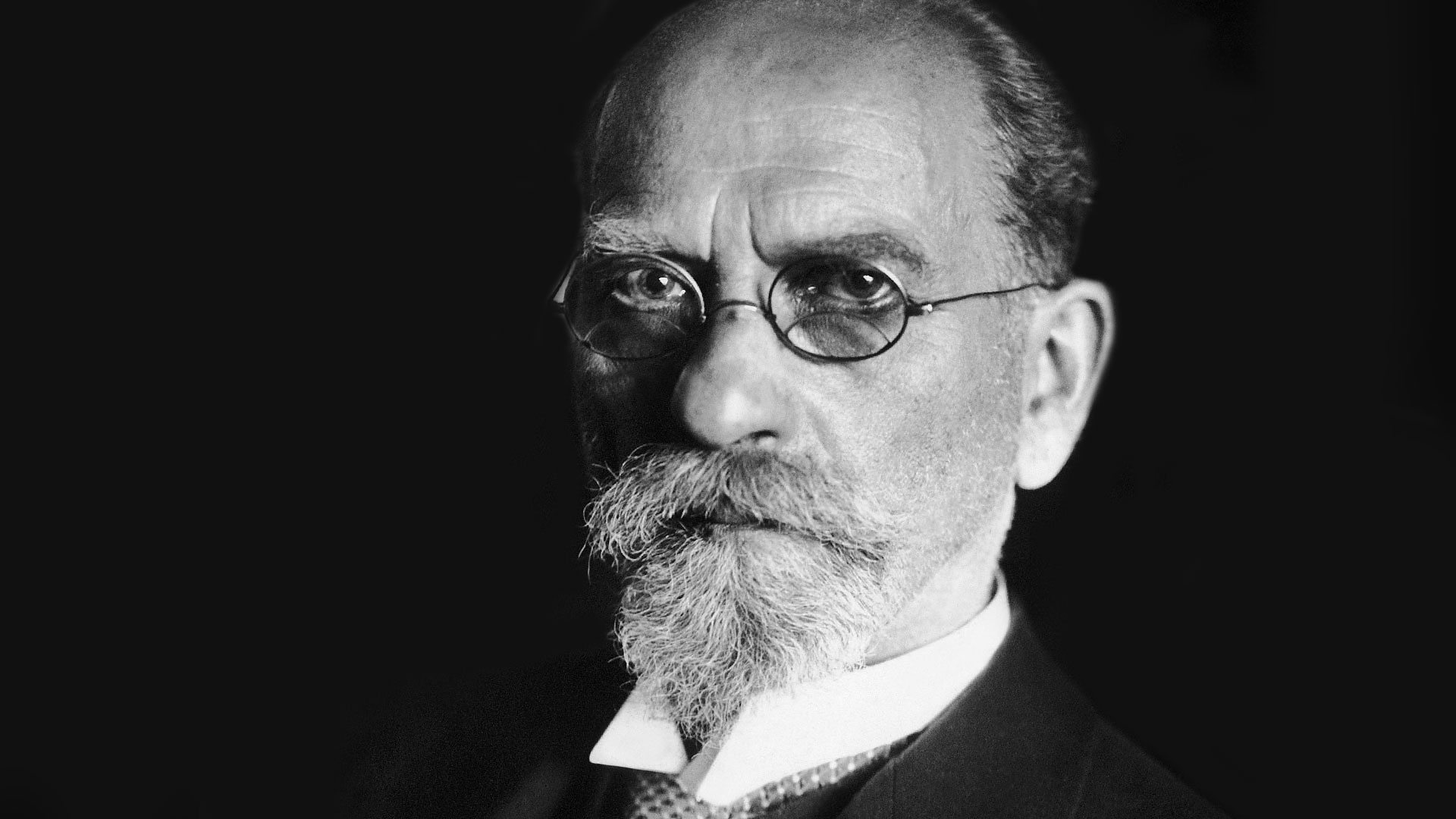
Edmund Husserl: The Mathematician of the Soul and the Father of Phenomenology
In the fragmented landscape of modern psychology, where practitioners often pledge loyalty to specific schools—CBT, Psychoanalysis, Somatic—there is one figure who provides the bedrock for them all, yet remains largely unknown to the average clinician: Edmund Husserl (1859–1938). While Sigmund Freud was descending into the murky depths of the unconscious, Husserl was climbing the mountain of the conscious mind, seeking a view of absolute clarity.
Husserl is the father of Phenomenology, a philosophical movement that arguably had the greatest impact on 20th-century continental philosophy and, subsequently, depth psychology. His radical call to return “to the things themselves” (Zu den Sachen selbst) challenged the dry, abstract sciences of his day. He argued that before we can understand the brain, biology, or society, we must first understand the lens through which we see them all: human consciousness itself. For the psychotherapist, Husserl is indispensable. He provides the toolbox for understanding how a client experiences their world, rather than just explaining why they are broken.
I. Biography: From Numbers to Nuance
The Mathematician’s Quest
Edmund Husserl was born in 1859 in Prossnitz, Moravia, into a secular Jewish family. His intellectual journey did not begin with the messy world of human emotion, but with the rigid purity of mathematics. He earned his Ph.D. in 1883 under the legendary mathematician Karl Weierstrass. This background is critical: Husserl never abandoned the desire for “absolute certainty.” He wanted to find a foundation for philosophy that was as solid as the laws of arithmetic.
His pivot to philosophy came after attending lectures by Franz Brentano in Vienna. Brentano introduced him to the concept of Intentionality—the idea that the mind is not a passive mirror of reality, but an active arrow pointing at reality. This was the spark. Husserl realized that psychology shouldn’t just be about biological reflexes; it had to account for the meaning of experience. He spent the rest of his life refining this insight, seeking a “science of the soul” that was as rigorous as physics but as deep as poetry.
The Shadow of the Third Reich
Husserl’s later years were marked by the tragedy of European history. Despite being a converted Lutheran and a German patriot, he was classified as Jewish by the rising Nazi regime. In 1933, he was suspended from the University of Freiburg and systematically erased from the academic community he helped build. The betrayal was personal: his most famous student, Martin Heidegger, joined the Nazi party and removed the dedication to Husserl from his masterpiece, Being and Time.
While Heidegger collaborated with the regime, Husserl worked in isolation, famously describing his task as “fighting for the meaning of humanity” against the barbarism of the times. He died in 1938. His manuscripts, numbering over 40,000 pages of shorthand, were smuggled out of Nazi Germany to Belgium by a Franciscan friar, Herman Van Breda, narrowly saving the phenomenological movement from destruction. This act preserved the intellectual lineage that would later influence Jean-Paul Sartre and the French Existentialists.
II. The War on Psychologism
To understand Husserl’s contribution, one must understand his enemy: Psychologism. In the late 19th century, many thinkers believed that logic and mathematics were just biological byproducts of the human brain. They argued that “2+2=4” is true only because the human species has evolved to think that way.
Husserl found this idea catastrophic. In his breakthrough work, Logical Investigations (1900), he argued that if logic is just a biological habit, then there is no such thing as objective truth—only “species truth.” If aliens evolved differently, would 2+2=5? Husserl said no. He asserted that logic is ideal and objective. By separating Logic (eternal truths) from Psychology (the empirical study of the brain), he paradoxically cleared the way for a pure psychology. He argued that we shouldn’t study the brain as a meat-machine; we should study the structure of experience itself.
III. A Phenomenological Dictionary for Therapists
Husserl developed a specific vocabulary to describe the workings of the mind. These concepts are the bedrock of modern phenomenological therapy and are essential for any clinician wishing to practice Existential Psychotherapy.
1. The Natural Attitude (Die natürliche Einstellung)
This is our default state of being. In the Natural Attitude, we assume the world exists exactly as we see it, independent of us. We are busy dealing with things—paying bills, driving cars—without noticing how those things are appearing to us.
Therapeutic Relevance: Clients usually enter therapy in the Natural Attitude regarding their problems (“I am a depressed person”). The therapist’s job is to shake them out of this default assumption and help them see their depression as a mode of experience rather than a fixed object.
2. Epoché (The Reduction)
Derived from the Greek word for “cessation,” the Epoché is the act of suspending judgment. We do not deny the world exists; we simply “bracket” the question of its reality to focus on how it appears.
Therapeutic Relevance: When a therapist listens to a client’s delusion or distorted belief without judging it as “true” or “false,” but simply exploring the texture of the experience, they are practicing the Epoché. This allows for deep empathy and validation.
3. Intentionality
Consciousness is always consciousness of something. There is no “thinking” without a thought; no “loving” without a beloved. The mind is relational by nature; it is an arrow shot at the world.
Therapeutic Relevance: We don’t treat “anger” in the abstract; we treat the client’s anger at their father or about their job. Understanding the intentional object is key to releasing the emotion.
4. Noesis and Noema
This describes the structure of Intentionality.
* Noesis: The act of perceiving (e.g., the act of looking, remembering, or fearing).
* Noema: The object as perceived (e.g., the perceived tree, the remembered mother).
Therapeutic Relevance: A trauma survivor has a fixed Noema of “Danger.” The therapist works on the Noesis (the act of perceiving) to make the world feel safe again. This distinction is vital in trauma conceptualization.
5. The Lifeworld (Lebenswelt)
Introduced in his final work, The Crisis of European Sciences, the Lifeworld is the pre-scientific world of everyday experience—the world of sunsets, headaches, and grief—before science explains it away as “photons” or “serotonin.” Husserl argued that science had lost its way by forgetting the Lifeworld.
Therapeutic Relevance: Psychiatry often treats the brain (science), but therapy must treat the Lifeworld (experience). This concept deeply influenced Maurice Merleau-Ponty and the development of somatic psychology.
6. Time-Consciousness
Husserl analyzed how we experience time not as a series of ticking seconds, but as a flow (flux). Every “now” moment contains a retention (a tail of the just-past) and a protention (an anticipation of the just-coming).
Therapeutic Relevance: Trauma is essentially a disruption of time-consciousness. The retention of the trauma is so strong that it overlays the present “now,” making the future (protention) look like the past. Therapies like Brainspotting help re-regulate this temporal flow.
IV. Husserl’s Legacy in Modern Therapy
Husserl never practiced therapy, but his fingerprints are on every modern modality that values the client’s perspective.
- Gestalt Therapy: Fritz Perls adapted Husserl’s focus on the “Here and Now” and the structure of awareness. The famous “empty chair” technique is a way of externalizing the Noema.
- Existential Therapy: Thinkers like Irvin Yalom and Rollo May built their practice on the phenomenological investigation of the “Givens of Existence.”
- Cognitive Behavioral Therapy (CBT): While often uncredited, Husserl’s insight that we structure our own reality anticipated the cognitive revolution. The idea that “thoughts create feelings” is a simplified version of Noesis creating Noema.
- Somatic Psychology: Through his influence on Merleau-Ponty, Husserl paved the way for understanding the body not as an object, but as the zero-point of orientation in the world.
V. Conclusion: The Ethical Imperative
In an age of fMRI scans and genetic testing, Husserl reminds us that the map is not the territory. You can map the neurons of a grieving mother, but you cannot find her grief in the cells. Grief exists in the Lifeworld. Husserl’s legacy is the demand that science remains human. He calls on therapists to be “mathematicians of the soul”—rigorous in their method, but infinite in their empathy.
Bibliography
- Husserl, E. (1900/2001). Logical Investigations (J. N. Findlay, Trans.). Routledge.
- Husserl, E. (1913/1983). Ideas Pertaining to a Pure Phenomenology and to a Phenomenological Philosophy (F. Kersten, Trans.). Martinus Nijhoff.
- Husserl, E. (1931/1960). Cartesian Meditations: An Introduction to Phenomenology (D. Cairns, Trans.). Martinus Nijhoff.
- Husserl, E. (1936/1970). The Crisis of European Sciences and Transcendental Phenomenology (D. Carr, Trans.). Northwestern University Press.
- Moran, D. (2000). Introduction to Phenomenology. Routledge.
- Zahavi, D. (2003). Husserl’s Phenomenology. Stanford University Press.









0 Comments