
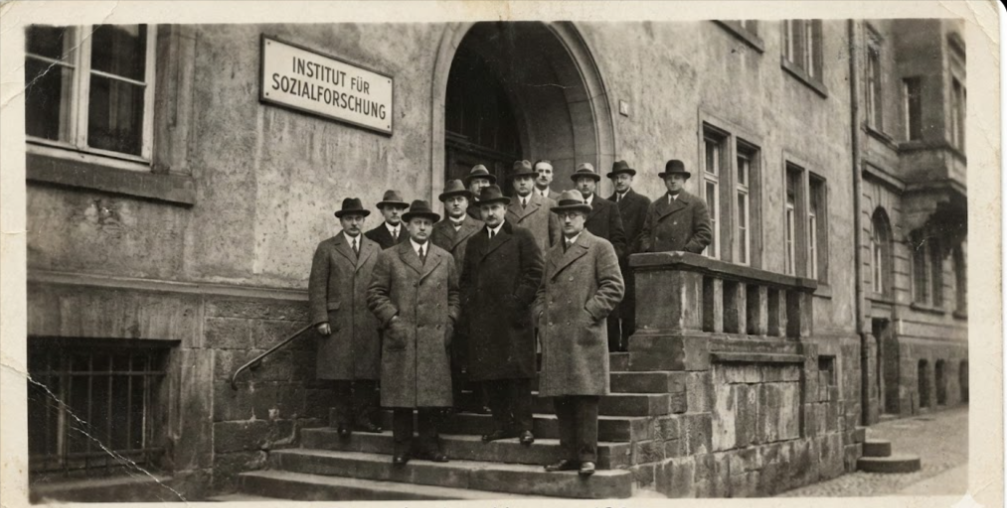
The Frankfurt School and the Architecture of Modern Trauma: Critical Theory’s Influence on Psychotherapy, Culture, and the Built Environment
How a group of exiled German-Jewish intellectuals transformed our understanding of psychology, society, and the spaces we inhabit
The Caesura of the Twentieth Century
The intellectual landscape of the twentieth century was forged in the crucible of unprecedented historical rupture. The Great War had shattered the illusion of continuous progress; the rise of fascism demonstrated that “civilization” could produce its own negation; and the Holocaust revealed that modernity’s most “advanced” nation was capable of industrialized murder on an unimaginable scale. Within this context, a specific constellation of thinkers, principally associated with the Institute for Social Research in Frankfurt, sought to articulate the nature of a world that had seemingly lost the capacity to communicate experience or preserve the meaning of reality itself.
What came to be known as the Frankfurt School was never a “school” in the traditional sense. It had no unified doctrine, no catechism, no agreed-upon methodology. What bound its members together was a shared project: the synthesis of Marxist social theory with Freudian psychoanalysis, pursued in the shadow of catastrophe. Their influence on psychotherapy has been both direct, through Erich Fromm’s clinical institutes and Theodor Adorno’s studies of the authoritarian personality, and indirect, shaping our very conceptualization of trauma, alienation, and the relationship between individual suffering and social structure. Their critique of the “culture industry” anticipated our current understanding of how mass media shapes consciousness, and their analysis of “instrumental rationality” diagnosed a pathology that continues to afflict modern healthcare, education, and governance.
This essay examines the profound influence of Frankfurt School thinkers on psychotherapy, their direct and unstated relevance to contemporary trauma theory, and their transformative impact on the arts and architecture. We will trace their ideas from the seminar rooms of Weimar Germany through the exile corridors of American universities to the urban planning debates of the present day. Central to this analysis is the exploration of their macro-conceptualizations of trauma, including the diagnosis that modern industrial society produces “wars and movies” as interchangeable spectacles, and the enduring relevance of these theories to contemporary societal trauma and trauma-informed care.
Philosophical Foundations: Hegel, Marx, Freud, and Heidegger
The Frankfurt School drew on a complex genealogy of influences that shaped their distinctive approach to psychology and society. Georg Wilhelm Friedrich Hegel’s dialectical method provided the philosophical scaffolding, his insight that consciousness develops through contradiction and negation, that what appears stable and self-evident is in fact the product of historical struggle. But where Hegel saw the dialectic culminating in reconciliation and the realization of Spirit, the Frankfurt thinkers found only “negative dialectics,” contradictions that refused resolution, wounds that would not heal.
Karl Marx’s critique of political economy provided the analysis of how material conditions shape consciousness, how the economic base determines the cultural superstructure. Yet the failure of revolutionary movements in Western Europe, the persistence of capitalism despite its contradictions, and the rise of fascism in Germany forced a rethinking of Marx’s predictions. If the working class was supposed to be the agent of historical transformation, why did German workers vote for Hitler? The answer could not be found in economics alone. Something was happening at the level of psychology, of subjectivity, of what Fromm would call “social character,” that traditional Marxism had ignored.
Sigmund Freud’s psychoanalysis provided the missing element: a theory of how social structures become internalized, how external domination becomes self-domination, how individuals come to desire their own subjugation. The Freudian concepts of repression, the unconscious, the superego as internalized authority, and the death drive offered tools for understanding why people would accept, even embrace, systems that harmed them. The Institute’s project was to historicize Freud, to show that the psychic structures he described were not timeless biological givens but products of specific social arrangements that could, in principle, be changed.
Martin Heidegger’s influence on the Frankfurt School was more ambivalent and more troubling. Herbert Marcuse had studied with Heidegger at Freiburg in the late 1920s, and his early work attempted to synthesize Heideggerian phenomenology with Marxist social theory. Heidegger’s analysis of “Being-in-the-world,” his critique of technological “enframing” (Gestell), and his concept of “authenticity” versus “das Man” (the anonymous “they” of everyday conformity) resonated with the Frankfurt School’s diagnosis of modern alienation. Adorno’s critique of “identity thinking,” the reduction of particulars to general concepts that suppresses their non-identical remainder, owes something to Heidegger’s analysis of how metaphysical categories occlude the question of Being.
Yet Heidegger’s embrace of National Socialism in 1933, his assumption of the rectorship at Freiburg under Nazi auspices, cast a permanent shadow over this inheritance. The Frankfurt thinkers were forced to ask whether Heidegger’s philosophy contained something that led toward fascism, whether his critique of modernity was itself a symptom of the very pathology it claimed to diagnose. Adorno’s The Jargon of Authenticity subjected Heideggerian language to withering critique, arguing that its appeals to “rootedness,” “homeland,” and “dwelling” mystified social relations and prepared the ground for blood-and-soil ideology. Yet the influence persisted, transformed and contested, in the Frankfurt School’s own analysis of technology, alienation, and the administered world.
Other influences shaped specific thinkers. Max Weber’s analysis of rationalization, the “iron cage” of bureaucratic modernity, informed Horkheimer and Adorno’s concept of “instrumental reason.” Georg Lukács’s theory of “reification,” how social relations come to appear as thing-like and immutable, shaped Adorno’s critique of commodity fetishism in culture. Edmund Husserl’s phenomenology, with its emphasis on describing experience as it is actually lived rather than as theory says it should be, influenced both Marcuse’s early work and the Institute’s empirical studies of working-class consciousness. Walter Benjamin’s unique synthesis of Jewish messianism, surrealist aesthetics, and Marxist materialism brought a mystical and redemptive dimension to Critical Theory that sat uneasily with Adorno’s more austere negativity.
Max Horkheimer and the Redirection of the Institute
The Institute for Social Research was founded in Frankfurt in 1923, initially as a center for orthodox Marxist scholarship. Its transformation into something far more distinctive began when Max Horkheimer assumed the directorship in 1930. Born in Stuttgart in 1895 to a wealthy Jewish industrialist family, Horkheimer had experienced firsthand the contradictions of bourgeois existence, the gap between professed values and lived reality that would become a central preoccupation of Critical Theory.
Horkheimer’s decisive contribution was to redirect the Institute away from economic determinism toward cultural critique. He recognized that the failure of revolutionary movements in Western Europe could not be explained by material conditions alone. Something was happening at the level of consciousness, of subjectivity, of the psychological mediations between individual and society, that traditional Marxism had ignored. The question was not merely why capitalism persisted, but why people seemed to desire their own domination. This question demanded a synthesis with psychoanalysis.
Under Horkheimer’s direction, the Institute developed what he called “interdisciplinary materialism,” bringing together philosophy, sociology, economics, and psychology in a unified critique of modern society. The journal Zeitschrift für Sozialforschung became the vehicle for this project, publishing foundational essays that would shape the Frankfurt School’s distinctive approach to social analysis.
Theodor W. Adorno and the Damaged Life
If Horkheimer provided the administrative vision, Theodor Adorno supplied much of the theoretical brilliance. Born in Frankfurt in 1903, Adorno was a prodigy of remarkable range. He trained as a composer under Alban Berg in Vienna, studied philosophy under Hans Cornelius, and possessed a sensitivity to aesthetic experience that would distinguish his work from the more sociologically oriented Frankfurt School members.
Adorno’s first, failed Habilitationsschrift attempted to combine Kant and Freud, arguing that the contents of the unconscious were at least partly determined by social reality. This claim, that the psyche is not merely biological but is shaped by historical and social forces, would become a cornerstone of Critical Theory’s engagement with psychoanalysis. Almost from its inception, the Institute pursued what Martin Jay called a “marriage of Marx and Freud,” but Adorno’s version of this marriage was distinctively anti-systematic. He was suspicious of any theory that claimed to explain everything, including Freud’s own metapsychology.
Adorno’s direct contribution to psychology came through the monumental study The Authoritarian Personality, published in 1950 as part of the American Jewish Committee’s “Studies in Prejudice” series. Working with a team that included Else Frenkel-Brunswik, Daniel Levinson, and Nevitt Sanford at UC Berkeley, Adorno helped develop the “F-scale” (F for Fascist), a questionnaire designed to measure authoritarian tendencies. The study proposed that certain personality traits, including rigid adherence to conventional values, authoritarian submission and aggression, anti-intraception (hostility to the subjective and imaginative), superstition and stereotypy, preoccupation with power, and destructive cynicism, tended to cluster together as a result of particular childhood experiences, especially harsh and repressive parenting.
The Authoritarian Personality was among the most influential psychological studies of the postwar era. It shaped decades of research on prejudice, conformity, and the relationship between personality and political ideology. Yet Adorno himself was ambivalent about the project. He saw it as part of a larger critique of modern society, not as a purely psychological investigation. The “authoritarian personality” was not merely an individual pathology but a social product, created by the same forces of rationalization and domination that characterized industrial capitalism.
Adorno’s concept of the “damaged life,” developed in his aphoristic masterpiece Minima Moralia, written during his California exile, captures the Frankfurt School’s understanding of how social pathology becomes individual suffering. “Wrong life cannot be lived rightly,” he wrote, meaning that within a fundamentally damaged society, even our most private experiences are contaminated. The individual who appears “well-adjusted” to a sick society is, from this perspective, the sickest of all, having successfully internalized the violence of the social order. This insight remains essential for any therapy that aspires to more than mere adaptation to pathological norms.
Erich Fromm and the Social Determination of Character
No member of the Frankfurt School had a more direct and lasting influence on clinical practice than Erich Fromm. Born in Frankfurt in 1900 to Orthodox Jewish parents, Fromm trained at the Berlin Psychoanalytic Institute under Hans Sachs and Theodor Reik before establishing his own practice in 1927. In 1929, he co-founded the Southwest German Institute for Psychoanalysis in Frankfurt, which would later become the Frankfurt Psychoanalytic Institute, one of the first psychoanalytic training centers in Germany.
Fromm joined the Institute for Social Research in 1930 as their psychology expert, and it was he who first attempted a systematic synthesis of Marx and Freud. His foundational essays in the Zeitschrift für Sozialforschung outlined a “Marxian social psychology” that addressed what he called the “psychological mediations between psyche and society.” Where Freud had focused on the biological drives and their vicissitudes, Fromm emphasized the social determination of character. He developed the concept of “social character,” the way a society socializes its members to accept and reproduce specific structures, which could explain why people internalized the values of systems that oppressed them.
Fromm’s understanding of individual trauma was inseparable from his analysis of social structure. He argued that the “normal” personality in capitalist society was itself a form of pathology, a “marketing orientation” in which individuals experience themselves as commodities to be sold in the personality market. The anxiety, emptiness, and compulsive activity that characterized modern existence were not individual failures but predictable responses to a social order that systematically frustrated genuine human needs for relatedness, transcendence, rootedness, identity, and a frame of orientation.
After fleeing Nazi Germany, Fromm continued his clinical and theoretical work in the United States. In 1943, he helped establish the New York branch of the Washington School of Psychiatry, and in 1946 he co-founded the William Alanson White Institute of Psychiatry, Psychoanalysis, and Psychology, where he served as Clinical Director. He later established psychoanalytic institutes in Mexico City, including the Instituto Mexicano de Psicoanálisis in 1956 and the psychoanalytic section of the medical school at the National Autonomous University of Mexico. His influence on the development of “milieu therapy” and the “therapeutic community” movement represents a direct transmission of Frankfurt School ideas into clinical practice.
Fromm’s 1941 book Escape from Freedom (published as The Fear of Freedom in the UK) became a foundational text in political psychology. Written in the months before Pearl Harbor, it applied psychoanalytic principles to explain why people would willingly surrender their freedom to authoritarian leaders. Fromm argued that the dissolution of medieval social bonds had created a new kind of freedom, but also a new kind of isolation and anxiety. Unable to bear the burden of autonomous existence, many individuals sought refuge in authoritarian movements that promised a return to certainty and belonging. The book’s central chapter, “Psychology of Nazism,” offered a psychoanalytic explanation for the appeal of fascism that remains urgently relevant today, as authoritarian movements resurge across the globe.
It should be noted that Fromm eventually broke with the more orthodox Frankfurt School members, particularly Adorno and Marcuse, who criticized his “revisionist” interpretation of Freud. Where Fromm softened Freud’s emphasis on sexuality and aggression in favor of a more humanistic psychology of social needs, Adorno and Marcuse saw this as an accommodation to the status quo. Marcuse’s epilogue to Eros and Civilization contains a devastating critique of Fromm’s “conformist” neo-Freudianism. Yet Fromm’s clinical influence far exceeded that of his critics. Through his institutes, his books (including The Art of Loving and The Sane Society), and his lectures at institutions like the New School for Social Research, he brought Frankfurt School ideas to a broad clinical and popular audience.
Herbert Marcuse and the Liberation of Instinct
If Fromm softened Freud, Herbert Marcuse radicalized him. Born in Berlin in 1898, Marcuse studied philosophy at Freiburg under Edmund Husserl and Martin Heidegger before joining the Institute in 1932. His early work attempted to synthesize Heideggerian phenomenology with Marxist social theory, seeking in Heidegger’s analysis of “authentic existence” a philosophical foundation for revolutionary practice. The rupture came with Heidegger’s embrace of Nazism, which forced Marcuse to rethink the relationship between ontology and politics.
Marcuse’s 1955 book Eros and Civilization: A Philosophical Inquiry into Freud remains one of the most ambitious attempts to derive revolutionary implications from psychoanalytic theory. He accepted Freud’s dark vision of civilization as founded on the repression of the instincts but rejected Freud’s conclusion that such repression was eternal and necessary. Drawing on Freud’s distinction between the “pleasure principle” and the “reality principle,” Marcuse argued that modern capitalism imposed a surplus repression beyond what was strictly necessary for social organization. The “performance principle,” his term for the specific historical form of the reality principle under capitalism, demanded not merely the postponement of gratification but the systematic suppression of human erotic and creative capacities.
The therapeutic implications were radical. Where Fromm and the neo-Freudians sought to help patients “adjust” to society, Marcuse argued that therapy should aim at “de-adaptation.” The goal was not to reconcile individuals to an inhuman social order but to preserve their capacity for critique and resistance. True mental health required not adjustment to the status quo but liberation from it. This vision influenced the anti-psychiatry movement of the 1960s and continues to resonate with critical perspectives on contemporary mental health treatment.
Marcuse also introduced concepts that have become standard in trauma-informed discourse. His analysis of how “false psychological needs” are created by the culture industry anticipated current critiques of consumer capitalism’s effects on mental health. His concept of “repressive desublimation,” the controlled release of sexuality that actually reinforces domination, remains relevant to analyses of how modern media both stimulates and manages desire. The apparent “sexual liberation” of contemporary culture, from this perspective, may be less a genuine freedom than a managed outlet that leaves deeper structures of domination intact.
Walter Benjamin and the Wound of Modernity
Walter Benjamin occupies a peculiar position in the Frankfurt School constellation. He was never a formal member of the Institute, though Adorno and Horkheimer supported him financially during his exile years and he contributed to the Zeitschrift. His friendship with Adorno was intellectually intense but personally fraught, marked by the younger man’s attempts to “correct” Benjamin’s Marxist deviations. Benjamin’s suicide at the French-Spanish border in 1940, fleeing the Nazis, gave his fragmentary oeuvre a tragic aura that has only enhanced his subsequent influence.
Benjamin’s importance to modern trauma theory cannot be overstated. Though primarily a literary critic and essayist, his philosophical investigations into modernity, technology, and the human sensorium provided a new vocabulary for understanding psychological injury that anticipated clinical concepts developed decades later. His essay “The Storyteller” observed that soldiers returning from the battlefields of World War I were “grown silent,” not richer but poorer in communicable experience. The strategic experience of trench warfare, the economic experience of inflation, and the physical experience of hunger had “thoroughly refuted” the authority of traditional wisdom. This “poverty of experience” created a “new, positive notion of barbarism,” where the individual must start from the beginning, rebuilding with next to nothing.
In his seminal essay “On Some Motifs in Baudelaire,” Benjamin explicitly adapted Freud’s neurological concepts from Beyond the Pleasure Principle to his own “shock theory.” Freud had argued that consciousness functions as a “protective shield” against external stimuli; trauma occurs when this shield is ruptured by an overwhelming onslaught. Benjamin extended this to metropolitan culture, positing that in the modern city, “shock has become the norm.” The individual must constantly “parry” shocks, from the roaring darkness of the subway to the ballistic images of the cinema, which prevents the “time to register” experience. This incessant multiplication of shocks creates a “pathogenic wound” caused by the speed and complexity of modern machinery.
Benjamin distinguished between two modes of temporal experience that map directly onto contemporary trauma theory. “Erfahrung” (experience in the full sense) involves the integration of events into a continuous narrative, their assimilation into memory and tradition. “Erlebnis” (mere lived-through occurrence) describes events that happen to us without being truly experienced, that leave traces in consciousness but never become part of a meaningful story. Modern life, Benjamin argued, was increasingly characterized by Erlebnis rather than Erfahrung, by a succession of shocks that could be registered but not digested. This is precisely the structure of traumatic memory as described by contemporary neuroscience: events encoded in implicit memory systems that intrude upon the present without being integrated into autobiographical narrative.
Benjamin’s analysis of “posthumous shock” in photography, his diagnosis of the “impoverishment of experience” through mechanical reproduction, and his understanding of how modern technology anaesthetizes sensory capacities while simultaneously overstimulating them, have become foundational concepts in contemporary trauma studies. His observation that the “optimists” of his time took “wars for movies,” failing to distinguish technologically manufactured slaughter from its cinematic representation, anticipates our current debates about media saturation, vicarious trauma, and the ethics of consuming images of violence.
The Later Generations: Habermas, Honneth, and the Struggle for Recognition
The second generation of the Frankfurt School is dominated by Jürgen Habermas, born in Düsseldorf in 1929 and still active as a public intellectual at nearly a century of age. Habermas joined the Institute as Adorno’s assistant in the 1950s but soon developed a distinctive theoretical project that departed significantly from his teachers’ pessimism.
Where Adorno and Horkheimer had diagnosed the “self-destruction of the Enlightenment,” Habermas sought to salvage its emancipatory potential. His theory of “communicative action” proposed that rational discourse, oriented toward mutual understanding rather than strategic manipulation, contained normative resources for critique and social transformation. This communicative rationality was not the “instrumental reason” that Adorno and Horkheimer had criticized but a different mode of rationality embedded in the very structure of language and social interaction.
Habermas’s relevance to psychotherapy lies in his analysis of how communication can be distorted by power relations and psychological defenses, and how genuine dialogue requires the overcoming of these distortions. His concept of the “ideal speech situation,” in which participants are free from domination and can argue purely on the basis of reasons, has influenced models of therapeutic communication and group process. His analysis of the “colonization of the lifeworld” by the “systems” of money and administrative power describes how impersonal bureaucratic and market forces invade domains that should be governed by communicative interaction, a dynamic clearly visible in the contemporary corporatization of healthcare.
Axel Honneth, born in 1949, represents the most prominent voice of the third generation. His work centers on the concept of “recognition,” drawing on Hegel’s analysis of the master-slave dialectic and the early Frankfurt School’s engagement with psychoanalysis. Honneth argues that social conflicts are fundamentally struggles for recognition, and that experiences of disrespect, humiliation, and misrecognition are at the root of both individual pathology and collective resistance.
Honneth distinguishes three spheres of recognition: love (in intimate relationships), rights (in legal-political relations), and solidarity (in communities of shared values). Injury in any of these spheres produces distinctive forms of psychological damage. The denial of love produces shame and loss of self-confidence. The denial of rights produces disrespect and loss of self-respect. The denial of solidarity produces denigration and loss of self-esteem. This framework has obvious relevance to trauma theory, which increasingly recognizes that trauma is not merely a matter of overwhelming events but of violated expectations, betrayed trust, and denied humanity.
The third generation also includes significant American-based philosophers who have extended Critical Theory in new directions. Nancy Fraser has developed influential analyses of justice that combine concerns with economic redistribution, cultural recognition, and political representation. Seyla Benhabib has brought Critical Theory into dialogue with feminist philosophy and the study of democratic citizenship. Their work continues the Frankfurt School’s project of understanding how social structures shape individual suffering and how critique can open possibilities for transformation.
Hannah Arendt: The Space of Appearance and the Loss of the Common World
Hannah Arendt’s relationship to the Frankfurt School was marked by personal friendship, intellectual affinity, and significant disagreement. Her friendship with Walter Benjamin, forged in the exile community of 1930s Paris, was both intellectually formative and practically consequential. It was Arendt who rescued Benjamin’s manuscripts after his death and brought them to Adorno in America. Yet she harbored personal dislike for Adorno himself, and her political philosophy differed significantly from the Marxist orientation of the Institute.
Arendt’s own intellectual formation was shaped by the same philosophical currents that influenced the Frankfurt School, but with different emphases. She had studied with Martin Heidegger at Marburg in the 1920s, and their relationship became not merely intellectual but romantic, a liaison that would haunt her reputation after Heidegger’s Nazi involvement became known. From Heidegger she took the phenomenological method, the analysis of human existence in terms of its fundamental structures, but she redirected it away from his solitary analysis of “Being-toward-death” toward the plurality of human beings appearing before one another in the public realm. Where Heidegger saw authentic existence in the solitary confrontation with mortality, Arendt found it in political action among equals.
Arendt shared with the Frankfurt School a preoccupation with the “burden of our time,” the unprecedented forms of domination represented by totalitarianism, and the fragility of democratic institutions in the face of mass society. Her analysis in The Origins of Totalitarianism, published in 1951, explored how the atomization of modern societies created the conditions for totalitarian movements. Her concept of “loneliness,” which she distinguished from “solitude,” described a “total loss of the common world,” the state in which one becomes incapable of appearing as an individual before others or sustaining the internal dialogue of thought.
This phenomenology of loneliness has direct relevance to contemporary mental health practice. Arendt argued that under totalitarianism, loneliness becomes “the norm rather than the exception.” Her analysis anticipated our current understanding of how social isolation contributes to psychopathology and how “world-alienation,” the feeling of being fundamentally homeless at an existential level, underlies both individual suffering and collective political apathy. The epidemic of loneliness in contemporary societies, the rise of “deaths of despair,” and the correlation between social media use and depression all confirm her diagnosis that the loss of a genuine public realm produces not merely political but psychological devastation.
Arendt’s most systematic work, The Human Condition (1958), distinguished three fundamental human activities: labor, work, and action. “Labor” corresponds to the biological life cycle, the repetitive activities necessary for survival that leave no lasting trace. “Work” creates the durable world of objects, the “artificial” realm of things that outlast individual human lives and provide stability amid the flux of nature. “Action,” the distinctively political activity, occurs when individuals appear before one another in speech and deed, initiating new processes that cannot be predicted from prior conditions.
This tripartite distinction has profound implications for understanding contemporary pathologies of meaning. Arendt warned that modern society was increasingly reducing all human activity to “labor,” the endless cycle of production and consumption that characterized what she called “the rise of the social.” When humans become mere “animal laborans,” when even their cultural products are treated as commodities to be consumed rather than works to be preserved, the capacity for action, and with it the distinctively human capacity for freedom, is endangered.
If Arendt shared the Frankfurt School’s diagnostic pessimism about modernity, she differed in her sources of hope. Where Adorno found in art the possibility of “determinate negation,” Arendt located the potential for redemption in the human capacity for “natality,” the ability to begin something new. Every human being, by virtue of being born, carries within them the capacity to initiate processes that break the cycle of the given. This emphasis on new beginnings, on the unpredictable character of action, and on the power of individuals to interrupt deterministic sequences has obvious relevance to therapeutic work with trauma survivors, for whom the possibility of a genuinely new beginning, rather than endless repetition, is the fundamental question.
Architecture and the Recovery of the Public Realm
Hannah Arendt’s philosophy has operated as a “conceptual and ethical foundation” for critical architectural theory, particularly through the work of Kenneth Frampton and George Baird. Frampton, born in 1930 and widely considered the most influential architectural historian since Sigfried Giedion, discovered Arendt’s work in 1965 and has returned to it throughout his career. His 1979 essay “The Status of Man and the Status of His Objects” remains a foundational text in architectural theory’s engagement with political philosophy.
Frampton used Arendt’s distinction between labor, work, and action to illuminate what he called “the invariably confusing distinction between building (as process) and architecture (as stasis).” He argued that modern architecture had lost its capacity to create a genuine “public realm” because it had collapsed the category of “work” into “labor.” When we consume our houses and furniture “like the good fruits of the earth,” treating them as disposable commodities rather than durable objects that carry memory and meaning, we fall into a state of “commodification” that undermines architecture’s political function.
For Frampton, following Arendt, the primary charge of architecture is the creation of the public realm, what Arendt called the “space of appearance” where citizens meet as equals to engage in speech and action. This notion became central to Frampton’s theory of “critical regionalism,” his attempt to define an architecture capable of resisting what he called the “placelessness” of neocapitalist urbanization. Against the unbounded “Megalopolis” that produces rootlessness and alienation, Frampton advocated for the “bounded place-form” that creates the conditions for political agency and human appearing.
The architect Leon Krier, who passed away in 2025, utilized Arendtian categories to launch a fierce critique of Modernist urbanism, particularly the “functional zoning” promoted by Le Corbusier and CIAM. Krier believed that the separation of work, life, and leisure led to “soulless cities” and a “loss of community.” He denounced the “towers in the park” as inhumane utopian ideologies that treated humans as abstract units rather than embodied beings with a need for connection and place.
Krier idealized the Greek polis as a structured, bounded public space where free individuals could appear before one another in speech and deed. He viewed the traditional city as a modern analogue to the polis. The square, the street, and the civic building were arenas for action, spaces for public life, dialogue, and shared identity. Modern urban planning, in his view, destroyed these spaces, replacing them with highways, parking lots, strip malls, and anonymous zoning.
Arendt had warned of the rise of systems that reduce humans to cogs, governed not by politics but by “the social” and administration. Krier saw modern architecture as complicit in this trend. Large-scale housing blocks, sterile planning, and the international style were the spatial expressions of totalitarian or technocratic ideologies. His vision promoted the masterplan as an integration of all urban functions within walking distance, where public monuments and squares symbolize societal values rather than commercial interests. This “critical architecture” seeks to relieve the “crisis of the object” by creating a sense of physical, spatial, and cognitive continuity within the city.
The Culture Industry and the Manufacture of Consent
The Frankfurt School’s most enduring contribution to our understanding of modern trauma may be its analysis of the “culture industry.” In their chapter in Dialectic of Enlightenment, Adorno and Horkheimer argued that mass culture in capitalist societies functions as a “factory producing standardized cultural goods,” films, radio programs, and magazines that are used “to manipulate mass society into docility and passivity.”
The culture industry creates what they called “false psychological needs” that can only be satisfied by the products of capitalism, locking consumers into a cycle of desire and consumption that never achieves genuine satisfaction. The “true psychological needs” of freedom, creativity, and genuine happiness are systematically suppressed, replaced by standardized pleasures that reinforce the existing order. “The stunting of the mass-media consumer’s power of imagination and spontaneity,” they wrote, “does not have to be traced back to any psychological mechanisms; he must ascribe the loss of those attributes to the objective nature of the products themselves.”
This analysis anticipated our current debates about social media, screen addiction, and the psychological effects of algorithmic content delivery. The inherent danger Adorno and Horkheimer identified, the cultivation of false needs that can only be met by the products of a system that perpetuates domination, has only intensified in the age of surveillance capitalism and attention economics. When algorithms are designed to maximize “engagement” by triggering emotional reactions, when social media platforms profit from outrage and anxiety, the culture industry’s colonization of consciousness reaches depths that Adorno and Horkheimer could only have imagined.
The Frankfurt School foresaw that the merger of entertainment and information would produce a peculiar form of consciousness, simultaneously overstimulated and anaesthetized, flooded with content yet starved for meaning. The “attention economy” that now dominates digital life represents the fulfillment of their diagnosis: human consciousness itself has become the raw material to be extracted, processed, and sold. The psychological consequences, from the anxiety and depression correlated with social media use to the fragmentation of attention that makes sustained thought increasingly difficult, confirm that the culture industry is not merely an economic phenomenon but a form of psychic violence.
Wars and Movies: The Aestheticization of Violence
One of the most profound macro-conceptualizations of trauma in the Frankfurt School tradition is the idea that modern industrial society produces “wars and movies” as two sides of the same coin, “a gargantuan representation of manipulative media power.” Benjamin noted that the “optimists” of his time took wars for movies, failing to distinguish the technologically manufactured slaughter of the battlefield from its cinematic representation. This was not merely a failure of perception but a structural feature of how modern media processes violence into spectacle.
The culture industry, Adorno argued, turns “man himself into a commodity,” alienating him from his own suffering and transforming the horror of war into a spectacle to be consumed. This aestheticization of politics, which Benjamin identified as the characteristic feature of fascism, continues in the endless recycling of violent imagery through news media, films, video games, and social media. The result is what researchers now call the “digital media trauma paradox,” in which trauma ensues from both “oversaturation from toxic digital content” and “exclusion from digital resources.”
Photography, film, and digital networks have produced “iconic images of violence,” from the liberation of the concentration camps to September 11th, that define collective memory while simultaneously “desensitizing” or “distressing” those who consume them. Benjamin’s theory of shock is more relevant than ever in an age where the “incessant multiplication of shocks” from digital media prevents individuals from forming a coherent narrative of their own lives. The endless scroll of disaster, atrocity, and outrage produces not engagement but numbness, not understanding but overwhelm.
The Frankfurt School anticipated that the distinction between reality and representation would become increasingly unstable. When wars are experienced primarily through screens, when political events are processed through the same media that deliver entertainment, when the boundary between news and spectacle dissolves, the capacity for genuine political response is undermined. This is not merely a matter of “information overload” but of a fundamental transformation in how reality is constituted. The “hyperreality” that Jean Baudrillard would later describe was already diagnosed in the Frankfurt School’s analysis of the culture industry.
Instrumental Rationality and the Administered World
The Frankfurt School’s critique of “instrumental rationality” offers another macro-conceptualization of trauma with direct clinical relevance. Instrumental rationality reduces thought to the calculation of means without evaluating ends. It asks “how?” but never “why?” or “for what purpose?” This mode of thinking, which reached its horrific culmination in the bureaucratic efficiency of the Holocaust, characterizes modern institutions including, crucially, the healthcare system itself.
The “administered world” that Adorno described is one in which human beings are processed according to standardized protocols that ignore their particularity, their suffering, their capacity for speech and action. This is not merely an abstract philosophical problem but a daily reality for patients navigating insurance bureaucracies, billing codes, and fifteen-minute medication checks. The Frankfurt School’s diagnosis of instrumental rationality as a pathology of modern civilization speaks directly to the “moral injury” experienced by clinicians forced to practice within systems that reduce healing to efficiency metrics.
Adorno and Horkheimer traced instrumental rationality back to the origins of Western thought, finding in the Homeric myth of Odysseus a prototype of the calculating self that masters nature through cunning and self-denial. The “dialectic of enlightenment” describes how the very rationality that was supposed to liberate humanity from myth and superstition becomes itself a form of domination. Reason, originally the tool of human emancipation, becomes the instrument of human domination when it is reduced to mere calculation. The administered world is the culmination of this process: a society in which nothing is allowed to exist for its own sake, in which everything must be justified by its utility, in which even human beings are valued only for their “productivity.”
The relevance to contemporary healthcare is obvious. The reduction of complex human suffering to diagnostic codes, the subordination of clinical judgment to algorithmic protocols, the measurement of therapeutic success by symptom checklists rather than lived experience, all represent the colonization of healing by instrumental rationality. The Frankfurt School’s critique suggests that the crisis of contemporary mental health treatment is not merely a matter of inadequate funding or poor training but reflects a deeper pathology of modern rationality itself.
Individual Trauma in the Context of Social Pathology
The Frankfurt School’s most distinctive contribution to trauma theory is its insistence that individual suffering must be understood in the context of social pathology. This is not to deny the reality of individual trauma but to situate it within the larger structures that produce and maintain it. The traumatized individual is not merely someone to whom something bad has happened but someone who bears the marks of a damaged social order.
Fromm’s concept of “social character” provides a framework for understanding how social structures become internalized as psychological dispositions. The “marketing orientation” that characterizes personality under late capitalism, the tendency to experience oneself as a commodity to be sold in the personality market, is not an individual pathology but a normal adaptation to an abnormal situation. The anxiety, emptiness, and compulsive activity that accompany this orientation are the predictable psychological costs of a social order that reduces human beings to their exchange value.
Benjamin’s analysis of shock provides another angle on how social conditions produce individual trauma. The modern city, with its constant bombardment of stimuli, demands a defensive heightening of consciousness that protects against individual shocks but at the cost of genuine experience. The individual develops what Benjamin called a “protective shield” that parries the constant shocks of metropolitan life but also prevents the integration of experience into memory and meaning. This is precisely the structure of chronic traumatization: a defensive organization that protects against overwhelming experience but at the cost of full aliveness.
Adorno’s concept of the “damaged life” captures the Frankfurt School’s understanding of how social violence becomes individual suffering. In a fundamentally damaged society, even our most intimate experiences bear the marks of social pathology. The family, supposedly a refuge from the cold world of the market, becomes instead a transmission belt for social domination, producing the “authoritarian personality” through harsh and repressive child-rearing. Love becomes impossible when individuals experience themselves and others as commodities. Creativity is stunted when culture is reduced to the products of the culture industry. The “damage” is not something added to an otherwise healthy individual but is constitutive of subjectivity under conditions of domination.
This perspective has important implications for clinical practice. If individual suffering is inseparable from social pathology, then treatment cannot be merely a matter of adjusting the individual to society. The goal of therapy, from this perspective, is not “adaptation” but the preservation of the capacity for critique and resistance. This does not mean that therapy must become political activism, but it does suggest that therapists need a critical understanding of how the social order shapes the psychic distress they encounter. To treat the symptom while ignoring the cause is to collaborate with the forces that produce suffering.
The Digital Reproduction of Trauma
The transition from the “shell-shocked man” of the Great War to the “digital dissociation” of the 21st century reveals the enduring predictive power of Benjamin’s shock theory. Modern interpretations of modernist experiments, including montage, ellipses, and fragmented language, see them as “stylistic features” that bear a “suggestive resemblance” to the symptoms of Post-Traumatic Stress Disorder. The narrative discontinuities and intrusive memories that characterize PTSD are mirrored in the aesthetic techniques that modernist artists developed to represent a world in which continuous experience had become impossible.
Benjamin’s observation that modern technology creates an “impoverishment of experience” is reflected today in the “blurring of lines between human and AI-driven interactions.” As the world progresses at a “breakneck pace,” the forms of life that Arendt described become increasingly difficult to sustain. The “space of appearance” where individuals can present themselves to one another in speech and deed is colonized by the virtual spaces of social media, where presentation is replaced by performance and genuine dialogue by algorithmic curation. The loneliness that Arendt identified as the precondition for totalitarianism has become endemic in societies saturated with connectivity but starved for connection.
The Frankfurt School foresaw that the technologies of communication would become technologies of isolation. Radio, which brought the voice of the Führer into every German living room, demonstrated how mass media could create the illusion of intimacy while actually atomizing the audience. Television extended this dynamic, creating what Adorno called “pseudo-individualization,” the illusion of personal connection and choice within a completely standardized system. Social media represents the culmination of this process: billions of individuals performing authenticity for algorithms designed to maximize engagement through emotional manipulation.
The psychological consequences are becoming increasingly clear. The correlation between social media use and depression and anxiety, especially among adolescents, confirms the Frankfurt School’s diagnosis that the culture industry damages consciousness. The fragmentation of attention, the addiction to notification, the anxiety of constant comparison, the depression of curated perfection, all represent the psychic costs of living within the most sophisticated culture industry ever constructed. The therapy room may be one of the few remaining spaces where sustained attention, genuine dialogue, and the slow work of meaning-making remain possible.
Recognition, Misrecognition, and the Wounds of Disrespect
Honneth’s theory of recognition provides a framework for understanding how social dynamics produce psychological injury. His distinction between three spheres of recognition, love, rights, and solidarity, maps onto different forms of trauma. The violation of intimate bonds produces one kind of wound; the denial of civil rights produces another; the denigration of one’s social identity produces yet another. Each form of misrecognition attacks a different aspect of the self, producing distinctive patterns of psychological damage.
This framework helps explain why trauma is not merely a matter of overwhelming events but of violated expectations and denied humanity. The child who experiences abuse suffers not only from the physical violation but from the betrayal of the love relationship that should have provided protection. The refugee who is denied asylum suffers not only from displacement but from the denial of the rights that should belong to all human beings. The member of a stigmatized group suffers not only from discrimination but from the denigration of the identity that should be a source of solidarity and pride.
The contemporary relevance is obvious. The movements for racial justice, gender equality, and LGBTQ+ rights can be understood as struggles for recognition in Honneth’s sense, demands that previously denied groups be acknowledged as full members of the human community. The psychological consequences of misrecognition, the shame, rage, and despair that accompany systematic disrespect, are not merely individual symptoms but political phenomena that demand collective response. The Frankfurt School’s insistence on the social determination of psychological life provides a framework for understanding these dynamics.
The Ongoing Relevance of Critical Theory for Psychotherapy
The Frankfurt School’s legacy is not a set of doctrines to be mechanically applied but a mode of thinking that refuses to accept the given as necessary. In an age when the forces they analyzed, instrumental rationality, the culture industry, mass loneliness, and the aestheticization of violence, have only intensified, their work remains not merely relevant but urgent.
For clinicians, the Frankfurt School offers several crucial insights. First, individual suffering must be understood in social context. The traumatized individual is not merely someone to whom something bad has happened but someone who bears the marks of a damaged social order. Second, “adjustment” to a sick society is not mental health but its opposite. The goal of treatment should be not adaptation but the recovery of the capacity for critique, creativity, and genuine connection. Third, the structures of contemporary healthcare, the billing codes and diagnostic categories, the fifteen-minute sessions and insurance authorizations, are themselves symptoms of the instrumental rationality that damages human life. To practice within these structures without critique is to collaborate with the forces that produce suffering.
The Frankfurt School also offers resources for hope. Adorno’s analysis of art suggests that aesthetic experience can provide a space of “determinate negation,” a glimpse of what a non-damaged life might be. Arendt’s concept of “natality” reminds us that every human being carries within them the capacity to begin something new, to interrupt the cycle of repetition that characterizes traumatic existence. Honneth’s theory of recognition suggests that the struggle for justice is also a struggle for psychological healing, that the movements that demand acknowledgment of previously denied groups are also movements toward collective mental health.
The contemporary world exhibits all the features that the Frankfurt School diagnosed: the culture industry’s colonization of consciousness, now extended through social media and algorithmic content delivery; the administered world’s reduction of human beings to data points and productivity metrics; the aestheticization of violence through the endless circulation of traumatic imagery; the loneliness that Arendt identified as the precondition for totalitarianism, now endemic in societies saturated with connectivity but starved for connection. Their analysis provides a framework for understanding these phenomena not as isolated problems but as interconnected symptoms of a damaged social order.
The task they set themselves, to understand how the Enlightenment project of human liberation became entangled with new forms of domination, and to salvage from the wreckage the possibility of genuine freedom, is the task that still awaits us. Whether through the “talking cure” of the clinic or the “Arendtian table” of the public square, the goal remains the same: to protect what is “valuable from our collective inheritance” and to sustain a world “worthy of our love.”
Bibliography
For readers interested in exploring these thinkers further, the following works are recommended:
Primary Texts from the Frankfurt School:
Adorno, Theodor W., Else Frenkel-Brunswik, Daniel J. Levinson, and Nevitt Sanford. The Authoritarian Personality. New York: Harper, 1950.
Adorno, Theodor W. Minima Moralia: Reflections on a Damaged Life. Translated by E.F.N. Jephcott. London: Verso, 1974. Originally published 1951.
Adorno, Theodor W. and Max Horkheimer. Dialectic of Enlightenment: Philosophical Fragments. Translated by Edmund Jephcott. Stanford: Stanford University Press, 2002. Originally published 1944/1947.
Benjamin, Walter. Illuminations: Essays and Reflections. Edited by Hannah Arendt, translated by Harry Zohn. New York: Schocken Books, 1968.
Fromm, Erich. Escape from Freedom. New York: Rinehart, 1941.
Fromm, Erich. The Sane Society. New York: Rinehart, 1955.
Fromm, Erich. The Art of Loving. New York: Harper, 1956.
Habermas, Jürgen. The Theory of Communicative Action. 2 vols. Translated by Thomas McCarthy. Boston: Beacon Press, 1984-1987.
Honneth, Axel. The Struggle for Recognition: The Moral Grammar of Social Conflicts. Cambridge: MIT Press, 1995.
Marcuse, Herbert. Eros and Civilization: A Philosophical Inquiry into Freud. Boston: Beacon Press, 1955.
Marcuse, Herbert. One-Dimensional Man: Studies in the Ideology of Advanced Industrial Society. Boston: Beacon Press, 1964.
Works by Hannah Arendt:
Arendt, Hannah. The Origins of Totalitarianism. New York: Harcourt, Brace, 1951.
Arendt, Hannah. The Human Condition. Chicago: University of Chicago Press, 1958.
Secondary Sources on the Frankfurt School:
Jay, Martin. The Dialectical Imagination: A History of the Frankfurt School and the Institute of Social Research, 1923-1950. Boston: Little, Brown, 1973.
Wiggershaus, Rolf. The Frankfurt School: Its History, Theories, and Political Significance. Translated by Michael Robertson. Cambridge: MIT Press, 1994.
On Architecture and the Public Realm:
Frampton, Kenneth. Labour, Work and Architecture: Collected Essays on Architecture and Design. London: Phaidon, 2002.
Frampton, Kenneth. Modern Architecture: A Critical History. 5th ed. London: Thames & Hudson, 2020.
Baird, George. The Space of Appearance. Cambridge: MIT Press, 1995.
Joel Blackstock, LICSW-S, is the Clinical Director of Taproot Therapy Collective in Hoover, Alabama. He specializes in complex trauma treatment and writes at GetTherapyBirmingham.com.




















0 Comments