
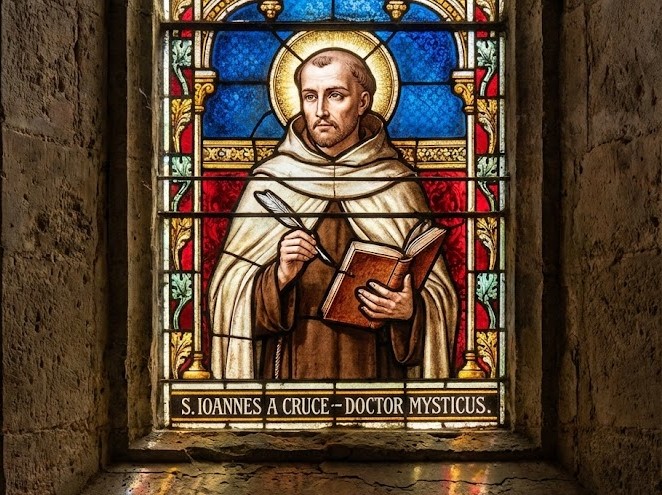
A Sixteenth Century Mystic Speaks to the Modern Consulting Room
In the annals of Western spirituality, few figures have captured the imagination of depth psychologists and existential therapists quite like the sixteenth century Spanish mystic Juan de Yepes y Álvarez, known to history as St. John of the Cross. Born in 1542 into poverty in the Castilian town of Fontiveros, orphaned young, and raised amid hardship, this poet and contemplative would eventually produce a body of work that transcends its religious origins to speak with remarkable precision to the most profound questions of psychological transformation. His concept of the “dark night of the soul” has become so thoroughly integrated into the vocabulary of psychotherapy that many clinicians invoke it without fully appreciating the depth of the original vision from which it emerged.
What is it about a Catholic mystic from Counter-Reformation Spain that continues to resonate with therapists trained in empirical traditions centuries later? The answer lies in St. John’s extraordinary capacity to articulate the inner phenomenology of psychological crisis and transformation with a precision that rivals any modern clinical description. His writings do not merely describe suffering but map its meaning, tracing the architecture of descent and ascent that characterizes the most profound forms of human change.
The Historical Context: Suffering as Forge
To understand St. John of the Cross is to understand that his work emerged not from abstract contemplation but from the crucible of lived experience. The circumstances of his imprisonment represent one of the most remarkable examples in Western literature of creative genius forged through suffering.
In December 1577, at the age of thirty five, St. John was seized by members of his own religious order, the Carmelites, who opposed the reforms he had undertaken with Teresa of Ávila. He was taken to the Carmelite monastery in Toledo and placed in a cell barely six feet wide and ten feet long, a space that had previously served as a latrine. For nine months, he endured conditions of extreme deprivation: no change of clothing, a diet of bread, water, and scraps of salt fish, and regular public floggings before the community. His only light came from a small aperture high in the wall, through which he tracked the movement of stars and read his breviary when occasionally permitted an oil lamp.
It was here, in this darkness both literal and figurative, that St. John composed the first thirty one stanzas of his masterwork, the Spiritual Canticle, writing on paper smuggled to him by a sympathetic guard. The poem that emerged from this abyss remains one of the supreme achievements of Spanish literature and a foundational text for understanding the psychology of transformation through suffering.
The biographical details matter enormously because they establish St. John’s credentials as a guide to the dark places of the soul. He did not theorize about psychological crisis from a position of comfort but wrote from within the very experience he describes. His eventual escape in August 1578, lowering himself from his cell window on a rope made from strips torn from his blankets, carries symbolic weight that has not been lost on depth psychologists: the soul must sometimes find its own way out of the darkness, using whatever resources it can fashion from the material of its imprisonment.
The Dark Night: A Psychological Reading
The phrase “dark night of the soul” has become so colloquialized that it risks losing its original precision. St. John describes not merely a period of difficulty or depression but a specific process of psychological and spiritual transformation characterized by the systematic dismantling of familiar structures of meaning, identity, and attachment.
In his treatise Dark Night, St. John distinguishes between two phases of this process. The first, which he calls the dark night of the senses, involves the purification of attachment to sensory pleasures and external sources of meaning. The second and more profound phase, the dark night of the spirit, involves the dissolution of deeper psychological structures: the ego’s cherished self-images, its spiritual consolations, and its very sense of coherent identity.
What makes St. John’s account so psychologically astute is his recognition that this process cannot be willed or controlled. The dark night is not something the individual chooses to enter but something that overtakes them. In language that anticipates the psychoanalytic understanding of the unconscious, St. John speaks of processes operating beyond the reach of conscious intention, working their transformation in ways that the rational mind cannot fully comprehend or direct.
The symptoms he describes will be immediately familiar to any depth therapist: a pervasive sense of emptiness and meaninglessness, the withdrawal of previously reliable sources of comfort and satisfaction, profound existential questioning, inability to pray or meditate in accustomed ways, and what St. John calls a “painful sense of one’s own wretchedness.” Yet crucially, St. John insists that these experiences, however agonizing, are not pathological but purposive. They represent not the breakdown of the psyche but its restructuring at a deeper level.
St. John of the Cross and Jungian Psychology
The parallels between St. John’s dark night and Carl Jung’s concept of individuation have been noted by scholars and clinicians since the early days of depth psychology. James Arraj’s study St. John of the Cross and Dr. C.G. Jung remains the definitive exploration of this relationship, tracing the structural correspondences between the mystic’s account of spiritual transformation and the psychologist’s description of the integration of unconscious contents into conscious awareness.
For Jung, the process of individuation necessarily involves a confrontation with the shadow, those aspects of the personality that have been rejected, denied, or never developed. This confrontation produces a psychological crisis that Jung himself experienced and documented in his autobiographical Memories, Dreams, Reflections. The parallels to St. John’s dark night are striking: both describe a period of profound disorientation during which the familiar ego structure dissolves, and both insist that this dissolution is necessary for the emergence of a more comprehensive and integrated self.
Jung’s concept of the shadow finds its counterpart in St. John’s description of the soul’s confrontation with its own “miserable imperfections” during the dark night. Both writers emphasize that what feels like destruction is actually the precondition for new construction. As Jung famously wrote, there can be no coming to consciousness without pain, a sentiment St. John would have endorsed entirely.
The Jungian archetype of the Self, understood as the totality of the psyche including both conscious and unconscious elements, corresponds structurally to St. John’s vision of the soul in union with the divine. Both represent a state of integration that transcends the limitations of the ordinary ego, and both are achieved only through a process of systematic transformation that often feels like annihilation.
Contemporary Jungian analysts continue to draw on St. John’s work as a resource for understanding the deeper layers of the individuation process. His detailed phenomenological descriptions provide clinical material that complements Jung’s more theoretical formulations, offering therapists a vocabulary for discussing experiences that might otherwise remain inarticulate.
The Transpersonal Dimension
Transpersonal psychology, with its explicit attention to spiritual experiences and states of consciousness that transcend ordinary ego boundaries, has embraced St. John of the Cross as one of the great cartographers of transcendent states. The work of Stanislav Grof on spiritual emergence and emergency draws heavily on the conceptual framework St. John provides for understanding crisis experiences that are transformative rather than pathological.
The distinction between the dark night and clinical depression represents a crucial contribution to psychiatric discourse. As the Psychiatric Times has noted, the dark night is not a disease but part of the price we pay for being vulnerable human beings seeking meaning and connection. Distinguishing between spiritual crisis and psychiatric illness has significant implications for treatment: what presents as depression may sometimes be the dark night, calling for a different kind of therapeutic response than pharmacological intervention or cognitive behavioral strategies aimed at symptom reduction.
Transpersonal therapists emphasize that St. John’s dark night, like the shamanic dismemberment experiences found in traditional cultures, represents a death and rebirth process that follows a recognizable pattern across cultures and historical periods. The universality of this pattern suggests that it reflects something fundamental about the structure of human psychological development, a built-in capacity for radical transformation that becomes activated under certain conditions.
Comparative Religion and the Universality of the Dark Night
One of the most compelling aspects of St. John’s work is its resonance with mystical traditions far removed from his sixteenth century Catholic context. Scholars of comparative religion have traced extensive parallels between his descriptions and those found in Sufi mysticism, Buddhist meditation traditions, Kabbalistic Judaism, and Hindu yoga.
The Sufi concept of fana, or annihilation of the ego in divine union, corresponds structurally to St. John’s account of the soul’s transformation in the dark night. Both traditions describe a process in which the separate self dissolves and is reconstituted in relation to a greater reality. The poetry of Rumi, with its emphasis on the soul’s longing for the Beloved and its willingness to be transformed by that longing, creates an unmistakable family resemblance with St. John’s Spiritual Canticle.
Elizabeth Harris’s scholarly comparison of St. John’s mysticism with Buddhist jhana meditation reveals striking similarities in the progressive stages of detachment from sensory experience, discursive thought, and the sense of separate self. While the metaphysical frameworks differ profoundly, the phenomenological descriptions converge on what appears to be a universal structure of contemplative development.
This cross-cultural resonance suggests that St. John’s writings describe not merely a Christian spiritual path but a fundamental human capacity for transformation that can be activated within various religious and philosophical frameworks. For clinicians working with clients from diverse backgrounds, this universality makes St. John’s insights applicable across cultural and religious boundaries.
The convivencia of medieval Spain, that remarkable period when Jewish, Christian, and Islamic cultures coexisted and influenced one another on the Iberian peninsula, provides important background for understanding St. John’s mysticism. Some scholars have argued that converso influences, from Jews and Muslims who converted to Christianity, enriched the mystical traditions from which St. John drew. His emphasis on direct experience over doctrinal formulation, on the inadequacy of conceptual knowledge to capture spiritual reality, resonates with apophatic traditions across all three Abrahamic faiths.
Models of Therapy Reflected in St. John’s Work
St. John’s writings implicitly contain what we might recognize today as sophisticated therapeutic principles. His understanding of transformation offers resources for multiple therapeutic modalities.
First, St. John anticipates the psychoanalytic recognition that insight alone is insufficient for deep change. His emphasis on the necessity of lived experience, on actually undergoing the darkness rather than merely understanding it intellectually, corresponds to the depth therapeutic insight that transformation requires more than cognitive restructuring. The dark night must be suffered, not simply analyzed.
Second, his approach is fundamentally relational, though the primary relationship is understood as being with the divine. Contemporary relational psychotherapy emphasizes that healing occurs within the context of attachment, and St. John’s entire framework assumes that the soul’s journey takes place within a relationship of profound love and trust. The therapist who accompanies a client through a dark night serves, in some sense, as a human representative of this sustaining presence.
Third, St. John’s work contains what we might call a paradoxical theory of change, anticipating insights that would not be formally articulated until the development of paradoxical interventions in family therapy. His insistence that the dark night cannot be rushed or controlled, that the soul must surrender rather than strive, that trying harder often makes things worse, these insights align with therapeutic approaches that work with resistance rather than against it.
Fourth, the somatics of St. John’s experience cannot be overlooked. His poetry and prose are rich with bodily metaphor and attention to physical sensation. Contemporary somatic therapies, which emphasize the embodied nature of psychological experience and trauma, find in St. John a precursor who understood that transformation is not merely a mental event but involves the whole person, body and soul together.
Why St. John Speaks Across the Ages
The enduring relevance of St. John of the Cross for psychotherapy rests on several foundations. His work addresses questions that no merely technological or procedural approach to mental health can resolve: questions of meaning, purpose, identity, and the human capacity for radical transformation.
In an age when psychology increasingly tends toward the medical model, treating psychological distress as illness to be cured rather than experience to be understood, St. John offers a corrective vision. Not all suffering is pathological. Some forms of psychological crisis represent not breakdown but breakthrough, not disease but development. The dark night is not something to be medicated away but something to be lived through with courage and faith.
St. John also speaks to our contemporary condition in his recognition that genuine transformation requires loss. Our culture tends to promise growth without sacrifice, change without cost, gain without pain. St. John knows better. The dark night involves the stripping away of consolations, attachments, and illusions that the ego would prefer to keep. There is no bypassing this process if genuine transformation is the goal.
Finally, St. John’s work embodies a synthesis of contemplative depth and practical wisdom that remains exemplary for clinicians. He was not merely a theorist but a director of souls, someone who accompanied others through their own dark nights. His writings emerged from this pastoral practice and retain the marks of their origin in their attention to practical detail, their anticipation of difficulties, and their unfailing compassion for the struggling soul.
The Dark Night as Invitation
For the depth psychologist or existential therapist encountering St. John of the Cross, the invitation is twofold. First, his writings offer conceptual resources for understanding experiences that might otherwise seem merely pathological or meaningless. The vocabulary of the dark night allows clinicians and clients alike to frame certain forms of suffering as potentially transformative, as labor pains attending the birth of a more authentic selfhood.
Second and perhaps more importantly, St. John’s life and work model a way of being with suffering that combines unflinching realism with sustaining hope. He knew the darkness intimately, having lived in it for nine months in that Toledo cell. Yet he emerged not embittered but transformed, not broken but deepened. His subsequent life of creative productivity and compassionate service testifies to the genuineness of the transformation the dark night wrought.
As therapists, we are called to be what Thomas Moore describes as midwives to our patients’ inner transformation, supporting and encouraging them as they struggle to give birth, often painfully, to new meaning in their lives. St. John of the Cross, that sixteenth century Spanish mystic who found poetry in prison and light in the darkest night, remains one of our most reliable guides to this sacred work.









0 Comments