
The Everywhen and the Architecture of the Psyche
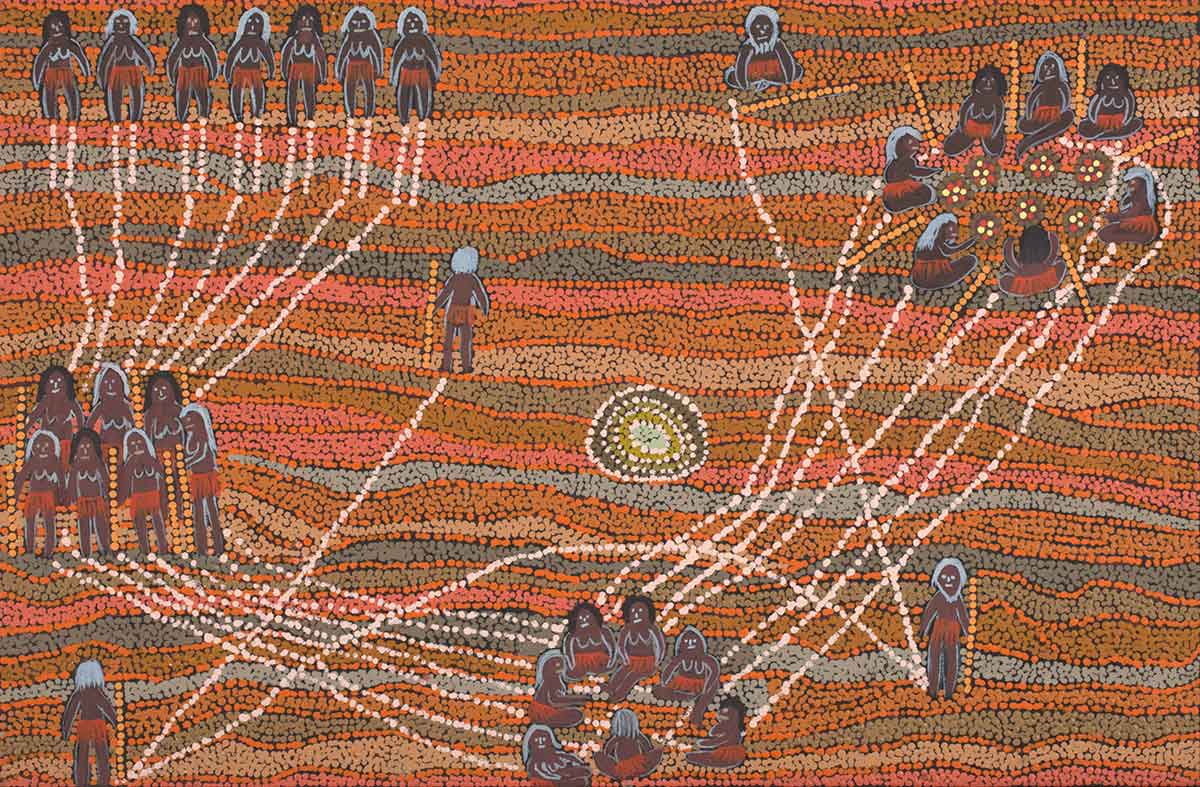
In the Western psychological tradition, there is an obsession with linearity. Lives are viewed as straight lines moving irrevocably from birth to death, cause to effect, trauma to symptom. However, the oldest continuous living culture on Earth, the Aboriginal peoples of Australia, possess a cosmological framework that challenges this entire structure: The Dreamtime (or Alcheringa in the Arrernte language).
The Dreamtime is not a “long time ago”; it is an “Everywhen.” It is a parallel reality of eternal creation that exists simultaneously with the present moment. For the depth psychologist, this offers a profound metaphor for the Unconscious. Just as the Ancestors in the Dreaming are perpetually singing the world into existence, the archetypes of the human psyche are constantly generating our reality beneath the threshold of awareness.
By exploring the parallels between the Dreamtime and psychological processes, we gain a map of the mind that is far more dynamic than the static models of Western psychiatry. The Dreamtime serves as a cosmological metaphor for the psyche, where the gods are perpetually engaged in the act of creation. This is not ancient history; it is live neurology.
David Tacey and the Spirit of Place
To bridge the vast conceptual gap between Indigenous Australian spirituality and Western psychoanalysis, the work of Dr. David Tacey is indispensable. An Australian public intellectual and leading scholar of Jungian studies, Tacey has spent his career examining how the “spirit of place” impacts the psyche.
While Carl Jung visited Africa and India to expand his understanding of the collective unconscious, he never fully engaged with the Australian continent. Tacey picked up where Jung left off. In works like Edge of the Sacred: Transformation in Australia (1995) and Gods and Diseases (2013), Tacey argues that the “Dreaming” is not just a cultural artifact but a psychological reality that Westerners ignore at their peril. His scholarship posits that the “Divided Mind” of the modern individual cannot be healed without acknowledging the indigenous roots of the human soul. The land itself forces a confrontation with the unconscious, demanding that we listen to the silence of the earth to hear the noise in our own heads.
The Dreamtime as Continuous Neurogenesis
In Aboriginal Australian belief, the Dreamtime is an ongoing process of creation. The gods, or ancestral beings, are constantly shaping and reshaping the world, performing the same actions over and over again, yet each time is unique and new. This idea of continuous creation bears a striking resemblance to the workings of memory reconsolidation in the human brain.
Just as the gods in the Dreamtime are always in the act of creation, our minds are constantly processing information, forming memories, and generating thoughts and emotions. Neuroscience reveals that memory is not a file stored in a cabinet; it is a protein string that must be rebuilt every time it is accessed. Each moment of consciousness is a new creation, a fresh interpretation of the world around us. In this sense, the Dreamtime is a perfect metaphor for the psyche’s ceaseless creative activity. Our perception of reality is not a passive reflection of an objective world but rather an active, ongoing construction of meaning.
Songlines as the Neural Pathways of the Soul
While the Dreamtime is seen as a separate realm from the mundane world, there are portals or access points between the two. In Aboriginal Australian culture, these portals are often associated with specific landforms and navigation routes called Songlines. These Songlines show where the mundane world and the Dreamtime intersect, revealing the presence of sacred forces that are continuously shaping reality.
In the context of the human psyche, these Songlines function exactly like neural pathways. They are the “paths of least resistance” that our thoughts and behaviors travel. When an Aboriginal person walks a Songline, they sing the land into existence. When a person thinks a thought, they fire a neural pathway that reinforces their reality. Deep therapy is essentially “tracking” these internal Songlines to find where the map has been distorted. We must walk the path of the ancestors—our parents, our culture, our trauma history—to understand where we are located in the landscape of the mind.
Trauma as Being “Out of Country”
The Aboriginal conceptualization of trauma offers a radical departure from the Western medical model. In the West, we often view trauma as a mechanical failure—a broken part of the brain that needs fixing. Through the lens of the Dreamtime, trauma is viewed as dislocation.
In Indigenous thought, health is inextricably tied to being “on Country”—connected to one’s land, lineage, and Songlines. Trauma occurs when a person is severed from their Songline. Psychologically, this mirrors the state of dissociation. The traumatized individual loses access to their internal map. They are wandering in a “profane” space, cut off from the “sacred” continuity of their own life story. They are, in a very real sense, “out of country” within their own minds.
If the world exists because it is sung, then trauma is the silencing of the song. In the Dreamtime, if the song stops, the land ceases to exist. Similarly, when trauma strikes, the narrative coherence of the self is shattered. The “I” that sings the story of the self falls silent. Clinical recovery, therefore, is not just about symptom reduction. It is about re-storying. The therapist acts as an elder who helps the patient find the broken Songline and begin singing it again, integrating fragmented traumatic memories into a coherent autobiography.
The Collective Unconscious and Ancestral Burdens
The idea of the Dreamtime as a realm where gods and ancestral beings are constantly shaping reality bears a striking resemblance to Carl Jung’s concept of the collective unconscious. Jung believed that the collective unconscious is a shared, universal repository of symbols, archetypes, and mythic themes that influence human experience across cultures and throughout history.
Dreamtime philosophy accepts that we carry the stories of the Ancestors. Trauma is often intergenerational. This aligns with the Jungian view of the family complex. We are often acting out a script written by ghosts. Healing requires becoming conscious of the script so we can improvise a new ending. As David Tacey suggests, we must confront the “Ancestors”—our inheritance—to stop them from possessing us. The gods and ancestral beings of the Dreamtime are not merely symbols or archetypes but living, creative forces that shape the world and our experience of it.
Re-Enchanting the World Through Narrative
The insights offered by the Dreamtime metaphor have profound implications for psychotherapy and personal growth. By recognizing the parallels between the Dreamtime and the workings of the human psyche, therapists and individuals can gain a deeper understanding of the processes of transformation and self-discovery.
One of the key implications is the importance of engaging with the unconscious as a source of wisdom and creativity. Rather than seeing the unconscious as a mere repository of repressed memories and desires, we can view it as the Dreaming—a source of continuous creation. Therapists act as modern navigators of these Songlines, helping individuals explore the symbols and archetypes that emerge from the depths of their being. By engaging with these symbols through techniques such as dream analysis and active imagination, individuals can tap into a source of inner guidance and transformation.
Ultimately, the concept of the Dreamtime as a cosmological metaphor for the psyche invites us to view our inner lives as a sacred, ever-unfolding process of creation. It challenges the sterility of modern psychology and reminds us that the human mind is not a computer to be programmed, but a landscape to be traversed. By embracing this perspective, we cultivate a deeper appreciation for the richness and complexity of our own minds and the ways in which they sing the world into being.
Further Reading & Resources
- David Tacey: Interview on Jung, Mysticism, and the Politics of Mythology.
- Stanford Encyclopedia of Philosophy: The Metaphysics of Time and Existence.
- Australian Institute of Aboriginal and Torres Strait Islander Studies: Map of Indigenous Australia.
- PubMed: Narrative processes in the neural representation of events.





0 Comments