
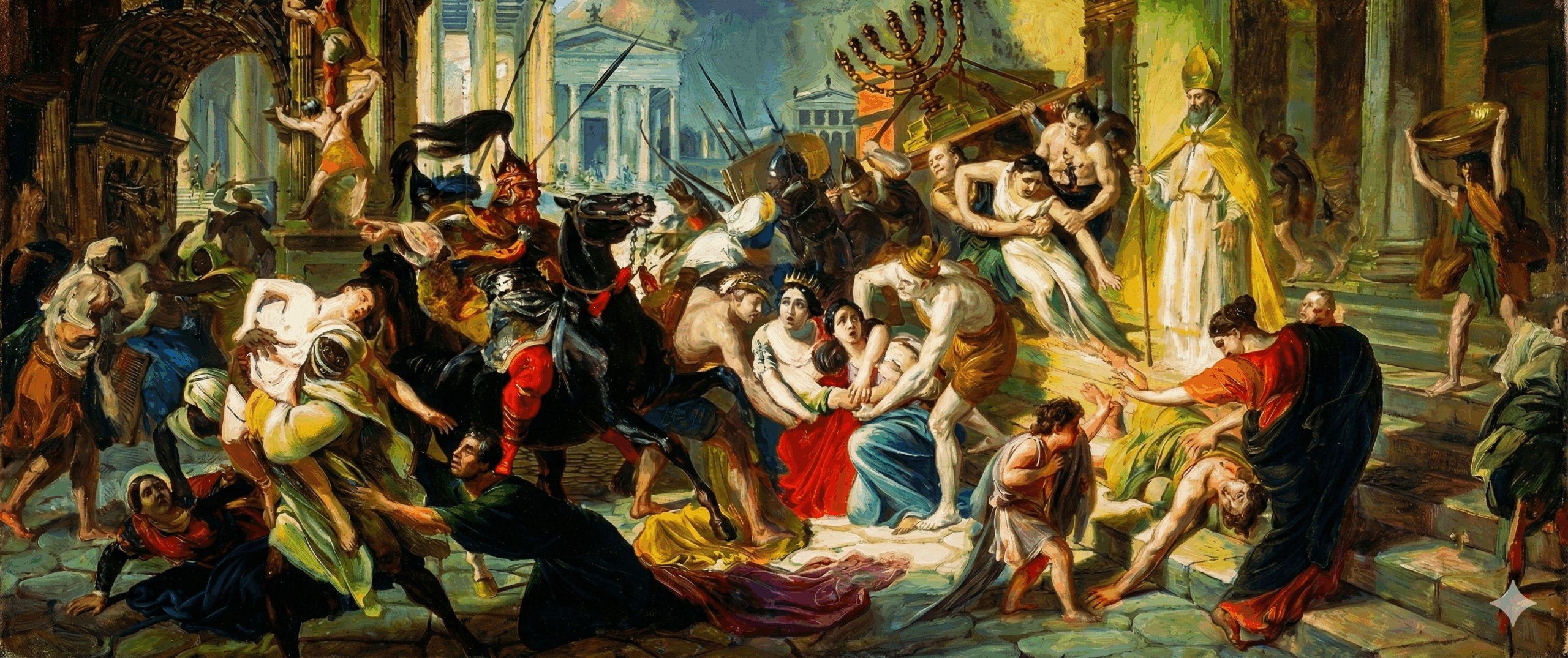
The Architecture of Collective Identity
Edward Edinger, in his seminal work Ego and Archetype, describes the fundamental psychological dynamic that governs both individual and collective development: the ego must separate from the unconscious matrix to achieve consciousness, yet it must maintain connection to the Self, the archetype of wholeness and meaning, or risk inflation and subsequent collapse. This process, which Edinger calls the ego-Self axis, operates not merely at the individual level but manifests in the rise and fall of civilizations themselves. What Rome experienced in its decline, and what we are experiencing now, is the catastrophic severing of this axis on a collective scale, the shattering of what we might call the Imperial Ego and its disconnection from the sustaining archetypal ground of meaning.
The Roman Empire, at its height, functioned as a vast psychological organism, a collective projection screen upon which millions of individuals could see their own significance reflected and magnified. This was not merely political allegiance or economic interdependence but something far deeper: a participation mystique, to use Lévy-Bruhl’s term that Jung adopted, where the individual psyche merged with the collective identity of Roma Aeterna. The shopkeeper in the Subura, the farmer in Gaul, the soldier on the Danube frontier, all participated in a shared psychological reality where personal limitation was transcended through identification with imperial greatness.
This Imperial Ego was not an abstraction but was maintained through concrete psychological mechanisms. The gladiatorial games, for instance, were not entertainment in our modern sense but were profound rituals of death and rebirth, where the collective could witness and master mortality itself. When a gladiator faced death with stoic resolve in the arena, every spectator participated in that confrontation with the ultimate shadow. The arena was a temenos, a sacred space where the chaos of existence was temporarily ordered through ritualized violence. The crowd’s thumbs up or down was not mere bloodlust but a participation in divine judgment, making each citizen a small god in the cosmological order.
The Imperial Cult provided another crucial mechanism for maintaining the ego-Self axis. The Emperor as Pontifex Maximus was not just a political leader but a living link between the human and divine realms. When citizens burned incense to the genius of the Emperor, they were not engaging in empty ritual but were actively maintaining the psychological connection between their personal ego and the transcendent Self as embodied in the state. The Pax Deorum, the peace of the gods, was simultaneously a political, religious, and psychological reality. As long as it held, the individual could feel secure in their place within a divinely ordered cosmos.
The Crisis of the Third Century as Collective Individuation Failure
What occurred during the Crisis of the Third Century was not merely political fragmentation or economic collapse but a fundamental breakdown of the collective individuation process. Between 235 and 284 CE, Rome experienced what we might diagnose as a civilizational nervous breakdown, a massive dissociation of the collective psyche from its organizing principle.
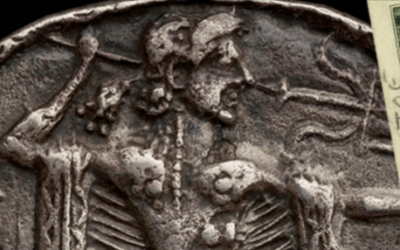
The capture of Emperor Valerian by the Persian King Shapur I in 260 CE represents what psychologists would now recognize as a profound narcissistic injury to the collective consciousness. An emperor had never before been captured alive and enslaved. This was not just a military defeat but an ontological catastrophe. If the Emperor was the bridge between human and divine, his capture meant that bridge had collapsed. The unthinkable had become real: Roma was not eternal, the gods were not protecting the empire, and the entire psychological structure upon which millions had built their identity was revealed as fragile fiction.
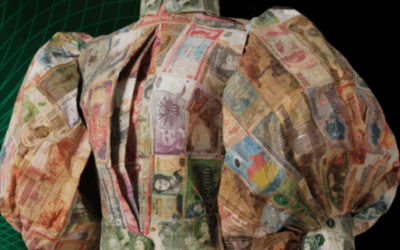
The economic dimension of this crisis carried its own psychological violence. The debasement of the denarius from nearly pure silver to less than five percent silver content was not merely inflation but the literal deterioration of value itself. Money, as Georg Simmel understood, is crystallized trust, and when that trust evaporates, so does the social fabric it upholds. The curiales, the middle class that formed the backbone of Roman civic life, found their savings evaporated, their social position undermined, their very identity as responsible citizens rendered meaningless. This economic anomie was simultaneously psychological anomie, what Durkheim identified as the condition where social norms lose their hold and individuals become disconnected from collective meaning.
The empire literally split apart during this period, with the Gallic Empire breaking away in the West and the Palmyrene Empire in the East. This was not just political fragmentation but psychological splitting, the kind of dissociation that occurs in severely traumatized individuals. The collective psyche could no longer maintain its unity and fractured into competing identities, each claiming to be the “true” Rome while the center dissolved into chaos.
During this period, we see the phenomenon that Edward Edinger would recognize as ego inflation followed by alienation. The Imperial Ego had become so identified with its own power and permanence that it lost connection to the deeper Self, the archetypal ground of being that could provide genuine stability. Like an individual who has become too identified with their persona, Rome had confused its political and military might with its essential being. When that might failed, there was nothing deeper to fall back on, no connection to the eternal aspects of the psyche that could survive temporal defeat.
The Retreat into the Mysteries: Seeking the Lost Self
As the public sphere collapsed and the Imperial Ego shattered, the Roman populace underwent what we might call a massive intrapsychic migration. Unable to find meaning in the civic religion that had become a hollow shell, they turned inward, seeking in the mystery cults what the state could no longer provide: a direct, personal connection to the numinous.
The mystery religions that flourished during this period were not merely alternative religious options but were psychological technologies for individual transformation in the absence of collective meaning. Each offered what the collapsing empire could not: a structured path of individuation that did not depend on external political or economic stability.
Mithraism, popular among soldiers, provided a graded hierarchy of spiritual advancement through seven levels: Raven, Bride, Soldier, Lion, Persian, Sun-Runner, and Father. In a world where military merit had devolved into assassination and coup, where a soldier might see five emperors in as many years, Mithraism offered a stable, eternal hierarchy based on spiritual rather than temporal achievement. The Mithraic mysteries took place in underground temples, the Mithraea, which were designed to resemble caves, symbolic wombs of rebirth. Here, in the darkness beneath the crumbling empire, initiates encountered the primal drama of light conquering darkness, of Mithras slaying the cosmic bull and releasing life into the universe.
The cult of Cybele and Attis offered something entirely different but equally necessary: emotional catharsis and the integration of the feminine. The public Roman religion had been predominantly masculine, focused on order, hierarchy, and control. As that order collapsed, the repressed feminine burst forth in the ecstatic rites of the Great Mother. The Day of Blood, when initiates would dance themselves into frenzy and sometimes castrate themselves in devotion to the goddess, represented a complete inversion of Roman virtus. Yet this apparent madness was psychologically necessary, a compensation for centuries of rigid masculine control.
The Eleusinian Mysteries, imported from Greece, promised initiates a blessed afterlife through participation in the drama of Demeter and Persephone. The central secret of Eleusis, never revealed but hinted at in ancient sources, seems to have involved a direct experience of continuity beyond death, perhaps through psychoactive substances or profound ritual techniques. In a world where collective immortality through the empire was no longer believable, the mysteries offered personal immortality through gnosis.
Christianity, which would eventually triumph over all other mystery cults, succeeded precisely because it combined elements from all of them while adding a crucial new dimension: it historicized the mystery. While Mithras and Osiris were mythical figures whose dramas occurred in illo tempore, mythical time, Christ was claimed to have lived, died, and resurrected in historical time, under Pontius Pilate. This grounding in history while maintaining the mystery structure proved irresistible to a population that needed both transcendent meaning and concrete hope.
The Gnostic Turn: When Reality Becomes Prison
The rise of Gnosticism during this period represents perhaps the most extreme psychological response to the collapse of the Imperial Ego. Gnosticism posited that the entire visible world, including the Roman Empire itself, was a prison created by a false god, the Demiurge. The true God was utterly transcendent, beyond this world of suffering and decay. Salvation came not through participation in civic life or even through traditional religious observance but through gnosis, secret knowledge that revealed the illusory nature of physical reality.
This Gnostic worldview represents what Edinger would recognize as a complete alienation of ego from Self, projected onto cosmological mythology. The ego, traumatized by the collapse of its identifications, declares the entire world of experience to be false. This is not mere escapism but a desperate attempt to preserve some kernel of meaning and identity in the face of overwhelming nihilistic threat. If the empire is not eternal, if the gods do not protect, if everything one believed sacred can be destroyed, then perhaps this whole reality is the problem.
The Gnostic mythology, with its complex hierarchies of aeons and archons, its secret passwords and hidden knowledge, provided initiates with a sense of superiority and agency even as their actual world crumbled. They might be powerless in the face of economic collapse and barbarian invasion, but they possessed the secret key to reality itself. They knew what others did not: that this world was a trap, and they had found the way out.
This Gnostic consciousness did not die with antiquity but has resurfaced repeatedly throughout Western history at moments of cultural crisis. We see it in the Cathars of medieval France, in the esoteric traditions of the Renaissance, in the conspiracy theories of our current moment. Whenever the collective ego suffers narcissistic injury, whenever the social order reveals itself as arbitrary and fragile, the Gnostic solution emerges: this world is false, controlled by evil forces, but we who possess the gnosis can see through the illusion.
The Gladiator and the Last Man
The transformation of the gladiatorial games during the decline provides a perfect metaphor for the psychological deterioration of the empire. In the early empire, gladiatorial combat had been a highly ritualized affair with strict rules, professional fighters, and genuine uncertainty of outcome. It was dangerous but not inevitably fatal, and successful gladiators could win freedom and fame. The crowd’s participation was active and discerning, appreciating skill and courage regardless of victory or defeat.
By the late empire, the games had degenerated into pure spectacle, mass slaughter without meaning or skill. Prisoners and Christians were thrown to beasts not as ritual sacrifice but as entertainment. The crowd no longer participated in cosmic judgment but merely consumed violence as distraction from their own powerlessness. The arena, once a sacred space where death was confronted and transcended, became what Baudrillard would later call a simulacrum, an image without reference to any underlying reality.
This degradation of the games parallels what Nietzsche would later identify as the emergence of the Last Man, the human type that seeks only comfort and distraction, that has lost the capacity for genuine struggle or transcendence. The late Roman citizen, watching prisoners torn apart by lions while eating free bread provided by the state, had become precisely this Last Man, unable to generate meaning from within, dependent on external stimulation to feel anything at all.
The psychological devastation this represents cannot be overstated. A culture that had defined itself through virtus, through manly courage and civic duty, had been reduced to passive consumption. The very activities that had once built character and maintained the ego-Self axis had become empty performances that only emphasized the absence of genuine meaning.
Constantine’s Solution: The Therapeutic State
The resolution that Constantine provided was not a restoration of the old order but its final burial beneath a new psychological paradigm. Constantine did not revive the Imperial Ego; he replaced it entirely with what we might call the Therapeutic State, where the government’s primary function was no longer to embody collective greatness but to provide spiritual comfort and salvation.
The adoption of Christianity as the state religion was simultaneously a psychological masterstroke and an admission of defeat. The empire could no longer offer its citizens glory, expansion, or even security, but it could offer them salvation. The City of Man had failed, but the City of God remained eternal. The ego-Self axis was reconstituted, but now the Self was located entirely beyond this world, in a transcendent realm that no barbarian could conquer and no economic crisis could devalue.
This shift represents what Edinger calls the transition from the heroic ego to the religious ego. The heroic ego seeks to establish itself through conquest and achievement in the external world. When this becomes impossible, when the external world proves unconquerable or meaningless, the ego must turn inward and upward, seeking connection to the Self through surrender rather than victory. Constantine’s genius was recognizing that this psychological transition, already occurring spontaneously through the mystery cults, could be harnessed and institutionalized.
The Edict of Milan in 313 CE, which legalized Christianity, was not just a political calculation but a psychological recognition that the old Roman identity was dead and could not be revived. The subsequent Council of Nicaea in 325 CE, which established orthodox Christian doctrine, was an attempt to provide a new, unified psychological framework for the empire’s diverse populations. The Nicene Creed became the new oath of citizenship, replacing the civic religion with a therapeutic theology.
The Architecture of Decline: From Forum to Basilica
The architectural transformation of this period provides concrete evidence of the psychological shift. The Roman Forum, the heart of civic life where citizens gathered to participate in politics and commerce, gradually emptied and fell into ruin. Meanwhile, the Christian basilica emerged as the new center of communal life. But the basilica was fundamentally different from the forum. Where the forum was open, horizontal, and democratic in its spatial arrangement, the basilica was enclosed, vertical, and hierarchical.
The basilica’s architecture directed attention not outward to fellow citizens but upward to the divine and forward to the altar where the mystery of transubstantiation occurred. The individual entering a basilica was meant to feel small, to experience their ego as insignificant compared to the divine majesty represented in the vaulted ceiling and the golden mosaics. This was architecture designed not to empower the civic ego but to humble it, to create the psychological conditions for surrender to a higher power.
The proliferation of monasteries during this period represents the ultimate form of what Morris Berman calls internal emigration. The monastery was a complete withdrawal from the failed civic order, a creation of alternative community based on spiritual rather than political principles. The monastic cell replaced the forum as the site of meaningful action. Prayer replaced politics. The cultivation of the soul replaced the cultivation of empire.
Yet this withdrawal was also a preservation. The monasteries became repositories of classical learning, copying manuscripts that would otherwise have been lost, maintaining intellectual traditions that the collapsing civic order could no longer support. The monks were like psychological seed banks, preserving the cultural DNA for a future renaissance that they could not imagine but somehow intuited would come.
The Psychological Economics of Collapse
The economic dimension of Rome’s fall carries profound psychological implications that economic historians often miss. The debasement of the currency was not just financial fraud but represented a breakdown in what money actually is: a collective agreement about value, a shared fiction that enables cooperation. When money loses its value, it’s not just purchasing power that evaporates but trust itself, the basic faith that promises will be kept, that effort will be rewarded, that the future has some relationship to the present.
The rise of feudalism from the ashes of the Roman economy represents a psychological regression from abstract to concrete relationships. Where Roman citizens had related to each other through law, through currency, through shared civic identity, medieval serfs related through personal bonds of loyalty and protection. This was a return to what anthropologists call mechanical solidarity, where social cohesion derives from sameness rather than interdependence. It was psychologically safer but also more limiting, like a traumatized individual who withdraws from complex relationships into rigid routine.
The hoarding of gold and silver that characterized the late empire and early medieval period was not just economic behavior but psychological symptom. In a world where abstract value had proven unreliable, only concrete, physical wealth felt real. The buried hoards discovered across former Roman territories tell a story of profound anxiety, of people who no longer trusted any institution to preserve value and so literally buried their wealth in the ground, returning it to the chthonic realm from which it came.
The Transformation of Time Consciousness
One of the most profound but subtle changes during this period was the transformation of time consciousness itself. Roman time had been fundamentally cyclical, based on the agricultural year and the recurring festivals that marked it. Historical time was measured from the founding of the city (ab urbe condita), implying an eternal present that extended indefinitely into the future. The Roman calendar was a technology for managing the present, not anticipating radical change.
Christian time consciousness was fundamentally different: linear, teleological, apocalyptic. History had a beginning (Creation), a middle (the Incarnation), and would have an end (the Second Coming). This was not cyclical time but arrow time, shot from the bow of divine providence toward a target of final judgment. Every moment became pregnant with eschatological significance. The present was no longer a stable platform for action but a brief waystation on the journey to eternity.
This shift in time consciousness had enormous psychological consequences. The Roman citizen had lived in a fundamentally stable temporal framework where the past provided guidance for the present and the future would resemble the past. The Christian convert lived in a radically unstable temporal framework where at any moment Christ might return and history itself might end. This created a peculiar combination of anxiety and hope, of urgency and resignation, that would characterize Western consciousness for the next millennium and beyond.
The apocalyptic imagination that flourished during this period was not merely religious superstition but a psychological necessity. When the external world becomes too chaotic to comprehend, the psyche seeks meaning through narrative, and the most compelling narrative in chaos is that it’s all leading somewhere, that the suffering has purpose, that there will be a final revelation that makes sense of everything. The Book of Revelation, with its bizarre imagery and violent culmination, became the template for understanding historical crisis. Every invasion, plague, or natural disaster could be read as a sign of the approaching end.
The Death of Public Man
Richard Sennett’s concept of the “fall of public man” finds its first historical instantiation in the decline of Rome. The Roman citizen of the Republic and early Empire had been fundamentally a public creature, defined by their role in civic life, their participation in public rituals, their contribution to collective enterprises. Virtue itself was public; Roman virtus was not private morality but public excellence, demonstrated in forum and battlefield.
The late empire saw the emergence of what we might call “private man,” the individual whose primary concern was personal salvation rather than public glory. This was not just a change in values but a fundamental reorganization of the psyche. The ego that had been directed outward, seeking validation through public achievement, turned inward, seeking validation through private revelation.
The rise of confession as a Christian practice exemplifies this transformation. Where the Roman citizen had proclaimed their deeds in public, the Christian penitent whispered their sins in private. Where Roman justice had been public spectacle, Christian forgiveness was intimate encounter. The self that had been performed in the forum was now examined in the cell. This internalization of moral life created new depths of psychological complexity but also new possibilities for neurosis, guilt, and what Freud would later identify as the discontent of civilization.
The hermits and stylites of this period represent the extreme form of this privatization. Saint Simeon Stylites, who lived for thirty-seven years on top of a pillar, became paradoxically famous for his rejection of fame, publicly visible in his rejection of public life. This was not just asceticism but a kind of psychological performance art, demonstrating through extreme withdrawal the impossibility of genuine public life in a collapsed civilization.
The Barbarian as Psychological Shadow
The relationship between Romans and barbarians during this period was not just military or political but profoundly psychological. The barbarian represented everything the Roman ego had repressed: wildness, spontaneity, freedom from law, connection to nature. As the Roman ego weakened, its shadow grew stronger, eventually overwhelming the conscious position.
The fascinating aspect of the barbarian invasions is how quickly the invaders became Romanized, adopting Roman law, Roman religion, Roman administrative structures. But this was a different kind of Romanitas, one that had integrated elements of the barbarian shadow. The Gothic kings who ruled Italy maintained Roman forms but infused them with Germanic warrior energy. This was not preservation but transformation, a psychological synthesis that created something genuinely new.
The figure of Stilicho, the half-Vandal general who effectively ruled the Western Empire in the early fifth century, embodies this psychological complexity. He was simultaneously the defender of Rome and a barbarian, the preserver of civilization and its transformer. His execution in 408 CE on charges of treason represents the Roman ego’s last desperate attempt to maintain its purity by rejecting the shadow. But the shadow cannot be permanently repressed; it returns with greater force. Two years after Stilicho’s death, Alaric and the Visigoths sacked Rome.
The psychological impact of the sack of Rome in 410 CE cannot be overstated. This was not just a military defeat but an ontological impossibility that had become real. Rome, the eternal city, had fallen to barbarians. Augustine’s “City of God,” written in response to this trauma, represents the ultimate psychological defense: if the earthly city could fall, then one’s true citizenship must be in the heavenly city that could never be conquered. This was not just theology but trauma response, a massive psychological dissociation from unbearable historical reality.
The Compensation of Byzantium
While the West collapsed into fragmentation, the Eastern Empire, centered in Constantinople, maintained continuity for another thousand years. This raises the question: what psychological factors allowed Byzantium to survive where Rome failed? The answer lies partly in Byzantium’s ability to maintain a more flexible ego-Self axis, one that could adapt to changing circumstances without completely fragmenting.
Byzantine identity was from the beginning more complex and multifaceted than Roman identity. It was simultaneously Greek and Roman, Christian and imperial, Eastern and Western. This complexity, which might seem like weakness, actually provided psychological resilience. The Byzantine ego was less rigid, more capable of incorporating contradiction and paradox. The famous Byzantine complexity in theology and politics reflects a psychological sophistication that could hold opposites in tension rather than splitting into fragments.
The Byzantine emperor’s role as God’s vice-regent on Earth provided a more sustainable psychological framework than the Roman emperor’s claim to divinity. The Byzantine emperor was powerful but not himself divine; he was the image of God but not God himself. This distinction created psychological space for both reverence and criticism, for loyalty that didn’t require absolute identification. The elaborate court ceremonies of Byzantium, often mocked as decadent, actually served crucial psychological functions, maintaining the numinous quality of power while acknowledging its human limitations.
The iconoclastic controversies that wracked Byzantium reveal the ongoing psychological struggle over the proper relationship between image and reality, between ego and Self. The iconoclasts, who sought to destroy religious images, were attempting to maintain a pure, unmediated relationship to the divine. The iconodules, who defended images, understood that the human psyche needs concrete symbols to relate to transcendent realities. The eventual triumph of the iconodules represents a psychological victory for the principle of incarnation, the recognition that the spiritual must be embodied to be psychologically real.
Modern Parallels: The Return of the Repressed
The document’s comparison between Rome’s crisis and our current moment is not merely analogical but points to deep psychological patterns that recur whenever civilizations reach similar inflection points. The American Imperial Ego, like its Roman predecessor, was built on expansion, both territorial and economic. The closing of the frontier, first geographical and then technological, creates the same psychological crisis: what happens to an identity built on growth when growth becomes impossible?
The retreat into what the document calls “digital mystery cults” follows exactly the same psychological pattern as the Roman retreat into traditional mysteries. QAnon functions precisely like ancient Gnosticism, offering initiates secret knowledge about the real powers controlling the world. The Demiurge has been updated to the Deep State, but the psychological function remains identical: providing a sense of agency and understanding in a world that feels increasingly chaotic and hostile.
The obsession with superhero movies represents our gladiatorial games, but revealing a crucial psychological difference. Where Romans watched actual humans confront actual death, we watch CGI gods battle CGI monsters in conflicts where death is always reversible and stakes are always abstract. This represents an even further retreat from reality, a double dissociation where even our fantasies have become fantasies of fantasies.
The rise of what the document identifies as therapeutic culture on the left mirrors the rise of Christianity in Rome, offering salvation through correct belief and proper confession of sins (checking privilege as modern examination of conscience). The cancellation dynamics of contemporary progressive culture mirror the exclusion practices of early Christian communities, maintaining group purity through excommunication of the impure.
The Psychological Necessity of Collapse
From a Jungian perspective, civilizational collapse might be necessary for psychological renewal. The ego, whether individual or collective, tends toward rigidity over time. It builds defenses against change, creates elaborate justifications for its limitations, and loses connection to the creative unconscious. Sometimes only complete breakdown can create the conditions for genuine transformation.
The alchemists, whom Jung studied extensively, understood this principle through the formula solve et coagula, dissolve and coagulate. The old form must be completely dissolved before the new form can crystallize. The Roman Empire had to die completely for medieval Christendom to be born. The question for our time is what new form will crystallize from our current dissolution.
The danger, as the document notes, is that the new form might be even more rigid and authoritarian than the old. The transition from the relatively pluralistic Roman Empire to the dogmatic medieval church-state represents a loss of psychological complexity that took centuries to recover. The totalitarian movements of the twentieth century showed that modern attempts at imposing meaning through force create even greater psychological devastation.
The Individuation of Civilizations
If we accept Edinger’s framework that the ego-Self axis operates at collective as well as individual levels, then civilizations themselves undergo something like individuation. They begin in unconscious participation mystique, develop ego consciousness through differentiation and achievement, face the crisis of the ego-Self split at their peak, and either achieve a new integration or fragment into dissolution.
Rome’s failure to achieve this integration was not inevitable but resulted from specific psychological rigidities. The Roman ego was too identified with power, too dependent on expansion, too attached to its self-image as eternal. When these identifications proved false, it had no psychological resources for transformation. The mystery cults and Christianity offered individual salvation but not collective renewal. They were symptoms of the failure, not solutions to it.
A successful civilizational individuation would require maintaining creative tension between ego and Self, between conscious achievement and unconscious wisdom, between progress and tradition. It would require what Jung called the transcendent function, the ability to hold opposites until a new synthesis emerges. This is precisely what our current civilization seems unable to achieve, splitting instead into polarized extremes that mirror each other’s shadow projections.
The Archaeology of the Future
Imagine archaeologists a thousand years from now excavating the ruins of our civilization. What will they find? Not aqueducts and amphitheaters but data centers and distribution warehouses, the infrastructure of our digital Imperial Ego. They will puzzle over the massive server farms that consumed the energy of entire rivers to maintain virtual worlds where people spent their lives. They will wonder at the elaborate logistics networks that delivered consumer goods within hours, creating a physical manifestation of instant gratification.
But they will also find, if they look carefully, the signs of our mystery cults. The modified skulls of people who underwent extreme plastic surgery to look like Instagram filters. The hoarded collections of vintage video games and vinyl records, our version of buried gold. The elaborate home altars where people performed their daily rituals of self-care and manifestation. The abandoned Amazon fulfillment centers that will seem to them like Egyptian pyramids, monuments to a death-denying culture that believed it could package and deliver immortality.
What they might not understand is the psychological devastation of living through the collapse of meaning itself. When Rome fell, its citizens could at least turn to Christianity or philosophy for alternative frameworks of meaning. We are experiencing something potentially more severe: the collapse of the very idea that meaning exists, what the document calls the meaning crisis. This is not just the death of God, which Nietzsche announced, but the death of the capacity to create gods, the exhaustion of the mythological imagination itself.
The Therapy of History
Yet perhaps this very extremity contains its own solution. The fact that we can recognize our situation, can draw these parallels with Rome, can understand the psychological dynamics at play, represents a form of consciousness unavailable to the Romans themselves. We have something they lacked: psychological insight into psychological processes. We can observe our own collapse with a kind of therapeutic distance, understanding our symptoms even if we cannot cure them.
This historical consciousness might itself be the therapy. By understanding that civilizations have collapsed before and life continued, that new forms emerged from the ruins, that meaning regenerated even after apparent total loss, we might find the psychological resources to navigate our own transformation. Not by preventing collapse, which may be inevitable, but by maintaining some thread of consciousness through it, some capacity to witness and understand what is happening.
The Roman who became a Christian was undergoing profound psychological transformation but could only understand it in religious terms. We have the possibility of understanding our transformation in psychological terms, of seeing the archetypes at work, the complexes constellating, the shadows projecting. Whether this consciousness will help or merely add another layer of suffering to the process remains to be seen.
The Sacred Wound
There is an ancient psychological truth that healing comes through the wound, that the place of greatest injury becomes the place of greatest strength. Rome’s wound was the loss of its Imperial Ego, its narcissistic injury at discovering it was not eternal. From this wound emerged a new form of consciousness, one that located meaning beyond temporal power, that found strength in weakness, that discovered the kingdom of heaven was within.
Our wound is perhaps deeper: the loss not just of a particular meaning system but of confidence in meaning itself. We have discovered that all our systems are constructed, that our realities are virtual, that our values are contingent. This is a narcissistic injury not to a particular ego but to the very principle of ego, to the belief that consciousness can adequately grasp reality.
Yet from this wound might emerge something genuinely new: a form of consciousness that can tolerate uncertainty without collapsing into nihilism, that can create meaning while knowing it is created, that can commit to values while recognizing their contingency. This would be a psychological achievement beyond anything Rome or any previous civilization has accomplished, a true evolution of consciousness rather than just another turn of the historical wheel.
The question is whether we have the psychological resources to stay conscious through the transformation, to maintain what Jung called the transcendent function even as everything transcendent seems to dissolve. The Romans couldn’t do it; they dissociated into otherworldly Christianity or barbarian immediacy. We might not be able to do it either, might fragment into our own forms of fundamentalism or primitivism. But we have at least the possibility, the knowledge of what is at stake, the psychological tools to attempt what no civilization has achieved: conscious participation in its own transformation.
The Mirror and the Lamp
The image that haunts this entire analysis is that of the shattered mirror, the Imperial Ego that can no longer reflect back to its citizens a coherent image of themselves. But perhaps the problem was always the mirror itself, the dependence on external reflection for identity. What if civilizational maturity means moving from mirror to lamp, from seeking identity in reflection to generating it from within?
The mystery cults intuited this but located the inner light in transcendent realms beyond this world. Modern psychology suggests the light exists within the psyche itself, in the Self that transcends but includes the ego. A mature civilization would be one that helps its citizens discover and develop this inner light rather than simply providing them with flattering mirrors or comforting delusions.
This is not a call for rugged individualism, which is just another form of ego inflation, but for what we might call psychological democracy: a society of individuals who have done enough inner work to contribute consciously to collective life rather than simply projecting their shadows onto it. This would be neither the Imperial Ego of Rome nor the therapeutic state of late antiquity but something new: a civilization that understands itself psychologically and can therefore transform consciously rather than compulsively.
We are far from achieving this, perhaps further than we realize. The forces pulling us toward fragmentation, toward the comfort of new mystery cults and digital dissociations, are powerful and perhaps irresistible. But simply understanding these forces, mapping them, naming them, is itself a form of resistance. Every act of psychological consciousness in an unconscious age is a small victory against the forces of dissolution.
The Roman watching the last gladiatorial games, sensing but not understanding that an entire world was ending, could only suffer blindly through the transformation. We have the possibility of suffering consciously, of understanding our symptoms as symbols, our collapse as potential transformation. Whether this consciousness will be enough to midwife a new form of civilization or merely allow us to document our own decline with greater precision remains to be seen. But consciousness itself, the light of awareness however small, remains the one indestructible element, the sacred flame that survived Rome’s fall and will survive ours, waiting to kindle new forms we cannot yet imagine.
The mirror is shattered, but perhaps it needed to shatter. Perhaps only in the fragments can we begin to see not our idealized reflection but our actual face, scarred and beautiful, ancient and new, dying and being born. Perhaps the real transformation begins not when we restore the mirror but when we realize we no longer need it, that we have become, each of us and all of us together, our own source of light.
Tags:
Meta Description:











0 Comments