
We are living through a shift in human consciousness as profound as the invention of the printing press. But unlike the slow, linear transformation of the Renaissance, this shift is instantaneous, atomized, and hyper-networked. We are moving into a “Radically Metamodern” era where the boundaries between the self and the screen, the citizen and the consumer, and the biological and the digital are dissolving.
Children today grow up learning they can manipulate the world with a touch, yet they often lack the literacy to understand the code that governs that manipulation. This creates a dangerous paradox: we have inflated egos—believing we are masters of our domain—while simultaneously suffering from deflated responsibility, anxious that we are actually powerless against global systems we cannot see.
This article explores how media culture has rewired our understanding of psychosis, politics, and the soul, and why the “science fiction” of the past is now our breaking news.
1. The Media Ecology of the Soul: From Literacy to “Touch”
To understand where we are going, we must understand what we lost. For centuries, the “Self” was defined by literacy—the ability to read, think linearly, and hold a private interior dialogue. But as Marshall McLuhan famously argued, the medium is the message. When the medium changed from the book to the screen, the message changed from “reflection” to “projection.”
We are witnessing the death of what Walter Ong called “Literate Consciousness.” In its place is a new “Secondary Orality”—a visual, tribal, and immediate way of being. Children who learn to swipe before they learn to read are developing a consciousness that expects instant responsiveness but lacks the deep focus required for critical analysis. They are users of a machine they do not understand, much like the citizens in Neil Postman’s vision of a society amusing itself to death.
This shift has profound implications for how we understand language itself. As explored in the future of language in the age of digital convergence, we are moving toward a communication style that is post-textual, symbolic, and meme-based—a return to hieroglyphics, but at the speed of fiber optics.
2. Prophets of the Glitch: Fiction That Predicted the Reality
It is disturbing to realize that our current reality was accurately predicted not by scientists, but by filmmakers and screenwriters. They saw that the commodification of information would eventually lead to the commodification of reality itself.
The Networked Rage
The 1976 film Network predicted the rise of anger-as-entertainment. It showed us a world where the news is not about truth, but about emotional engagement. Today, we live in the prophet of our algorithmic age, where our rage is harvested by platforms to keep us scrolling.
The Corporate Soul
Similarly, Blade Runner foresaw a world where the line between human and machine is blurred by corporate ownership. As discussed in More Human Than Human, we are entering an era where our memories and identities are increasingly owned by tech monopolies.
The War for Reality
Perhaps most shockingly, the video game Metal Gear Solid 2 predicted the “Post-Truth” era decades before it arrived. It outlined a system of information control where context is destroyed, and society fragments into echo chambers. This is explored in the psychology of Metal Gear Solid: war, identity, and the prophet in the machine.
3. The Atomized Citizen: Adam Curtis and the New Politics
How did we get here politically? The documentary filmmaker Adam Curtis argues that we replaced “collective power” with “individual expression.” We stopped trying to change the world and started trying to change ourselves.
This mirrors the political strategy of the 1990s, where “all politics became national.” Just as counties lost their specific identity to national ideological waves, our individual psyches are now flattened by global algorithmic trends. We are atomized—isolated in our rooms—yet hyper-networked into a global nervous system of anxiety.
This creates a state of “Oh Dear”-ism, where we feel overwhelmed by the chaos of the world but powerless to stop it. As seen in Adam Curtis’s films, the system manages us not by suppressing our feelings, but by feeding them back to us in a harmless feedback loop.
We must ask if we are living in the scenario described in Silent Weapons for Quiet Wars, where the population is distracted by triviality while the economic machinery operates without their consent.
4. The Architecture of Psychosis: Technology and the Self
This hyper-connectivity is changing the very definition of mental illness. In the past, psychosis was often religious; today, it is technological. The “Influencing Machine”—the delusion that one is being controlled by hidden technology—is no longer just a delusion. It is a metaphor for our actual relationship with the algorithm.
As explored in The Influencing Machine: How Technology Shapes the Architecture of Psychosis, the boundary between “paranoid delusion” and “surveillance capitalism” is vanishing. The algorithm is watching you. It is predicting your behavior.
This leads to a breakdown of the “Real.” We are entering a hyperreality described by Jean Baudrillard, where the simulation is more real than the territory. For the generation growing up now, the digital avatar is the primary self; the biological body is just the hardware.
5. The Future: AI, Enchantment, and the Post-Truth Therapist
What happens when Artificial Intelligence enters this mix? We risk a final “disenchantment” of the world, where creativity and connection are automated.
The AI Mirror
However, there is a counter-movement. As AI becomes better at mimicking humans, humans may be forced to become more authentically human. We may see a “Re-Enchantment”—a return to the mystical and the somatic—precisely because it is the only thing the machine cannot do.
This sets the stage for a Metamodern future. Therapy will no longer be about “adjusting” the client to society (because society is crazy). It will be about building a “Self” robust enough to withstand the dark psychology of the algorithm.
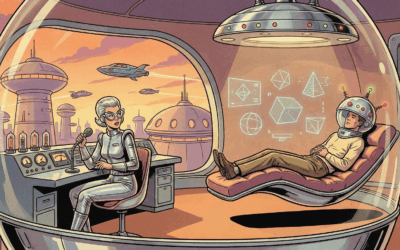
The therapist of the future will not just treat “anxiety.” They will treat the weaponization of collective trauma. They will help clients navigate the new media landscape without losing their souls.
We are on track for a world where reality is customizable, truth is optional, and the self is a project. To survive, we must learn to read the code—not just the computer code, but the cultural and psychological code that is running in the background of our civilization.
We must reclaim the archetypes that the algorithm is trying to eat. The revolution will not be televised; it will be felt, deeply and somatically, by those who refuse to become compatible with the machine.
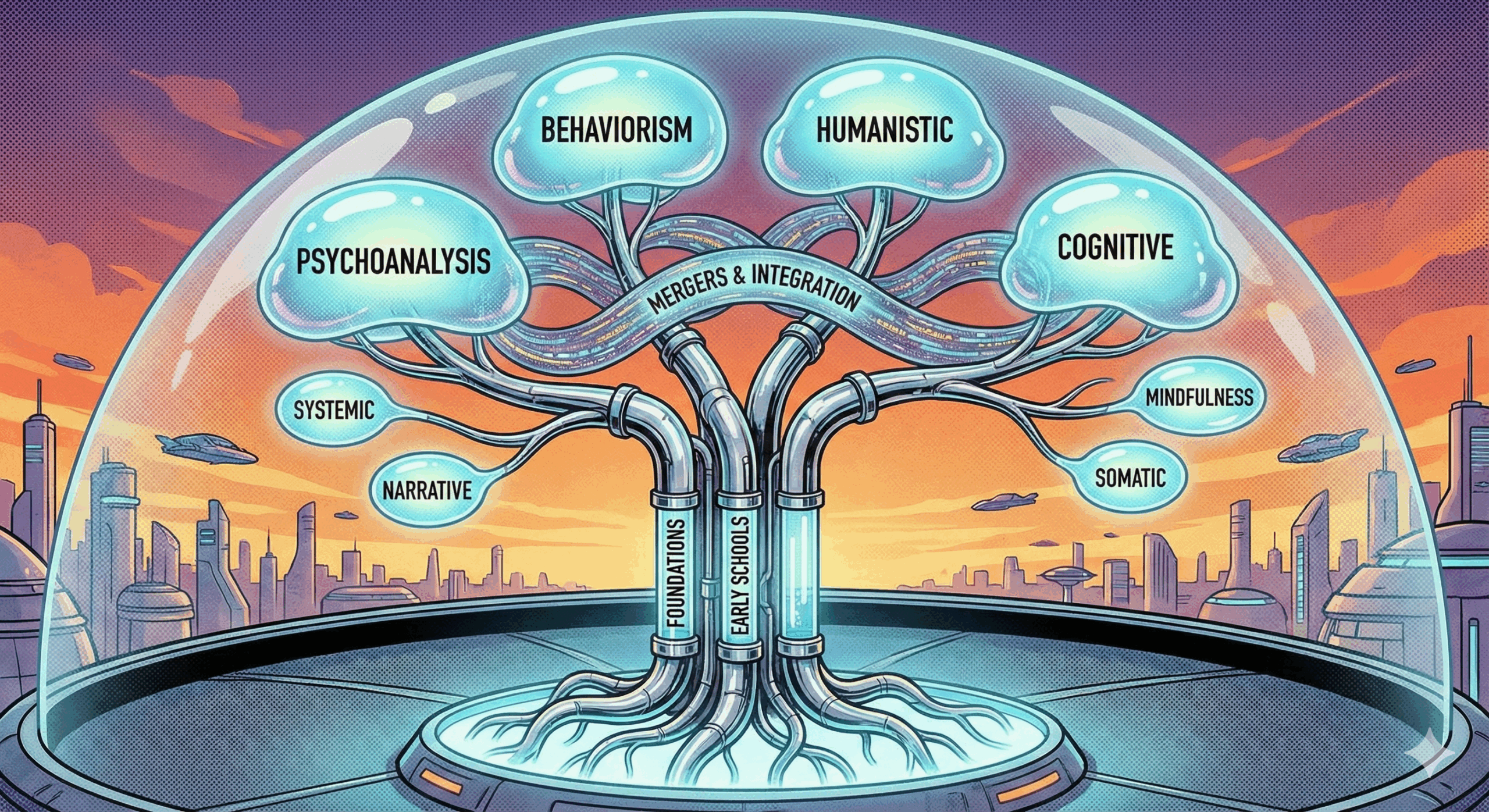
e integration. The warring “schools” of therapy will dissolve into a unified science of human flourishing.
We will no longer ask “Is it biological or psychological?” We will understand that the architecture of the soul and the machine are one and the same. The therapist of the future will effectively be a “systems engineer” of the human organism—adjusting the gut microbiome, tuning the vagus nerve, and guiding the mythopoetic journey of the soul simultaneously.
This is the vision laid out in Sailing the Foam: History, Madness, and the Future of Therapy. We are moving away from the era of managing symptoms and toward the era of optimizing consciousness.
If you are in therapy today, you are a pioneer. You are participating in a field that is rapidly shedding its skin. By engaging with somatic work, nutritional psychiatry, and depth psychology, you are essentially time-traveling—using the tools of the future to heal in the present.
To understand the philosophical shift that underpins this future, explore the concept of the fusion of science and mysticism.
















0 Comments