
Why Internal Family Systems (IFS) Therapy Works: Exploring the Philosophical, Biological, and Neuroexperiential Foundations
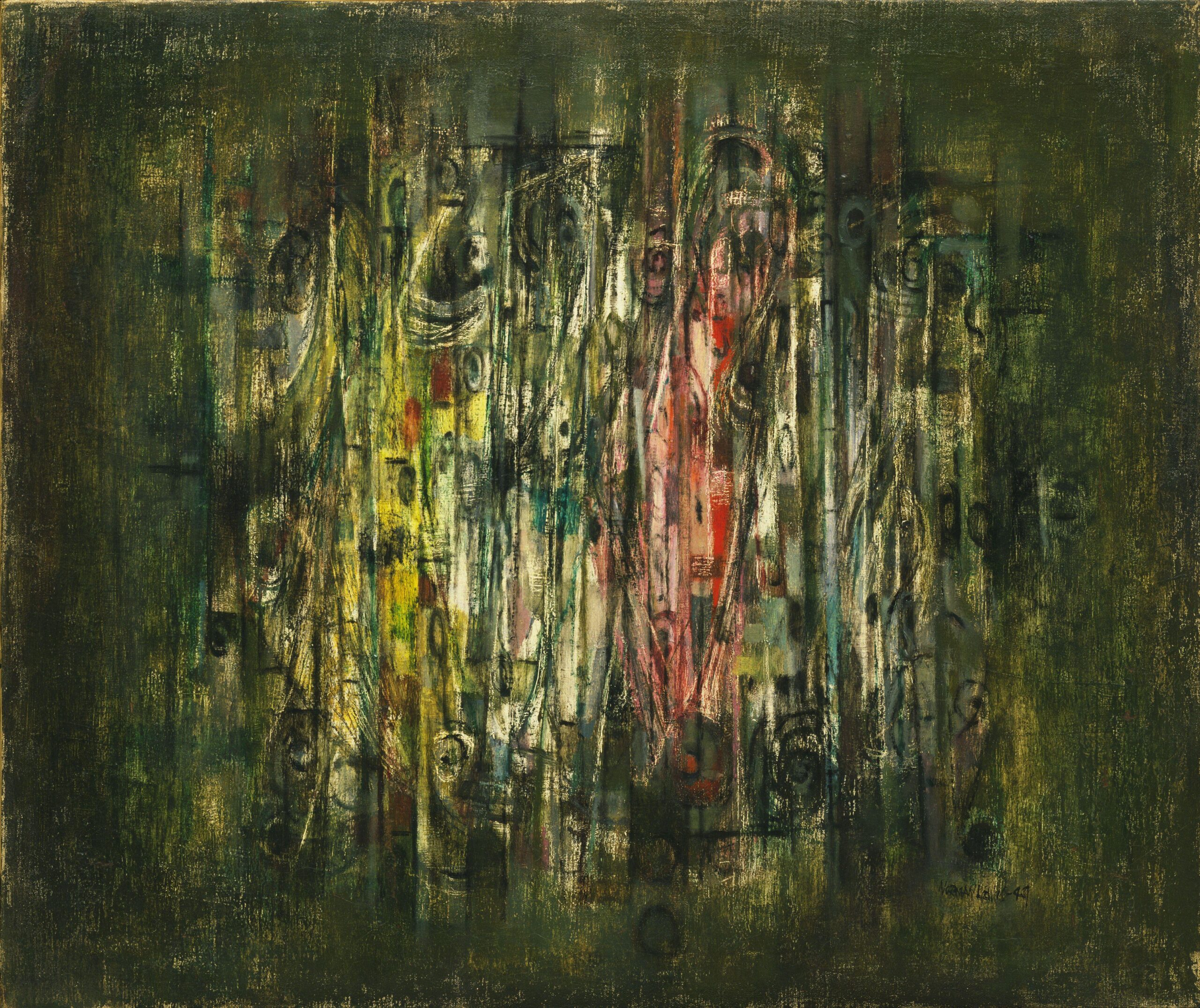
The Internal Family Systems (IFS) model, developed by Richard Schwartz, has gained significant recognition as an effective therapeutic approach for treating a wide range of mental health issues. This essay explores the philosophical, biological, and neuroexperiential underpinnings of IFS, shedding light on why this approach works. We will delve into the concept of multiple consciousness, the role of competing neural networks, and the importance of cultivating metacognition in the healing process.
The Multiplicity of Consciousness
At the heart of why IFS works is the recognition that we have multiple types of consciousness operating simultaneously, with multiple conflicting neural networks active at once (Schwartz, 2001). To heal, we must learn to sit with the tension of these opposites, rather than trying to repress or eliminate one side. This insight – that the mind contains multitudes – is what guided the early parts-based psychologies.
The Philosophical Roots of IFS
Sigmund Freud recognized the existence of competing drives, but largely misunderstood their nature and motivations (Schwartz, 2001). Alfred Adler took this further, noticing how extreme psychological traits often emerged to compensate for their opposites (Carlson & Englar-Carlson, 2017). But it was Carl Jung who saw most clearly that true healing requires us to acknowledge both poles of our nature, to hold the tension of opposites rather than repressing one side (Jung, 1969).
Jung’s theory of archetypes – universal patterns of psychic energy – has been both prescient and problematic. While modern neuroscience has moved beyond some of his specific formulations, the core insight that the mind is made up of many competing networks, unlike a computer or algorithm, is now being validated by researchers like Michael Gazzaniga and Antonio Damasio, as well as other cognitive therapists and neurologists (Gazzaniga, 2018; Damasio, 2010).
IFS also draws on the perennial philosophy – the idea that there is a universal truth underlying the world’s spiritual traditions, which emphasizes the existence of an innate wisdom or “Self” within each individual (Schwartz, 2001). By connecting with this Self, IFS suggests, we can bring our inner parts into harmonious balance.
The Parts-Based Paradigm: From Jung to IFS
The parts-based, somatic, and experiential therapies that have emerged in recent decades can be seen as direct descendants of Jungian psychology. As IFS founder Richard Schwartz explains, his model combines the experiential focus of Fritz Perls’ Gestalt therapy with the parts-based “map” of the psyche developed by Jung, while also drawing on perennial philosophy traditions (Schwartz, 2001).
Other post-Jungian theorists have likewise sought to integrate analytical psychology with somatic and experiential practices and Eastern wisdom traditions. Hal and Sidra Stone’s Voice Dialogue, for instance, and Arnold Mindell’s Process-Oriented Psychology, bear many similarities to IFS in their emphasis on embracing all parts of the self (Stone & Stone, 1989; Mindell, 2010).
The Neurobiology of a Divided Mind
What was once a purely philosophical or analytical premise is now finding solid empirical grounding in neuroscience. Quantitative EEG and fMRI studies have revealed the existence of multiple, often competing neural networks in the brain – some evolutionarily ancient, some shaped by early childhood experiences, some influenced by genes and epigenetics (Gazzaniga, 2018; Damasio, 2010). This research is demonstrating how each part of the mind has its own goals, memories, and traits, laid down at different stages of development.
Some of these parts originated to protect us from acute traumas or attachment injuries; some are carry-overs from previous evolutionary challenges; some embody our highest ideals and aspirations (Schwartz, 2001). When external triggers or internal conflicts activate these subsystems, their opposing agendas can manifest as psychological distress and dysfunction.
Metacognition: The Key to Healing
The central task of IFS is to transform our relationship to these parts by cultivating meta-awareness or “Self energy.” In this state of mindful metacognition, we can witness and engage with our inner factions objectively, without being overwhelmed by them (Gazzaniga, 2018). We learn to sit in the tension of opposites, extending curious compassion to even the most troubling parts of our psyche.
This is a delicate balancing act. We need to open empathic space for exiled emotions and impulses while also retaining the ballast of our witnessing consciousness. Too much merger with a traumatized part can pull us into the vortex of its pain; too much dissociation can make us neglect its messages. The goal is an intimate “you-I” relationship, in which we can honor the needs of our parts without being hijacked by them (Schwartz, 2001).
Schwartz calls this “unblending”: a state of dual awareness that allows us to engage a part without fusing with it (Schwartz, 2001). As we build trust with the fear-based “manager” parts and unburden the wounded “exiles,” our core Self becomes the gravitation center around which the system revolves. We shift from a paradigm of inner conflict to one of inner communion and self-acceptance.
Somatic and Experiential Approaches
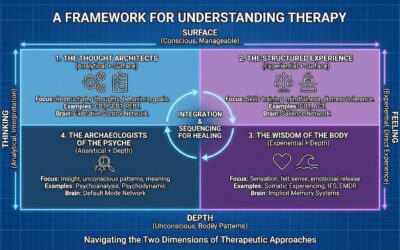
While IFS relies largely on visualization and verbal dialoguing techniques to contact parts, somatic and experiential modalities offer complementary avenues for deepening this work. The focused mindfulness of Brainspotting, for instance, with its emphasis on the “felt sense,” can help override the top-down inhibitions of the prefrontal cortex and evoke dissociated parts more quickly and viscerally (Grand, 2013).
Emotional Transformation Therapy (ETT), meanwhile, harnesses the symbolic power of color, imagery, and eye movements to activate core feelings and memories in ways that can bypass the verbal, conceptual mind (Vazquez, 2014). By pairing these unconditioned stimuli with new experiences of safety and mastery, ETT aims to rapidly update deep emotional learnings.
Somatic therapies like Sensorimotor Psychotherapy or Somatic Experiencing help regulate the autonomic nervous system and build bodily awareness, which is crucial for handling traumatic activation (Levine, 2010; Ogden & Fisher, 2015). Since our parts carry not just mental but also physiological signatures, enlisting the body is often essential to achieving full resolution and integration.
Towards a More Integrated Therapy
The genius of IFS is its recognition that we are, each of us, many – and its empowering vision of how to turn this inner diversity into a source of healing and Self-leadership. By combining the conceptual clarity of a parts-based model with the emotional depth of experiential techniques and the regulatory wisdom of somatic practices, IFS offers a uniquely integrative and hopeful approach to human growth.
As we’ve seen, IFS reflects an emerging scientific consensus that the human brain is less like a unitary machine and more like an ecosystem of interacting networks – each with its own evolutionary origins, developmental functions, and triggering stimuli (Gazzaniga, 2018). By helping us surf the dynamic tensions within this living system, IFS points a way towards true “intrapersonal” intelligence.
Of course, this is not a quick or linear path. The process of shifting our inner world from a paradigm of polarization to one of Self-led collaboration is a profound journey that takes patience, courage, and no small amount of faith. Parts work can stir up buried traumas and trigger painful periods of disorientation. We must be willing to pass through cycles of rupture and repair, over and over, in pursuit of a more integrated wholeness.
But as the growing popularity and efficacy of IFS demonstrates, this is a journey worth taking – not just for the individuals who undergo it directly, but for all those whose lives they touch. For as within, so without. The same archetypal dynamics that play out in the microcosm of our individual minds shape the cultures and systems in which we collectively live and work.
In a world riven by conflict and dissociation, there may be no more urgent task than learning to host the myriad voices within us with openhearted awareness. The hidden promise of parts work is a radical politics of embracing every exile, a new ecology of mind in which all the fragmented aspects of self and society are welcomed back into the wholeness of true belonging.
IFS, in this sense, is more than just a therapy – it is a paradigm and a way of life. A life in which no part is left behind, no story untold, no wound unmet by the miracle of presence. In learning to honor the full spectrum of our inner diversity, we apprentice ourselves to the master craft of love. And what larger calling could there be than that?
Further Resources and Reading on IFS
Books:
-
Introduction to Internal Family Systems (Second Edition) by Richard C. Schwartz: This foundational book offers a comprehensive overview of the IFS model, detailing its principles and applications.
-
Internal Family Systems Therapy (Second Edition) by Richard C. Schwartz and Martha Sweezy: This updated edition delves deeper into the therapeutic techniques and case studies associated with IFS.
-
No Bad Parts: Healing Trauma and Restoring Wholeness with the Internal Family Systems Model by Richard C. Schwartz: This book emphasizes the concept that all parts of ourselves are valuable and explores how to heal trauma through IFS.
-
Internal Family Systems: Skills Training Manual by Frank G. Anderson, Martha Sweezy, and Richard C. Schwartz: This manual provides practical exercises and guidance for applying IFS techniques in therapeutic settings.
Training Programs:
-
IFS Institute Training Programs: The IFS Institute offers structured training programs, including Level 1, Level 2, and Level 3 courses, designed for both professionals and individuals seeking personal growth.
-
GoodTherapy IFS Training Courses: GoodTherapy provides a selection of IFS training courses suitable for therapists and counselors aiming to integrate IFS into their practice.
Bibliography
- Carlson, J., & Englar-Carlson, M. (2017). Adlerian psychotherapy. American Psychological Association.
- Damasio, A. (2010). Self comes to mind: Constructing the conscious brain. Pantheon.
- Gazzaniga, M. S. (2018). The consciousness instinct: Unraveling the mystery of how the brain makes the mind. Farrar, Straus and Giroux.
- Grand, D. (2013). Brainspotting: The revolutionary new therapy for rapid and effective change. Sounds True.
- Jung, C. G. (1969). The structure and dynamics of the psyche (2nd ed.). Princeton University Press.
- Levine, P. A. (2010). In an unspoken voice: How the body releases trauma and restores goodness. North Atlantic Books.
- Mindell, A. (2010). Process mind: A user’s guide to connecting with the mind of God. Quest Books.
- Ogden, P., & Fisher, J. (2015). Sensorimotor psychotherapy: Interventions for trauma and attachment. W.W. Norton.
- Schwartz, R. C. (2001). Introduction to the Internal Family Systems model. Trailheads Publications.
- Stone, H., & Stone, S. (1989). Embracing our selves: The Voice Dialogue manual. New World Library.
- Vazquez, S. (2014). Emotional Transformation Therapy: An interactive ecological psychotherapy. Jason Aronson.










0 Comments