
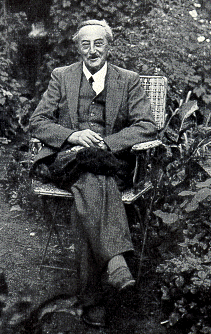
The Architect of Transitions
Life is a series of crossings. We cross from childhood to adulthood, from single to married, from work to retirement, from life to death. But how do we cross safely? Arnold van Gennep (1873–1957) was the first anthropologist to recognize that all human societies use a specific technology to manage these transitions: the Rite of Passage.
Van Gennep’s discovery was not just academic; it unveiled the hidden grammar of human transformation. He showed that without a ritual container, the psyche often fails to make the crossing, leaving the individual stuck in a permanent state of adolescence or trauma. His tripartite model—Separation, Liminality, Incorporation—is now a cornerstone of modern psychotherapy and trauma treatment.
Biography & Timeline: Arnold van Gennep (1873–1957)
Born in Germany to a Dutch father and French mother, Van Gennep was a true European cosmopolitan. Despite his brilliance, he was largely marginalized by the French academic establishment, led by Emile Durkheim. While Durkheim focused on social stability, Van Gennep was obsessed with social movement—how people change.
His masterpiece, The Rites of Passage (1909), was largely ignored in his lifetime but was rediscovered in the 1960s by Victor Turner. Today, it is considered one of the most influential texts in anthropology.
Key Milestones in the Life of Arnold van Gennep
| Year | Event / Publication |
| 1873 | Born in Ludwigsburg, Kingdom of Württemberg. |
| 1909 | Publishes Les Rites de Passage, outlining the universal structure of transition rituals. |
| 1912-1915 | Chair of Ethnography at the University of Neuchâtel (Switzerland), his only permanent academic post. |
| 1957 | Dies in Bourg-la-Reine, France. |
The Tripartite Structure of Rites of Passage
Van Gennep identified a universal pattern in all rituals of change. Whether it is an Aboriginal walkabout or a military boot camp, the structure is the same:
1. Separation (Pre-Liminal)
The individual is stripped of their old identity. They are removed from the community, their head is shaved, or they are given a new name. This is a symbolic death.
2. Transition (Liminal)
The Latin word limen means “threshold.” This is the “betwixt and between” stage. The initiate is no longer a child, but not yet an adult.
Characteristics: Ambiguity, chaos, reversal of roles, and high vulnerability. In this stage, the initiate is like soft clay, ready to be reshaped.
3. Incorporation (Post-Liminal)
The individual re-enters society with a new status. There is a celebration, a meal, or a public acknowledgement. The chaos of the liminal stage is resolved into a new order.
The Conceptualization of Trauma: The Stuck Liminality
Van Gennep’s model offers a powerful lens for understanding PTSD and complex trauma. Trauma is often an involuntary Rite of Passage.
The Failed Crossing
A traumatic event (Separation) throws the individual into a state of chaos (Liminality). However, in modern society, we often lack the rituals of Incorporation.
The Result: The survivor remains “stuck” in the liminal phase. They live in a permanent state of high arousal, ambiguity, and disconnection. They are “betwixt and between”—neither fully alive nor dead. They are ghosts in their own lives.
Therapy as Ritual Incorporation
Psychotherapy serves as the missing third stage. It provides the “Sacred Space” where the chaotic experience can be narrated and integrated. The therapist acts as the “Ritual Elder” who welcomes the survivor back into the community of the living.
Legacy: The Necessity of Ritual
Van Gennep teaches us that transitions are dangerous. If we do not ritualize them, they can destroy us. We see this in the “gang initiations” of urban youth—a desperate, distorted attempt to create a Rite of Passage where society has failed to provide one.
For the modern clinician, Van Gennep is a reminder that healing is not just about fixing symptoms; it is about helping the client cross the threshold from the “Old Self” to the “New Self.”
Further Reading & Resources
- University of Chicago Press: The Rites of Passage.
- Victor Turner: The Ritual Process: Structure and Anti-Structure (Cornell University Press, 1969).
- Encyclopedia Britannica: Arnold van Gennep.
Explore More on Ritual & Psychology
- Victor Turner and Liminality
- Mircea Eliade: The Sacred and the Profane
- The Dreamtime and Sacred Space
The Architect of Transitions
Life is a series of crossings. We cross from childhood to adulthood, from single to married, from work to retirement, from life to death. But how do we cross safely? Arnold van Gennep (1873–1957) was the first anthropologist to recognize that all human societies use a specific technology to manage these transitions: the Rite of Passage.
Van Gennep’s discovery was not just academic; it unveiled the hidden grammar of human transformation. He showed that without a ritual container, the psyche often fails to make the crossing, leaving the individual stuck in a permanent state of adolescence or trauma. His tripartite model—Separation, Liminality, Incorporation—is now a cornerstone of modern psychotherapy and trauma treatment.
Biography & Timeline: Arnold van Gennep (1873–1957)
Born in Germany to a Dutch father and French mother, Van Gennep was a true European cosmopolitan. Despite his brilliance, he was largely marginalized by the French academic establishment, led by Emile Durkheim. While Durkheim focused on social stability, Van Gennep was obsessed with social movement—how people change.
His masterpiece, The Rites of Passage (1909), was largely ignored in his lifetime but was rediscovered in the 1960s by Victor Turner. Today, it is considered one of the most influential texts in anthropology.
Key Milestones in the Life of Arnold van Gennep
| Year | Event / Publication |
| 1873 | Born in Ludwigsburg, Kingdom of Württemberg. |
| 1909 | Publishes Les Rites de Passage, outlining the universal structure of transition rituals. |
| 1912-1915 | Chair of Ethnography at the University of Neuchâtel (Switzerland), his only permanent academic post. |
| 1957 | Dies in Bourg-la-Reine, France. |
The Tripartite Structure of Rites of Passage
Van Gennep identified a universal pattern in all rituals of change. Whether it is an Aboriginal walkabout or a military boot camp, the structure is the same:
1. Separation (Pre-Liminal)
The individual is stripped of their old identity. They are removed from the community, their head is shaved, or they are given a new name. This is a symbolic death.
2. Transition (Liminal)
The Latin word limen means “threshold.” This is the “betwixt and between” stage. The initiate is no longer a child, but not yet an adult.
Characteristics: Ambiguity, chaos, reversal of roles, and high vulnerability. In this stage, the initiate is like soft clay, ready to be reshaped.
3. Incorporation (Post-Liminal)
The individual re-enters society with a new status. There is a celebration, a meal, or a public acknowledgement. The chaos of the liminal stage is resolved into a new order.
The Conceptualization of Trauma: The Stuck Liminality
Van Gennep’s model offers a powerful lens for understanding PTSD and complex trauma. Trauma is often an involuntary Rite of Passage.
The Failed Crossing
A traumatic event (Separation) throws the individual into a state of chaos (Liminality). However, in modern society, we often lack the rituals of Incorporation.
The Result: The survivor remains “stuck” in the liminal phase. They live in a permanent state of high arousal, ambiguity, and disconnection. They are “betwixt and between”—neither fully alive nor dead. They are ghosts in their own lives.
Therapy as Ritual Incorporation
Psychotherapy serves as the missing third stage. It provides the “Sacred Space” where the chaotic experience can be narrated and integrated. The therapist acts as the “Ritual Elder” who welcomes the survivor back into the community of the living.
Legacy: The Necessity of Ritual
Van Gennep teaches us that transitions are dangerous. If we do not ritualize them, they can destroy us. We see this in the “gang initiations” of urban youth—a desperate, distorted attempt to create a Rite of Passage where society has failed to provide one.
For the modern clinician, Van Gennep is a reminder that healing is not just about fixing symptoms; it is about helping the client cross the threshold from the “Old Self” to the “New Self.”
Further Reading & Resources
- University of Chicago Press: The Rites of Passage.
- Victor Turner: The Ritual Process: Structure and Anti-Structure (Cornell University Press, 1969).
- Encyclopedia Britannica: Arnold van Gennep.













0 Comments