
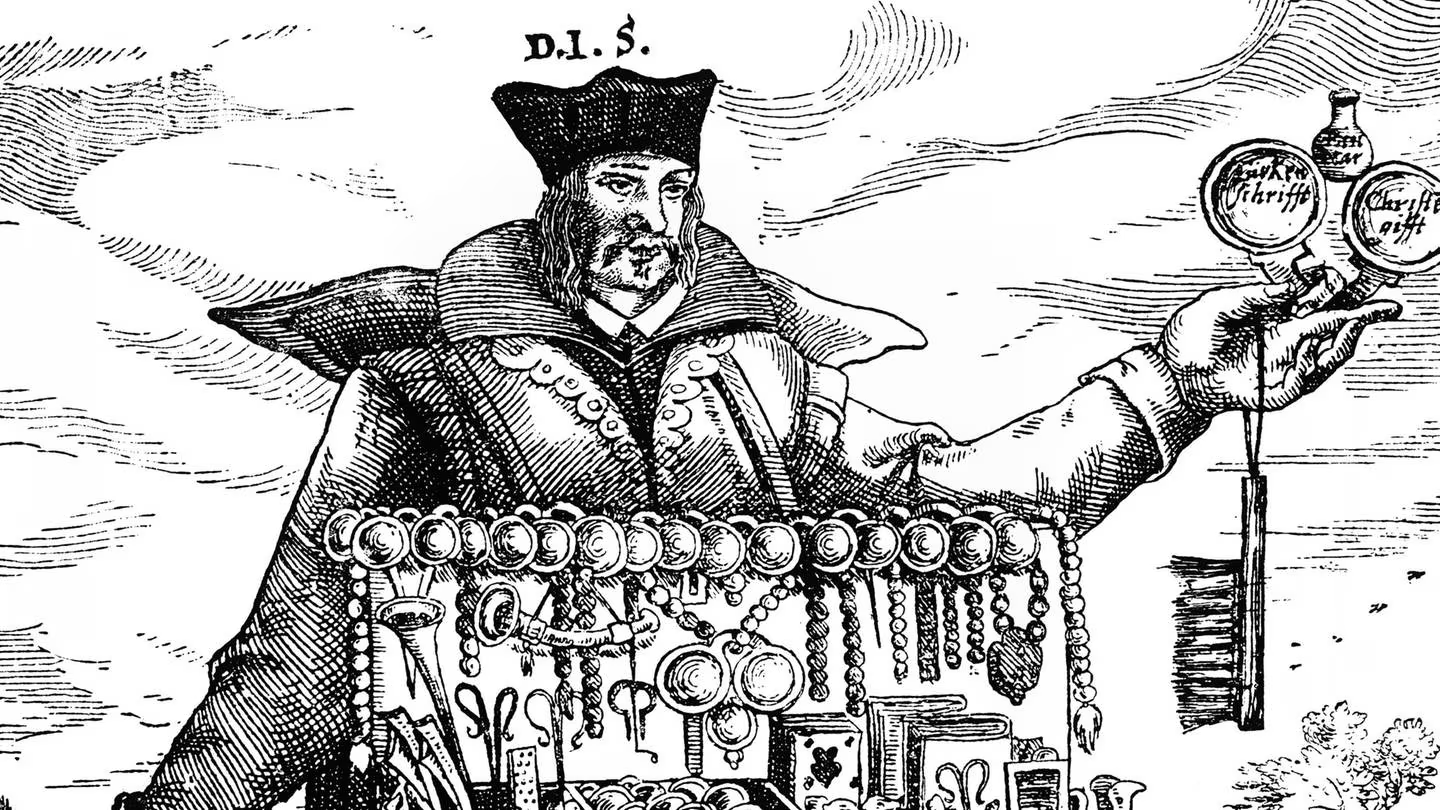
Angelus Silesius is the pen name of Johannes Scheffler (1624–1677), a Lutheran-born physician from Breslau, now Wrocław in Poland, who converted to Catholicism in 1653 and later became a priest. He is known for the Cherubinic Wanderer, a book of short rhymed paradoxes about God and the self first printed in 1657, among them “The rose is without why; it blooms because it blooms.”1, 2
The couplets can sound like instructions for destroying the self: be nothing, want nothing, die to yourself. Read with the preface he wrote for them, they say something more careful. What has to go is the self’s grip on fixed descriptions of itself. “I am not what I know,” one couplet says. The soul, he insisted, never stops being a creature, any more than iron in a fire stops being iron. That is close to what trauma therapy asks: to loosen an identity like “victim” or “the one who always gets left” without pretending the harm did not happen. The history stays true. It stops being the whole definition of the person.
Who Angelus Silesius was
Johannes Scheffler was baptized in Breslau on Christmas Day 1624, about five weeks after the death of Jakob Böhme, the Görlitz shoemaker and theosopher whose books would later redirect his life. His father, a Protestant from Kraków ennobled by King Sigismund III, was 62 when his son was born. His father died in 1637 and his mother in 1639.1
Scheffler studied medicine at Strasbourg and Leiden, where he read Böhme and the Flemish mystic Jan van Ruusbroec, and took his doctorate in philosophy and medicine at Padua on 9 July 1648. As court physician to the strictly Lutheran Duke of Württemberg-Oels he grew close to Abraham von Franckenberg, a friend of Böhme’s. When the court preacher refused to license a small devotional book Scheffler had drawn from the mystics, and Franckenberg died in 1652, he resigned and went home.1
On 12 June 1653 he was received into the Catholic Church at St. Matthias in Breslau and took the name Johannes Angelus. Angelus is Latin for angel, from the Greek word for messenger. He later added Silesius, “the Silesian,” to the name on his writings so that he would not be confused with a theologian of the same name.1, 3
Ordained a priest in 1661, he became a combative figure of the Counter-Reformation in Silesia. His first major tract, on the Turkish threat, got him charged with disturbing the peace in 1663. Over about twelve years he published 55 polemical writings against Protestants, 39 of them collected in 1677 as Ecclesiologia. The gap between the quiet epigrams and the abusive tracts was so wide that in 1853 one scholar tried to prove that Scheffler and Angelus Silesius were two different men. He died after years of illness at the St. Matthias house in Breslau on 9 July 1677, aged 52.1, 3
| Year | Event |
|---|---|
| 1624 | Baptized Johannes Scheffler in Breslau, 25 December |
| 1643–1648 | Studies at Strasbourg, Leiden and Padua; doctorate at Padua, 9 July 1648 |
| 1649–1652 | Physician at the court of Oels; friendship with Abraham von Franckenberg |
| 1653 | Becomes a Catholic, 12 June; takes the name Johannes Angelus |
| 1654 | Honorary physician to the imperial court |
| 1657 | Geistreiche Sinn- und Schlussreime (Vienna) and the hymns Heilige Seelenlust |
| 1661 | Ordained priest at Neisse, 29 May |
| 1664–1666 | Court marshal to the Prince-Bishop of Breslau |
| 1674–1675 | Enlarged second edition, with a sixth book, titled Cherubinischer Wandersmann |
| 1677 | Ecclesiologia; dies in Breslau, 9 July |
What the Cherubinic Wanderer is
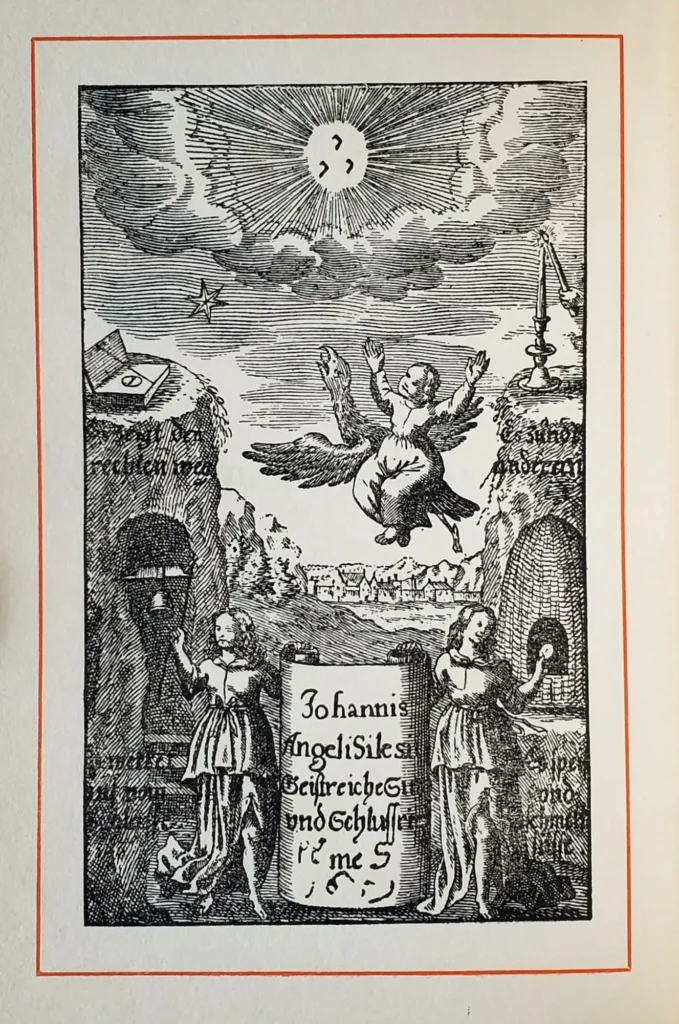
The book first appeared in Vienna in 1657, approved by a Jesuit censor, as Geistreiche Sinn- und Schlussreime, roughly “witty epigrams and closing rhymes.” The familiar title came with the enlarged second edition of 1674 or 1675, depending on the source. The Neue Deutsche Biographie holds that the first edition’s epigrams were written before his conversion.1, 2 The six books of the 1675 edition hold more than 1,600 numbered epigrams, most of them alexandrine couplets: two rhymed lines of about twelve syllables, each split by a pause. Some are quatrains or longer. The form is built for antithesis.
He knew the couplets could be read as heresy, and his preface says so. They contain “many strange paradoxes” about union with God and deification, he warns, and their brevity makes it easy to give them a damnable sense. So he states once and for all that he nowhere means the human soul could lose its createdness and be changed into God’s uncreated being. The soul becomes by grace what God is by nature. His authorities include Johannes Tauler, whom he cites repeatedly, Jan van Ruusbroec’s Spiritual Espousals, Bernard of Clairvaux, and a theological commentary on John of the Cross. He also quotes the Flemish Benedictine Louis de Blois on iron in a fire: it takes on the fire’s form, yet the soul’s own being remains, “just as the glowing iron does not stop being iron.” To lose oneself in that way, Blois writes, “is rather to find oneself.”2
Five couplets, translated plainly
These are literal renderings of the 1675 German text, cited by book and number. A widely used modern English translation is Maria Shrady’s, published in 1986 in Paulist Press’s Classics of Western Spirituality series.2, 4
I.5, “One does not know what one is.” “I do not know what I am; I am not what I know: a thing and not a thing, a dot and a circle.” Whatever I can say about myself, I am more than the saying.
I.25, “God is not grasped.” “God is a pure nothing; no Now and no Here touches him. The more you reach for him, the more he un-becomes for you.”
I.10, “I am like God, and God like me.” “I am as great as God, he is as small as I. He cannot be above me, nor I beneath him.” Next to I.8, which says God cannot live an instant without him, he wrote in the margin: see the preface. He knew how it sounded.
II.136, on Gelassenheit. “Go out, and God comes in. Die to yourself, and you live God. Be not, and it is he.” Gelassenheit, the title of the couplet before it, is the German mystics’ word for releasement or letting-be.
I.289, “Without why.” “The rose is without why; it blooms because it blooms. It pays no attention to itself and does not ask whether anyone sees it.” Martin Heidegger used it in Der Satz vom Grund (1957) to work through the principle that nothing is without a reason.2, 9
Two lines are often credited to him online. “Die before you die, so that when you die, you will not die” is genuine: it is IV.77, titled “Spiritual dying,” which in full reads “Die before you die, so that you need not die when you are to die; otherwise you may perish.” The other, “The way to life is death, the way to rise is fall,” did not turn up in the 1675 text. Close to it in spirit are VI.121, “life is given to you only through death,” and I.27, where the wise man who dies a thousand times seeks a thousand lives “through truth itself.”2
Ungrund, abyss and the divine nothing
Earlier versions of this page put the Ungrund at the center of Silesius’s thought. The word is Böhme’s, his name for the groundless depth of God, and Schelling later took the concept over from him.5 In the Wanderer it appears, as far as I could find, once: “God is indeed an unground; but whoever is to see him must climb to the summit of the eternal mountains” (V.29). Silesius’s own words for that territory are Abgrund (abyss), Nichts (nothing) and Wüste (desert). “The abyss of my spirit always cries out to the abyss of God: say, which is deeper?” (I.68). In I.7 he must go “beyond God, into a desert,” and the margin points the reader to the mystics’ “negative contemplation,” the apophatic way of speaking of God by what God is not.2
The old page also equated the Ungrund with the unconscious. That is a modern overlay. Jung read the mystics roughly this way, but it was his interpretation, not theirs.
What Jung actually said about him
In Psychological Types (1921), right after a long reading of Meister Eckhart, Jung turns to “that solitary poet whose tragic fate it was to find no relation either to his own times or to his own inner vision.” Silesius, he says, sings in intimate verse the “relativity of God” that Eckhart labored to express in thought, and he quotes a dozen couplets, I.8 and I.10 among them. In the paragraphs just before, on Eckhart, he reads such union as the ego becoming identical again with the unconscious, so that God “disappears as an object,” and says the Eastern analogies had been elaborated by writers “more qualified than myself.”6 Jung later found one such scholar in the Indologist Heinrich Zimmer, whom he met in 1932 and who became a close friend.
Jung’s other comment is less flattering. In Two Essays in Analytical Psychology he describes the “mana-personality,” the inflation that follows when the ego takes over the power it has won from the unconscious and casts itself as the hero, the saint, “the friend of God.” This “uncomfortable kinship with the gods,” he writes, struck so deep into “poor Angelus Silesius’ bones” that it drove him “back to the nethermost womb of the dark Mother,” Jung’s image for the Catholic Church, “unfortunately very much to the detriment of his lyrical gifts and the health of his nerves.”7 Both passages are in the English Collected Works, edited by Herbert Read, Michael Fordham and Gerhard Adler.
So Jung read Silesius as both renewal and inflation. Edinger’s model separates an ego inflated by identification with the Self from one in working relationship with it, which is exactly the question Silesius’s boldest couplets raise.8
Ego death that does not erase the person
“Ego death” is a modern phrase, and it invites a misreading. Silesius does write that as long as you still are something, know something, love and have something, “you are not, believe me, free of your burden” (I.24). But his preface rules out the reading in which the person is abolished. The iron glows and stays iron. In I.27 it is “through truth itself,” not through forgetting, that the wise man who dies a thousand times seeks new life. What dies is a way of holding the self.
Analytical psychology has a developmental version of this. Michael Fordham proposed that the infant’s self “deintegrates” rather than splits or disintegrates, and that the ego matures through both deintegrative and integrative processes.11 A healthy self comes apart and re-forms many times. That is different from a self that shatters.
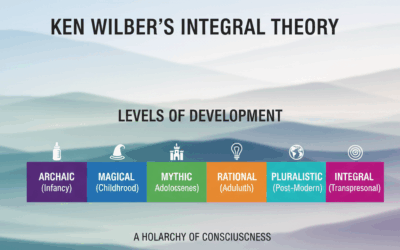
Not every loss of self is a gain. Ken Wilber called the confusion the pre/trans fallacy: pre-egoic and trans-egoic states can look alike, so people elevate regression into transcendence or reduce transcendence to regression.10 Feeling unreal, or like an outside observer of one’s own thoughts and body, may be depersonalization, a dissociative symptom, rather than mystical release.16 “No self” language can appeal to someone who is already dissociating, and it can dress up numbness as peace.
His own life is the other caution. The poet of Gelassenheit spent much of his last fourteen years on polemical tracts. The Neue Deutsche Biographie says the mystical thinker became a Catholic fighter, and that in these quarrels the religious element vanishes and only crude abuse on both sides remains.1 Diagnosing a seventeenth-century man from his pamphlets would be glib, but the pattern is familiar in depth work. Insight into the emptiness of the ego does not by itself change character, and a one-sided attitude pushed out of one area of life tends to return in another.
What this looks like in therapy
People rarely arrive saying their ego needs to die. They say “I’m the one who gets left,” or “I’m damaged.” Usually these are accurate summaries of what happened, compressed into a statement of what the person is. The compression is where the trouble lies.
The research is suggestive, though correlational. The Centrality of Event Scale measures how far a traumatic or stressful event has become central to someone’s identity and life story. A systematic review of 92 publications found it correlates most strongly with measures of trauma, PTSD, grief and autobiographical memory.12 That does not prove a trauma-centered identity causes symptoms, but it fits what clinicians see: when one event organizes the whole self, the event keeps happening.
One capacity that may loosen it is what researchers call decentering. Bernstein and colleagues describe three linked processes: meta-awareness, disidentification from internal experience, and reduced reactivity to the content of thoughts.13 “I am not what I know” points the same way in seventeenth-century German. The thought “I’m worthless” is an event in the mind, not a verdict.
Victimhood needs care. Gabay and colleagues describe a “tendency for interpersonal victimhood,” an enduring feeling that the self is a victim across many relationships, made up of a need for recognition, moral elitism, a lack of empathy and rumination; their eight studies examined its links to negative attributions, biased recall and the desire for revenge.14 The construct describes a general personality tendency, not a verdict on people who were actually harmed. In therapy the harm is acknowledged first and fully. The need for recognition is legitimate, and when it is never met it can harden into identity.
In practice the work tends to go like this:
- Name what happened, specifically. Nobody is asked to minimize, forgive on schedule or skip to transcendence.
- Notice the leap from “this happened to me” to “this is what I am.” It often happens in one breath, and the person may not hear it until it is reflected back.
- Ask what the identity protects. Parts-based and depth approaches treat a self-description like “victim” or “the strong one” as something that once kept the person safe. It loosens when that protection is no longer needed, not when it is argued away.
- Watch for false peace. If letting go feels like going numb or floating outside oneself, that may be dissociation to work with, not a breakthrough.
Be wary of rebirth language too. In one study that measured college students before and after a traumatic event, the growth people reported was largely unrelated to measured change, and perceived growth went with more distress while actual growth went with less.15 Nobody should be pushed to say the worst thing that happened to them made them better. Silesius’s rose does not ask whether anyone sees it. Real change often looks like that: less narrating of one’s own transformation, more room to live.
If you are in Alabama and an old identity has started to feel more like a cell than a description, that is a reasonable thing to bring to a therapist. You can read how we approach Jungian depth therapy in Hoover, or contact us to ask whether it would fit.
References
- Stammler, W. (1953). Angelus Silesius (eigentlich Johannes Scheffler). In Neue Deutsche Biographie (Vol. 1, pp. 288–291). https://www.deutsche-biographie.de/gnd118503111.html#ndbcontent
- Angelus Silesius. (1675). Cherubinischer Wandersmann oder Geist-Reiche Sinn- und Schluss-Reime (2nd enl. ed.). Schubarth. (Original work published 1657 as Geistreiche Sinn- und Schlussreime). Transcription read at Projekt Gutenberg-DE: https://projekt-gutenberg.org/authors/angelus-silesius/books/cherubinischer-wandersmann; complete text checked in the 1905 Diederichs reprint of the 1675 edition: https://archive.org/details/desangelussilesi00angeuoft
- Lemcke, L. (1875). Angelus Silesius, mit seinem Vaternamen Johann Scheffler. In Allgemeine Deutsche Biographie (Vol. 1, pp. 453–456). https://www.deutsche-biographie.de/gnd118503111.html#adbcontent
- Angelus Silesius. (1986). The cherubinic wanderer (M. Shrady, Trans.; J. Schmidt, Intro.). Paulist Press. https://doi.org/10.5040/9780809172061
- Friedrich, H. J. (2009). Der Ungrund als Nichts. In Der Ungrund der Freiheit im Denken von Böhme, Schelling und Heidegger (pp. 79–126). frommann-holzboog. https://doi.org/10.5771/9783772830051-79
- Jung, C. G. (1971). Psychological types (H. G. Baynes, Trans., rev. R. F. C. Hull; Collected Works Vol. 6). Princeton University Press. (Original work published 1921). Paragraphs 430–433.
- Jung, C. G. (1966). Two essays in analytical psychology (R. F. C. Hull, Trans.; 2nd ed.; Collected Works Vol. 7). Princeton University Press. Paragraphs 377–378 and 396.
- Edinger, E. F. (1972). Ego and archetype: Individuation and the religious function of the psyche. G. P. Putnam’s Sons for the C. G. Jung Foundation for Analytical Psychology.
- Heidegger, M. (1991). The principle of reason (R. Lilly, Trans.). Indiana University Press. (Original work published 1957)
- Wilber, K. (1982). The pre/trans fallacy. Journal of Humanistic Psychology, 22(2), 5–43. https://doi.org/10.1177/0022167882222002
- Fordham, M. (1973). Maturation of ego and self in infancy. In M. Fordham (Ed.), Analytical psychology: A modern science (pp. 83–94). William Heinemann Medical Books. https://doi.org/10.1016/b978-0-433-30880-5.50011-6
- Gehrt, T. B., Berntsen, D., Hoyle, R. H., & Rubin, D. C. (2018). Psychological and clinical correlates of the Centrality of Event Scale: A systematic review. Clinical Psychology Review, 65, 57–80. https://doi.org/10.1016/j.cpr.2018.07.006
- Bernstein, A., Hadash, Y., Lichtash, Y., Tanay, G., Shepherd, K., & Fresco, D. M. (2015). Decentering and related constructs: A critical review and metacognitive processes model. Perspectives on Psychological Science, 10(5), 599–617. https://doi.org/10.1177/1745691615594577
- Gabay, R., Hameiri, B., Rubel-Lifschitz, T., & Nadler, A. (2020). The tendency for interpersonal victimhood: The personality construct and its consequences. Personality and Individual Differences, 165, 110134. https://doi.org/10.1016/j.paid.2020.110134
- Frazier, P., Tennen, H., Gavian, M., Park, C., Tomich, P., & Tashiro, T. (2009). Does self-reported posttraumatic growth reflect genuine positive change? Psychological Science, 20(7), 912–919. https://doi.org/10.1111/j.1467-9280.2009.02381.x
- American Psychiatric Association. (2013). Diagnostic and statistical manual of mental disorders (5th ed.). American Psychiatric Publishing. https://doi.org/10.1176/appi.books.9780890425596
















0 Comments