
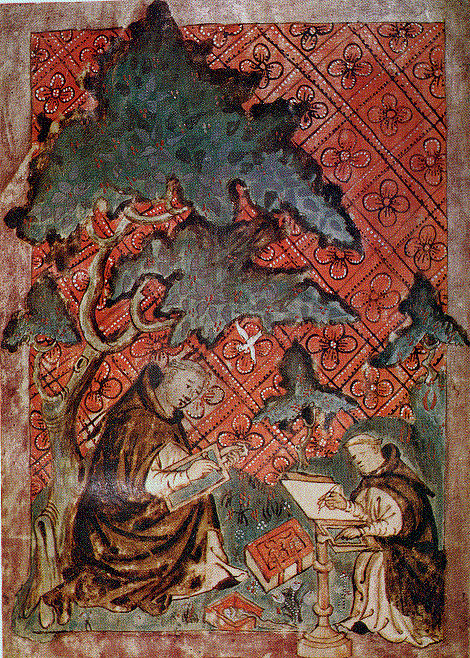
Jan van Ruusbroec (1293 to 1381) was a Flemish priest and mystic who wrote in Middle Dutch about the soul’s path from moral effort to inner longing to union with God. His map of three lives, his image of God as an abyss that ebbs and flows, and his ideal of a “common life” joining rest and action read today like an early psychology of integration.
Key takeaways
- Jan van Ruusbroec was a Brabantine priest and prior of Groenendaal who wrote about the spiritual life in Middle Dutch rather than Latin.
- His Spiritual Espousals maps three lives, active, interior and contemplative, a sequence that resembles Jung’s process of individuation.
- Ruusbroec distinguished true rest in God from a self-induced ‘natural rest’, a distinction close to what clinicians call spiritual bypass and dissociation.
- His ideal of the common life joins inner rest and outward action, which is a fair picture of what recovery from trauma looks like.
- Through Geert Grote and the Devotio Moderna, Ruusbroec’s integration of contemplation and service shaped later European spirituality.
Who was the mystic of the Sonian Forest?
Ruusbroec spent the last four decades of his long life at Groenendaal, a hermitage in the Sonian Forest (the forest of Soignes) just south of Brussels. Later generations called him the Admirable Doctor, Doctor Admirabilis, and the Catholic Church beatified him in 1908. He was not a university theologian. He was a chaplain and then a prior who wrote in the vernacular of Brabant, so that lay people, Beguines and religious without Latin could read about the interior life in their own tongue.3
What makes him interesting to a therapist is not a vague likeness to modern ideas. It is the care with which he described inner states: the heat of early devotion, the cold of abandonment that follows, the false peace of emptiness, and the steadier life that can hold stillness and work together. Evelyn Underhill, whose 1915 study introduced him to many English readers, praised his “intimate psychological analysis” of these movements.2
His picture of God is dynamic rather than static. For Ruusbroec the life of the Trinity is a constant flowing out and flowing back, which he compared to an ocean that ebbs and flows. Human beings share in that rhythm: we go out into works of love and are drawn back into rest.4 Readers trained in Carl Jung’s psychology will hear an echo of the Self, which Jung described as a centre that is always pulling the personality toward wholeness rather than a fixed thing one possesses. The two are not the same idea, but they share a sense that the deepest centre of a person is alive and moving.
Ruusbroec’s life and timeline (1293 to 1381)
He was born in 1293 in the village of Ruisbroek, a few miles from Brussels, and took his name from it. At about eleven he left home to live in Brussels with his uncle Jan Hinckaert, a canon of the collegiate church of St. Gudula. He was ordained priest in 1317, at about twenty-four, and served as a chaplain at St. Gudula for some twenty-six years.2
In Brussels he opposed a popular woman teacher remembered as Bloemardinne, whose followers were linked with the movement known as the Free Spirit. The Free Spirit, as its critics described it, taught that a soul united with God was beyond moral law and no longer needed virtue, sacraments or effort. Ruusbroec’s early writings were aimed partly against this teaching. His answer was that real union with God produces more love and more service, never less.2
In 1343, at about fifty, he left the city with Hinckaert and another canon, Frank van Coudenberg. Underhill describes their reasons as a growing distaste for the noise of Brussels, dissatisfaction with the low level of religious life at the cathedral, and a desire for surroundings suited to contemplation. Duke John III of Brabant gave them the old hermitage of Groenendaal. For several years they lived with no formal rule. Then, in March 1349, the bishop of Cambrai clothed them as Canons Regular under the Rule of St. Augustine, with Coudenberg as provost and Ruusbroec as prior, an office he held until his death on 2 December 1381.14 2
Key milestones in the life of Ruusbroec
| Year | Event / Publication |
| 1293 | Born in Ruisbroek, near Brussels. |
| 1317 | Ordained as a priest; serves as chaplain at St. Gudula. |
| c. 1335 | Writes The Spiritual Espousals (Die Geestelike Brulocht), his masterpiece on the stages of the mystical life. |
| 1343 | Leaves Brussels to found the hermitage at Groenendaal. |
| 1350 | Groenendaal becomes a priory; Ruusbroec serves as its first prior. |
| 1381 | Dies at the age of 88. Beatified by Pope Pius X in 1908. |
- 1293: born at Ruisbroek, near Brussels.
- About 1304: moves to Brussels to live with his uncle Jan Hinckaert.
- 1317: ordained priest; chaplain at St. Gudula.
- 1330s: writes his first books, including The Kingdom of Lovers and The Spiritual Espousals.
- 1343: withdraws to Groenendaal with Hinckaert and Coudenberg.
- 1349: the community becomes a house of Augustinian canons; Ruusbroec becomes prior.
- About 1360: walks to the Carthusian house at Herne to explain his teaching; writes The Little Book of Clarification.
- 1381: dies at Groenendaal on 2 December, aged about eighty-eight.
- 1908: beatified by Pope Pius X.
What did Ruusbroec write?
Eleven treatises survive. The best known is The Spiritual Espousals (Die geestelike brulocht), built on a single verse from the parable of the wise and foolish virgins: “See, the bridegroom is coming; go out to meet him.” The others include The Kingdom of Lovers, The Sparkling Stone, The Spiritual Tabernacle, The Seven Enclosures, A Mirror of Eternal Blessedness, The Seven Rungs, The Little Book of Clarification and The Twelve Beguines.1 3 Around 1360 the Carthusians of Herne, puzzled by passages in his first book, invited him to explain himself, and the aged prior made the journey on foot to do so.3
What are Ruusbroec’s three lives?
The Spiritual Espousals is divided into three books, one for each stage of the spiritual life: the active life, the interior or God-desiring life, and the contemplative or God-seeing life. Each book follows the same pattern, taken from the verse: Christ comes, the soul sees, and the soul goes out to meet him.1 Read psychologically, the sequence resembles the movement Jung called individuation, the lifelong process of becoming the whole person one already is. The parallel is a lens, not an equation, but it is a useful one.
The active life
The first life is the work of ordinary virtue: humility, justice, generosity and discipline of desire. Ruusbroec insists it is the foundation for everything that follows and is never left behind. In Jung’s language this resembles the tasks of the first half of life, which he described in his 1930 lecture “The Stages of Life”: building a stable ego, finding one’s place, learning to work and to love.10 James Hollis has written at length about this same transition.
The interior life
The second life turns inward. Ruusbroec describes it through the course of the sun across the zodiac. First comes a spring and summer of ardour, the “storm of love” in which the person burns with longing for God. Then the sun descends. Christ seems to withdraw, consolation stops, and the person “finds himself poor, wretched and abandoned.” Ruusbroec treats this darkness as necessary, not as failure: by this “dark stairway,” as Underhill renders it, every person who would reach God must go.2 A depth psychologist recognises here the meeting with what has been kept out of awareness, the Shadow, and the loss of the comforts that held the old identity together.
The contemplative life
The third life is what Ruusbroec calls God-seeing. Here the person rests in the “essential unity” where the soul’s ground meets God, beyond images and beyond the soul’s own activity, yet without ever ceasing to be a creature distinct from God. That last point is central to him. In The Sparkling Stone he devotes a chapter to how we, though one with God, remain eternally other than God.2 6 Jung’s realisation of the Self has the same double character: the ego comes into relation with something larger than itself without being dissolved into it.
What does Ruusbroec mean by the Abyss?
Ruusbroec’s word for the depth of God is afgrond, abyss or groundless ground. He describes it in deliberately unsettling terms: “a dim silence and a wild desert,” a “fathomless” being that is “wayless,” without manner or path.2 This language comes from the negative theology of Pseudo-Dionysius, which says God is better approached by unknowing than by concepts, and it overlaps with the “ground” of Meister Eckhart.8
For a depth psychologist the image invites comparison with the collective unconscious, Jung’s term for the layer of the psyche that is shared, inherited and far larger than personal memory. The comparison has to be held carefully. Ruusbroec is speaking of God, not of a layer of the mind, and Jung himself always said he could describe only the psychological image, not the reality behind it. What the two share is an experience: entering the depth means losing the rigid boundaries of the ego, and that is awe-inspiring and frightening at once. Jung read Eckhart closely for exactly this reason, devoting a long section of Psychological Types (1921) to the relativity of the God-image in Eckhart’s sermons.9 The wider story of how these medieval writers shaped Jung is traced in the influence of Christian mystics on Jungian thought.
Trauma, fragmentation and the common life
Ruusbroec’s most useful idea for clinicians is the common life (ghemeyne leven). The “common” person, in his sense, is not ordinary but shared out: equally at home in inner rest and outward work, flowing inward to God and outward to neighbours without strain between the two. He grounds this in the life of the Trinity itself, where the Spirit flows out and returns. Rik Van Nieuwenhove traces the common life as a spiritual ideal of the Low Countries in which activity and rest are held in harmony.5 7 Trauma tends to do the opposite. It splits a person into a part that keeps functioning and a part that is frozen, numbed or flooded.
Natural rest and the wish to feel nothing
Ruusbroec was sharp about a counterfeit of contemplation he called “natural rest.” He meant a self-induced quiet, which Underhill quotes him describing as “consisting in nothing but an idleness and interior vacancy, to which they are inclined by nature and habit.” Anyone can learn to empty the mind, he said; that emptiness has nothing to do with God and leads people to neglect love and virtue.2 A related failure was later named “spiritual gluttony” by St. John of the Cross, who used the phrase in The Dark Night for beginners who chase the sweetness of prayer rather than God.12
Clinicians have their own names for this pattern. Spiritual bypass, as Craig Cashwell and colleagues describe it, is the use of spiritual beliefs and practices to avoid real contact with one’s psychological unfinished business.13 In traumatised people it often overlaps with dissociation, the nervous system’s way of checking out when pain is too much. This is also why some people find that meditation can make trauma worse: the practice deepens the numb distance instead of resolving it. Ruusbroec’s distinction between true rest, which is full of love and returns to life, and natural rest, which is empty and withdrawn, is a good working test.
Living without why
Against both striving and withdrawal Ruusbroec sets an ideal he shares with the Low Countries and Rhineland mystics, often summed up in the phrase to live “without why” (sonder waerom). It is most associated with Eckhart and was later turned into verse by Angelus Silesius, whose rose “is without why; it blooms because it blooms.” To live without why is to act from love itself rather than from a calculation of reward, fear of punishment or need for approval.4 8
In therapy this looks like the slow move from a rigid identity organised around survival (“I must be perfect to be safe”) to a freer one (“I am worth something without earning it”). The point is not that people stop caring about outcomes. It is that their actions stop being driven by the old defensive reasons and start coming from somewhere steadier.
The Sparkling Stone
The Sparkling Stone takes its title from Revelation 2:17, where the one who overcomes is given “a white stone, and in the stone a new name written.” Ruusbroec identifies the stone with Christ and with the new name each person receives in union: a gift that is bright, small, hard and unbreakable.1 2 Depth psychology reads the same image in its own terms. Jung treated the stone as one of the oldest symbols of the Self, discussing the alchemists’ lapis at length in Aion (1951), and he carved his own Bollingen stone as a meditation on it.11
Clinically, the image speaks to something trauma therapists see often: beneath the damage there is a core that was not destroyed. Trauma may shatter a person’s sense of safety and of who they are, but it does not reach everything. Reconnecting a person with that inner core is one of the central goals of depth work, and it has close cousins in other models, such as the undamaged Self described in Internal Family Systems.
How can Ruusbroec’s ideas be used in therapy?
We do not teach theology in the therapy room, and clients do not need to share Ruusbroec’s faith to use his map. What his writings give a therapist is a vocabulary for stages and for counterfeits. Several of his ideas translate directly into clinical work:
- Desolation as a stage, not a verdict. People in midlife depression, burnout or a crisis of faith often describe a loss of meaning very close to Ruusbroec’s autumn of the soul. Treating it as part of a passage rather than proof of failure changes how a person can bear it.
- Telling rest from numbness. The distinction between true rest and “natural rest” helps a therapist notice when calm is actually shutdown, a pattern common in trauma and in spiritual communities that prize serenity.
- Holding action and rest together. The common life is a fair description of what recovery looks like: a person who can be still without collapsing and active without being driven.
- Working from the undamaged core. The sparkling stone gives clients an image for the part of them that trauma did not reach.
At Taproot this fits the way we already work. In Brainspotting and other brain-based trauma therapies, the client is helped to stay present with sensation in the body rather than leave it, which is the practical opposite of natural rest. In Jungian work, images like the abyss and the stone are taken seriously as expressions of the psyche, and religious or spiritual experience is treated as material for growth rather than a symptom. For clients for whom faith matters, theologians such as Paul Tillich, with his God as the “ground of being,” and Jungian writers such as Lionel Corbett continue the same conversation.
Legacy: the integration of action and contemplation
Ruusbroec’s lasting contribution is his insistence that the highest state is not withdrawal from the world but a return to it. The contemplative, in his account, flows inward into God and outward into love in a single rhythm, the way breath goes in and out.5
That ideal travelled. Geert Grote visited Groenendaal after his conversion in 1374 and formed a close friendship with the old prior. Grote went on to found the Brothers and Sisters of the Common Life and the movement called the Devotio Moderna, whose most famous product is The Imitation of Christ, traditionally attributed to Thomas à Kempis.2 His works were also read in the Rhineland, and Underhill notes that many passages in the later sermons of Johannes Tauler suggest his influence. Not everyone approved: around 1400 the Paris chancellor Jean Gerson criticised the third book of the Espousals as too close to pantheism, and the Groenendaal canon Jan van Schoonhoven wrote a defence.8 In 1552 the Carthusian Laurentius Surius published a complete Latin translation that carried him across Catholic Europe.2
For a person in therapy the message is hopeful. The goal is not only to feel better in a consulting room. It is to return to relationships, work and ordinary days from a place that is whole enough to hold both stillness and effort. The mystic and the merchant, the therapist and the client, are asked to make the same integration.
Further reading on Ruusbroec
- John Ruusbroec: The Spiritual Espousals and Other Works, translated by James A. Wiseman (Paulist Press, Classics of Western Spirituality), the standard English selection.1
- Evelyn Underhill, Ruysbroeck (1915), still a readable introduction to his life and teaching.2
- John Arblaster and Rob Faesen, eds., A Companion to John of Ruusbroec (Brill, 2014), the best current scholarly overview.3
- Louis Dupré, The Common Life (1984), on the origins of his Trinitarian mysticism.7
Explore more on mysticism and psychology
Ruusbroec belongs to a family of medieval mystics whose maps of the soul still help people make sense of suffering. Eckhart, Tauler and Silesius each describe the same descent into the ground and the same return to life in their own way. If these ideas speak to something in your own life, Jungian therapy at Taproot is a place to work with them, or you can contact us to talk about where to begin.
Frequently asked questions
Who was Jan van Ruusbroec?
Jan van Ruusbroec (1293 to 1381) was a Flemish priest and mystic from near Brussels. After about twenty-six years as a chaplain at St. Gudula, he withdrew in 1343 to Groenendaal in the Sonian Forest, where he became prior of a house of Augustinian canons. He wrote eleven treatises in Middle Dutch, including The Spiritual Espousals and The Sparkling Stone, and was beatified in 1908.
What is The Spiritual Espousals about?
The Spiritual Espousals is Jan van Ruusbroec’s best-known work. It is built on the verse ‘See, the bridegroom is coming; go out to meet him’ and is divided into three books describing the active life of virtue, the interior life of longing for God, and the contemplative life of union in which the soul remains distinct from God.
What did Ruusbroec mean by the common life?
For Ruusbroec the common life (ghemeyne leven) is the life of a person who is equally at home in contemplative rest and in active love, flowing inward to God and outward to neighbours in one rhythm. He grounded it in the life of the Trinity. It is the opposite of a spirituality that withdraws from ordinary duties and relationships.
What is the Sparkling Stone in Ruusbroec?
The Sparkling Stone is a treatise by Jan van Ruusbroec named after the white stone with a new name written on it in Revelation 2:17. Ruusbroec identifies the stone with Christ and with the new identity given in union with God. Jungian readers link the image with the stone as a symbol of the Self.
Did Ruusbroec criticise false mysticism?
Yes. Jan van Ruusbroec opposed the Free Spirit teaching that a united soul is above moral law, and he criticised a self-made ‘natural rest’, an inner emptiness anyone can produce by habit. He taught that genuine union with God produces more love and service, not withdrawal into passive calm.
How does Ruusbroec relate to Carl Jung?
Jan van Ruusbroec and Carl Jung both describe a passage from an ego built on effort, through darkness and loss, to a relationship with a larger centre. Ruusbroec spoke of God and the Abyss, while Jung described psychological images such as the Self. The parallels help therapists work with spiritual experience without reducing it.
Related reading
- Eugene Gendlin: A Biographical Timeline
- Francine Shapiro: From Cancer Diagnosis to Revolutionary Trauma Treatment Through Eye Movements
- Who Is Stanislas Dehaene? The Neuroscientist Who Discovered How Consciousness Ignites in the Brain
- Michael Meade: Mythopoetic Wisdom for a Troubled World
- The Psychology of Selves: The Pioneering Work of Hal and Sidra Stone
- Esther Harding and the Reclamation of the Feminine in Depth Psychology
References
- Ruusbroec, J. van. (1985). John Ruusbroec: The spiritual espousals and other works (J. A. Wiseman, Trans.). Paulist Press.
- Underhill, E. (1915). Ruysbroeck. G. Bell and Sons.
- Arblaster, J., & Faesen, R. (2014). John of Ruusbroec’s life and works. In J. Arblaster & R. Faesen (Eds.), A companion to John of Ruusbroec (pp. 47-80). Brill. https://doi.org/10.1163/9789004270763_004
- McGinn, B. (2014). Essential themes in Ruusbroec’s mysticism. In J. Arblaster & R. Faesen (Eds.), A companion to John of Ruusbroec (pp. 130-178). Brill. https://doi.org/10.1163/9789004270763_007
- Van Nieuwenhove, R. (2014). Ruusbroec, Jordaens, and Herp on the common life: The transformation of a spiritual ideal. In J. Arblaster & R. Faesen (Eds.), A companion to John of Ruusbroec (pp. 204-236). Brill. https://doi.org/10.1163/9789004270763_009
- Van Nieuwenhove, R. (2003). Jan van Ruusbroec, mystical theologian of the Trinity. University of Notre Dame Press.
- Dupré, L. (1984). The common life: The origins of trinitarian mysticism and its development by Jan Ruusbroec. Crossroad.
- McGinn, B. (2012). The varieties of vernacular mysticism, 1350-1550. Crossroad.
- Jung, C. G. (1971). Psychological types (Collected Works, Vol. 6; H. G. Baynes, Trans., rev. R. F. C. Hull). Princeton University Press. (Original work published 1921)
- Jung, C. G. (1969). The stages of life. In The structure and dynamics of the psyche (Collected Works, Vol. 8, 2nd ed.; R. F. C. Hull, Trans.). Princeton University Press. (Original work published 1930)
- Jung, C. G. (1959). Aion: Researches into the phenomenology of the self (Collected Works, Vol. 9, Part 2; R. F. C. Hull, Trans.). Princeton University Press. (Original work published 1951)
- John of the Cross. (1991). The collected works of St. John of the Cross (Rev. ed.; K. Kavanaugh & O. Rodriguez, Trans.). ICS Publications.
- Cashwell, C. S., Bentley, P. B., & Yarborough, J. P. (2007). The only way out is through: The peril of spiritual bypass. Counseling and Values, 51(2), 139-148. https://doi.org/10.1002/j.2161-007x.2007.tb00071.x
- Scully, V. (1910). A mediaeval mystic: A short account of the life and writings of Blessed John Ruysbroeck, canon regular of Groenendael, A.D. 1293-1381. Thomas Baker.





0 Comments