
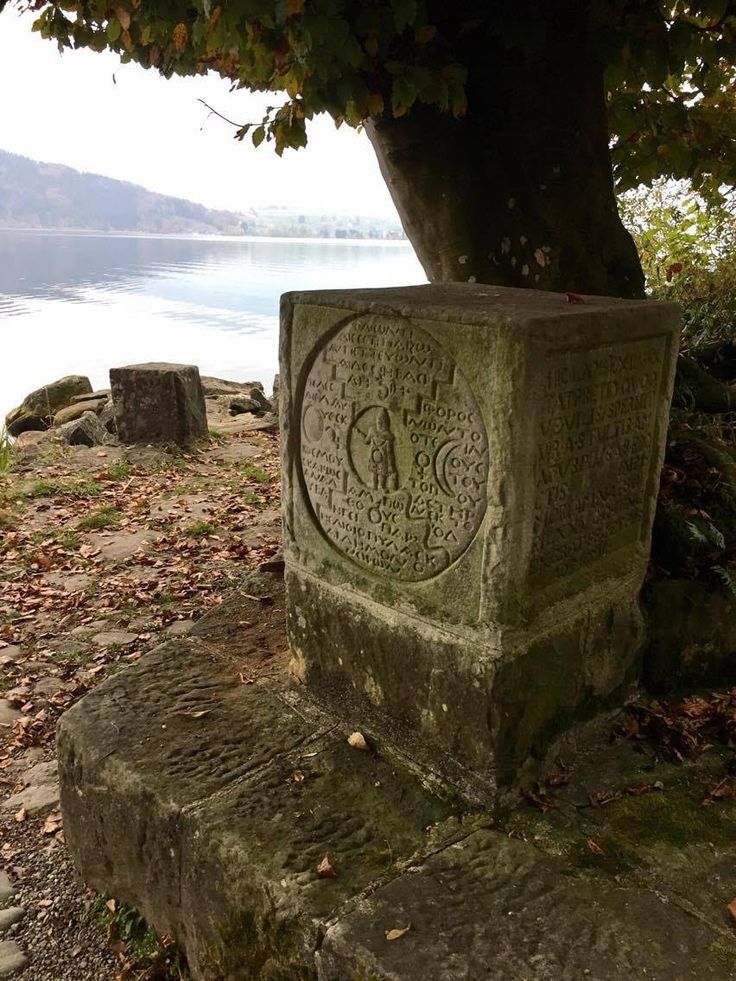
In the garden of his Bollingen Tower retreat, on the shore of Lake Zurich, stands a peculiar monument – a stone cube, some twenty inches thick, carved on three sides with cryptic inscriptions. This is the Bollingen Stone, erected by Carl Jung in 1950 to commemorate his 75th birthday. Far from a mere ornamental marker, however, the Stone represents a profound expression of Jung’s psychological and philosophical worldview. Through its amalgam of symbols, quotations, and structural motifs, it encapsulates the core ideas and preoccupations of Jung’s life’s work: individuation, alchemy, the collective unconscious, and the quest for wholeness of Self.
As Jung recounts in his autobiographical “Memories, Dreams, Reflections,” the story of the Stone is a curious one, beginning with an apparently chance occurrence that Jung interpreted as meaningful:
In 1950 I made a kind of monument out of stone to express what the Tower means to me. The story of how this stone came to me is a curious one. I needed stones for building the enclosing wall for the so-called garden, and ordered them from the quarry near Bollingen. I was standing by when the mason gave all the measurements to the owner of the quarry, who wrote them down in his notebook. When the stones arrived by ship and were unloaded, it turned out that the cornerstone had altogether the wrong measurements; instead of a triangular stone, a square block had been sent: a perfect cube of much larger dimensions than had been ordered, about twenty inches thick. The mason was furious and told the barge men to take it right back with them. But when I saw the stone, I said, “No, that is my stone, I must have it!” For I had seen at once that it suited me perfectly and that I wanted to do something with it.
This anecdote hints at several key aspects of Jung’s approach: his attentiveness to synchronicity and the unconscious significance of seemingly chance events; his fascination with the symbolic valence of dreams, visions and the material world; and his drive to give creative expression to inner experience. The Bollingen Stone weaves these strands together into a single, enigmatic statement. In this essay, we will undertake a detailed exploration of the Stone’s components, tracing how each facet reflects and embodies Jung’s thought. Through examining the historical context of the Stone’s creation, its physical description and layout, the inscriptions and symbols on its faces, the symbolism of its medium and placement, and its relationship to Jung’s key psychological concepts, we will attempt to unpack the meaning of this masterful psychosymbolic synthesis.
Historical Context
The Bollingen Stone cannot be fully understood without reference to the place and time of its creation – specifically, the Bollingen Tower complex that Jung began constructing in 1923 and continued to expand over the following decades. Situated on the upper shores of Lake Zurich, the Tower served as a kind of spiritual retreat and psychological hermitage for Jung, a place of solitude where he could withdraw from worldly concerns and devote himself to inner work. As he described it in Memories, Dreams, Reflections:
At Bollingen I am in the midst of my true life, I am most deeply myself…At times I feel as if I am spread out over the landscape and inside things, and am myself living in every tree, in the splashing of the waves, in the clouds and the animals that come and go, in the procession of the seasons. There is nothing… with which I am not linked. Here everything has its history, and mine; here is space for the spaceless kingdom of the world’s and the psyche’s hinterland.
Jung built the Tower with his own hands, as a kind of ongoing alchemical labor that paralleled his psychological investigations. Over time it grew into a multi-level structure with several annexes, each of which had a symbolic meaning connected to a stage of life – the central round tower, for instance, represented the maternal hearth and the deep unconscious, while the upper annex hosted Jung’s library and study, the realm of intellectual work. For Jung, building and inhabiting the Tower was a way of enacting in stone his process of individuation, of integrating the disparate parts of his psyche.
It was in this charged symbolic context that Jung erected the Bollingen Stone in 1950, to mark his 75th birthday – a major milestone that, in alchemical terms, represented the Rubedo or “reddening,” the final phase of the opus in which the lapis or philosopher’s stone was forged. By this point, Jung had been living with and meditating on the meaning of the Tower for almost three decades, and the Stone can be seen as his attempt to distill that experience into a single, dense statement. The fact that he carved the Stone himself, and incorporated into it quotations and symbols that had long preoccupied him, suggests that he saw it as a kind of summation of his life’s work, a testament in stone to the psychological truths he held most dear.
At the same time, 1950 also marked Jung’s partial retirement from public life following a series of debilitating health crises, including a broken foot that left him bedridden for months. During this period of enforced inactivity and convalescence, he experienced a stream of vivid dreams and visions that he would later chronicle in his enigmatic last work, the Red Book or Liber Novus. In this visionary material, Jung dialogued with mythic figures and confronted numinous images from the collective unconscious, in what he called a “most difficult but unavoidable experiment.” The Bollingen Stone can thus be seen as an outward manifestation of this inner journey, a way of grounding Jung’s “confrontation with the unconscious” in solid, earthly form. As he wrote in Memories, Dreams, Reflections:
The stone stands outside the Tower, and is like an explanation of it. It is a manifestation of the occupant, but one which remains incomprehensible to others. Do you know what I wanted to chisel into the back face of the stone? “Le cri de Merlin!” For what the stone expressed reminded me of Merlin’s life in the forest, after he had vanished from the world. Men still hear his cries, so the legend runs, but they cannot understand or interpret them.
With this allusion to the Arthurian wizard Merlin, Jung identifies himself with the archetypal figure of the wise old hermit, dwelling apart from society and deciphering the cryptic language of the soul. Like Merlin’s cries, the Bollingen Stone speaks this language in a form at once private and universal, deeply personal to Jung yet pointing beyond him to the mythopoetic substratum of the psyche.
Constructing a Psychic Place: The Architecture Behind the Retreat
Depth psychology has generally read the Tower the way it reads a dream, as an image of the inner world, while treating the actual masonry as scenery. A 2025 architectural study by Martin Gledhill, who discussed the project at length in an interview for this site, argues that the building itself did real psychological work rather than merely illustrating it. Gledhill, an architect as well as a student of analytical psychology, calls the result a “Psychic Place,” a term meant to capture how the topography of Jung’s unconscious and the typology of an actual plot of lakeshore land came to inhabit one another over three decades of building.
One piece of evidence Gledhill draws on is simply how Jung’s own language for the place changed over time. In early letters it is “my little place in the country,” a phrase carrying no more weight than any weekend cottage would. Only after years of building does it become, in Jung’s own usage, simply “the tower,” a contraction that tracks a real elevation in status, from leisure retreat to internal symbolic organ. The building grew the same way the phrase did, without a master plan. Begun in 1923, not long after the death of Jung’s mother, as a single round structure keyed to the maternal hearth, it gained annexes in 1927, a lakeside loggia in 1931, an upper tower in 1935, and a final wing in 1955 that gave the complex its full, staggered, four-part footprint. Gledhill’s contention is that these additions were paced by dream material rather than by drafting, so that the unconscious itself functioned as architect.
Across all four building phases the same two shapes recur: the circle and the square. In a 1959 letter to a student of architecture, Jung described this pairing as the language of family, shelter, and what he called the “drilling place of the inner man, the abode of gods.” Read alongside the kind of sacred geometry that recurs across so much of the built world, the circle and square at Bollingen enact in stone the same coniunctio the Stone performs in miniature, a feminine, earthly, squared foundation married to a masculine, heavenly, round tower above it. Even the complex’s octagonal touches, Gledhill notes, quietly borrow the geometry of a baptistry, a shape historically built for the specific purpose of being reborn inside. Readers curious how this same instinct shows up in contemporary practice can find a related discussion elsewhere on this site, in a piece pairing Jung’s own building habits with the traditionalist architect Leon Krier and the architecture of the archetype.
Physical Description and Layout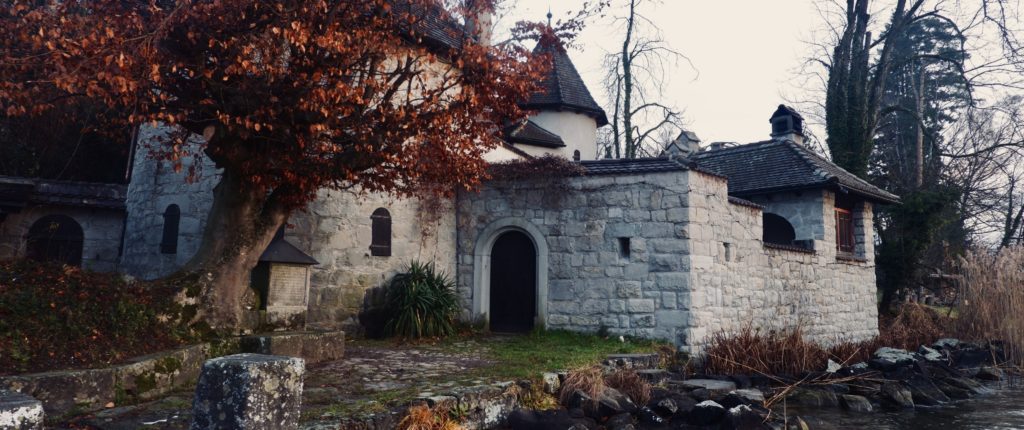
At first glance, the Bollingen Stone appears to be a simple geometric solid – a cube of reddish-brown sandstone, its sides measuring approximately twenty inches across. On closer inspection, however, the Stone reveals itself to be an intricately carved symbolic monument, its three visible faces adorned with inscriptions, pictograms, and arcane designs. (The fourth side, facing a screen of bushes, is left blank.) This three-sided layout is itself significant, reflecting Jung’s fascination with the power of trinities and triadic structures in myth, religion, and psychology.
As Jung details in Memories, Dreams, Reflections, the decision to shape the stone into a cube emerged spontaneously as he worked on it, following a kind of unconscious guidance:
I chiseled this into the stone; in translation it goes:
Here stands the mean, uncomely stone, ‘Tis very cheap in price! The more it is despised by fools, The more loved by the wise.
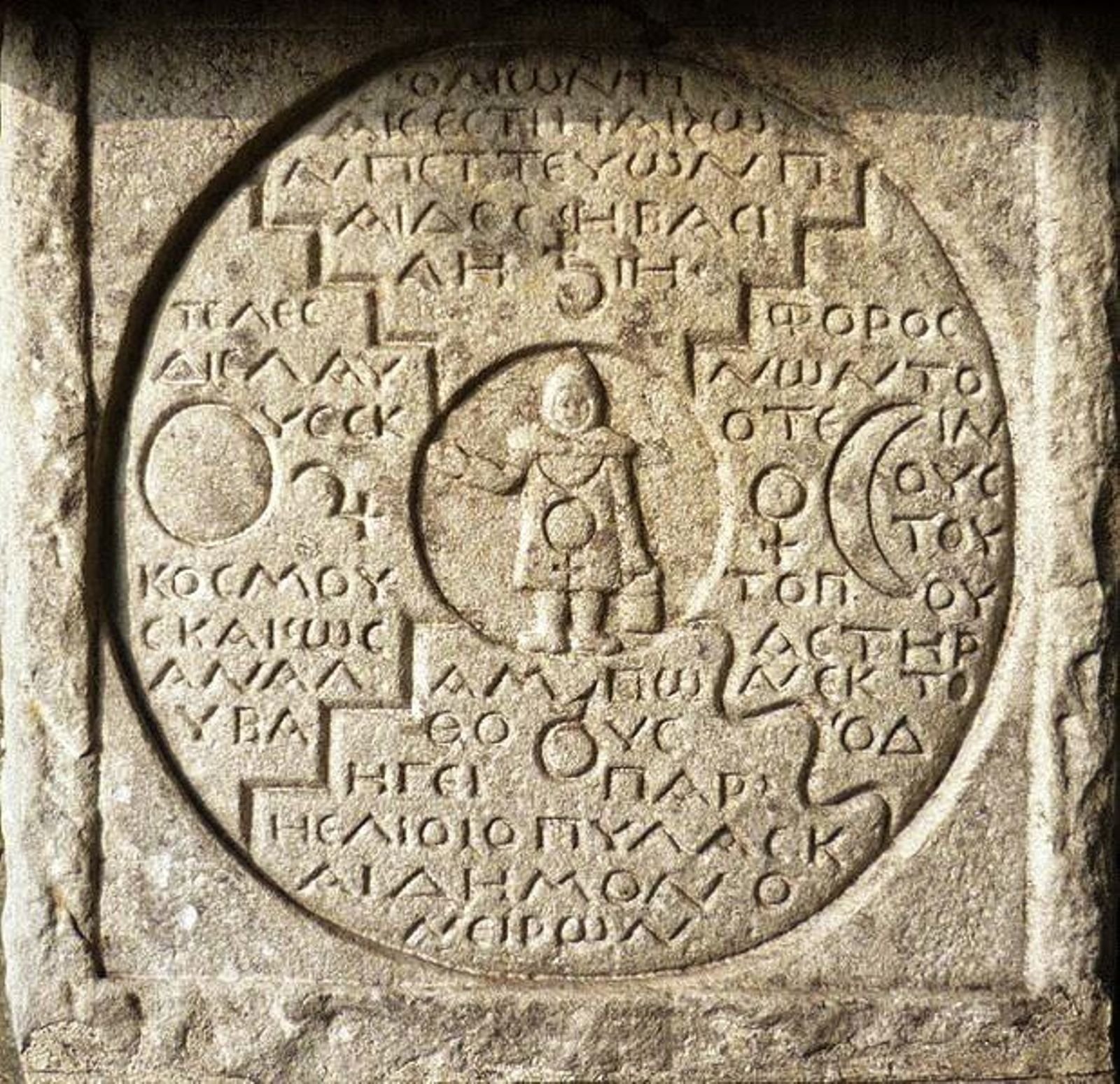
This verse refers to the alchemist’s stone, the lapis, which is despised and rejected. Soon something else emerged. I began to see on the front face, in the natural structure of the stone, a small circle, a sort of eye, which looked at me. I chiseled it into the stone, and in the center made a tiny homunculus…The inscription is in Greek; the translation goes:
Time is a child playing like a child playing a board game- the kingdom of the child. This is Telesphoros, who roams through the dark regions of this cosmos and glows like a star out of the depths. He points the way to the gates of the sun and to the land of dreams.
These words came to me one after the other while I worked on the stone.
In this way, the basic form and components of the Stone – the cube, the inscriptions, the homunculus figure – emerged in a process of active imagination, as if dictated by the archaic strata of Jung’s psyche. The Stone is thus not a composition in the ordinary sense but something more organic and inevitable, a message from the depths crystallized in stone.
The overall effect of the layout is to create a sense of rotating perspectives, a shifting point-of-view as one circles the cube and considers its faces in turn. No single side can be privileged, no single interpretation exhausts the Stone’s meanings. Like a three-dimensional mandala, it invites contemplation from every angle, promising an ever-deepening understanding. At the same time, this formal arrangement also suggests the dialectical structure of Jungian thought, in which psyche is seen as a self-regulating system of dynamic oppositions – conscious and unconscious, masculine and feminine, light and shadow. As we shall see, this theme of opposites reconciled in a higher synthesis runs through the Stone’s pictorial and textual elements as well.
The Stone Itself: Bollinger Sandstein and the Linth Valley
It is worth pausing on what the Stone is actually made of before returning to what it says. The material Jung carved is a specific regional stone called Bollinger Sandstein, quarried locally and used in the region since Roman times; the same stone faces Zurich’s Grossmünster and Fraumünster churches. Petrographically it runs to roughly a third to half quartz, a quarter to a third feldspar, a small fraction of mica and chlorite, and a lime binder holding the matrix together, giving it a blue-gray to gray-green cast beneath its reddish surface weathering, along with enough thermal mass to keep a stone tower livable through a Swiss winter without electricity or plumbing, both of which the Tower did without for years.
The stone also carries a quieter regional history. A few miles from Bollingen, the Linth Valley hydro-engineering project of 1807 to 1823, led by the Zurich statesman Hans Konrad Escher, was the first great modern engineering scheme in Switzerland, draining marshland and helping stitch the young confederation into a single, governable landscape. Escher’s engineering pointed outward, mastering a river system to unify a modern state. Jung’s stonework, carried out in the same regional material a century later, pointed in the opposite direction, building a small, deliberately primitive enclosure to unify a single fragmented psyche against the pressures of the same modern world Escher’s canal had helped bring into being, an inversion this site explores at the scale of an entire city in a piece on Birmingham’s own industrial architecture as a mirror of collective consciousness.
First Side: Alchemical Wisdom and Personal Dedication
The first side of the Bollingen Stone one encounters on approaching from the Tower is the one that bears the alchemical inscription Jung alludes to above:
Hic lapis exilis extat, precio quoque vilis spernitur a stultis, amatur plus ab edoctis.
Here stands the mean, uncomely stone, ‘Tis very cheap in price! The more it is despised by fools, The more loved by the wise.
This verse, attributed to the 14th-century alchemist Arnaldus de Villanova, refers to the fabled philosopher’s stone or lapis philosophorum, the elusive goal of the alchemical opus. Though it appears humble and worthless to the ignorant, the initiated alchemist recognizes the stone as the great treasure, the key to the transmutation of base matter into gold and the attainment of immortality. For Jung, this cryptic imagery symbolized the process of individuation, the lifelong labor of self-realization in which the crude ore of the unconscious is refined into the pure gold of the Self. As he wrote in Psychology and Alchemy:
The individual is “contained” in the lapis…and is at the same time its container. In other words, he is the Atman, the All-Highest, though at first he is only potentially so. He does not know that he harbors the great treasure, the jewel beyond all price.
By inscribing this verse on the Stone, Jung identifies himself with the archetypal adept, one who grasps the hidden value of the psyche and dedicates his life to actualizing it. At the same time, the choice of Latin – the language of medieval scholarship – lends the inscription an air of antiquity, rooting Jung’s stone in the half-buried hermetic tradition.
Below the alchemical verse runs Jung’s personal dedication:
IN MEMORIAM NAT[ivitatis] S[uae] DIEI LXXV C G JUNG EX GRAT[itudine] FEC[it] ET POS[uit] A[nn]O MCML
In memory of his 75th birthday, C.G. Jung out of gratitude made and set it up in the year 1950.
With this inscription, Jung makes explicit the commemorative function of the Stone, tying it to the milestone of his 75th year. The phrase “out of gratitude” suggests the Stone serves as a kind of offering or ritual gift, expressing Jung’s appreciation for the transformative experiences and insights granted him over the course of his long inner journey. By describing himself in the third person, Jung also creates a sense of distance or impersonality, as if speaking from a point beyond the individual ego. The Stone thus becomes a monument not only to Jung-the-man but to the archetypal process of individuation that he saw as the goal of all human development.
Considered together, the first side’s inscriptions establish two of the Stone’s central themes: its roots in alchemical symbolism and its connection to Jung’s personal growth. By combining esoteric wisdom with private meaning, Jung creates a multilayered text that operates on both the collective and individual levels, reaching down into the ancestral past while also reflecting his unique experience. This blending of the universal and particular, the ancient and contemporary, will characterize the Stone’s other faces as well.
Second Side: Telesphoros and the Mandala
Continuing around the cube, one comes to the second side, which features at its center the small homunculus figure Jung mentions carving on a whim. This figure represents Telesphoros (literally “the one who brings fulfillment”), the childlike companion of Asclepius, Greek god of medicine. Telesphoros was associated with recovery and regeneration, and was often depicted in statuary holding a scroll or wearing the hooded cloak of a traveler. For Jung, this spirit of healing wisdom embodied the archetype of the puer aeternus or “eternal youth,” a personification of the transformative potential of the unconscious. As he explains in Alchemical Studies:
Telesphoros…is a parakletos and a servus fugitivus, a messenger from the higher world and at the same time a fugitive, a captive of the lower world…He is a mediator who unites the two worlds.
Surrounding the figure of Telesphoros is a cryptic inscription in Greek, alluding to the cosmic forces that shape psychic life:
Ὁ Αἰὼν παῖς ἐστι παίζων, πεττεύων· παιδὸς ἡ βασιληίη. Time is a child at play, gambling; a child’s is the kingdom.
This line, a fragment attributed to the pre-Socratic philosopher Heraclitus, suggests the playful, nonrational aspect of the unconscious, which follows its own inscrutable laws beyond the control of the ego. Like a child absorbed in a game, psyche unfolds according to a pattern that defies adult understanding, revealing its secrets only to those who approach it with an attitude of openness and innocence. This childlike quality also connects with Jung’s concept of the “divine child” archetype, a symbol of life-renewing potential found across mythologies worldwide.
As if to underscore this theme of life-giving play, Jung surrounds the Telesphoros figure with a mandala divided into quadrants, each marked with an astrological or alchemical symbol:
- Top: Saturn
- Bottom: Mars
- Left: Sun/Jupiter (male)
- Right: Moon/Venus (female)
- Middle of Figure: Mercury
This fourfold pattern reflects Jung’s doctrine of quaternity, in which wholeness is achieved through the balanced opposition of complementary forces – in this case, the masculine and feminine principles, the light of consciousness and the dark of the unconscious. As Jung elaborates in Aion:
The quaternity is the schema par excellence of the God-image, of the self, and of wholeness. It is a symbol expressive of totality…the self that is represented by this quaternion symbolizes the essence of psychic wholeness.
By placing Telesphoros at the center of this archetypal configuration, Jung suggests that the path to wholeness lies through an encounter with the transpersonal wisdom of the unconscious, the hermetic guide that dwells within each individual. The mandala becomes a map of the individuation process, the gradual integration of conscious and unconscious components into a complete, self-regulating system.
The inscription encircling the mandala reinforces this meaning:
Τελεσφόρος διελαύνων τοὺς σκοτεινοὺς τοῦ κόσμου τόπους, καὶ ὡς ἀστὴρ ἀναλάμπων ἐκ τοῦ βάθους, ὁδηγεῖ παρ’ Ἠελίοιο πύλας καὶ δῆμον ὀνείρων.
Telesphoros traveling through the dark places of the cosmos, and shining like a star out of the depths, points the way to the gates of the sun and the land of dreams.
Here Telesphoros is depicted as a psychopompos or “soul-guide,” a liminal figure who spans the divide between the upper world of light and the underworld of chthonic forces. By venturing into these crepuscular realms and returning with transformative insights, he enacts the basic rhythm of Jungian analysis: the descent into the unconscious in search of lost or neglected potentialities, and the re-emergence into consciousness with a broader, more integrated sense of self.
The reference to “the gates of the sun and the land of dreams” – a line adapted from Homer’s Odyssey – further underscores this theme of the night-sea journey, the mythic adventure that leads through darkness to new light. In Jungian terms, this corresponds to the process of dreaming itself, in which the ego-consciousness of the day is immersed in the timeless realm of the unconscious, there to encounter archetypal energies and hidden facets of the personality. By incorporating this mythological motif into the Bollingen Stone, Jung affirms the central place of dreams and active imagination in his therapeutic approach.
Taken as a whole, the second side of the Stone presents a vivid symbolic synthesis of key Jungian concepts: the puer aeternus and divine child archetypes, the quaternity schema, the uniting of opposites in the mandala, and the role of dreams in the individuation process. By interweaving these themes into a dense network of allusions, Jung creates a kind of visual and verbal mandala, a “window” into the complex dynamics of the psyche.
Third Side: The Orphan’s Monologue
Rounding the Stone to its third and final carved side, one discovers what is perhaps the cube’s most enigmatic face: a long Latin inscription, written in the first person, that seems to give voice to the stone itself. Known as the “Orphan’s Monologue,” this cryptic text weaves together alchemical and mythological references into a paradoxical statement of the Stone’s nature and origins:
Orphanusum solus d’amun ubiqui reperior
Ulusum set me contrarious
Juvenis et senex simul Nullius pater nec mater est
Nam in profundum ut piscis haurior
Aut ut lapis albus caelo decido
In silvis montibusque vagor
Set intestus lateo intimas homines
Mortalis sum singulis attamen aevorum mutationibus intactus
In translation:
An orphan am I, alone; yet found everywhere.
I am one, yet set against myself.
A youth and an old man at once.
I have no father nor mother,
For I must be fetched like a fish from the deep
Or fall like a white stone from heaven.
In the woods and mountains I roam
Yet hidden I lie in the innermost man.
Mortal am I to each, yet untouched by the changes of aeons.
In this poem, the Stone seems to speak in riddles, offering a series of paradoxical statements about its identity and origins. It is an “orphan,” without father or mother, yet found everywhere; singular yet divided against itself; both young and old; drawn from the depths yet fallen from the sky. These contradictory images suggest the Stone as an embodiment of coincidentia oppositorum or the “union of opposites,” the alchemical principle Jung saw as central to individuation. As he writes in Mysterium Coniunctionis:
The self is made manifest in the opposites and in the conflict between them; it is a coincidentia oppositorum. Hence the way to the self begins with conflict…The confrontation of the two positions generates a tension charged with energy and creates a living, third thing…a movement out of the suspension between opposites, a living birth that leads to a new level of being, a new situation.
At the same time, the orphan’s speech also resonates with the ancient idea of the anima mundi or world-soul, the vital spirit that animates all of creation. By attributing voice and volition to the Stone, Jung affirms the aliveness of matter, the numinous power of the non-human world to inform human experience. The poem’s references to woods and mountains, to the depths of the sea and the heights of heaven, evoke the vast elemental forces that shape psyche, the “objective psyche” that exists beyond the confines of the individual. In communing with this lithic Other, Jung expands the boundaries of the self to encompass the wider cosmos, realizing what he called the “self-world,” the experience of “man as microcosm.”
The theme of the stone as messenger from the depths is reinforced by the allusion to the “fish from the deep” and the “white stone from heaven.” In alchemical symbolism, the fish often represents the lapis philosophorum in its unrefined state, the unconscious content that must be “fished” out of the waters of the psyche and subjected to the fires of consciousness. The white stone, meanwhile, is a common emblem of the goal of the opus, the purified and perfected form of the lapis – an image Jung employs repeatedly in his writings. By figuring the stone through these symbols, Jung points to its dual nature as prima materia and final result, the raw stuff of psyche and its ultimate transformation.
The opening line’s description of the stone as “alone; yet found everywhere” also suggests its deep link to the collective unconscious, the universal psychic substratum that Jung held to be the source of all individual experience. Though the Bollingen Stone is a unique, hand-crafted object, profoundly personal to Jung, it also taps into the archetypal patterns and energies that structure the human mind across cultures and epochs. In this sense, the Stone is both radically particular and radically general, a private totem and a monument to the objective realities of soul.
Finally, the closing line – “Mortal am I to each, yet untouched by the changes of aeons” – underscores the Stone’s function as a kind of existential timestamp, a marker of both permanence and transience. By creating the cube on his 75th birthday, Jung acknowledges his own mortality, the “allotted span” of an individual life; yet by working in stone, he also gestures beyond that span to the immense, slow rhythms of the geological and historical cycles that dwarf human being. The Stone is thus a paradox and a koan, a reflection on the self’s finitude and its participation in a greater, enduring Mystery.
Beyond the Birthday Stone: The Fish-Snake, Mercurius, and Ursa Movet Molem
The three-sided cube of 1950 is the Bollingen Stone that has entered the literature, but it was never the only carving on the property. Media scholar Mathew Mather’s study of the alchemical Mercurius in Jung’s later life, The Alchemical Mercurius: Esoteric Symbol of Jung’s Life and Works, gives sustained attention to a scattering of lesser-known engravings elsewhere at Bollingen that the biographical literature has mentioned only in passing. Read together, they extend the same themes already carved into the birthday stone, the chthonic, the astrological, and the geopolitical, onto a wider canvas.
One carving depicts what Mather calls a fish-snake, a hybrid image of the kind Jung discussed at length in Aion, where he wrote of water, fish, and serpent as three related symbols of psychic assimilation, each numinous and each carrying its own partial autonomy from the ego. Jung had lectured at Eranos in 1942 on the Grimm tale of the spirit trapped in the bottle, the story of a boy who frees a towering spirit from beneath an oak tree only to hear it announce, “I am the great and mighty spirit Mercurius, and now you shall have your reward: whoso releases me, him I must strangle.” The boy survives only by tricking the spirit back into its glass. Jung read the tale as a parable of what an over-rationalized consciousness does to its own instinctual ground, bottling it until the pressure turns dangerous. The fish-snake carved at Bollingen functions as a permanent acknowledgment of that pressure, a ward built into the foundation rather than a decoration laid on top of it.
A second and stranger carving, sometimes called the anima milking Pegasus, began the way the birthday stone itself began, as a shape Jung said he first noticed already latent in the rock. What emerged was a mare’s hindquarters descending from above, a kneeling woman drawing milk from it, and two inscriptions: a Latin line reading roughly “let the light I have carried in my womb shine forth,” and a Greek pun on the name Pegasus as “fount-horse.” Jung read the woman as the anima appearing in the guise of an ancient ancestress, and the milk she draws as lac virginis, virgin’s milk, or aqua doctrinae, the water of doctrine, standing in for the water Aquarius normally pours. The substitution matters astrologically: in the precession of the equinoxes, Pegasus sits just above the second fish of Pisces and just before Aquarius, so a feminine Pegasus pouring milk instead of water reads as an image of gestation for the coming age, the anima herself nursing the transition out of the two-thousand-year age of Pisces that Jung anatomizes at length in Aion.
In front of that same tableau, Jung carved a small stone ball beneath the paws of an approaching she-bear, with the inscription Ursa movet molem, “the she-bear moves the mass.” On one register this is straightforward astronomy, a reference to the Great Bear wheeling around the pole star and, with it, the slow turning of the ages themselves. Jung’s letters from the 1950s show him reading it on a second register too, as the heraldic bear of Russia, the raw and undomesticated energy of the Cold War’s eastern half setting a new collective psychological process in motion whether the world wanted it or not. It is Jung’s own reading, offered here as biography rather than as a claim about geopolitics, but it is a vivid reminder that the Stone’s garden was never hermetically sealed off from the century outside its hedge.
Symbolism and Imagery
Throughout the Bollingen Stone’s inscriptions and designs, certain themes and symbols recur, weaving the various elements into a coherent if multivalent whole. Chief among these is the motif of circularity or rotation, expressed through the mandala form, the recursive patterns of the inscriptions, and the cube’s very invocation of a center around which consciousness revolves. This cosmic wheel reflects the self-regulating nature of the psyche, which is always tending toward balance; it also evokes the “circulation of the light” in alchemy, the vivifying spirit that flows between the poles of matter and mind.
Another dominant strand is the interplay of opposites: father/mother, youth/age, conscious/unconscious, mortal/immortal. By juxtaposing these contraries and hinting at their ultimate unity, Jung suggests the essentially dialectical movement of individuation, the drive to reconcile psychic conflicts in a higher synthesis. At the same time, this wedding of antinomies expresses the paradoxical logic of the unconscious itself, which transcends the categories of Aristotelian thought. The Stone thus becomes an emblem of what Jung called the mysterium coniunctionis, the “mysterious conjunction” of seemingly irreconcilable realities.
The relationship between microcosm and macrocosm – the “personal” and “cosmic” dimensions of the psyche – also emerges as a central theme, encoded in the Stone’s fusion of human and elemental imagery. The tiny figure of Telesphoros, no larger than a thumbnail, is juxtaposed with the cube’s monumental scale, while the Latin poem blends references to the stars and abyss with images of the “innermost man.” In this way, Jung suggests the ultimate continuity between psyche and world, the identity of anima and anima mundi. As he puts it in Alchemical Studies, “The self…is an a priori existent out of which the ego evolves. It is, so to speak, an unconscious prefiguration of the ego.”
Finally, the Stone’s emphasis on the transformative power of the unconscious, the motive force of individuation, is conveyed through a rich panoply of alchemical symbols: the lapis or philosophers’ stone, the homunculus, the fish, the white stone, the union of paired opposites in the mandala. These images, drawn from the vast storehouse of esoteric tradition, point to the miraculous capacity of the psyche to transmute and transcend itself, to breed new form from the womb of the underworld. For Jung, who devoted the last decades of his life to rehabilitating the alchemical world-view, this “art of transformation” was the key to all psychospiritual growth.
The Stone as a Medium
Jung’s choice of stone as the medium for this dense web of meanings is itself deeply significant. In its obduracy and earthiness, its intractability to all but the most persistent human efforts, stone represents the bedrock of psyche, the fundamental matrix that precedes and conditions all our experience. Alchemically, it corresponds to the prima materia, the inchoate “first matter” from which the lapis is slowly hewed; psychologically, it evokes the brute facticity of the objective psyche, the inherited structures of the collective unconscious.
At the same time, the act of carving and inscribing stone, of shaping resistant matter to human ends, mirrors the ego’s struggle to assimilate the powers of the unconscious, to make meaning from the blooming, buzzing confusion of instinct and archetype. In chiseling his deepest preoccupations into the rock, Jung thus enacts in miniature the labor of a lifetime, the opus contra naturum (“work against nature”) by which the alchemists sought to redeem fallen creation.
Stone also serves as a kind of elemental language, a “lithic Esperanto” that binds Jung’s personal experience back to the wider history of the human engagement with the underworld. From the cave-paintings of Lascaux to the stone circles of Avebury, from the sepulchers of the Valley of the Kings to the temples of Göbekli Tepe, our ancestors have long entrusted their spiritual technologies to the silence and permanence of rock. The Bollingen Stone participates in this ancient lithic tradition, while also transposing it into a new key.
Finally, the Stone’s static solidity forms a striking counterpoint to the dynamism of psyche, with its fluid mutations and mercurial shifts of meaning. The stone’s “statements” are fixed, obdurate, resistant to alteration; yet they are also polysemous, endlessly interpretable, generative of new significance with each turn of the hermeneutic wheel. In this paradox, the Stone mirrors the “adamantine” nature of the archetype, which is at once universal and infinitely particular, a product of the collective psyche that flowers uniquely in each individual.
The stone and the tower around it are aging the way any sandstone structure on a damp lakeshore ages, and that fact has become part of their story too. The complex now carries a Swiss Class B heritage designation as a cultural property of regional significance, a formal recognition that sits oddly beside its continuing status as private property, still held by a family trust and still, by design, closed to the public. Commentators on the site’s preservation have argued that keeping it a lived-in home rather than converting it into a museum is in fact the choice most faithful to what Jung built it for, a private vessel for interior work rather than a monument meant to be looked at. The Tower remaining slightly out of reach may be the last, and least advertised, of its psychological functions.
Astrological Elements
As noted above, the mandala on the Bollingen Stone’s second side is structured around a fourfold schema of astrological symbols, with each quadrant of the circle marked by a planetary deity. This “astrologization” of the cube is far from incidental; rather, it reflects Jung’s abiding fascination with the ancient art of the stars, which he saw as a kind of intuitive psychology, a pre-scientific mapping of the archetypal forces that govern the soul.
In Jung’s view, the planets and luminaries of traditional astrology were not to be understood concretely, as physical bodies exerting literal influences, but rather symbolically, as metaphorical representations of different facets or functions of the psyche. Thus Saturn, the cold and leaden “greater malefic,” corresponds to the melancholic temperament, the tendency toward depression, inertia and entropy; Mars, the lesser malefic, signifies the choleric disposition, the passionate and impulsive energies of the id. The “benefic” planets, Jupiter and Venus, represent the more positive and socially-adapted aspects of the personality, while the Sun and Moon symbolize the fundamental polarities of consciousness and the unconscious, yang and yin, animus and anima.
By arranging these symbols in a circular mandala, Jung suggests their complementary and compensatory relationship, the way in which seemingly opposed psychic tendencies secretly imply and complete each other. The darkness of Saturn, the “spirit of gravity,” is balanced by the light of the Sun; the aggression of Mars is tempered by the harmony of Venus. In this way, astrology becomes for Jung a kind of alchemical calculus, a symbolic language for describing the “inscape” of the self.
The astrological face of the Stone also points to Jung’s concept of synchronicity, the “acausal connecting principle” he saw as the link between the inner world of psyche and the outer world of matter. For Jung, the ancient notion of the “music of the spheres,” the harmony between celestial events and human affairs, was not merely a poetic conceit but a profound intuition of the deep consubstantiality of mind and nature. By grounding his monument in the cycles of the stars, Jung affirms the ultimate unity of anima and cosmos, the “unus mundus” or “one world” that underlies all existence.
The Quaternity Concept
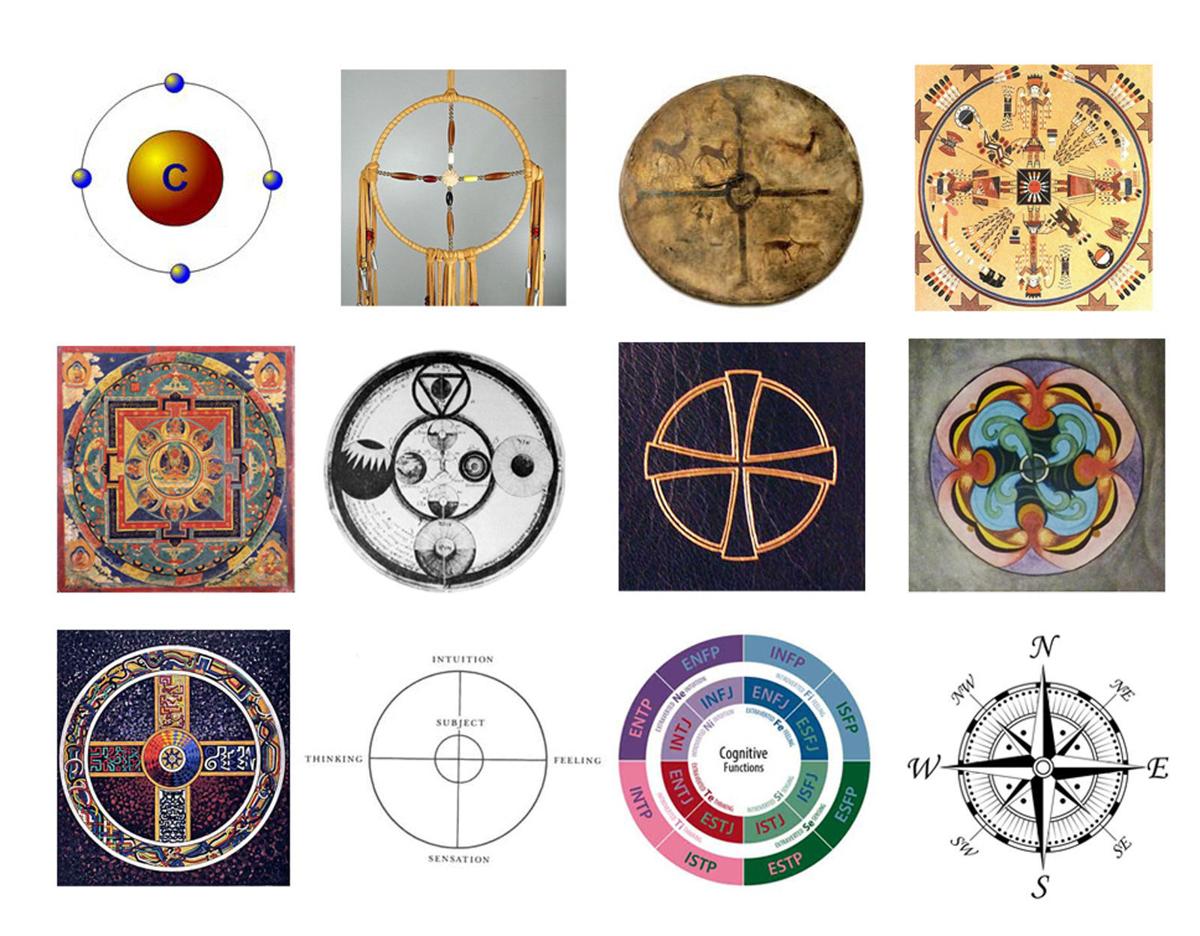
The fourfold structure of the Stone’s astrological mandala also reflects Jung’s broader preoccupation with the motif of quaternity, which he saw as a universal symbol of wholeness and integration. In Jungian thought, the quaternity represents the minimum number of elements necessary to achieve a stable system, a self-regulating totality; it is the numerical archetype of the self, the pattern that reconciles all oppositions in a higher synthesis.
This theme of fourness runs throughout Jung’s work, from his early theory of psychological types (thinking, feeling, sensation, intuition) to his later exploration of alchemical imagery (the four elements, the four stages of the opus). In each case, Jung understood the quaternity as a spontaneous product of the objective psyche, an archetypal “thought-form” that arises whenever consciousness strives to comprehend its own origins and ground.
On the Bollingen Stone, this quaternal schema is expressed not only through the astrological mandala but also through the cube’s three-dimensional structure, which implies a fourth, unseen side. This “dark face” of the Stone, left blank and unknown, suggests the apophatic aspect of the self, the “divine darkness” that transcends all images and concepts. By gesturing toward this unrepresentable reality, Jung acknowledges the ultimate mystery of the psyche, the surd at the heart of all our myths and symbols.
At the same time, the Stone’s manifest faces also encode quaternal structures, from the four lines of the Latin dedication to the four-part structure of the Orphan’s monologue. This recurrence of the “quaternity archetype” across different levels of the cube creates a sense of fractal resonance, a mirroring of self-similar patterns at various scales. In this way, Jung suggests the holographic nature of the psyche, in which each part contains the whole in nuce.
The Topsy-Turvy House: Bachelard’s Mistranslation of the Jungian Psyche
The house has always been the working metaphor beneath the Tower, and beneath the Stone that stands outside it, so it matters that the metaphor itself has a documented history of getting garbled in transmission. In a 1934 essay on complex theory, Jung described the conscious mind as a person living in a house. A disturbing noise breaks out where that person actually lives, in the inhabited upper rooms of consciousness, and the healthy response is to go down and investigate the cellar it is coming from. Gaston Bachelard, writing in French two decades later in his celebrated Poétique de l’Espace, tells a different story: his homeowner hears a noise in the cellar and flees upward to the attic, where, finding nothing, he simply decides the noise was imagination.
Lucy Huskinson, a philosopher at Bangor University who would later blurb Gledhill’s own study of the Tower, traced the discrepancy to its source in a 2012 paper for the International Journal of Jungian Studies. Bachelard, it turns out, had been working from a French anthology that had already reversed the cellar and the attic before it ever reached him, so his famous image is less an invention of his own than an error inherited from a translator standing between him and Jung, then built into one of the century’s most influential meditations on domestic space. Huskinson calls the result a “topsy-turvy house of psyche,” and the inversion is not a trivial one. Bachelard’s homeowner meets an unconscious disturbance by fleeing to safety and successfully talking himself out of it. Jung’s homeowner is described as genuinely in the grip of an autonomous complex, one that has to be met by descending toward it, not escaped by retreating further into the light.
Read against that history, the actual layout of the Bollingen Tower looks like Jung’s own rebuttal of the inversion, written before the inversion itself existed. He did not build his library as an escape upward from the round tower’s maternal hearth below it. He built it as one more station on a single vertical route he walked daily, cellar and upper room alike lived in rather than fled between, which sits closer to the original 1934 image than to the one that made Bachelard famous.
The Contagion of the Lithic Archetype: Christiana Morgan and Marie-Louise von Franz
The impulse to build one’s individuation rather than merely narrate it did not stay contained inside Jung’s own hedge. Two of the women closest to his circle each raised an answering structure of their own, and set beside Bollingen, both sharpen what the original Stone is actually doing.
Christiana Morgan, the American psychologist who co-developed the Thematic Apperception Test with Henry Murray, traveled to Zurich for analysis in 1926 while working through an intense relationship with Murray. Her sessions produced more than a hundred visions of mythic and archetypal material through active imagination, material substantial enough that it became the basis for the Visions Seminars. Recent biographical scholarship has been more willing than the earlier literature to say plainly that Morgan’s private visionary material was used in ways she had not fully agreed to, and that she is owed more credit than she received at the time for shaping seminars that helped define analytic technique. Morgan and Murray went on to build their own retreat, a cylindrical structure on the Parker River in Rowley, Massachusetts, that she largely designed and helped raise with local craftsmen, integrating carving, stained glass, and landscape into a single work. Inside it the two took on archetypal personas, Wona and Mansol, and used the tower to explore territory the era’s conventions did not otherwise allow. Contemporary biographers read the Tower on the Marsh as Morgan’s assertion of an authorship the historical record too often gave to the men around her, and the site today is the subject of active preservation efforts near a New England coastal research station.
A few kilometers from Bollingen itself, Marie-Louise von Franz, the alchemical scholar who financed her own training in the 1930s by translating Latin and Greek hermetic texts, and eventually Arabic ones too, built a third tower near Wagen after being told, in effect, that a house would not do and only a tower would serve. Distinguished by blue-gray and yellow shutters, her tower is deliberately square rather than round, a choice read through the I Ching’s association of the square with earth, the receptive, and grounded reality, in conscious contrast to the round, expansive geometry Jung had already claimed. Von Franz belonged to the same Zurich circle as Barbara Hannah, and among that circle the phrase carved into Jung’s own hillside, Ursa movet molem, came to be applied to her work as well, an image of the same slow, geological patience turning the mass of the collective unconscious by other hands.
Three structures, then, raised within a few decades of one another, one an ocean away: round, cylindrical, and square, each built by hand as a load-bearing act of individuation, each choosing its own geometry to say something different about the psyche, in much the same way the original Stone says something different depending on which of its three faces a visitor happens to be standing before.
The Stone in the Context of Jung’s Life and Work
Ultimately, the full meaning of the Bollingen Stone can only be grasped in the context of Jung’s life and work as a whole. The Stone stands as a kind of summation and condensation of the major themes that preoccupied Jung throughout his career: the reality of the psyche, the process of individuation, the archetypes of the collective unconscious, the alchemical art of psychospiritual transformation.
In particular, the Stone’s imagery and inscriptions reflect Jung’s intensive study of alchemy and Gnosticism in the last decades of his life, when he came to see these esoteric traditions as vital keys to the psychology of the self. Works like Psychology and Alchemy (1944), Aion (1951), and Mysterium Coniunctionis (1955-56) are shot through with references to the lapis philosophorum, the homunculus, the coniunctio oppositorum, and other alchemical motifs that find expression on the Stone. In this sense, the cube can be seen as a physical distillation of the densely woven themes of Jung’s later writings.
At the same time, the Stone also bears the imprint of Jung’s own “confrontation with the unconscious,” the pivotal spiritual crisis he underwent in the years following his break with Freud. The vivid dreams, visions and fantasies Jung experienced during this period, many of them recorded in his Red Book, laid the foundation for his mature psychology of the archetypes and the individuation process. The Stone’s mythopoeic imagery and paradoxical inscriptions seem to spring directly from this visionary matrix, recapitulating in miniature the major leitmotifs of Liber Novus.
Finally, the Stone can be understood as an expression of Jung’s deep engagement with the “objective psyche,” the autonomous, impersonal dimension of the mind that exists beyond the ego. Jung’s lifelong effort to understand and integrate this transpersonal reality led him to develop such key concepts as the collective unconscious, synchronicity, and the self, all of which find symbolic representation in the Stone. In its fusion of personal and archetypal meanings, its combination of conscious design and unconscious guidance, the cube embodies Jung’s ideal of the individuated personality
The scholarship gathered above since that original synthesis, the architectural biography of the wider complex, the corrected history of how Jung’s own house metaphor traveled through Bachelard, the answering towers raised by Christiana Morgan and Marie-Louise von Franz, and the quieter carvings scattered around the property, does not compete with this reading so much as extend its logic outward, from the birthday cube to the whole acre of ground it stands on.
Further Reading: Three Guides to the Stone
The Expert Analyzer: Edward Edinger. If Jung’s own writing feels too cryptic, Edward Edinger is the definitive guide. In his book The Creation of Consciousness, he dedicates brilliant sections to decoding Jung’s late-life work at Bollingen. Edinger is unmatched at taking Jung’s dense alchemical jargon and explaining exactly what the Stone means for a reader’s own psychological growth.
The Inner-Circle Witness: Aniela Jaffé. As Jung’s private secretary and the co-author of his autobiography, Aniela Jaffé wrote beautifully about the Stone in her essay collection, From the Life and Work of C.G. Jung. She provides the intimate, human context of watching Jung retreat to Bollingen to carve the Stone, capturing the specific, quiet atmosphere of the tower that shaped his final years.
The Modern Deep-Dive: Martin Gledhill. For a massive, definitive modern breakdown, architectural scholar Martin Gledhill’s recent book, The Bollingen Tower: Constructing a Jungian Sense of Place, is the gold standard. He spends chapters analyzing the physical geometry of the Stone, its specific location on the property, and how Jung used stonemasonry as a literal tool for “soul-making.”
Influences on Jung
Who Influenced Carl Jung?
Martin Heidegger
Jean Paul Sartre
Peter Sloterdijik
Maurice Merleau-Ponty
Gaston Bachelard
Jean Gebser
Gilbert Durand
Friedrich Schelling
Friedrich Nietzsche
Immanuel Kant
Freidrich Hegel
Ernst Cassirer
Hans-Georg Gadamer Plato
Neoplatonism
Gilbert Simondon
Arthur Schopenhauer
Henri Bergson
Wolfgang von Goethe
Martin Buber
Hermes Trismegistus
Jakob Boehme
Emanuel Swedenborg
John Scottus Eriugena
Pseudo-Dionysius
Nicolas Cusas
Amalric of Bena
Gerhard Dorn
Zosimos
Plotinus
What is Gnosticism?
Robert Grossette
Meister Eckhart
Teresa of Avila
St. John of the Cross
Suhrawardi
Ibn’ Arabi
Pierre Teilhard de Chardin








0 Comments