
Nicholas of Cusa’s coincidence of opposites (coincidentia oppositorum) is the claim that in God, the infinite, the contraries that exclude each other in ordinary thought coincide: the absolute maximum is also the minimum. In On Learned Ignorance (1440) he argued that reasoning can never reach that point, so wisdom begins with knowing exactly where one’s knowledge stops.1
Cusa meant this as theology, and it should be read that way first. It also describes a psychological capacity, and it is the one trauma takes away. A mind under threat tends to sort experience into absolutes: safe or dangerous, all my fault or entirely theirs. Recovery looks less like picking the right side than like regaining the ability to hold two true things at once without forcing a verdict, and Cusa’s learned ignorance, an exact sense of the limits of one’s own vantage point, is the stance that makes that possible. Carl Jung called the process by which a new attitude grows out of held opposites the transcendent function. He never ties that idea to Cusa in any passage I have found, but he quoted him repeatedly and called him the philosopher of the union of opposites.2
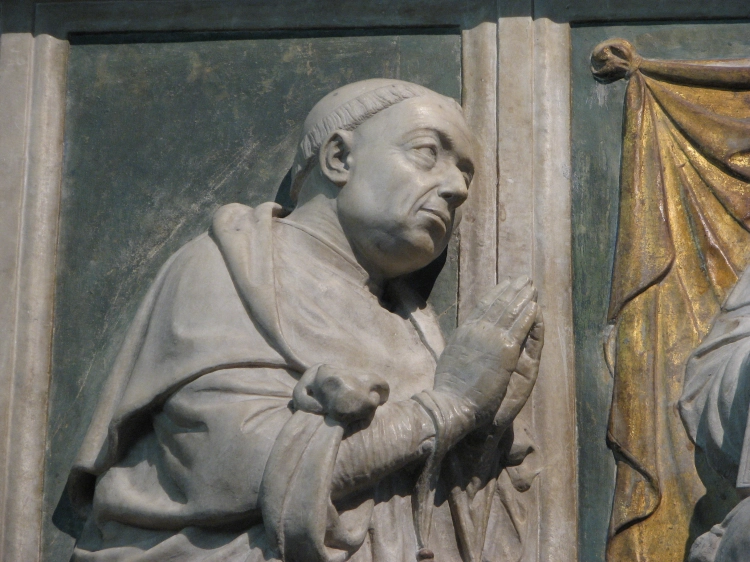
Who Nicholas of Cusa was
Nicholas was born in 1401 in Kues, now Bernkastel-Kues, on the Moselle, the son of a prosperous merchant. He studied at Heidelberg and Padua, took a doctorate in canon law in 1423, and was mostly self-taught in philosophy and theology. In Cologne he showed that the Donation of Constantine was an eighth-century forgery. At the Council of Basel he first argued that a general council outranks the pope, then went over to the papal side, and in 1437 he sailed with the embassy sent to Constantinople to reconcile the Greek Church with Rome. He said the central insight of On Learned Ignorance came to him on the voyage home.1 He finished the book at Kues on 12 February 1440.3
Cusa spent his working life negotiating between parties that each held part of a case: council and pope, Latin and Greek churches, a reforming bishop and a duke who wanted the old arrangements left alone. Shortly after Constantinople fell in 1453 he wrote De pace fidei, which imagines representatives of all nations and religions agreeing in heaven on one faith expressed in a variety of rites.4 A man who keeps finding that each side sees part of the truth has a practical reason to look for a unity above the contradiction. That is my reading, not his account of himself.
| Year | Event |
|---|---|
| 1401 | Born in Kues on the Moselle |
| 1423 | Doctorate in canon law at Padua |
| 1433 | De concordantia catholica, written at the Council of Basel |
| 1437–38 | Embassy to Constantinople |
| 1440 | Completes De docta ignorantia (On Learned Ignorance) |
| 1448 | Accepts the cardinalate under Nicholas V, having declined Eugenius IV’s nomination of 1446 |
| 1450 | Named bishop of Brixen in the Tyrol |
| 1453 | De visione Dei (The Vision of God) for the monks of Tegernsee; De pace fidei |
| 1460 | Taken prisoner at Bruneck by Duke Sigmund of Tyrol during their conflict over church reform |
| 1464 | Dies at Todi on 11 August; buried in San Pietro in Vincoli, Rome, his heart sent to the hospice he founded in Kues |
Dates from the SEP, the Catholic Encyclopedia and Wikipedia.1, 5, 4
What the coincidence of opposites means
On Learned Ignorance treats God as the absolute maximum, the universe as a “contracted” or limited maximum, and Christ as both at once. Its premise is that “there is no proportion between finite and infinite.” For Cusa, knowing is a kind of measuring, a comparison of more and less. The infinite has no more and less, so it cannot be measured, and a mind that understands why has made its ignorance “learned.” In God the maximum and the minimum coincide, because both carry the mind past the whole domain of more and less, and so God lies beyond the region where the principle of contradiction holds.1
Two details matter for anyone who borrows the idea for psychology. First, Cusa does not say everything is the same. In the Stanford Encyclopedia’s summary, “It is not that creatures coincide with God or God with creatures, but that in God all else coincides as nothing else than God.”1 Distinctions stay real where people live. Second, he does not say the finite mind can get there by thinking harder. In Book I, chapter 3, the intellect stands to truth as a polygon inscribed in a circle stands to the circle: the more angles it has, the more it resembles the circle, yet it never becomes equal to it, even with its angles multiplied without end, unless it is resolved into identity with the circle.3 (The paraphrase is mine, from the Latin.) The polygon pictures the limit, not its crossing.
A few years later, in On Conjectures, he drew the consequence: “every positive human assertion of the truth is a conjecture.” He meant not a guess but a true, partial likeness, shaped by the knower’s body, position and language. He also separated ratio, discursive reasoning, from intellectus, a direct intellectual seeing.1 The coincidence of opposites defeats ratio, not thinking as such. In that respect a Cusan paradox works a little like a Zen koan, built to exhaust one mode of thought so another can start.
His deepest roots, the SEP says, are in Proclus and Pseudo-Dionysius the Areopagite, whose negative theology he extends.1 Donald Duclow’s essays group him with Eriugena and Meister Eckhart as “masters of learned ignorance,”6 and readers who know the Kabbalah’s Ein Sof, literally “without end,” will recognize a family resemblance.
The icon and the wall of paradise
When the Benedictines of Tegernsee asked him for a treatise on mystical theology, Cusa answered in 1453 with De visione Dei, written as a prayer, and sent a painting with it.1 His preface names other images whose eyes seem to follow the viewer, such as “the archeress in the market-place of Nuremberg” and the Veronica in his own chapel at Koblenz. The picture he sent showed “the figure of an omnivoyant,” and he called it “the icon of God.”7 It was probably a Veronica, a face of the suffering Christ with the eyes painted to look straight out of the picture.1
Then he set an exercise. Hang the icon on a north wall and stand around it. Each brother will find that it “looketh upon him as if it looked on none other.” If one walks from west to east, the gaze goes with him. Now let a second brother walk the opposite way at the same time and say what he sees. The first will hear that the gaze moved with the other man too, “and he will believe him. But, had he not believed him, he could not have conceived this to be possible.”7 That small experiment holds most of what I find clinically useful in Cusa. Two observations that contradict each other at the level of perception are both true, neither observer can confirm the other’s from where he stands, and the only way to hold both is to trust a second witness.
The wall comes in chapter 9: “the place wherein Thou art found unveiled is girt round with the coincidence of contradictories, and this is the wall of Paradise wherein Thou dost abide. The door whereof is guarded by the most proud spirit of Reason, and, unless he be vanquished, the way in will not lie open.” In chapter 10 he applies the image to time: “Now and Then coincide in the circle of the wall of Paradise.”7
One phrase often credited to Cusa is older than he is. God as an infinite sphere “whose centre is everywhere and whose circumference is nowhere” is the second definition in the anonymous Book of the 24 Philosophers, first attested in a twelfth-century manuscript.8 Cusa’s best-known use of it, in Book II of On Learned Ignorance, concerns the physical universe, whose true center and circumference are God, “who is everywhere and nowhere.”1
What Jung actually took from Cusa
Jung cites Cusa often, and nearly always for the same idea. In “The Psychology of the Transference” he notes that Cusa “regarded antinomial thought as the highest form of reasoning,” says the symbol of wholeness “is a coincidentia oppositorum which, as we know, Nicholas of Cusa identified with God,” and concludes: “The alchemists are as it were the empiricists of the great problem of the union of opposites, whereas Nicholas of Cusa is its philosopher.” His footnotes show he read Cusa partly through Edmond Vansteenberghe’s 1920 study.2 In Aion he calls the self “a true ‘complexio oppositorum,'” footnoted “A definition of God in Nicholas of Cusa.”9 In Mysterium Coniunctionis he traces the idea “from the tao of Lao-tzu to the coincidentia oppositorum of Cusanus,” the same lineage our piece on Lao Tzu and Jung follows, and he names its cost for the poet Angelus Silesius, for whom its “logical consequence—the relativity of the God-concept—proved disastrous.” Silesius, Jung adds, “had drunk with Jacob Boehme at the fount of Mater Alchimia.”10
What Jung did not do, as far as I can find, is connect Cusa to the transcendent function. That essay was written in 1916 and did not come to light for forty years. Cusa does not appear in it, and the volume that contains it mentions him once, in “On the Nature of the Psyche.”11, 12 The parallel is still worth drawing, as long as it is called a parallel. Jung writes that “the shuttling to and fro of arguments and affects represents the transcendent function of opposites,” and that the confrontation of the two positions “creates a living, third thing—not a logical stillbirth in accordance with the principle tertium non datur but a movement out of the suspension between opposites, a living birth that leads to a new level of being.”11 Both men refuse the either/or of formal logic, and both place the answer past the point where the reasoning ego can manufacture it.
The difference matters as much. Cusa’s coincidence is God, who in The Vision of God is seen only insofar as God grants it.1 Jung’s third thing is a symbol the psyche produces, and he kept the boundary: “It is far from my intention to cross swords with this great man. My business is merely the natural science of the psyche.”2 Martin Buber, who later objected to Jung’s reduction of psychic life to the categories of a private unconscious, wrote his 1904 dissertation on individuation in Nicholas of Cusa and Jakob Boehme.13 See also how the Christian mystics shaped Jungian thought.
Trauma and the collapse into either/or
Now the psychological half: when a person is overwhelmed, thinking narrows toward absolutes. The research points that way, though none of it was designed to test Cusa.
Anke Ehlers and David Clark’s cognitive model of PTSD holds that the disorder persists when a trauma is processed in a way that produces a sense of serious, current threat, driven by excessively negative appraisals and by a trauma memory that is poorly elaborated and poorly placed in context.14 The Posttraumatic Cognitions Inventory, built by Edna Foa with Ehlers, Clark and colleagues, found three clusters of such appraisals in 601 volunteers, negative thoughts about the self, negative thoughts about the world, and self-blame, and they separated traumatized people with PTSD from those without it.15 Outside the clinic, Suedfeld and Tetlock scored diplomatic messages from five twentieth-century crises and found their “integrative complexity” significantly lower in the two that ended in war.16 Governments are not patients, but the pattern is familiar: threat simplifies.
Research on borderline personality disorder, where black-and-white thinking has been studied directly, adds a correction. Arntz and ten Haaf found that people with BPD rated others in more dichotomous terms than two comparison groups, but the evidence for “splitting” as a specific trait was not convincing, and in interviews their descriptions of others could not be told apart from non-patients’ in complexity. The groups were small, 18 people each.17 In that one study, the problem looked like a pull toward extreme verdicts, not an inability to think in nuance.
The opposite pattern shows up too. A 2014 meta-analysis of 42 studies and more than 11,000 people found post-traumatic growth and PTSD symptoms positively related (r = .32), with a curved relationship fitting better than a straight line; the authors wrote that positive and negative outcomes “can co-occur.”18 “I was badly hurt” and “I have changed in ways I value” are not rival accounts, one of which has to win.
Here Cusa’s image needs a limit. Inside his wall, then and now coincide in eternity. In a trauma memory they coincide in the wrong way: the past was never filed as past, so it keeps arriving in the present. Therapy does not aim at a mystical coincidence of times. It aims to put “then” back in then, so that a person can hold both “it happened” and “it is over.”
What this looks like in therapy
None of this is a technique. It shows up as a stance, in three ways.
The first is the therapist’s own learned ignorance. A case formulation is, in Cusa’s sense, a conjecture: a likeness of a person shaped by where the therapist stands. Held that way, it models the skill being taught: knowing the edge of your own view without abandoning it.
The second is the second witness. Cusa’s monks learned that the icon’s gaze moved both ways only by believing a brother’s report. People who have been hurt often hold one perception as total: everyone leaves, I am the problem. A steady relationship with someone who sees the same events from another position is how a second true thing gets into the room. It does not replace the first. It sits beside it until the person can hold both.
The third is knowing what both/and does not mean. Holding opposites does not mean deciding that harm was secretly good. Some things are simply true: the abuse was wrong, the danger is past. The both/and work happens inside a person’s experience of themselves, between a part that is furious and a part that still misses the person who did the harm, or between “I should have known” and “I was a child.”
Dialectical behavior therapy is the clearest treatment built on this idea; Lynch, Linehan and colleagues list dialectics, with mindfulness, validation and chain analysis, among its potential mechanisms of change.19 The evidence should be stated carefully. A 2020 Cochrane review of 75 randomized trials found that psychotherapy for borderline personality disorder reduced symptom severity compared with usual treatment on moderate-quality evidence, while the advantages for DBT specifically rested on low-quality evidence.20 Jungian therapy, which works with the tension of opposites through dreams and images, has a thinner base: mostly naturalistic and retrospective studies, mainly from Germany and Switzerland, encouraging but not randomized.21
One line from chapter 7 of The Vision of God deserves to stand on its own. In contemplative silence Cusa hears God answer, “Be thou thine and I too will be thine,” and takes it to mean he has been left “free to be mine own self,” and that unless he is his own, God cannot be his.7 Therapy borrows nothing theological from that sentence, but the order of operations is familiar. A person who does not yet belong to themselves cannot fully belong to anyone else.
Cusa’s legacy, without the myths
Giordano Bruno quoted him and Jacques Lefèvre d’Étaples edited his works in Paris in 1514, though there was no Cusan school and, by the SEP’s judgment, few later thinkers apart from Bruno understood him until the late nineteenth century.1, 4 German studies appeared from the 1840s,5 the Heidelberg Academy’s critical edition ran from 1932 to 2007, and Ernst Cassirer called him the “first modern thinker” and made him the focal point of Italian Renaissance philosophy, a thesis Eugenio Garin and Paul Oskar Kristeller contested.1, 4 The page also claimed that Wolfgang Pauli, Jung’s collaborator, found in Cusa a language for wave-particle duality. I could find no source for that. Cusa’s real scientific afterlife is more modest: an earth that moves and is not the exact center of the universe, argued on metaphysical grounds, and a claimed squaring of the circle that Regiomontanus refuted.1, 5
If your thinking about yourself has narrowed to verdicts, or an old experience still arrives as if it were happening now, therapy can work with that slowly, without forcing a resolution. You can read how we approach it in Jungian depth therapy in Hoover, or reach us through the contact page to talk about whether it fits.
References
- Miller, C. L. (2025). Cusanus, Nicolaus (Nicolas of Cusa). In E. N. Zalta & U. Nodelman (Eds.), The Stanford encyclopedia of philosophy (Winter 2025 ed.). Metaphysics Research Lab, Stanford University. https://plato.stanford.edu/archives/win2025/entries/cusanus/
- Jung, C. G. (1954). The psychology of the transference. In The practice of psychotherapy (R. F. C. Hull, Trans.; Collected works of C. G. Jung, Vol. 16, paras. 527, 537). Pantheon Books. https://archive.org/details/20191216psychotherapy
- Nicholas of Cusa. (1913). De docta ignorantia libri tres (P. Rotta, Ed.). Gius. Laterza & Figli. (Original work completed 1440) https://archive.org/details/McGillLibrary-rbsc_klibansky_nicolai-cusani-de-docta_B765N53D61913-20860
- Wikipedia contributors. (2026). Nicholas of Cusa. In Wikipedia. Retrieved November 8, 2026, from https://en.wikipedia.org/wiki/Nicholas_of_Cusa
- Hagen, J. (1911). Nicholas of Cusa. In The Catholic encyclopedia (Vol. 11). Robert Appleton Company. https://www.newadvent.org/cathen/11060b.htm
- Duclow, D. F. (2024). Masters of learned ignorance: Eriugena, Eckhart, Cusanus. Routledge. (Original work published 2006) https://doi.org/10.4324/9781003554257
- Nicholas of Cusa. (1928). The vision of God (E. G. Salter, Trans.; introduction by E. Underhill). J. M. Dent & Sons; E. P. Dutton. (Original work written 1453) https://archive.org/details/visionofgod00nich
- Wikipedia contributors. (2026). Book of the 24 Philosophers. In Wikipedia. Retrieved November 8, 2026, from https://en.wikipedia.org/wiki/Book_of_the_24_Philosophers
- Jung, C. G. (2014). The structure and dynamics of the self. In Aion: Researches into the phenomenology of the self (R. F. C. Hull, Trans.; Collected works of C. G. Jung, Vol. 9, Pt. 2, 2nd ed., pp. 222–265). Princeton University Press. https://doi.org/10.1515/9781400851058.222
- Jung, C. G. (2014). The personification of the opposites. In Mysterium coniunctionis (R. F. C. Hull, Trans.; Collected works of C. G. Jung, Vol. 14, 2nd ed., pp. 89–257, paras. 124, 200). Princeton University Press. https://doi.org/10.1515/9781400850853.89
- Jung, C. G. (2014). The transcendent function. In The structure and dynamics of the psyche (R. F. C. Hull, Trans.; Collected works of C. G. Jung, Vol. 8, 2nd ed., pp. 67–91, para. 189). Princeton University Press. (Original work written 1916) https://doi.org/10.1515/9781400850952.67
- Jung, C. G. (2014). On the nature of the psyche. In The structure and dynamics of the psyche (R. F. C. Hull, Trans.; Collected works of C. G. Jung, Vol. 8, 2nd ed., pp. 159–234). Princeton University Press. https://doi.org/10.1515/9781400850952.159
- Scott, S. (n.d.). Martin Buber (1878–1965). In Internet encyclopedia of philosophy. Retrieved November 8, 2026, from https://iep.utm.edu/martin-buber/
- Ehlers, A., & Clark, D. M. (2000). A cognitive model of posttraumatic stress disorder. Behaviour Research and Therapy, 38(4), 319–345. https://doi.org/10.1016/S0005-7967(99)00123-0
- Foa, E. B., Ehlers, A., Clark, D. M., Tolin, D. F., & Orsillo, S. M. (1999). The Posttraumatic Cognitions Inventory (PTCI): Development and validation. Psychological Assessment, 11(3), 303–314. https://doi.org/10.1037/1040-3590.11.3.303
- Suedfeld, P., & Tetlock, P. E. (1977). Integrative complexity of communications in international crises. Journal of Conflict Resolution, 21(1), 169–184. https://doi.org/10.1177/002200277702100108
- Arntz, A., & ten Haaf, J. (2012). Social cognition in borderline personality disorder: Evidence for dichotomous thinking but no evidence for less complex attributions. Behaviour Research and Therapy, 50(11), 707–718. https://doi.org/10.1016/j.brat.2012.07.002
- Shakespeare-Finch, J., & Lurie-Beck, J. (2014). A meta-analytic clarification of the relationship between posttraumatic growth and symptoms of posttraumatic distress disorder. Journal of Anxiety Disorders, 28(2), 223–229. https://doi.org/10.1016/j.janxdis.2013.10.005
- Lynch, T. R., Chapman, A. L., Rosenthal, M. Z., Kuo, J. R., & Linehan, M. M. (2006). Mechanisms of change in dialectical behavior therapy: Theoretical and empirical observations. Journal of Clinical Psychology, 62(4), 459–480. https://doi.org/10.1002/jclp.20243
- Storebø, O. J., Stoffers-Winterling, J. M., Völlm, B. A., Kongerslev, M. T., Mattivi, J. T., Jørgensen, M. S., Faltinsen, E., Todorovac, A., Sales, C. P., Callesen, H. E., Lieb, K., & Simonsen, E. (2020). Psychological therapies for people with borderline personality disorder. Cochrane Database of Systematic Reviews, 2020(5), Article CD012955. https://doi.org/10.1002/14651858.CD012955.pub2
- Roesler, C. (2013). Evidence for the effectiveness of Jungian psychotherapy: A review of empirical studies. Behavioral Sciences, 3(4), 562–575. https://doi.org/10.3390/bs3040562










0 Comments