
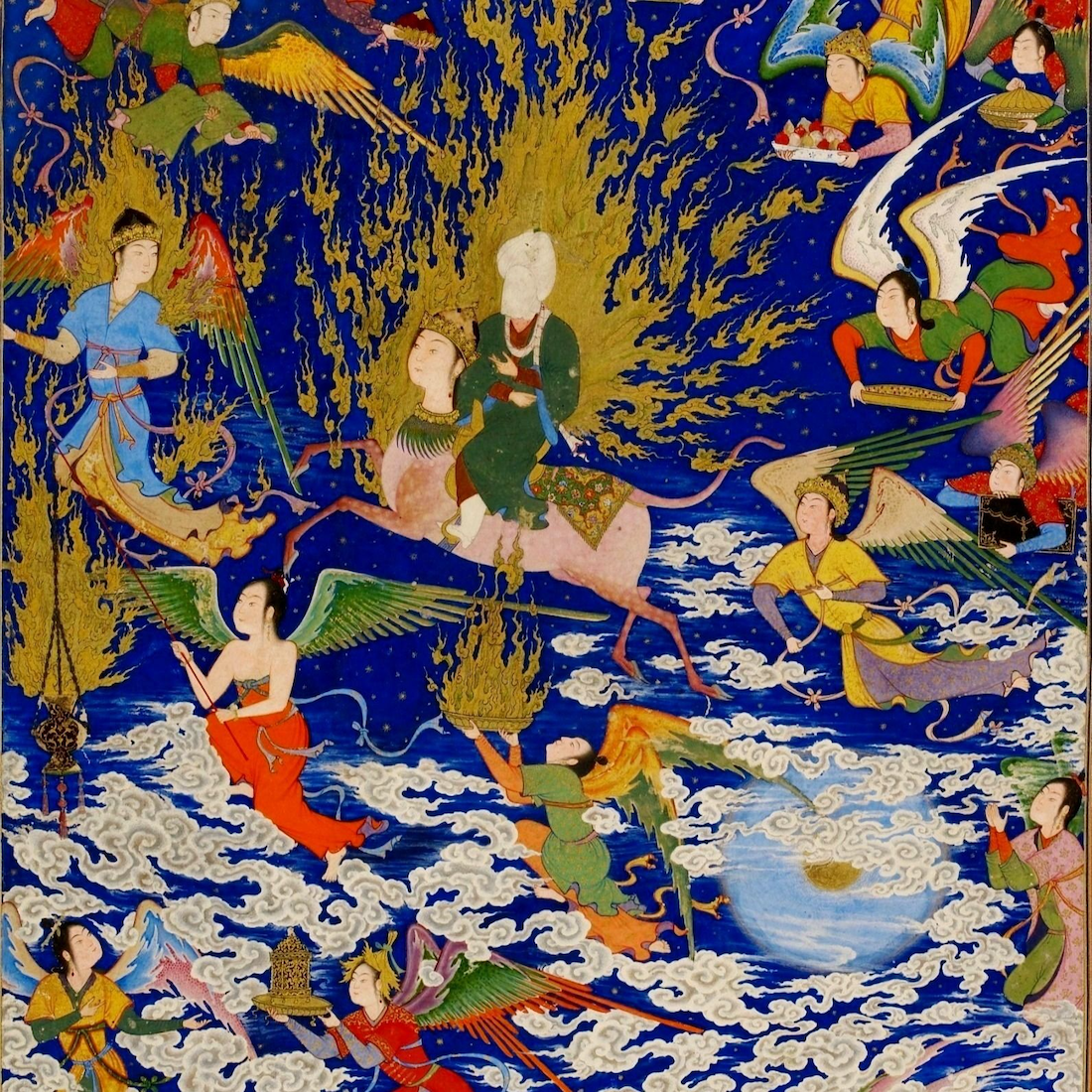
Ibn ʿArabi (1165-1240) was an Andalusian Sufi master whose teaching on the oneness of being, the perfect human and the creative imagination shaped Islamic mysticism for eight centuries. For depth psychology he matters because he treated imagination as a real world between spirit and matter, an idea Henry Corbin carried into the Jungian circle and that closely parallels Jung’s active imagination.
Key takeaways
- Ibn ʿArabi (1165-1240) was an Andalusian Sufi master whose Meccan Revelations and Bezels of Wisdom shaped Islamic mystical thought for centuries.
- The phrase wahdat al-wujud was attached to his school later, but the idea of one Being disclosing itself in every creature runs through all his work.
- His perfect human gathers every divine name in one form, a picture that depth psychologists read as an image of the individuated Self.
- Ibn ʿArabi treated imagination as a real intermediate world, and Henry Corbin carried this idea into the Eranos circle around Carl Jung.
- Jungian active imagination and dream work share his attitude that inner images are met, not invented, and deserve to be taken seriously.
Who was Ibn ʿArabi?
Muhyi al-Din Muhammad ibn ʿAli ibn al-ʿArabi was born in Murcia, in Muslim Spain, in 1165 and moved with his family to Seville as a boy. Later Sufis called him al-Shaykh al-Akbar, “the Greatest Master.” He was not a philosopher in the narrow sense of the Arabic falsafa tradition: he was a visionary, a scholar of the Qur’an and the hadith, and a teacher of the spiritual path, who wrote out of what he described as unveiling and direct experience.9
As a young man in Córdoba he met the philosopher Ibn Rushd (Averroes), an encounter he later recorded as a meeting between reasoned thought and the knowledge given by unveiling. Around 1200 he left al-Andalus for good. He reached Mecca in 1202, where he began his largest work and met Nizam, the young woman whose wisdom and beauty inspired the love poems of the Tarjuman al-ashwaq (The Interpreter of Desires). He travelled through Egypt, Iraq and Anatolia, and in the 1220s settled in Damascus, where he died in November 1240. His tomb there is still visited.9
Hundreds of works are attributed to him. Two carry most of his teaching. Al-Futuhat al-Makkiyya (The Meccan Revelations or Openings) is a vast compendium in 560 chapters, begun in Mecca and finished in a second draft in Damascus in 1238.2 Fusus al-hikam (The Bezels of Wisdom), written in Damascus around 1229, is short and dense: 27 chapters, each setting the wisdom of one prophet, from Adam to Muhammad, like a stone in a ring.1 Most of the ideas below, the unity of being, the perfect human and the world of imagination, are worked out across both books.
What is the unity of being (wahdat al-wujud)?
The doctrine of unity
The idea most often linked with Ibn ʿArabi is wahdat al-wujud, the oneness or unity of being. The phrase itself does not appear as a technical term in his writings. It was attached to his school by later followers and, more sharply, by critics such as Ibn Taymiyya, who used it as a label for what they saw as his errors. The idea behind it, however, runs through everything he wrote.4
That idea is simple to state. There is only one real being, which Ibn ʿArabi calls al-Haqq, the Real or the Truth, and al-wujud, Being. Everything else exists by borrowing from it. Creatures are not illusions, nor are they separate substances standing beside God. Each is a tajalli, a self-disclosure of the Real in a particular form. The multiplicity of the world is how the one Being shows itself.4
Ibn ʿArabi often uses the language of reading here. The Qur’an speaks of its own verses as ayat, “signs,” and it uses the same word for the things of nature. He takes the parallel seriously: the cosmos is a book written by God, its creatures are words and letters, and to know the world properly is to read it as revelation.4 Every being has its own “face” turned toward the Real, so nothing is merely neutral matter.
Transcendence and immanence: the Essence and the names
Unity does not mean that God and the world are simply the same. Ibn ʿArabi distinguishes the divine Essence (dhat) from the divine names. The Essence is nondelimited (mutlaq): beyond every definition, relation and description, unknowable in itself. The names, such as the Merciful, the Knowing, the Living or the Forgiving, are relations between that Essence and the world. Because the possible relations are without limit, the names are not confined to the traditional ninety-nine; every creature manifests a particular configuration of them.4
This gives him two ways of speaking about God that he insists must be held together. Tanzih declares God incomparable: nothing is like Him. Tashbih declares God similar: He is the Seeing, the Hearing, present in every form. To hold only the first produces a remote and abstract God; to hold only the second collapses God into the world. The person of real knowledge sees with “two eyes,” affirming both at once.4 Readers who know the Jewish mystical tradition will recognise the structure in the Kabbalistic distinction between the hidden Ein Sof and the sefirot through which it is expressed.
The barzakh, the isthmus between
The term that lets Ibn ʿArabi hold these opposites together is barzakh, a Qur’anic word for an isthmus or barrier between two seas that keeps them apart while touching both. For him a barzakh is anything that stands between two things, separating and joining them at once. Every created thing is a barzakh between sheer Being and sheer nonexistence: it is, and yet it is not by itself. Each is a mazhar, a locus where the names appear.4
The supreme barzakh is the human being. Ibn ʿArabi calls the cosmos the “great human” (al-insan al-kabir) and the human being the “small cosmos.” The cosmos displays the names spread out across countless creatures; the human gathers all of them in one form. That is why, in his telling, the human is the meeting place of God and world, and why the next idea, the perfect human, grows directly out of this one.1
What unity of being means for the perennial philosophy and depth psychology
The perennial philosophy holds that a common core of spiritual truth underlies the world’s religions. Ibn ʿArabi gives that core a precise form: one Reality, disclosing itself in endless forms, which can be recognised directly in every dimension of existence. He arrives there from within Islam, through the Qur’an’s language of signs and faces, not by abstracting from all religions. That gives his version a concreteness the more general statements of perennialism often lack.11
For depth psychology the parallel is with the wholeness of the psyche, which includes both conscious and unconscious elements. Carl Jung described the Self as the archetype of that wholeness and the regulating centre of the personality, larger than the ego and never fully known by it.15 Individuation, in Jung’s sense, is the long process by which a person becomes conscious of these deeper layers and lives from that larger centre. Read psychologically, the unity of being suggests that the many images, moods and figures of inner life are not random fragments. They are expressions of one underlying psyche, much as Ibn ʿArabi’s creatures are self-disclosures of one Being. Jung was careful to say that the Self is a psychological image and not a statement about God, but he also saw that religious images of divine unity and psychological images of wholeness can hardly be told apart in experience.
Who is the Perfect Human (al-insan al-kamil)?
The human being as microcosm
Ibn ʿArabi’s second great theme is al-insan al-kamil, the perfect or complete human being. He builds it on a hadith he quotes often: “God created Adam in His form.” In his reading, Adam was created in the form of the name Allah, the all-comprehensive name that gathers every other divine name. The human being therefore contains, in potential, every quality displayed anywhere in the cosmos.1
The opening chapter of the Fusus makes this vivid. God wished to see His names displayed in a being that could reflect them as a whole. The cosmos had been made, but it was like an unpolished mirror. Adam was the polishing of that mirror, the point at which the cosmos became able to reflect what was shown in it.1 The human soul, in this picture, is itself a barzakh between spirit and body, taking part in every level of reality.
The perfect human is the one who actualises that potential. Ordinary people carry the divine form in a latent, unbalanced and largely unconscious way, with some qualities swollen and others hidden. The prophets and the great saints are those in whom the qualities are realised fully and in proportion. Ibn ʿArabi held that this completion is the purpose of human existence, the possibility built into every soul, even if few reach it.3
Human perfection and the Sufi path
The Sufi path, for Ibn ʿArabi, is the process of becoming this complete human. His usual name for it is al-takhalluq bi-akhlaq Allah, “assuming the character traits of God”: becoming generous with the Generous, patient with the Patient, forgiving with the Forgiving, until the names that are present in potential are present in fact.3 Discipline, remembrance of God and service to a teacher are the means; a polished heart is the result.
The Futuhat maps this path in great detail as a sequence of stations (maqamat), states (ahwal) and waystations (manazil), each opening a new kind of knowledge. The summit is not one more station. Ibn ʿArabi calls it the “station of no station” (maqam la maqam). The person who reaches it is not fixed in any single quality or experience; he moves freely through all of them as the moment requires, because he is attached to none.3 He saw this as the inheritance of Muhammad, the prophet whose station, in his reading, included all others.
The Muhammadan Reality
Behind the perfect human stands a cosmic principle that Ibn ʿArabi and his school called the Muhammadan Reality (al-haqiqa al-muhammadiyya). It is the first thing God brought forth, the archetypal pattern of all prophets and of the cosmos itself, close to what Greek-speaking philosophers had called the Logos. The historical Muhammad is its full manifestation, and every prophet and saint is one of its facets.7
The Fusus also gives the perfect human a cosmic role. He is to the world what a seal is to a treasury: as long as the seal is in place, the treasury is kept. In this sense the perfect human preserves the cosmos and is the channel through which mercy reaches it.1 The Western scholar Reynold Nicholson, in his 1921 essay on the perfect man, traced how ʿAbd al-Karim al-Jili, writing about 1400, built a whole system on Ibn ʿArabi’s foundations.12
What the perfect human means for the perennial philosophy and depth psychology
For the perennial philosophy the perfect human is a claim about human nature: the realisation of the divine in the human is possible for everyone, whatever their culture. Ibn ʿArabi also insists that this realisation happens through particular prophets, revelations and lineages of teachers. Seyyed Hossein Nasr, who wrote about him within the perennialist school, stressed exactly this pairing: a universal goal reached by a particular, traditional road.11
For depth psychology the perfect human is a symbol of the individuated personality. Jung’s Self is the archetype of wholeness, and individuation is the gradual integration of what was unconscious into a more complete life.15 Ibn ʿArabi’s ascending stations read, in this light, like an ancient phenomenology of psychological development, and his “station of no station” is close to what therapists hope for: a person who is no longer captured by one complex, mood or role, and can move among them freely. The prophets and saints of his tradition work in the psyche as archetypal images of that completeness, figures who show what a fuller human life might look like.
What is the imaginal world in Ibn ʿArabi?
The ontology of imagination
Ibn ʿArabi’s teaching on imagination (khayal) is the part of his work most important for psychology. For him imagination is not only a mental faculty that makes things up. It is a level of reality. He distinguishes “contiguous” imagination (khayal muttasil), the image-making power within each person, from “discontiguous” imagination (khayal munfasil), an intermediate world that exists independently of any one mind.3
Widest of all is “nondelimited imagination” (al-khayal al-mutlaq): the cosmos as a whole. Because everything other than God both is and is not, everything has the in-between quality of an image. Ibn ʿArabi liked to cite the saying “People are asleep, and when they die they wake up”: the world is a dream that must be interpreted, real as a self-disclosure of the Real, unreal if taken as standing on its own.3
Within this, the intermediate world of imagination is where spiritual realities take on form and bodily things take on meaning. Later thinkers, beginning with Suhrawardi‘s school, called it ʿalam al-mithal, the world of images or likenesses. It is where prophets receive revelation in visible form, where true dreams come from, where the angel Gabriel appears to Muhammad as a man, and where the events of the afterlife take place.5 Henry Corbin coined the Latin name mundus imaginalis for it, and the English word “imaginal” to keep it apart from the merely imaginary. He described it as the place where spirits take bodies and bodies become spiritual.7
Imagination and spiritual practice
Because the imaginal world is real, the spiritual path for Ibn ʿArabi involves learning to perceive it. The organ of that perception is the heart (qalb). He draws on the Arabic root of the word, which carries the sense of turning and fluctuation (taqallub): the heart is the faculty that can turn with each new self-disclosure of the Real and take on its shape.3 Remembrance of God (dhikr) and watchful meditation (muraqaba) polish the heart until it reflects what is shown to it without distortion.
He also gives imagination a role in prayer. A hadith says that one should worship God “as if you see Him.” Ibn ʿArabi takes the “as if” seriously: the believer is to see in imagination, and in doing so meets the Real in the only form in which it can be met. Corbin built much of his reading of Ibn ʿArabi around this teaching of “creative imagination” and prayer.7
The heavenly ascent
Ibn ʿArabi’s accounts of the miʿraj, the Prophet Muhammad’s night ascent through the heavens, describe the path as a journey through imaginal levels. In the Futuhat chapter on “the alchemy of happiness” (chapter 167), two travellers make the ascent: one follows reason alone, the other follows the Prophet. At each heaven the follower meets a prophet and learns the knowledge proper to that sphere, while the rationalist learns only about the planet.2 Each level is a quality the soul must take on, and the journey ends beyond all levels, in the station of no station.
The ascent ends in the heart. Ibn ʿArabi often cites a divine saying in which God declares that His heavens and earth cannot contain Him, but the heart of His faithful servant does. A heart that has made the journey becomes the “Throne of the All-Merciful,” wide enough to hold every form in which the Real appears.4
What the imaginal world means for the perennial philosophy and depth psychology
For the perennial philosophy, Ibn ʿArabi’s teaching restores the dignity of myth, symbol and image as ways of knowing alongside concepts and reasoning. Perennialists commonly describe reality as a hierarchy of levels from matter to spirit; he names the precise level where the two meet, and he makes it the place where religious experience actually happens.
For depth psychology the comparison with Jung is direct. Jung’s collective unconscious is the transpersonal layer of the psyche, structured by archetypes that appear in dreams, visions and myths.14 Ibn ʿArabi’s divine names, realised in the soul through imaginal encounter, play a similar part in his system. Corbin made the link personal: from 1949 he lectured at the Eranos meetings in Ascona alongside Jung, and his book on Ibn ʿArabi’s creative imagination grew out of lectures given there in the 1950s.7
The clearest bridge is active imagination. Jung developed it from 1913, during the period recorded in his Red Book, and described it later as a way of letting an inner image move and speak while the conscious ego stays present and responds.14 The image is treated as having its own life and intention, not as a fantasy to be steered. That is close to Ibn ʿArabi’s discontiguous imagination: an image met, not invented. Jungian dream interpretation rests on the same attitude, and the Sufi practice of interpreting true dreams (taʿbir, literally “crossing over”) is its older cousin. Corbin’s distinction between the imaginal and the imaginary is the distinction every Jungian analyst makes between a living symbol and a passing fancy.
How does Ibn ʿArabi hold unity and diversity together?
Although the oneness of being is his central theme, Ibn ʿArabi constantly stresses that unity shows itself only through diversity. Each name has its own quality, and each creature reflects the Real in a way no other creature does. Self-disclosure never repeats. He taught a “renewal of creation with each breath” (tajdid al-khalq maʿa al-anfas), drawing on the Qur’an’s phrase about a “new creation” (Qur’an 50:15): the world is re-created at every instant, so that it is always new.4
The same principle shapes his view of religions. He quotes the Qur’an’s “Wherever you turn, there is the face of God” (Qur’an 2:115) and holds that every revealed religion is a true path to the Real, shaped to the needs and capacities of the people who receive it. His best-known lines on this come from the Tarjuman al-ashwaq, in Nicholson’s 1911 translation:10
My heart has become capable of every form: it is a pasture for gazelles and a convent for Christian monks, / And a temple for idols and the pilgrim’s Ka’ba and the tables of the Tora and the book of the Koran. / I follow the religion of Love: whatever way Love’s camels take, that is my religion and my faith.
Ibn ʿArabi was not a casual universalist. He remained a committed Muslim and taught that the revelation given to Muhammad comprehends the others, as he put it, like the sun among the stars, which do not lose their light when the sun appears.5 He placed the core of that revelation in tawhid, the declaration of divine unity, which is also the root of his doctrine of the one Being. What he offered instead was a principle for understanding difference. Every person worships “the god created in belief,” the form in which the Real has appeared to that person. Each such god is a true but limited disclosure. The one who knows recognises the Real in every form of belief, while knowing that it is bound by none of them.5
This teaching has a psychological edge. The image each of us holds of God, of the world and of ourselves is shaped by our history and our capacity. Ibn ʿArabi neither dismisses those images nor treats them as final. He asks that they be held as real disclosures and kept open to what they do not yet include.
How did Ibn ʿArabi’s ideas spread?
His influence on later Islamic thought was enormous. The key figure was Sadr al-Din al-Qunawi (d. 1274), his stepson and closest disciple, who taught in Konya and gave the teaching a more systematic, philosophical form. Qunawi was in contact with the circle of Rumi, who lived in the same city.11 From Konya the school spread east and west. Dawud al-Qaysari (d. 1350) wrote an influential commentary on the Fusus, and the Persian poet and scholar ʿAbd al-Rahman Jami (d. 1492) carried the teaching into Persian literature. Through these writers Ibn ʿArabi’s vocabulary became the common language of Sufi metaphysics from the Ottoman lands to India.11
He was also controversial. Some jurists and theologians, most famously Ibn Taymiyya (d. 1328), attacked his work as pantheism contrary to Islamic doctrine, and arguments over him continue. Most Sufis, and many ordinary Muslims, nonetheless revere him as the Greatest Master. Michel Chodkiewicz has shown how closely Ibn ʿArabi’s teaching is tied to the text of the Qur’an and to Islamic law, which complicates the picture of him as a freethinker standing outside his tradition.8
In the West, serious study began with Nicholson in the early twentieth century and deepened with Corbin, Toshihiko Izutsu, Nasr, Chodkiewicz and William Chittick. Izutsu’s Sufism and Taoism (1983) set Ibn ʿArabi’s metaphysics beside the thought of Lao Tzu and Chuang Tzu, finding a shared structure of an unknowable Absolute and its self-manifestation.13 Chittick’s translations and studies, beginning with The Sufi Path of Knowledge (1989), made the technical vocabulary available in English.3 Stephen Hirtenstein’s biography gave English readers a full account of his life.9
Scholars and admirers have compared his ideas with Neoplatonism, with Meister Eckhart‘s distinction between God and the Godhead, with Nicholas of Cusa‘s coincidence of opposites, with Hegel‘s Absolute that comes to know itself through its own unfolding, and even, in popular writing, with quantum physics. The visionary geography of Emanuel Swedenborg, another influence on Jung, is often read alongside his intermediate world. The comparisons are partial, but they show why his work speaks to readers far outside Islam.
Why does Ibn ʿArabi matter to the perennial philosophy?
The phrase “perennial philosophy” goes back to the Renaissance, and Aldous Huxley’s anthology The Perennial Philosophy (1945) made it popular, gathering sayings from many traditions around a shared core: a divine ground of being, a self that can know it, and a life aimed at that knowledge.6 The Traditionalist writers of the twentieth century, Nasr among them, saw Ibn ʿArabi as one of the clearest witnesses to that core.11
He offers three of its central themes in a worked-out form. The first is the oneness of being that pervades all reality. The second is the inner unity of the religious paths, held together with a real respect for their differences. The third is the human vocation to realise the divine within the crucible of the heart. He gives each of them a technical vocabulary, a set of practices and a map of experience, which is why later perennialists returned to him so often.
He also warns against a thin version of perennialism. For Ibn ʿArabi the universal is reached only through the particular: through a specific revelation, a specific discipline, a specific teacher. The heart that becomes “capable of every form” gets there by going deep into one form first. That is close to how depth psychology works, which approaches the universal layers of the psyche only through one person’s particular dreams, symptoms and history.
What can Ibn ʿArabi offer psychotherapy?
Ibn ʿArabi’s picture of the soul’s ascent through stations, ending in the station of no station, can be read as a symbolic account of psychological wholeness. The traveller takes on one quality after another, is changed by each, and is finally held by none. Jung’s account of individuation describes a similar movement: the ego meets and integrates shadow, anima or animus and other archetypal figures, and the centre of the personality shifts toward the Self.15 Neither picture is a straight line, and both treat the inner images as guides rather than symptoms to be removed.
In Jungian therapy, this shows up in practical ways. We take dreams seriously as communications, not as noise. When a strong image appears, we may invite a client to stay with it, describe it, and let it respond, which is active imagination in its simplest form. We pay attention to the client’s image of God or of the sacred, without either endorsing or debunking it, because therapy that rules on metaphysics for the client has left its own ground and because, as Ibn ʿArabi saw, the “god of belief” says a great deal about the person who holds it. Clients who come from religious backgrounds, or who have left them, often find it a relief to be able to speak about these images openly.
The same attitude carries into the body-based trauma work done at Taproot. In Brainspotting, a client focuses on a felt sense in the body while the therapist holds a fixed point in the visual field; images, memories and sensations then arise and move without being forced. Many clients describe this as meeting something that has its own life, which is very close to the older language of an image that is met rather than made. The therapist’s task in both traditions is similar: to stay present, curious and steady while the image unfolds.
Ibn ʿArabi also helps with a common trouble in therapy: the sense of being split into incompatible parts. His teaching that unity appears only through diversity, and that each quality has its place in a complete human being, supports the work of helping people accept parts of themselves they have rejected. The aim is not to erase anger, grief or longing, but to let each find its proper place, so that no single quality takes over the whole person.
Finally, he insisted that knowledge of the Real and knowledge of oneself are bound together. He often cited the saying “Whoever knows himself knows his Lord.” For a therapist this is a reminder that self-knowledge is not a narrow, technical goal. Becoming more conscious of one’s own depths opens a person to meaning, relationship and, for many, the sacred. That is the point at which a twelfth-century Sufi master and a modern depth psychologist find they are working on the same question.
At Taproot Therapy Collective we draw on Jungian, existential and body-based approaches because, like Ibn ʿArabi, we take the images of the psyche seriously as a source of healing and meaning. If you would like to work with dreams, symbols or the deeper questions of your life, you can contact us to begin.
Frequently asked questions
What does wahdat al-wujud mean?
Wahdat al-wujud means the oneness or unity of being. It names the teaching, associated with Ibn ʿArabi, that only God truly exists and that every creature is a self-disclosure of that one Being in a particular form. Ibn ʿArabi did not use the phrase as a technical term; later followers and critics did. The idea, though, is central to his writing.
What is the imaginal world according to Ibn Arabi?
For Ibn ʿArabi, the imaginal world is an intermediate level of reality between pure spirit and the physical world. In it spiritual realities take visible form, true dreams and prophetic visions arise, and bodily things carry meaning. Henry Corbin called it the mundus imaginalis and coined the word imaginal to separate it from the merely imaginary.
How is Ibn Arabi connected to Carl Jung?
The main link is Henry Corbin, the French scholar of Islamic mysticism who lectured at the Eranos meetings with Carl Jung from 1949. Corbin’s book on Ibn ʿArabi’s creative imagination grew from those lectures. Jungians have since compared Ibn ʿArabi’s imaginal world with the collective unconscious and his practice of imaginal perception with Jung’s active imagination.
Who is the perfect human in Sufism?
In Ibn ʿArabi’s Sufism, the perfect human (al-insan al-kamil) is a person who fully realises all the divine names latent in the human form, which was created in the image of God. The prophets and great saints are its examples. Through this figure the cosmos becomes a clear mirror in which God’s qualities are reflected.
What are Ibn Arabi’s most important books?
Ibn ʿArabi’s two central works are al-Futuhat al-Makkiyya (The Meccan Revelations), a vast work in 560 chapters begun in Mecca in 1202, and Fusus al-hikam (The Bezels of Wisdom), written in Damascus around 1229 in 27 chapters on the prophets. His love poems, the Tarjuman al-ashwaq, are also widely read in English translation.
Related reading
- The Razor and the Psyche: William of Ockham’s Enduring Legacy for Depth Psychology and Psychotherapy
- Charles Eames: Pioneering Designer of the Modern Era
- Ludwig Mies van der Rohe: Architect of the Modern Age
- Martin Heidegger and the Quest for Being: Implications for Psychotherapy and Depth Psychology
- Gerhard Dorn: Alchemist, Philosopher, Visionary
- Jean-Paul Sartre: Existentialism, Freedom, and the Human Condition
References
- Ibn al-ʿArabi. (1980). The bezels of wisdom (R. W. J. Austin, Trans.). Paulist Press.
- Ibn al-ʿArabi. (2002). The Meccan revelations (Vol. 1; M. Chodkiewicz, Ed.; W. C. Chittick & J. W. Morris, Trans.). Pir Press.
- Chittick, W. C. (1989). The Sufi path of knowledge: Ibn al-ʿArabi’s metaphysics of imagination. State University of New York Press.
- Chittick, W. C. (1998). The self-disclosure of God: Principles of Ibn al-ʿArabi’s cosmology. State University of New York Press.
- Chittick, W. C. (1994). Imaginal worlds: Ibn al-ʿArabi and the problem of religious diversity. State University of New York Press. https://doi.org/10.1515/9780791498958
- Huxley, A. (1945). The perennial philosophy. Harper & Brothers.
- Corbin, H. (1969). Creative imagination in the Sufism of Ibn ʿArabi (R. Manheim, Trans.). Princeton University Press.
- Chodkiewicz, M. (1993). An ocean without shore: Ibn Arabi, the Book, and the Law (D. Streight, Trans.). State University of New York Press.
- Hirtenstein, S. (1999). The unlimited mercifier: The spiritual life and thought of Ibn ʿArabi. Anqa Publishing; White Cloud Press.
- Ibn al-ʿArabi. (1911). The Tarjuman al-ashwaq: A collection of mystical odes (R. A. Nicholson, Ed. & Trans.). Royal Asiatic Society.
- Nasr, S. H. (1964). Three Muslim sages: Avicenna, Suhrawardi, Ibn ʿArabi. Harvard University Press.
- Nicholson, R. A. (1921). Studies in Islamic mysticism. Cambridge University Press.
- Izutsu, T. (1983). Sufism and Taoism: A comparative study of key philosophical concepts. University of California Press.
- Jung, C. G. (1959). The archetypes and the collective unconscious (R. F. C. Hull, Trans.; Collected Works, Vol. 9, Pt. 1). Princeton University Press.
- Jung, C. G. (1959). Aion: Researches into the phenomenology of the self (R. F. C. Hull, Trans.; Collected Works, Vol. 9, Pt. 2). Princeton University Press.









Very interesting! I think anyone interested in the psychological implications of our religion should read “Psychotherapy for Muslims” by Sultan Califi. M.I.