

The mundus imaginalis is Henry Corbin’s Latin name for an intermediate world, between the senses and the intellect, that medieval Persian philosophers called ‘alam al-mithal, the world of images. Corbin (1903–1978), a French philosopher and scholar of Islamic thought, chose the word “imaginal” to keep this world apart from the “imaginary.” Its images, he argued, are perceived, not made up.
That distinction is why therapists still read him. Corbin gives Jung’s active imagination something it never had on its own terms: an ontology, a reason to treat the figures of dreams and reveries as met rather than manufactured. My argument here is that the stance is clinically sound and the cosmology is optional. Corbin kept the two apart himself, though from the other side: he called himself a metaphysician, not a psychologist, said he avoided talking about angels in front of psychologists, and thought psychology alone could only “prepare the battleground.”1 He would not have called the cosmology optional.
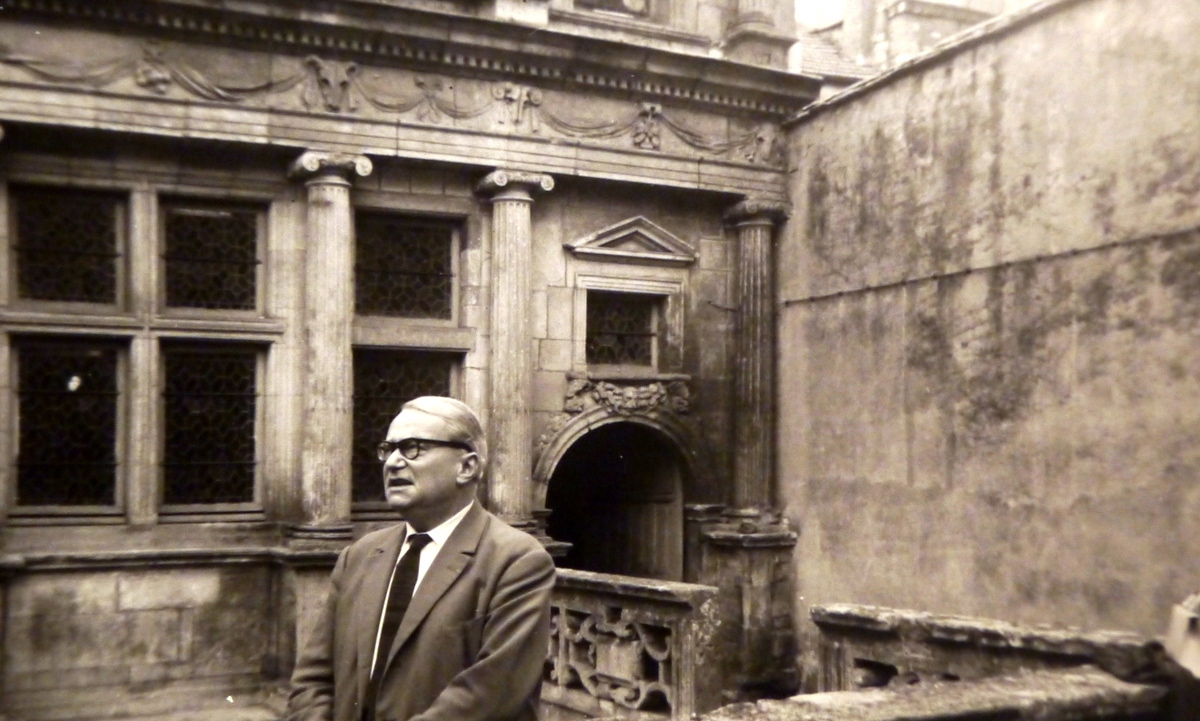
Who Henry Corbin was
Corbin was born in Paris on April 14, 1903,3 and died there on October 7, 1978.2 In the mid-1920s Étienne Gilson’s commentary on a Latin translation of Avicenna gave him his first contact with Islamic philosophy, and he went on to study Arabic, Persian and Turkish and to follow Louis Massignon’s courses.1,2 In the late 1920s (Corbin remembered the 1927–28 academic year; Charles Adams dates it to the autumn of 1929), Massignon handed him a lithographed edition of Suhrawardi’s Hikmat al-ishraq, the “Oriental Theosophy,” saying there was something in it for him. Corbin later wrote that the encounter sealed his “spiritual destiny.”1,2
He was also Heidegger’s first French translator; he visited Heidegger in Freiburg in 1934 to plan the selection that appeared at the end of the decade as Qu’est-ce que la métaphysique?1,2,4 In October 1939 he left for Istanbul on a short mission to copy Suhrawardi manuscripts and, because of the war, stayed until September 1945.1,2
| Year | Event |
| 1903 | Born in Paris, April 14 |
| 1927–1929 | Massignon gives him Suhrawardi’s Hikmat al-ishraq |
| 1939–1945 | Wartime years in Istanbul; first volume of his Suhrawardi edition published there2 |
| 1946–1973 | Heads the department of Iranology at the Institut franco-iranien, Tehran; founds the Bibliothèque iranienne series in 19492 |
| 1949 | First lectures at the Eranos meetings in Ascona, Switzerland |
| 1954 | Succeeds Massignon in the chair of Islam and the religions of Arabia at the École pratique des hautes études |
| 1958 | L’imagination créatrice dans le soufisme d’Ibn ‘Arabî; English translation 1969, reissued in 1998 as Alone with the Alone |
| 1964 | Histoire de la philosophie islamique, which disputed the view that philosophy in Islam ended with Averroes2 |
| 1978 | Dies in Paris, October 7 |
What the mundus imaginalis is
The idea is older than Corbin. Suhrawardi (1154–1191), the Persian founder of the Illuminationist school, who was executed at Aleppo, added a fourth level to the usual ladder of being: a world of “suspended images” between the material world and the pure lights of the intellect. It explained prophetic vision and how souls experience reward and punishment after death. Corbin rendered Suhrawardi’s ‘alam al-mithal as mundus imaginalis, though some scholars now prefer the plainer “world of images.”5 See our piece on Suhrawardi’s Illuminationist philosophy and depth psychology.
Ibn ‘Arabi (1165–1240), born in Murcia, who settled in Damascus in 1223 and died there, worked the idea out at length. For him, William Chittick explains, imagination (khayal) has an ontological status, not just a psychological one. The in-between world is where spiritual beings take bodily form, as when Gabriel appeared to Mary as a man, and where bodily things are spiritualized, as in the pleasures and pains of the afterlife. Anything that both divides and joins two things he called a barzakh, an isthmus. The heart has two eyes, reason and imagination, and letting either one dominate distorts what it sees.6 More in our essay on Ibn ‘Arabi and the perennial philosophy.
Corbin’s contribution was the vocabulary and the argument. In “Mundus imaginalis ou l’imaginaire et l’imaginal,” collected in Face de Dieu, face de l’homme (an English version appeared in the Jungian journal Spring in 1972), he described an intermediate world no less real ontologically than the world of the senses or of the intellect, with a faculty of perception of its own.7,8 Because “imaginary” had come to mean unreal, he needed a new word. In a late summary he called it “the median world where the spirit takes body and where bodies are spiritualized,” and credited the name to “our Persian Platonists.”1 Chittick adds a caution: “creative imagination,” the phrase in the title of Corbin’s book on Ibn ‘Arabi, has no equivalent in Ibn ‘Arabi’s own vocabulary.6,9 Readers of the Romantics will recognize a cousin in William Blake’s visionary imagination; Corbin himself set his Islamic sources beside Western visionaries such as Jacob Boehme and Swedenborg.4
The Angel, the exile and ta’wil
Three more of Corbin’s themes have been pulled loosely into psychology. First, the Angel. Suhrawardi’s allegorical treatises, among them A Tale of Occidental Exile, stage a meeting between a seeker and a guide figure who instructs the novice in the quest for the world of light.5 Corbin built much of his work around Suhrawardi’s angelology, which he tied to the angelology of ancient, Zoroastrian Iran.1,2 He wrote of the “Perfect Nature” as the philosopher’s Angel, a personal guide and heavenly alter ego.8
Second, exile. Corbin read the “Occident” of Suhrawardi’s tale metaphysically, as the setting of the light and the place of decline, and said the tale was the moment he cast off the weight of finitude he had found in Heidegger.4 It describes the soul’s condition. It is not a theory of trauma, and Corbin offered none, though the old page said he did.
Third, ta’wil, which Corbin said “means to re-conduct something to its source, to its archetype”: the spiritual reading of scripture practiced by Twelver and Ismaili Shi’ite thinkers. An authentic ta’wil, he insisted, “has nothing to do with inoffensive ‘allegory’.”4 He did not apply it to symptoms. Comparing the ta’wil of prophetic visions with a psychologist’s analysis of them, he saw “a tremendous gulf between the two.”1
Corbin, Jung and Eranos
In 1949 Olga Fröbe-Kapteyn invited Corbin to the Eranos circle she had founded at Ascona, on Lake Maggiore. He gave two lectures that August and kept returning for more than a quarter of a century.1 Jung, in Corbin’s phrase, was the meetings’ “tutelary genius.” The two men talked at Ascona, Küssnacht and Bollingen, and Corbin’s long defense of Jung’s Answer to Job, which critics of many confessions had attacked, won him Jung’s “lasting friendship.”1
Friendship was not discipleship. The old page said that “Jung provided the psychology; Corbin provided the theology,” as if they shared one project. Corbin’s own account, written months before his death, says otherwise: “I was a metaphysician, not a psychologist. Jung was a psychologist and not a metaphysician.” And: “I was friends with Jung, but I was never a ‘Jungian’.”1 He admired how Jung defended “the reality of the soul” against Freud and the psychology laboratory. But he thought “the Western psychologist still lacks the seat or metaphysical framework that ontologically assures the functioning of this mediating world,” and concluded: “Jungian psychology may serve to prepare the battleground, but a victorious issue shall depend upon other arms than those of psychology.”1
The psychologists who took Corbin furthest were the archetypal school. OPUS Archives, which holds Hillman’s papers, lists Corbin among the influential authors in Hillman’s work, and Corbin named Hillman among his friends at Eranos.1,10 Hillman’s archetypal psychology took up the word “imaginal” and put imagination at the center of psychology. Tom Cheetham’s Imaginal Love (2015) compares the two men’s ideas of imagination.10,11 Mary Watkins carried the adjective into developmental psychology with Invisible Guests: The Development of Imaginal Dialogues (1986).12 The old page called Corbin Hillman’s “master.” I found no source for that word; the influence itself is plain.
Why “encountered, not invented” matters
Jung reached a similar conclusion from the clinical side. In Memories, Dreams, Reflections he describes Philemon, a figure from his fantasies in the years after his break with Freud, and says the figure taught him that there are things in the psyche he did not produce, which produce themselves and have their own life.13 Active imagination, the method he built from that experience, asks the ego to differentiate itself from such figures and talk with them rather than decode them; Joan Chodorow’s anthology Jung on Active Imagination gathers his main statements.14 What Corbin added was a reason, from outside psychology, to take that experience at face value.
Ibn ‘Arabi is more useful in the consulting room than the either-or usually attached to Corbin. The old page said a dream figure “is not just a ‘part of the self’; it is an autonomous entity.” Ibn ‘Arabi’s position is subtler. In Chittick’s summary, “A dream is both the soul and what is seen; or, it is neither the soul nor what is seen.”6 That is how a careful clinician can hold a dream figure: it comes from the dreamer, and it is not under the dreamer’s control.
Cognitive science offers part of an explanation for why images can feel met rather than made. A 2015 review by Joel Pearson and colleagues concluded that visual mental imagery works like a weak form of perception, with brain activity for imagined and seen images resembling each other as early as primary visual cortex.15 Emily Holmes and Andrew Mathews reviewed evidence that imagery evokes stronger emotion than verbal thinking about the same material, partly because people respond to images “as if” to real events.16 In a small, uncontrolled 1989 study, Paul Tholey had nine lucid dreamers set tasks for their dream characters; some managed them, though their arithmetic was poor, and Tholey suggested treating such characters as if they were rational beings.17 None of this proves Corbin’s cosmology. It shows that the experience of encounter is real as experience, and that a therapy which treats images as decoration throws away some of its strongest material.
What this looks like in therapy
The figure gets asked before it gets explained. Suppose a dream brings a stranger who follows the dreamer from room to room. The reflex is to translate at once: the stranger is your father, your ambition, your anxiety. An imaginal approach slows that down. What does he want? What happens in your chest when you turn to face him? In active imagination the client continues the scene while awake and speaks with the figure; Robert A. Johnson’s Inner Work (1986) remains the plainest lay guide (see our profile of Robert A. Johnson’s mythopoetic psychology).18 Interpretation still comes, after the image has had its say; our piece on how active imagination differs from meditation walks through the method.
Neither “it’s only you” nor “it’s a separate being.” Following Ibn ‘Arabi rather than the popular Corbin, the therapist holds the figure as both the client’s and not the client’s, with a point of view the client does not control. Parts-based therapies make the same working assumption. It spares the client two errors: dismissing the figure and being ruled by it.
The body belongs to the image. Images arrive with sensation, posture and breath, and tracking those keeps imaginal work from becoming an intellectual game, a point at the heart of Marion Woodman’s work on the embodied soul.
Containment comes before encounter. The Jungian analyst Brian Feldman has argued that a psychological container, a “psychic skin” that first forms in infancy, has to be in place before imaginal processes can serve growth.19 Corbin made a parallel point from the side of metaphysics: a proper framework, he wrote, “preserves the imaginal from the derailings and divagations of the imaginary, of hallucination and of madness.”1 In practice, that argues for starting people with psychotic experiences or severe dissociation with stabilization rather than deep imaginal immersion; our page on dissociation therapy describes that work.
Trauma images are memories first. A flashback or a post-traumatic nightmare is not a visit from the imaginal world, and much of the evidence for imagery work in trauma comes from methods that handle the image on purpose, by revisiting it or by rewriting it. A 2017 meta-analysis of imagery rescripting found large pre-to-post improvements across 19 trials with 363 adults, mostly with PTSD or social anxiety, though only seven trials were randomized.20 A 2013 meta-analysis of treatments for chronic nightmares found large pre-to-post reductions in nightmare frequency from imaginal confrontation and rescripting; more time spent confronting the nightmare’s content went with better results, though the authors call for dismantling studies.21 A therapist shaped by Corbin may hesitate to alter a dream figure. With trauma nightmares, deliberately facing or rewriting it is often the point.
I could find no randomized trial of active imagination on its own. The best-known evidence for Jungian therapy as a whole comes from naturalistic and retrospective outcome studies in Germany and Switzerland, reviewed by Christian Roesler in 2013, which report lasting improvement but are not randomized trials.22 Imaginal work at Taproot is one part of Jungian depth therapy, not a stand-alone cure for anything.
Critics, and Corbin in history
Corbin’s critics are worth hearing, because their objection bears on therapy. Steven Wasserstrom’s Religion after Religion (1999), on Corbin, Mircea Eliade and Gershom Scholem, all Eranos lecturers between 1949 and 1978, argues that they changed the study of religion by de-emphasizing law, ritual and social history and exalting myth and mysticism, and that the most controversial result was to minimize the binding moral law of the monotheisms.23 Hermann Landolt, by contrast, reads Corbin’s scholarship as a critique of Orientalism different in kind from Edward Said’s, rooted in German phenomenology.24 Corbin’s “Orient” was never a place on a map. Even Freiburg, Tehran and Isfahan, he told an interviewer, were for him “emblematic cities,” symbols of a permanent voyage.4
Read with a historian’s eye, Corbin’s project is one mid-century European answer to secularization, worked out in Istanbul libraries during a world war and in a French institute in Tehran. That does not make it wrong. It does mean the imaginal can become a place to hide from history. The same risk shows up in therapy when a dream of being hunted is read only as archetypal drama and never as a picture of an actual employer, landlord or marriage. Good imaginal work runs in both directions, from the image to the life and back again.
If dreams, recurring figures or inner images have been pressing on you and you want a place to look at them carefully, our Jungian depth therapy page explains how we approach that work in Hoover, and you can contact us to ask whether it fits.
References
- Corbin, H. (1981). Biographical post-scriptum to a philosophical interview (M. Evans-Cockle, Trans.). Association des amis de Henry et Stella Corbin. (Written June 1978; originally published in C. Jambet (Ed.), Henry Corbin, Cahiers de l’Herne). https://www.amiscorbin.com/en/biography/biographical-post-scriptum-to-a-philosophical-interview/
- Adams, C. J. (2005). Corbin, Henry. In L. Jones (Ed.), Encyclopedia of religion (2nd ed.). Macmillan Reference USA. (Original work published 1987). https://www.encyclopedia.com/environment/encyclopedias-almanacs-transcripts-and-maps/corbin-henry
- Kalin, I. (2006). Corbin, Henry (1903–1978). In D. M. Borchert (Ed.), Encyclopedia of philosophy (2nd ed.). Macmillan Reference USA. https://www.encyclopedia.com/humanities/encyclopedias-almanacs-transcripts-and-maps/corbin-henry-1903-1978
- Corbin, H., & Nemo, P. (1976). From Heidegger to Suhravardi: An interview with Philippe Nemo (M. Evans-Cockle, Trans.). Association des amis de Henry et Stella Corbin. https://www.amiscorbin.com/en/biography/from-heidegger-to-suhravardi/
- Marcotte, R. (2019). Suhrawardi. In E. N. Zalta (Ed.), The Stanford encyclopedia of philosophy. Stanford University. https://plato.stanford.edu/entries/suhrawardi/
- Chittick, W. (2025). Ibn ‘Arabī. In E. N. Zalta (Ed.), The Stanford encyclopedia of philosophy. Stanford University. https://plato.stanford.edu/entries/ibn-arabi/
- Corbin, H. (1983). Face de Dieu, face de l’homme. Flammarion.
- Association des amis de Henry et Stella Corbin. (n.d.). Henry Corbin lexicon. https://www.amiscorbin.com/en/lexicon/
- Corbin, H. (1969). Creative imagination in the Sūfism of Ibn ‘Arabī (R. Manheim, Trans.). Princeton University Press.
- OPUS Archives and Research Center. (n.d.). James Hillman collection. https://www.opusarchives.org/james-hillman-collection/
- Cheetham, T. (2015). Imaginal love: The meanings of imagination in Henry Corbin and James Hillman. Spring Publications.
- Watkins, M. (1986). Invisible guests: The development of imaginal dialogues. Analytic Press.
- Jung, C. G. (1963). Memories, dreams, reflections (A. Jaffé, Ed.; R. Winston & C. Winston, Trans.). Pantheon Books.
- Jung, C. G. (1997). Jung on active imagination (J. Chodorow, Ed.). Princeton University Press. https://doi.org/10.1515/9781400866854
- Pearson, J., Naselaris, T., Holmes, E. A., & Kosslyn, S. M. (2015). Mental imagery: Functional mechanisms and clinical applications. Trends in Cognitive Sciences, 19(10), 590–602. https://doi.org/10.1016/j.tics.2015.08.003
- Holmes, E. A., & Mathews, A. (2010). Mental imagery in emotion and emotional disorders. Clinical Psychology Review, 30(3), 349–362. https://doi.org/10.1016/j.cpr.2010.01.001
- Tholey, P. (1989). Consciousness and abilities of dream characters observed during lucid dreaming. Perceptual and Motor Skills, 68(2), 567–578. https://doi.org/10.2466/pms.1989.68.2.567
- Johnson, R. A. (1986). Inner work: Using dreams and active imagination for personal growth. Harper & Row.
- Feldman, B. (2004). A skin for the imaginal. Journal of Analytical Psychology, 49(3), 285–311. https://doi.org/10.1111/j.1465-5922.2004.00463.x
- Morina, N., Lancee, J., & Arntz, A. (2017). Imagery rescripting as a clinical intervention for aversive memories: A meta-analysis. Journal of Behavior Therapy and Experimental Psychiatry, 55, 6–15. https://doi.org/10.1016/j.jbtep.2016.11.003
- Hansen, K., Höfling, V., Kröner-Borowik, T., Stangier, U., & Steil, R. (2013). Efficacy of psychological interventions aiming to reduce chronic nightmares: A meta-analysis. Clinical Psychology Review, 33(1), 146–155. https://doi.org/10.1016/j.cpr.2012.10.012
- Roesler, C. (2013). Evidence for the effectiveness of Jungian psychotherapy: A review of empirical studies. Behavioral Sciences, 3(4), 562–575. https://doi.org/10.3390/bs3040562
- Wasserstrom, S. M. (1999). Religion after religion: Gershom Scholem, Mircea Eliade, and Henry Corbin at Eranos. Princeton University Press. https://doi.org/10.1515/9781400823178
- Landolt, H. (1999). Henry Corbin, 1903–1978: Between philosophy and orientalism. Journal of the American Oriental Society, 119(3), 484–490. https://doi.org/10.2307/605942













0 Comments