
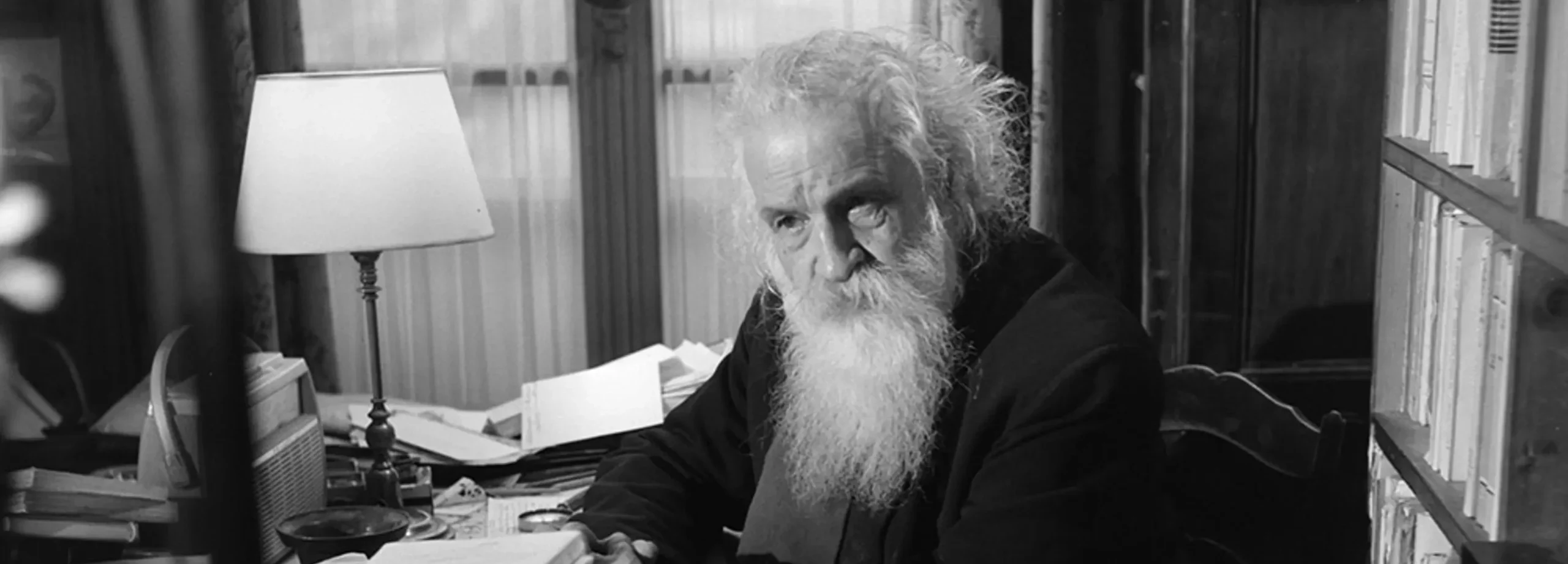
Gaston Bachelard (1884 to 1962) was a French philosopher who wrote first about how science changes its mind and then about how people dream matter, space and home. His books on fire, water, air, earth and the house treat images as real psychological events, which makes him a quiet ally of depth psychology and of any therapy that works with imagery.
Key takeaways
- Gaston Bachelard (1884 to 1962) wrote two bodies of work, one on how science breaks with common sense and one on the poetic imagination of matter and space.
- His epistemological obstacles are inner, psychological pulls toward comfortable images, such as heat imagined as a fluid, that science must overcome.
- In five books on fire, water, air and earth he treated the elements as the hormones of the imagination, each organising complexes of images.
- The Poetics of Space reads the house as an instrument for daydreaming, with a clear attic, a dark cellar and refuges such as nests, shells and corners.
- For therapists, Bachelard offers a way to let images reverberate, especially remembered houses, before interpreting them, which suits Jungian and somatic work.
Who was Gaston Bachelard?
Bachelard was born on 27 June 1884 in Bar-sur-Aube, a small town in Champagne, and he came to philosophy late and by a side door. He worked for years as a postal clerk while studying mathematics and physics at night, served in the trenches through the First World War, and lost his wife in 1920, leaving him to raise their daughter Suzanne, who later became a philosopher of science herself. He taught physics and chemistry at the secondary school in his home town through the 1920s, passed the agrégation in philosophy in 1922 and defended his doctoral thesis, Essai sur la connaissance approchée, in 1927.11
He taught at the University of Dijon from 1930 and in 1940 took the chair of history and philosophy of science at the Sorbonne, where he directed the Institute for the History of Science until he retired in 1954. Georges Canguilhem succeeded him. Bachelard died in Paris on 16 October 1962. The range of that career is the key to his work. A man who could write on quantum mechanics and on Edgar Allan Poe, he wrote two bodies of books, one on the scientific mind and one on the poetic imagination, and he treated each as the other’s necessary counterpart.11
What was Bachelard’s “new scientific spirit”?
Before he was a reader of poets, Bachelard was an epistemologist, a philosopher of how knowledge is made. He rejected the picture of science as a slow, steady pile-up of facts. In his view science advances by breaking with what came before, including with ordinary perception and common sense. Later writers named this idea the epistemological break, and Bachelard’s own phrase was rupture épistémologique.12
Epistemological obstacles
In La formation de l’esprit scientifique (1938; English translation The Formation of the Scientific Mind), Bachelard introduced the epistemological obstacle. An obstacle is not an external limit such as a missing instrument. It is an inner, psychological pull toward explanations that feel right. He catalogued them: the lure of first experience, the rush to general laws, the verbal obstacle in which one vivid word (a sponge, for instance) stands in for an explanation, and the substantialist habit of imagining every quality as a hidden substance.2
The idea of heat as a fluid shows how this works. People feel warmth flow from a stove into their hands, so for a long time physics described heat as caloric, an invisible liquid that moved from body to body. Thermodynamics had to break with that comfortable image before heat could be understood as motion. Bachelard subtitled the book “a contribution to a psychoanalysis of objective knowledge”, because he thought the scientist had to examine his own reveries as a patient examines his dreams.2
The New Scientific Spirit and open rationalism
In Le nouvel esprit scientifique (1934) Bachelard asked what relativity and quantum mechanics demanded of philosophy. His answer was a “non-Cartesian” epistemology. Descartes had looked for simple, clear, fixed starting points. The new physics showed that simplicity is reached at the end of a long construction and that categories such as substance, position and causality have to be revised as instruments and mathematics change.1 In La philosophie du non (1940) he generalised the point: a mature science says no to its own earlier concepts and absorbs them into wider ones, as non-Euclidean geometry absorbs Euclid.9
The resulting stance is often called Bachelard’s open rationalism. Reason is not a fixed set of rules but a discipline that keeps correcting itself, and a scientist who cannot tolerate uncertainty, probability and revision will defend obstacles instead of making discoveries. Mary Tiles shows how this view of science as a series of corrections, rather than a mirror held up to nature, shaped French philosophy of science for decades.12
Why did a philosopher of science turn to poetry?
The turn grew out of the obstacles themselves. While cataloguing the images that science had to purge, Bachelard noticed how powerful and how lovely they were. Science, he concluded, must strip itself of metaphor to become objective. The human being, though, lives in metaphor, and those same images are the material of poems, dreams and memory. If the scientist must leave them behind, the philosopher can still study them for what they are.10
Bachelard did not see the two projects as a contradiction. Edward Kaplan describes them as a deliberate polarity: a day side of rigorous concepts and a night side of images, each kept pure by not being confused with the other. The person who knows both lives a fuller mental life than the one who knows only one.10
What is Bachelard’s psychoanalysis of the elements?
Between 1938 and 1948 Bachelard wrote five books on the four classical elements. He treated fire, water, air and earth not as chemistry but as the basic substances of reverie, and in Air and Dreams he called them the “hormones of the imagination”: each element sets a whole cluster of images in motion. He grouped the clusters as “complexes”, borrowing the word from psychoanalysis, and often named them after a myth or a poet.5
The Psychoanalysis of Fire (1938)
Fire is the first prohibition a child meets: do not touch. Bachelard called the wish to know more than the adults, and to steal their fire, the Prometheus complex. Other complexes cover the pull toward fiery death and renewal (Empedocles), fire imagined as produced by friction and so tied to sexual rhythm (Novalis), and the fire of alcohol that seems to burn inside the drinker (Hoffmann). Fire is the element of change, of passion and of purification, and it is a living presence in the home that has to be tended and fed.3 Bachelard’s account of how fire was dreamed by chemists before chemistry overlaps with Jung’s reading of the alchemists, who were also projecting the psyche into matter; Taproot’s essay on alchemy and psychology follows that thread.
Water and Dreams (1942)
L’eau et les rêves moves from clear, springtime water to deep, still and heavy water. Clear water is the mirror of Narcissus, and Bachelard reads that mirror as a source of beauty as well as vanity. Maternal water is imagined as milk, the first nourishing liquid. Dark water carries melancholy and death: the Ophelia complex of drowning, the Charon complex of the final crossing.4
Air and Dreams (1943)
L’air et les songes is the book of ascent, falling and flight. Air is less a substance than a movement, so this volume develops what Bachelard called the dynamic imagination. A long chapter on Nietzsche reads him as the poet of heights, cold mountain air and the will that climbs; Taproot’s essay on Nietzsche’s influence on psychology gives the wider background.5
Earth and Reveries of Will and of Repose (1948)
Earth needed two books. La terre et les rêveries de la volonté is about resistance: hard rock, iron, the forge and the kneaded dough, matter that answers the hand and so forges the will.6 Its companion, La terre et les rêveries du repos, turns inward to caves, roots, labyrinths and the belly of the whale in what Bachelard called the Jonah complex, and its chapter on the house is the seed of his best-known book.
What does The Poetics of Space say about the house?
La poétique de l’espace (1957, translated by Maria Jolas in 1964) is a phenomenology of intimate space. Bachelard proposed “topoanalysis”, the study of the sites of our inner life, and he began with the house because it is the first world a person knows. The house, he argued, is less a building than an instrument for daydreaming: it shelters reverie and lets the dreamer dream in peace, and the houses of childhood keep living in the body as habits of movement long after we leave them.7
Attic and cellar
Bachelard read the house as vertical. The roof and attic belong to clear thought: up there the structure is visible and the mind feels rational. The cellar is the dark part of the house that shares in the forces underground, where fear has no ready explanation. To make the point he cited Jung’s image of consciousness as a man who hears a noise in the cellar and runs to the attic instead, finding nothing there to frighten him.7 Bachelard added that a Paris apartment, stacked between other apartments, has no cellar and no roots, and that city dwellers lose part of that vertical dream.
Nests, shells, corners and drawers
Later chapters move through drawers, chests and wardrobes (spaces of secrecy), nests and shells (the need to be held and to curl up), corners, miniature, “intimate immensity” and roundness. Each image is studied for the feeling of refuge or expansion it gives. Bachelard quotes Rilke often here, and Taproot’s piece on Rilke and the poetic soul pairs well with these chapters. Architects took the book up quickly, and Taproot’s essay on how spatial design shapes the psyche carries his questions into building.7
By analysing such spaces Bachelard shows how we inhabit our own minds. A remembered house works as a map of the psyche, with rooms that are open, rooms kept locked and stairs that lead down.
What is the difference between formal and material imagination?
In the introduction to Water and Dreams Bachelard distinguished two powers of imagination. Formal imagination delights in novelty, colour and surface: the picturesque, the variety of shapes, the eye’s pleasure. Material imagination goes into the substance of things: the wetness of water, the weight of stone, the heat of fire. He championed the second, because images rooted in matter are the ones that last and that move us below the level of ideas.4
He also borrowed from the psychiatrist Eugène Minkowski the idea of reverberation. A true image does not merely echo something we already knew. It sounds through us and becomes our own, and that resonance comes before any interpretation of it.7
Reverie
Material imagination leads to reverie, the waking, relaxed daydream that was Bachelard’s last great subject. In La poétique de la rêverie (1960) he separated reverie from the night dream: in reverie the dreamer is present, the ego loosens without disappearing and a gentle, cosmic sense of belonging to the world can emerge. Bachelard did not see reverie as escape. He saw it as a heightened state of consciousness, with its own “cogito of the dreamer”. He also drew on Jung’s anima and animus to describe the two tones of the psyche, reverie as soft and receptive anima and project as active animus, and he gave long chapters to reveries toward childhood.8 Readers who want the Jungian side can turn to Taproot’s piece on anima and animus.
Who did Bachelard influence?
His influence reaches from the history of science to architecture and psychoanalysis.11
- Phenomenology. Maurice Merleau-Ponty described the “flesh” of perception as an element in the old sense of water, air, earth and fire, the same territory Bachelard had opened for the study of embodied perception. Jean-Paul Sartre drew on Bachelard’s psychoanalysis of matter in the existential psychoanalysis section of Being and Nothingness (1943) when he analysed qualities such as the viscous.
- Structuralism and history of thought. Michel Foucault was not Bachelard’s student. He trained in the line Bachelard founded through Canguilhem, who examined his thesis on the history of madness, and Foucault’s idea of the episteme in The Order of Things (1966) reworks the Bachelardian break. Louis Althusser borrowed the break as the “epistemological cut”. Taproot’s essay on the psychology of Foucault follows that line.12
- Myth criticism. Gilbert Durand started from Bachelard in Les structures anthropologiques de l’imaginaire (1960). He kept the idea that images form lawful constellations but replaced the four elements with three dominant reflexes (posture, swallowing and rhythm) arranged in a diurnal and a nocturnal regime.13
- Depth psychology. Bachelard’s method of dreaming the world with open eyes sits close to Jung’s active imagination, and archetypal psychologists, James Hillman among them, read him closely for his insistence on staying with the image rather than translating it into a concept.
Where does Bachelard sit among his neighbours?
Bachelard belongs to a French conversation about time, imagination and lived experience. His early books on time argued with Henri Bergson: against Bergson’s continuous duration, L’intuition de l’instant (1932) and La dialectique de la durée (1936) held that experience is built from discontinuous instants. His sense of dwelling runs parallel to Martin Heidegger, though Bachelard comes at the house through images rather than through being. Later, Peter Sloterdijk took up the question of intimate space again in his trilogy of spheres and bubbles.
Across these thinkers runs a single question that Taproot returns to often: why the psyche needs matter, place and body to find meaning. Our essay on psychotherapy’s search for meaning between science and spirit picks it up from the clinical side, and Bachelard is one of its best guides because he respected both the laboratory and the poem.
How can therapists use Bachelard’s ideas?
Bachelard was not a clinician, and he never offered a therapy. What he gives therapists is a way of attending to images. A depth-oriented therapist hears the stuff of a client’s language: the person who feels “underwater”, the anger that “burns”, the depression that weighs like wet earth, the anxiety that leaves no ground to stand on. Bachelard would say these are not decorations on a feeling but the shape the feeling takes in the imagination, and they can be explored on their own terms before anyone explains them.
House imagery is the richest example. In Jungian work a house in a dream is commonly read as an image of the dreamer’s psyche, a reading Jung drew from his own 1909 dream of descending through the floors of a house to a cave below the cellar. A therapist can invite a client to describe a childhood home slowly: which room felt safe, where the stairs went, what was in the basement, which door stayed closed. The remembered layout often shows how the person organises closeness and threat, and the cellar and the locked room frequently hold what has not yet been felt. Taproot’s guide to Jungian dream interpretation covers how such images are approached in a dream.
Bachelard’s point that houses live on in the body as habits of movement also fits somatic and brain-based trauma work. When a client imagines climbing the stairs of a childhood house, the body often answers before words do: breath changes, shoulders lift, the gaze shifts. In somatic therapy and in Brainspotting, the therapist slows down to follow that felt response rather than interpreting the image away, much as Bachelard asked readers to let an image reverberate before analysing it.
At Taproot we use Bachelard as a reminder that images are a primary language of the psyche. Clients working with recurring dreams, with grief tied to a lost home, or with trauma held in particular places can find that reverie, gently guided, opens what direct questions cannot. That work sits at the centre of our Jungian depth therapy in Hoover.
Frequently asked questions
What is Gaston Bachelard best known for?
Gaston Bachelard is best known for The Poetics of Space (1957), a study of how the house, drawers, nests, shells and corners shape daydreaming. Philosophers of science also know him for the epistemological obstacle and the epistemological break, ideas he developed in The New Scientific Spirit (1934) and The Formation of the Scientific Mind (1938).
What does Bachelard mean by material imagination?
For Gaston Bachelard, material imagination is the power to dream the substance of things, such as the wetness of water, the heat of fire or the weight of stone. He contrasted it with formal imagination, which enjoys surface, shape and novelty, and he held that images rooted in matter are the ones that move us most deeply.
What do the attic and cellar mean in The Poetics of Space?
Bachelard read the house vertically. The attic and roof stand for clear, rational thought, where the structure of the house is visible. The cellar is the dark part of the house tied to underground forces and unexplained fear. He cited Jung’s image of consciousness fleeing a noise in the cellar by running to the attic.
Was Michel Foucault a student of Gaston Bachelard?
No. Michel Foucault worked in the tradition Gaston Bachelard founded, but his mentor was Georges Canguilhem, Bachelard’s successor at the Sorbonne, who examined Foucault’s thesis on the history of madness. Foucault’s idea of the episteme in The Order of Things (1966) reworks Bachelard’s notion of the epistemological break.
How is Bachelard used in psychotherapy?
Gaston Bachelard never proposed a therapy, but depth and somatic therapists use his attention to images. A therapist may ask a client to walk slowly through a remembered childhood house, noticing which rooms felt safe, which stayed locked and what the body does on the stairs, letting the image speak before it is interpreted.
Related reading
- Emanuel Swedenborg’s Mystical Visions and Their Influence on Carl Jung’s Psychology
- Ludwig Mies van der Rohe: Architect of the Modern Age
- Max Weber: The Architect of Modern Sociology
- The Philosophy Behind and Around Carl Jung
- Paul Ricoeur: A Philosopher of Language, Narrative Identity and Hermeneutics
- Ibn ‘Arabi and the Perennial Philosophy: Insights for Depth Psychology
References
- Bachelard, G. (1984). The new scientific spirit (A. Goldhammer, Trans.). Beacon Press. (Original work published 1934)
- Bachelard, G. (2002). The formation of the scientific mind: A contribution to a psychoanalysis of objective knowledge (M. McAllester Jones, Trans.). Clinamen Press. (Original work published 1938)
- Bachelard, G. (1964). The psychoanalysis of fire (A. C. M. Ross, Trans.). Beacon Press. (Original work published 1938)
- Bachelard, G. (1983). Water and dreams: An essay on the imagination of matter (E. R. Farrell, Trans.). Pegasus Foundation. (Original work published 1942)
- Bachelard, G. (1988). Air and dreams: An essay on the imagination of movement (E. R. Farrell & C. F. Farrell, Trans.). Dallas Institute Publications. (Original work published 1943)
- Bachelard, G. (2002). Earth and reveries of will: An essay on the imagination of matter (K. Haltman, Trans.). Dallas Institute Publications. (Original work published 1948)
- Bachelard, G. (1964). The poetics of space (M. Jolas, Trans.). Orion Press. (Original work published 1957)
- Bachelard, G. (1969). The poetics of reverie: Childhood, language, and the cosmos (D. Russell, Trans.). Orion Press. (Original work published 1960)
- Bachelard, G. (1968). The philosophy of no: A philosophy of the new scientific mind (G. C. Waterston, Trans.). Orion Press. (Original work published 1940)
- Kaplan, E. K. (1972). Gaston Bachelard’s philosophy of imagination: An introduction. Philosophy and Phenomenological Research, 33(1). https://doi.org/10.2307/2106717
- Smith, R. C. (2016). Gaston Bachelard, revised and updated: Philosopher of science and imagination. State University of New York Press.
- Tiles, M. (1984). Bachelard: Science and objectivity. Cambridge University Press.
- Durand, G. (1960). Les structures anthropologiques de l’imaginaire. Presses Universitaires de France.









0 Comments