

The fusion of horizons (Horizontverschmelzung) is Hans-Georg Gadamer’s name for what happens when understanding succeeds. In Truth and Method (1960) he argued that no one understands a text or another person from nowhere. We start inside a horizon built by history, language and our own past, and understanding happens when that horizon shifts in contact with someone else’s, so that neither stays what it was.1, 2
The clinical consequence is the argument of this piece. A therapist does not understand a client by emptying out his or her own assumptions, which cannot be done, but by putting them at risk in conversation. Prejudice, in Gadamer’s neutral sense of pre-judgment, is the condition of understanding rather than its enemy. A diagnosis is one more pre-judgment to be tested inside the dialogue, not the point where understanding stops.

Who Gadamer was
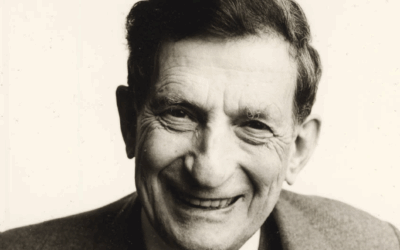
Gadamer was born in Marburg on 11 February 1900 and grew up in Breslau, now Wrocław in Poland, where his father was a professor of pharmacy. His mother died of diabetes when he was four. He finished a doctorate on Plato at Marburg in 1922, the same year he contracted polio, whose after-effects stayed with him for life.1
The decisive teacher was Martin Heidegger, who taught at Marburg from 1923 to 1928. Gadamer worked as his unpaid assistant, was stung when Heidegger judged him weak in philosophy, retreated into classical philology, and regained Heidegger’s respect through that philological work before submitting a habilitation on Plato’s dialectical ethics in 1928.1 Gadamer took from Heidegger’s account of understanding as a basic way of existing the idea that interpretation is not something we occasionally do to texts. It is how a human being is in the world.
His record under the Third Reich was one of accommodation. He never joined the Nazi Party but did belong to the affiliated National Socialist teachers’ organization, and he neither supported the regime loudly nor opposed it. Critics such as Richard Wolin have argued that he went further than reluctant compliance; defenders such as Richard Palmer have replied.1 After Leipzig, where he was rector in 1946, and a short stay in Frankfurt, he succeeded Karl Jaspers at Heidelberg in 1949. He died there on 13 March 2002, aged 102.1
Truth and Method appeared in 1960, when he was sixty, and did not reach English until 1975. Its subtitle was Grundzüge einer philosophischen Hermeneutik, the basic features of a philosophical hermeneutics.1, 3, 5 Gadamer did not invent hermeneutics. The discipline began with rules for interpreting scripture, and in the nineteenth century Friedrich Schleiermacher and Wilhelm Dilthey tried to turn it into a method that would make the human sciences properly scientific.1 Gadamer’s move was to stop treating understanding as a method at all. The book opens with art, arguing that after Kant’s aesthetics the experience of art had been reduced to subjective taste, and then widens into a theory of all understanding.1 He said his concern was “not what we do or what we ought to do, but what happens to us over and above our wanting and doing.”2, 3
Prejudice is where understanding starts
The older hermeneutic circle was a puzzle about texts: you understand the parts of a book through the whole and the whole through its parts. Heidegger turned it into something more basic. To understand anything at all, we must already have some grasp of it and already stand in a world with it. Even a painting has to be grasped as something, if only as paint on canvas, before it can be interpreted at all.1
Gadamer’s name for that prior grasp is Vorurteil, prejudice, taken back to its literal sense of pre-judgment, the Latin praejudicium.1 The Enlightenment wanted reason to clear all prejudice away, and Gadamer called this the Enlightenment’s own “prejudice against prejudice.”2, 3 His point is not that every prejudice is good. Some distort. The point is that we do not know in advance which ones will hold up, and that a mind without any would have nothing to ask with. Our prejudices come to the fore in the process of understanding itself, and once they are visible they can be questioned in their turn.1, 3 He also described an “anticipation of completeness”: we approach a text, or a person, assuming that it makes sense as a whole, and we revise that assumption as we go.1
Psychotherapy has its own version of the Enlightenment ideal. In 1912 Freud advised analysts to be opaque to the patient and, like a mirror, to show nothing but what the patient shows them.4 His image in that paper is a mirror, not the “blank screen” it is often paraphrased as. Read through Gadamer, the problem is not that the analyst might fail to stay blank. There was never a blank surface to begin with. What a clinician notices and which questions occur at all are already shaped by training, culture and personal history. Pretending otherwise does not remove those prejudices. It only keeps them out of view, where they cannot be corrected.
What the fusion of horizons means
“Horizon” is a term Gadamer took over from phenomenology, the tradition Edmund Husserl founded, where it names the wider context of meaning in which anything shows up.1 Our horizon is historical through and through. Gadamer called the awareness of this wirkungsgeschichtliches Bewusstsein, usually translated as historically effected consciousness: understanding is itself an effect of history, and we never get fully behind it. “To be historically,” he wrote, “means that knowledge of oneself can never be complete.”2, 5
That sounds like a prison, and Gadamer insisted it is not. A horizon is “something into which we move and that moves with us.”2, 3 When we meet something strange, whether an old text, another culture or another person, understanding means forming a new, wider context in which the strange thing makes sense. Neither side comes out unchanged.1 Three misreadings are worth naming.
First, the fusion is not empathy in the sense of climbing inside someone else’s head. Gadamer rejected the idea that understanding means gaining access to an inner realm of another person’s private meaning.1 I never leave my own horizon. I widen it. Second, it is not a merger in which the stronger horizon swallows the weaker one, and it is not a final agreement. The process never completes.3 Third, it is not an extra step added after understanding. In the afterword to Truth and Method Gadamer wrote that “working out the historical horizon of a text is always already a fusion of horizons,”2, 3 and he made the same point about application: it “is neither a subsequent nor merely an occasional part of the phenomenon of understanding, but co-determines it as a whole from the beginning.”1, 2 We understand something only by understanding what it means for us, here.
Some of this comes from Hegel. Gadamer was sympathetic to Hegel’s dialectic and to its attempt to get beyond the split between subject and object, but rejected the Hegelian aim of complete, transparent self-knowledge.1 For a therapist, insight is real and always partial.
Conversation is not a technique
Gadamer’s model for all understanding is the conversation. A real conversation is never fully under either partner’s control. It is led by the matter under discussion, what he called die Sache, and it takes place in language.1 “All understanding is interpretation,” he wrote, “and all interpretation takes place in the medium of a language.”2, 5 He compared this to play. Players do not direct a good game; they are caught up in it, and the game in a sense plays them.3
The outcome he described is not one person winning the other over. “To reach an understanding in a dialogue,” he wrote, “is not merely a matter of putting oneself forward and successfully asserting one’s own point of view, but being transformed into a communion in which we do not remain what we were.”2, 3 Late in life he put the whole project in one sentence: “By hermeneutics I understand the ability to listen to the other in the belief that he could be right.”3, 6
Gadamer applied this directly to medicine in The Enigma of Health, a collection of lectures and essays published in German in 1993. Dialogue between doctor and patient, he wrote, “is only really successful when it takes place almost as if it were a normal conversation. In our everyday lives we fall into discussions which are sustained by everyone involved rather than led by one person in particular.”5, 7
What Habermas and Derrida objected to
Gadamer’s two famous arguments were with thinkers who shared much of his starting point. Both bear on therapy.
Jürgen Habermas owed Gadamer a favor: Gadamer had pushed to bring him to Heidelberg before Habermas had even finished his habilitation.3 Their exchange was collected in the 1971 volume Hermeneutik und Ideologiekritik.8 Habermas objected that Gadamer’s respect for tradition and authority left no footing for criticizing ideology. A conversation can feel like mutual understanding while carrying distortions that serve inherited relations of domination.8 In “The Hermeneutic Claim to Universality” he argued that hermeneutic consciousness stays incomplete until it reflects on the limits of hermeneutic understanding itself.3, 9 In Knowledge and Human Interests (1968) he had already held up psychoanalysis as the one tangible example of a science built on methodical self-reflection.10 Gadamer answered that Habermas’s own position was the uncritical one, since no critique can stand wholly outside tradition, and that hermeneutic experience is already critical because it keeps sorting which prejudices still hold and which have failed.8 More on Habermas’s side is in our piece on Habermas and psychotherapy.
Paul Ricoeur gave the tension its best-known name. In Freud and Philosophy (1965) he placed Freud alongside Marx and Nietzsche as masters of a hermeneutics of suspicion, interpretation that reads a hidden meaning under the apparent one.8, 11 Ricoeur’s wider project is covered in our piece on Ricoeur, narrative identity and hermeneutics. In the consulting room the two attitudes have to live together. Trust without suspicion colludes with whatever story a family taught a child about itself. Suspicion without trust turns the therapist into an interrogator who already knows what everything really means.
Jacques Derrida met Gadamer at the Goethe Institute in Paris in 1981. Gadamer mentioned in passing the openness, or good will, that understanding another person requires. Derrida’s reply attacked that appeal to good will, his own lecture dealt only with Heidegger and Nietzsche, and commentators have described the event as an encounter rather than a real dialogue.3, 12 Derrida’s doubt is still worth hearing: “I am not convinced that we ever really have this experience that Professor Gadamer describes, of knowing in a dialogue that one has been perfectly understood or experiencing the success of confirmation.”8, 12 Clients sometimes say a version of this, often to a therapist who was sure they had understood.
In the 1980s “hermeneutic” psychoanalysis was sometimes taken to mean that an interpretation only has to hang together, not to be true. Louis Sass and Robert Woolfolk argued that Donald Spence’s influential Narrative Truth and Historical Truth (1982), often read as the hermeneutic reformulation of psychoanalysis, rested on positivist assumptions and swung between relativism about interpretations and objectivism about science.13 Gadamer rejected both subjectivism and relativism.1 In a real conversation the subject matter pushes back, and so does the person.
What this looks like in therapy
None of this is a technique, and Gadamer said plainly that he was not offering a method.3 It describes what already happens between two people in a room, and some clinical habits follow from taking that seriously. For more on how philosophy can sharpen clinical perception, see Lenses of Inquiry: How Philosophy Can Inform Psychology.
Diagnosis becomes an interpretation. Richard Chessick argued that a hermeneutic approach moves away from the detached, neutral observer and treats diagnoses and formulations not as natural-science facts but as temporary formations that change with historical eras and cultures, while steering between naive realism on one side and relativism on the other.14 Diagnosis still guides treatment choices, flags risk and lets clinicians talk to each other. But the label is a pre-judgment held while listening, not the final word on who the person is.
The therapist’s own horizon is part of the material. Take a sentence therapists hear constantly: “My parents did the best they could.” A clinician who grew up in a chaotic house may hear minimization and push. One who grew up in a steady house may hear settled peace and move on. Both are prejudices in Gadamer’s sense, and neither is a mistake yet. The work is to notice which one is operating, ask a question that could prove it wrong, and let the answer change the picture. Adil Qureshi made the same argument for cross-cultural work, arguing that a therapist’s culturally given pre-understandings, including racial and ethnic prejudice the therapist rarely notices, shape treatment planning, interventions and the relationship itself.15 It is a conceptual paper, not a trial.
Words carry horizons. When someone says “I’m depressed,” the word may mean a flat heaviness, a grief that has gone on too long, or a marriage that has quietly ended. Understanding it is a slow back-and-forth toward a shared language for this person’s version, not a match against a checklist. Gadamer described the needed capacity as “a form of attentiveness, namely the ability to sense the demands of an individual person at a particular moment and to respond to those demands in an appropriate manner. It is in these terms that we must understand what is involved in therapeutic dialogue.”5, 7
The relationship is where the work happens. Donnel Stern called Gadamer’s hermeneutics “a philosophy for the embedded analyst” and tied it to what he called the social paradigm of psychoanalysis, in which the analyst works from inside the relationship rather than above it.16 Donna Orange combined Gadamer’s hermeneutics with Emmanuel Levinas’s ethics and reread Ferenczi, Fromm-Reichmann, Winnicott, Kohut and Brandchaft as interpreters in this sense.17 Alliance research fits this emphasis without testing Gadamer directly. A meta-analysis of 295 studies of adult psychotherapy, covering more than 30,000 patients, found a correlation of about r = .28 between alliance and outcome, consistent across treatment approaches. Because the finding is correlational, it does not show that the relationship causes the improvement.18
Symbols are not decoded once. In Jungian depth therapy a dream image is worked with over time rather than translated once, and Gadamer gives a reason: the interpreter’s own meaning always enters into understanding a work.3 Ricoeur later called the excess that keeps a text or symbol open its “surplus of meaning.”19 The same holds for the story a person tells about his or her life: returning to it from a changed horizon is not repetition.
If you are in the Birmingham area and want therapy that treats you as a partner in the conversation rather than a case to be sorted, you can read about existential therapy at Taproot or contact us to ask whether it is a good fit.
References
- Malpas, J. (2022). Hans-Georg Gadamer. In E. N. Zalta & U. Nodelman (Eds.), The Stanford encyclopedia of philosophy. Stanford University. https://plato.stanford.edu/entries/gadamer/
- Gadamer, H.-G. (1989). Truth and method (2nd rev. ed.; J. Weinsheimer & D. G. Marshall, Trans.). Crossroad. (Original work published 1960)
- Barthold, L. S. (n.d.). Hans-Georg Gadamer. In Internet encyclopedia of philosophy. https://iep.utm.edu/gadamer/
- Freud, S. (1958). Recommendations to physicians practising psycho-analysis. In J. Strachey (Ed. & Trans.), The standard edition of the complete psychological works of Sigmund Freud (Vol. 12). Hogarth Press. (Original work published 1912)
- Shannon, P. (2026). Interpretation and the art of care: Gadamer’s hermeneutics and physician wellbeing. Philosophy, Ethics, and Humanities in Medicine, 21(1), 13. https://doi.org/10.1186/s13010-026-00215-4
- Grondin, J. (2003). Hans-Georg Gadamer: A biography (J. Weinsheimer, Trans.). Yale University Press.
- Gadamer, H.-G. (1996). The enigma of health: The art of healing in a scientific age (J. Gaiger & N. Walker, Trans.). Stanford University Press. (Original work published 1993)
- George, T. (2025). Hermeneutics. In E. N. Zalta & U. Nodelman (Eds.), The Stanford encyclopedia of philosophy. Stanford University. https://plato.stanford.edu/entries/hermeneutics/
- Habermas, J. (1990). The hermeneutic claim to universality. In G. L. Ormiston & A. D. Schrift (Eds.), The hermeneutic tradition: From Ast to Ricoeur (pp. 245–272). State University of New York Press.
- Habermas, J. (1971). Knowledge and human interests (J. J. Shapiro, Trans.). Beacon Press. (Original work published 1968)
- Ricoeur, P. (1970). Freud and philosophy: An essay on interpretation (D. Savage, Trans.). Yale University Press. (Original work published 1965)
- Michelfelder, D. P., & Palmer, R. E. (Eds.). (1989). Dialogue and deconstruction: The Gadamer-Derrida encounter. State University of New York Press.
- Sass, L. A., & Woolfolk, R. L. (1988). Psychoanalysis and the hermeneutic turn: A critique of Narrative Truth and Historical Truth. Journal of the American Psychoanalytic Association, 36(2), 429–454. https://doi.org/10.1177/000306518803600208
- Chessick, R. D. (1990). Hermeneutics for psychotherapists. American Journal of Psychotherapy, 44(2), 256–273. https://doi.org/10.1176/appi.psychotherapy.1990.44.2.256
- Qureshi, A. (2005). Dialogical relationship and cultural imagination: A hermeneutic approach to intercultural psychotherapy. American Journal of Psychotherapy, 59(2), 119–135. https://doi.org/10.1176/appi.psychotherapy.2005.59.2.119
- Stern, D. B. (1991). A philosophy for the embedded analyst: Gadamer’s hermeneutics and the social paradigm of psychoanalysis. Contemporary Psychoanalysis, 27(1), 51–80. https://doi.org/10.1080/00107530.1991.10746693
- Orange, D. M. (2011). The suffering stranger: Hermeneutics for everyday clinical practice. Routledge. https://doi.org/10.4324/9780203863633
- Flückiger, C., Del Re, A. C., Wampold, B. E., & Horvath, A. O. (2018). The alliance in adult psychotherapy: A meta-analytic synthesis. Psychotherapy, 55(4), 316–340. https://doi.org/10.1037/pst0000172
- Ricoeur, P. (1976). Interpretation theory: Discourse and the surplus of meaning. Texas Christian University Press.















0 Comments