
The dark night of the soul is John of the Cross’s name for a stage of prayer in which spiritual comfort dries up while the longing for God goes on. Major depression is a medical condition: low mood or lost pleasure, plus other symptoms, lasting at least two weeks and impairing daily life. The two can look alike, and John himself wrote that melancholy frequently comes with the night.1, 2
Popular writing often gets that last point backward, using the phrase to say a depression is really spiritual and so not a matter for doctors. John argued close to the opposite. He told confessors to check whether a person’s dryness came from melancholy, and he warned that the two frequently travel together. This article follows him. A spiritual crisis and a depressive episode are different things, but one does not rule out the other. A good clinician assesses for both, treats what is there, and does not strip the experience of the meaning the person finds in it.
Who John of the Cross was
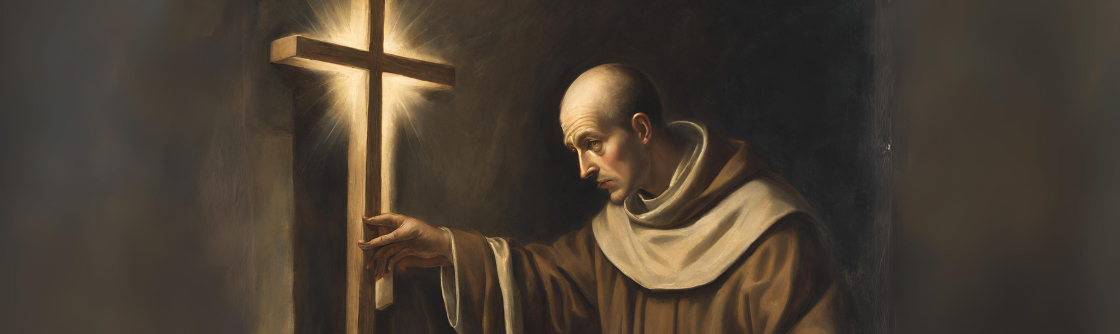
Juan de Yepes was born in 1542 in Fontiveros, a village near Ávila. His father died when John was little more than two years old, and his mother raised the family in poverty, moving to Arévalo and eventually Medina del Campo. Older accounts, including an earlier version of this page, call him an orphan. He was not: his mother lived until 1580.3, 4
He took the Carmelite habit in Medina in 1563, studied at Salamanca and was ordained a priest in 1567. Later that year, probably in September, he met Teresa of Ávila. He was thinking of leaving for the Carthusians; she asked him instead to help found the first house of reformed, or Discalced, Carmelite friars. In November 1568 at Duruelo he took the reform’s vows as Juan de la Cruz.3 Teresa’s own map of the soul is the natural companion to his; see Teresa of Ávila’s Interior Castle.
The reform split the order. On the night of December 2, 1577, Carmelites opposed to it seized John in Ávila, where he was confessor to the nuns of the Incarnation, and took him to their priory in Toledo. After two months he was moved to a room six feet wide and ten feet long, lit only by a slit high in the wall. He had his breviary, the same unwashed habit for months, fasts on bread and water, lice and floggings. He composed poetry in his head, including a large part of the Spiritual Canticle, and under a new, kinder jailer he managed to get paper and ink. In August 1578 he loosened the screws of his door lock, climbed out a window on a rope made from strips of two old bed covers, and found refuge with Teresa’s nuns in Toledo.3, 4
The prose treatises came after the escape, in Andalusia. He began the Ascent of Mount Carmel in 1578 or 1579 and finished it, along with the Dark Night, as prior in Granada in the 1580s; the Living Flame of Love dates from around 1585. In 1591 his own reform stripped him of his offices, and after falling ill with fever that September he died at Úbeda on December 14. He was canonized in 1726 and named a Doctor of the Church in 1926.3
What the dark night actually is
The Dark Night is a commentary on an eight-stanza love poem. It opens, in E. Allison Peers’s translation, “On a dark night, Kindled in love with yearnings—oh, happy chance!—I went forth without being observed.” By the fifth stanza the speaker is praising a “night more lovely than the dawn” that has joined lover and Beloved. John’s prologue says the first two stanzas describe two purgations and the other six describe union. The commentary barely reaches those six: it breaks off after one short chapter on the third stanza, and the last five are never explained.1 What most people now call the dark night comes from the opening of a poem whose subject is being led by love into union.
John divides the subject between two books. The Ascent covers the active night: what a person does, loosening the grip of appetite and then of their own ideas about God. The Dark Night covers the passive night: what is done to someone who can no longer do it alone. Each has two stages. The night of sense comes to beginners. Prayer that used to be sweet turns dry, and the person wants to be alone and quiet without being able to think of anything in particular. The night of the spirit, for those further along, is harsher: “what the sorrowful soul feels most in this condition is its clear perception, as it thinks, that God has abandoned it.”1
Why darkness? Because, John says, divine wisdom is too bright for the soul, the way bright light blinds an owl, and he notes that “Saint Dionysius and other mystical theologians call this infused contemplation a ray of darkness.”1 That line ties him to the negative theology of Pseudo-Dionysius the Areopagite, which approaches God by denying that any concept fits. It is not the claim, made in this page’s earlier version, that God was only a projection of the ego. John’s point is that no idea is adequate to God, not that nothing is there.
John’s own test for melancholy
In the prologue to the Ascent, John complains about advisers who meet a person in this state “like Job’s comforters, and say that it is suffering from melancholy, or low spirits, or a morbid disposition, or that it may have some hidden sin.” Then he warns of the reverse mistake: people who think, “or whose confessors will think,” that they are in the dark night when they are not. He promised to explain “how it may be known if it be melancholy,” and did so in Book I, chapter 9 of the Dark Night.3
His test has three signs. First, the person finds no pleasure in the things of God and none in anything else either. John concedes at once that this sign is not enough on its own, because a “melancholy humour” “oftentimes makes it impossible for the soul to take pleasure in anything.” Second, the memory turns to God “with painful care and solicitude,” afraid it is failing him. Lukewarmness does not care; the night cares terribly. Third, the person can no longer meditate with the imagination, and the inability grows instead of passing, whereas an indisposition “never lasts for long.”1
Then comes the sentence popular accounts leave out. The dryness of the night “may sometimes be increased by melancholy or some other humour (as it frequently is)” and still do its work. When melancholy alone is the cause, John says, the longing for God is missing.1 His signs were not meant to sort people into a spiritual box or a medical box. They told a spiritual director whether the night was present, on the assumption that melancholy, a bodily disorder in the humoral medicine of his day, might be present as well.
Read with modern eyes, the signs have limits. The first is close to anhedonia, one of the two core symptoms of a major depressive episode. The second, an anxious preoccupation with failing God, can resemble depressive guilt or religious scrupulosity. The third uses duration in the opposite way from modern diagnosis, which treats symptoms that last longer than two weeks as more concerning, not less.2 John wrote for vowed religious under spiritual direction, not for a clinic, and his test is a reason to ask careful questions, not a replacement for them.
Dark night vs depression: what clinicians compare now
In DSM-5, a major depressive episode requires five of nine symptoms over at least two weeks, one of which must be depressed mood or markedly reduced interest or pleasure, with real distress or impairment. The others include changes in sleep, appetite and energy, slowed or agitated movement, poor concentration, worthlessness or excessive guilt, and recurrent thoughts of death or suicide.2 Nothing in that list asks what the suffering means to the person. The criteria can catch a depression hiding inside a spiritual story, but they cannot say whether something else is happening too.
Gerald May, a psychiatrist who wrote on contemplative spirituality, offered working distinctions in his 2004 book The Dark Night of the Soul. In his account, people in a dark night tend to keep their sense of humor and their compassion for others, both of which depression usually wears down. He also wrote that the two can happen at once and that there is never a spiritual reason to leave an illness untreated.5 Reviewing the book, the Jesuit psychoanalyst W. W. Meissner faulted May for asserting the differences rather than examining them.6 Fairly so: we know of no study that has tested May’s heuristics.
The research on the dark night itself is small and qualitative. Glòria Durà-Vilà and Simon Dein compared the dark night with depressive episodes through the writings and biographies of five religious figures and argued that a key clinical risk is pathologizing a crisis the person experiences as meaningful.7 In a follow-up ethnography of ten contemplative Augustinian nuns in Spain, symptoms that might otherwise have been called a depressive episode were understood by the nuns as a dark night and worked through with reflection and religious meaning.8 These studies show how a frame changes an experience, not that depression in a religious person is usually a dark night.
Psychiatry has made some room for the question. In 1992 David Lukoff, Francis Lu and Robert Turner proposed a category for religious and spiritual problems to reduce harm from misdiagnosis.9 DSM-IV adopted “Religious or Spiritual Problem” in 1994, and DSM-5 keeps it among conditions that may be a focus of clinical attention, not mental disorders.2, 10 The push came from transpersonal clinicians, and the proposal grew out of the work of the Spiritual Emergence Network, whose initial focus was “spiritual emergencies,” the idea behind Stanislav and Christina Grof’s 1989 book of that name.10, 11 The Grofs argued that some crises of identity and meaning are attempts at growth rather than breakdown. That is a hypothesis, not a finding, and we know of no study showing that many psychotic or depressive episodes are really spiritual emergencies, as this page once claimed.
Spiritual distress is not harmless by default either. A meta-analysis of 32 longitudinal studies found that religious and spiritual struggles predicted small increases in later psychological distress; in the 12 studies that also measured positive outcomes such as well-being, struggles showed no significant link either way.12 And this page’s old claim that “medication alone will not work” for a spiritual night has no evidence behind it. For adult depression, a network meta-analysis of 101 trials with 11,910 patients found psychotherapy and medication about equally effective, and the combination better than either alone.13 If depression is present, it deserves treatment whatever else is going on, and decisions about medication belong with a prescriber.
Contemplative trouble is not only Catholic. Among 60 Western Buddhist meditators recruited because practice had become difficult for them, 82 percent reported fear, anxiety, panic or paranoia, and 63 percent described surges of “somatic energy,” which the authors do not connect to yoga but which resemble yogic accounts of kundalini and the chakras. Seventeen percent reported suicidality, 17 percent needed inpatient care, and medication was among the remedies described as helpful for the most severe episodes.14 Because the sample was chosen for its difficulties, these figures are not rates for meditators in general. A systematic review of 83 studies put the overall rate of meditation adverse events at about 8 percent, ranging from about 4 percent in experimental studies to 33 percent in observational ones, with anxiety and depression the most commonly reported.15
The Jungian reading, and its limits
Jung, early on, read a descent symbolically without denying illness. In Psychology of the Unconscious he read Hölderlin’s hymn “Patmos,” with its lines “But where Danger threatens / The Rescuer appears,” as an image of libido that “has now sunk to the lowest depths,” where renewal can begin. In the same pages he wrote that the poem arrives under “the gathering clouds of insanity.”16 He did not choose between the symbolic and the psychiatric reading. Hölderlin’s descent was both, which is part of why Hölderlin’s influence on Jung still repays attention.
A Jungian reading can map John’s two nights onto individuation, taking the night of sense as the collapse of the persona’s satisfactions and the night of the spirit as a meeting with the shadow. James Arraj’s St. John of the Cross and Dr. C. G. Jung (1986) compares John and Jung at book length.17 Some call the night a nigredo, the blackening stage Jung studied in alchemy. These are interpretations. John wrote in the language of Scripture and scholastic theology, not alchemy, and for him God was not a part of the psyche but the one the soul was being led toward. In the consulting room the comparison can help someone see that the collapse of old meanings may be a passage and not only a loss. Our essay on the influence of Christian mystics on Jungian thought traces the wider debt.
What this looks like in therapy
Assessment runs on two tracks at once.
- Screen for depression directly, with a brief measure such as the PHQ-9 and an interview about sleep, appetite, energy, duration and whether work and relationships are slipping.18
- Ask about suicide plainly. A spiritual explanation for the pain does not rule out risk, and the sense of being abandoned by God can sit right next to thoughts of death.
- Take a history: earlier episodes, periods of elevated mood, substance use and medical causes, which DSM-5 requires ruling out.2
- Ask what the person’s tradition says is happening, and whether they have a spiritual director, pastor or teacher.
- Notice whether the worry about God is a searching ache or a loop of doubt, confession and reassurance-seeking. The second pattern can be scrupulosity, religious or moral obsessions and compulsions that are a recognized presentation of obsessive-compulsive disorder, with a cognitive-behavioral model that guides treatment.19 We describe that work on our page about OCD treatment in Birmingham.
If depression is there, it gets treated, and a referral for a medication evaluation is part of that, not a verdict on someone’s spiritual life. If dryness is there without depression, the work looks different: less symptom reduction, more accompaniment. In a meta-analysis of 97 studies, the most rigorous comparisons found that therapy adapted to a client’s religious or spiritual life reduced psychological distress about as much as standard therapy and improved spiritual well-being more.20 Depth work such as Jungian therapy can help a person hold the medical and spiritual readings side by side.
Either way, the relationship carries much of the load. Across 295 studies, the strength of the therapeutic alliance correlated with outcome at about r = .28.21 That is a correlation, not proof of cause, but John would not have been surprised. “These souls turn back at such a time,” he wrote, “if there is none who understands them.”1
When the question of meaning can wait
Get help today if you are thinking about suicide or have a plan, if you cannot eat, sleep or get out of bed for days, if you are hearing or seeing things other people do not, or if you do not feel safe. In the United States you can call or text 988 to reach the 988 Suicide & Crisis Lifeline, or call 911 in an emergency. Our list of crisis resources in Birmingham covers local options. None of this rules out a spiritual reading later; it keeps you steady enough to have one.
If you are in Alabama and unsure whether you are living through depression, a dark night or both, that is a reasonable question to bring to a therapist. You can read how we approach depression treatment in Hoover, or contact us to talk it through.
References
- John of the Cross. (1959). Dark night of the soul (E. A. Peers, Trans. & Ed.; 3rd rev. ed.). Image Books. (Original work written in the 1580s). https://www.ccel.org/ccel/john_cross/dark_night.html
- American Psychiatric Association. (2013). Diagnostic and statistical manual of mental disorders (5th ed.). American Psychiatric Publishing. https://doi.org/10.1176/appi.books.9780890425596
- John of the Cross. (1962). Ascent of Mount Carmel (E. A. Peers, Trans. & Ed.; 3rd rev. ed.). Image Books. Includes Peers’s “Outline of the life of St. John of the Cross.” (Original work written c. 1579–1588). https://www.ccel.org/ccel/john_cross/ascent.html
- John of the Cross. (1991). The collected works of St. John of the Cross (K. Kavanaugh & O. Rodriguez, Trans.; Rev. ed., with revisions and introductions by K. Kavanaugh). ICS Publications.
- May, G. G. (2004). The dark night of the soul: A psychiatrist explores the connection between darkness and spiritual growth. HarperSanFrancisco.
- Meissner, W. W. (2004, March 1). Mystic madness (Review of the book The dark night of the soul, by G. G. May). America. https://www.americamagazine.org/books/2004/03/01/mystic-madness/
- Durà-Vilà, G., & Dein, S. (2009). The dark night of the soul: Spiritual distress and its psychiatric implications. Mental Health, Religion & Culture, 12(6), 543–559. https://doi.org/10.1080/13674670902858800
- Durà-Vilà, G., Dein, S., Littlewood, R., & Leavey, G. (2010). The dark night of the soul: Causes and resolution of emotional distress among contemplative nuns. Transcultural Psychiatry, 47(4), 548–570. https://doi.org/10.1177/1363461510374899
- Lukoff, D., Lu, F., & Turner, R. (1992). Toward a more culturally sensitive DSM-IV: Psychoreligious and psychospiritual problems. The Journal of Nervous and Mental Disease, 180(11), 673–682. https://doi.org/10.1097/00005053-199211000-00001
- Lukoff, D., Lu, F. G., & Turner, R. P. (1998). From spiritual emergency to spiritual problem: The transpersonal roots of the new DSM-IV category. Journal of Humanistic Psychology, 38(2), 21–50. https://doi.org/10.1177/00221678980382003
- Grof, S., & Grof, C. (Eds.). (1989). Spiritual emergency: When personal transformation becomes a crisis. Jeremy P. Tarcher.
- Bockrath, M. F., Pargament, K. I., Wong, S., Harriott, V. A., Pomerleau, J. M., Homolka, S. J., Chaudhary, Z. B., & Exline, J. J. (2022). Religious and spiritual struggles and their links to psychological adjustment: A meta-analysis of longitudinal studies. Psychology of Religion and Spirituality, 14(3), 283–299. https://doi.org/10.1037/rel0000400
- Cuijpers, P., Noma, H., Karyotaki, E., Vinkers, C. H., Cipriani, A., & Furukawa, T. A. (2020). A network meta-analysis of the effects of psychotherapies, pharmacotherapies and their combination in the treatment of adult depression. World Psychiatry, 19(1), 92–107. https://doi.org/10.1002/wps.20701
- Lindahl, J. R., Fisher, N. E., Cooper, D. J., Rosen, R. K., & Britton, W. B. (2017). The varieties of contemplative experience: A mixed-methods study of meditation-related challenges in Western Buddhists. PLOS ONE, 12(5), e0176239. https://doi.org/10.1371/journal.pone.0176239
- Farias, M., Maraldi, E., Wallenkampf, K. C., & Lucchetti, G. (2020). Adverse events in meditation practices and meditation-based therapies: A systematic review. Acta Psychiatrica Scandinavica, 142(5), 374–393. https://doi.org/10.1111/acps.13225
- Jung, C. G. (1916). Psychology of the unconscious: A study of the transformations and symbolisms of the libido (B. M. Hinkle, Trans.). Moffat, Yard and Company. (Original work published 1912). https://www.gutenberg.org/ebooks/65903
- Arraj, J. (1986). St. John of the Cross and Dr. C. G. Jung: Christian mysticism in the light of Jungian psychology. Tools for Inner Growth.
- Kroenke, K., Spitzer, R. L., & Williams, J. B. W. (2001). The PHQ-9: Validity of a brief depression severity measure. Journal of General Internal Medicine, 16(9), 606–613. https://doi.org/10.1046/j.1525-1497.2001.016009606.x
- Abramowitz, J. S., & Jacoby, R. J. (2014). Scrupulosity: A cognitive–behavioral analysis and implications for treatment. Journal of Obsessive-Compulsive and Related Disorders, 3(2), 140–149. https://doi.org/10.1016/j.jocrd.2013.12.007
- Captari, L. E., Hook, J. N., Hoyt, W., Davis, D. E., McElroy-Heltzel, S. E., & Worthington, E. L., Jr. (2018). Integrating clients’ religion and spirituality within psychotherapy: A comprehensive meta-analysis. Journal of Clinical Psychology, 74(11), 1938–1951. https://doi.org/10.1002/jclp.22681
- Flückiger, C., Del Re, A. C., Wampold, B. E., & Horvath, A. O. (2018). The alliance in adult psychotherapy: A meta-analytic synthesis. Psychotherapy, 55(4), 316–340. https://doi.org/10.1037/pst0000172






0 Comments