
Updated November 2026 · By Joel Blackstock, LICSW-S
John Scottus Eriugena (c. 800–c. 877) was an Irish scholar at the court of the Frankish king Charles the Bald, generally regarded as the most original philosopher in the Latin West between Boethius and Anselm. One of the few Western scholars of his century who read Greek, he translated Pseudo-Dionysius into Latin and wrote the Periphyseon, a dialogue in which all reality goes out from God and returns.1
That cycle of going out and coming back, which medieval writers called exitus and reditus, is the closest premodern picture I know of what Carl Jung called individuation. Eriugena’s hidden God does not stay hidden. It unfolds into a world of distinct things, and the unfolding is how it comes to know itself. Psychological wholeness works the same way: a person reaches it by differentiating and then reintegrating, not by refusing to differentiate, and the return does not erase the distinctions it gathers. Eriugena adds a second lesson therapy needs. The self at the center of the process can be known to exist but never fully defined.
Who Eriugena was
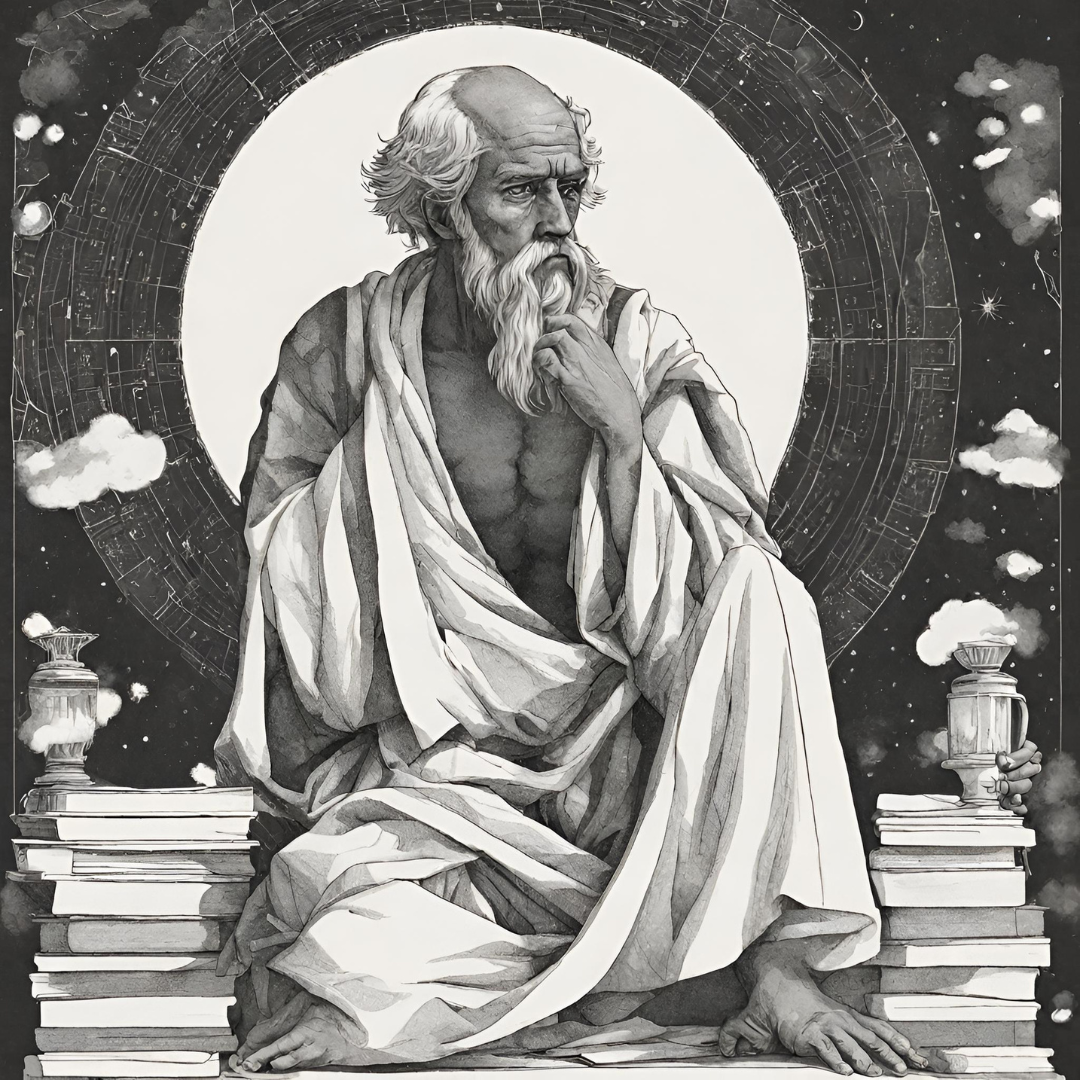
Almost nothing is known about his early life. Scholars place his birth in Ireland around 800. He signed his translation of Dionysius with a word he seems to have coined, Eriugena, “Irish-born,” while contemporaries called him Johannes Scottus, John the Irishman. Some reference works have him arriving in France around 845 or 847,2, 3 but the first certain record comes around 850, when Bishop Pardulus of Laon mentions “a certain Irishman, named Johannes, who is at the palace of the king.” He taught the liberal arts at the court of Charles the Bald, and there is no direct evidence that he was a monk or a priest.1
His first known treatise went badly. Around 851 Archbishop Hincmar of Reims asked him to refute the monk Gottschalk, who read Augustine as teaching a double predestination of the elect to heaven and the damned to hell. Eriugena’s On Divine Predestination argued, more from logic than from Scripture, that God predestines no one to evil and that “sin, death, unhappiness are not from God.” Prudentius of Troyes told him, “Your Capella has led you into a labyrinth,” meaning the liberal-arts handbook he taught from, and councils at Valence (855) and Langres (859) condemned the book, and the official denunciations dismissed it as pultes Scottorum, “Irish porridge.”1
The king kept protecting him. Around 860 Charles asked him to translate the Greek writings of Pseudo-Dionysius the Areopagite and his negative theology; a manuscript of them had reached Charles’s father in 827 as a gift from the Byzantine emperor. Eriugena finished around 862, then translated Maximus the Confessor and Gregory of Nyssa.1
The Periphyseon, also called On the Division of Nature, was probably begun in the early 860s and finished around 867: a long dialogue between a teacher and a student, dedicated to his friend Wulfad.1 He probably died around 877. The story that his students stabbed him to death with their pens is a twelfth-century tale, and William of Malmesbury, who told it, probably confused him with another John.1, 2
The four divisions of nature
The Periphyseon opens abruptly. Nature, the teacher says, is “the general term for all things that are and all things that are not,” and it divides into four:1, 5
- Nature that creates and is not created: God as the source.
- Nature that is created and creates: the primordial causes, the patterns of all things held in the divine Word.
- Nature that is created and does not create: particular things in place and time.
- Nature that neither creates nor is created: God again, as the end to which everything returns.
This is not a ladder. The first and fourth divisions are the same God, seen as beginning and as end; the dialogue’s fifth book is about the return to God as end. The middle two are cause and effect, which Eriugena treats as mutually dependent.1, 4 The scheme is closer to a circle than a staircase. And “nature” includes what is not. God is said not to be because God exceeds every category, which Eriugena calls nihil per excellentiam, nothingness through excellence, as opposed to the nihil per privationem, nothingness through lack, of formless matter.1 When he calls God “nothing,” he means the opposite of empty.
It is tempting to map the four divisions one to one onto the unconscious, the archetypes, the ego and the Self. That is too neat. The primordial causes resemble Jung’s archetypes in one respect: both are pattern-giving causes known only through what they produce. But Eriugena’s causes are eternal ideas in the mind of God, while Jung’s archetypes are psychological, thought-forms that, as he put it, “must be conjectured as the unconscious organizers of our ideas.”6 And the fourth division is God at the end of all things, not the human Self at the end of therapy. The useful parallel lies in the movement, not the boxes.
Going out and coming back
Eriugena almost certainly never read Plotinus, Porphyry or Proclus. His Neoplatonism came through Christian Greek writers, Dionysius, Maximus and Gregory of Nyssa above all, read alongside Augustine, whose psychology of the divided will still matters in therapy. Citing Augustine, he argued “that true philosophy is true religion and conversely that true religion is true philosophy.”1 That specific lineage is worth remembering before treating him as one more witness to a perennial philosophy shared across traditions.
From Maximus especially he took a cosmos in motion: all things flow out from God (processio, exitus) and return (reditus). He paired the two movements with the two basic operations of his logic, division and analysis, so that thought and reality mirror each other.1 The going out is not God losing something. It is God appearing. Eriugena calls creation a theophany, a self-manifestation in which the hidden God “creates himself” in creatures and, in the Stanford Encyclopedia’s summary, “moves from darkness into the light, from self-ignorance into self-knowledge.”1 Dermot Moran reads this as an early idealism, in which God’s self-knowledge is expressed through human knowledge.7 The idea travels: Henry Corbin titled a chapter of his book on the Sufi Ibn ‘Arabi and the imaginal world “The Creation as Theophany.”8
The return has two levels. In the general return, every effect goes back to its cause: bodies to their incorporeal reasons, the temporal to the eternal, human nature to its idea in the mind of God. In the special return the elect are deified (theosis), merging with God as many lights blend into one light or a drop of water into a stream. Yet Eriugena also says human beings will always differ from God, because they were created and God was not. Moran and Guiu note that a case can be made the other way, since in places he lets perfected human nature share in divine attributes in a genuine way, so the balance is disputed.1 On the reading I find most faithful, the return gathers. It does not erase.
Hell, in this scheme, is not a place. Eriugena preferred the Greek hades to the Latin infernus because he read it as meaning sorrow, a state. Those who refuse to let go of the passing “circumstances” of things stay trapped in their own phantasiae, their mental images, and that is what hell names.1
One correction to a common gloss: Eriugena does not treat life in a body as an innocent descent. Following Gregory of Nyssa, he treats the spatio-temporal world, our physical bodies and the division of the sexes as consequences of the Fall (Moran and Guiu call him somewhat ambiguous here, but this appears to be his considered view), and in the return the body is absorbed into spirit and then into mind.1 That is where the psychological parallel strains.
Condemned, and read anyway
The Periphyseon had a real vogue in the twelfth century. Then it was caught up in the case against Amalric of Bena and David of Dinant, two Paris theologians, and was condemned with them in 1210 and 1225 for seeming to identify God with creation. Eriugena had written that “we ought not to understand God and the creature as two things distinct from one another, but as one and the same” (III.678c), though he also insisted that God remains beyond everything he makes.1 Reference works disagree about who issued the 1225 condemnation: Wikipedia names Pope Honorius III and a council at Sens, the 1909 Catholic Encyclopedia a Council of Paris. The dates are firmer than the venue.2, 3 Meister Eckhart and Nicholas of Cusa knew the book anyway, and Cusanus owned a copy. After Thomas Gale printed it at Oxford in 1681 it went onto the Index of Prohibited Books, where it stayed until the Index was abolished in the 1960s. In the nineteenth century Hegel’s followers took him up, reading him, in Moran and Guiu’s words, “rather uncritically as an absolute idealist and as the father of German idealism.”1
The parallel with individuation
I have found no sign that Jung built on the Periphyseon. In Psychological Types (1921; English 1923) he used the ninth-century quarrel over the Eucharist, casting “Scotus Erigena” as the chief opponent of Paschasius Radbertus, to contrast two kinds of thinking, and guessed, cautiously, that Erigena was an introvert. In the same passage, which leans on Hase’s History of the Church, he repeated as fact the Malmesbury murder story, dating it to about 889.9 Part of that picture rests on a misattribution: the Eucharist treatise long credited to Eriugena is not his, and is now assigned to Ratramnus of Corbie.2, 3 So the parallel I am drawing is structural, not a line of influence.
Start with Aion (1951). In its chapter “The Structure and Dynamics of the Self,” Jung draws the self as a circular formula. “The whole cycle necessarily returns to its beginning,” he writes, and the process “changes the originally unconscious totality into a conscious one.” Then: “the self is not just a static quantity or constant form, but is also a dynamic process. In the same way, the ancients saw the imago Dei in man not as a mere imprint, as a sort of lifeless, stereotyped impression, but as an active force.”6
Set that beside Eriugena. His God begins hidden, goes out into distinct things, and comes back, and the coming back is not a rewind, because what returns has been manifested.1, 7 Jung’s self moves the same way: the unconscious whole differentiates into conscious contents, and the return to wholeness arrives with consciousness added. Edward Edinger, a psychiatrist and founding member of New York’s C. G. Jung Foundation, made the cycle explicit in Ego and Archetype (1972). The ego separates from the self and reunites with it repeatedly, “both in childhood and in maturity,” in a pattern he called “cyclic (or better, spiral),” each turn “producing an increment of consciousness.”10 Two features of Eriugena’s version are worth keeping.
Differentiation is not the fall. For Eriugena, division is how the One shows itself, and there is no return without a going out. A person likewise cannot integrate what has never been told apart. In Edinger’s diagrams, undifferentiated wholeness is the state before there is an ego at all: “Ego and Self are one, which means that there is no ego.”10
The return keeps the distinctions. Eriugena’s deified creatures blend like lights, yet he insists they remain creatures. Jung is blunter. As the ego takes in more of the unconscious it approaches the self in “a never-ending process,” and without “a critical line of demarcation” the result is inflation: “It must be reckoned a psychic catastrophe when the ego is assimilated by the self.”6
The parallel strains at the body. Eriugena was kinder to the visible world than most Neoplatonists, since he treated nature as theophany and its contemplation as part of the way back, but his return still runs upward, body into spirit, spirit into mind.1 Jung’s circle in Aion runs downward first. The figure of wholeness “descends from above through his Shadow” into Physis, nature and matter, before rising again, and psyche and matter “exist in one and the same world.”6 Individuation goes down through the shadow and the body. A psychological reading has to correct Eriugena there.
Knowing that you are, not what you are
The idea from the Periphyseon that travels best into a therapy room is its negative anthropology. Following Maximus, Eriugena says God knows that he is but not what he is: “God does not know of Himself what He is because He is not a ‘what,’ being in everything incomprehensible both to Himself and to every intellect” (II.589b–c). Because human beings are made in God’s image, the same holds for us. The mind knows that it exists but cannot circumscribe its own essence; it can only name the “circumstances” around it, such as place, time and condition (II.586d). Eriugena treats this self-ignorance as a mark of dignity, since an image of an infinite God has to be uncircumscribable too.1
Willemien Otten has argued that this pairing of negative theology with a negative anthropology goes back to Dionysius and has traced it forward to Eriugena.11 Moran adds that, for Eriugena, the soul in its present embodied state knows itself only imperfectly; full self-knowledge would mean knowing oneself as one’s idea in God.7
Jung’s language is close. In Aion the self is a God-image, “or at least cannot be distinguished from one,” and the ego’s approach to it never finishes.6 Edinger calls the self a paradox, “simultaneously the center and the circumference of the circle of totality.”10 Neither treats the self as a thing that can be pinned down.
What this looks like in therapy
None of this makes Eriugena a therapist, and none of it is a technique. It is a way of reading what already happens in depth-oriented work.
Differentiate first. People often arrive fused with a state: “I am anxious,” “I am a failure.” Much of the early work is division in Eriugena’s sense, telling apart the anxious part from the part that notices it, the old fear from the present situation, the inherited rule from one’s own value. Parts-based therapy makes this explicit. You cannot bring home what you never noticed had left.
Return without merging. Integration is not dissolving into a feeling, a memory or a spiritual experience. After an overwhelming experience, of grace or of terror, the risk Jung named is inflation; its mirror is alienation, the sense of having fallen out of meaning. Edinger described early development as a repeating cycle of inflation and alienation that can stall into a “sterile oscillation” between the two when early relationships go badly.10 The work is to keep the ego standing, with sleep, work, relationships and a body that can feel the floor, while the larger material comes in a piece at a time.
Hold descriptions lightly. A diagnosis describes circumstances. It helps choose a treatment and gives a person words for what is happening, but it does not settle what someone is. For a person convinced they know exactly what they are, usually something bad, the apophatic reply is not a nicer label. It is a refusal to close the question.
Notice the hell of fixed images. Eriugena’s hell is being stuck in one’s own phantasiae. Therapists meet secular versions often: rumination, grief that circles a single scene, the replayed grievance. The aim is not to argue the images away but to loosen their grip enough that the person can move again.
Bring the body back. Here we part company with Eriugena. He wanted the return to leave the body behind; much trauma work goes through it instead, which is why it often includes somatic therapy that tracks the nervous system and the body.
A word on evidence. Research on Jungian therapy specifically is limited. A 2013 review by Christian Roesler gathered outcome studies, mostly from Germany and Switzerland, with naturalistic and retrospective designs rather than randomized trials; they reported improvements in symptoms and functioning that held for up to six years after treatment.12 That is encouraging but not decisive, and nothing in Eriugena adds to it. The philosophy is a way of understanding the work, not proof that it succeeds.
If the idea of a self larger than your current story, and never fully definable, speaks to something you are living through, depth-oriented therapy is one place to work with it. You can read about Jungian depth therapy at Taproot in Hoover, or contact us to ask whether it is a good fit.
References
- Moran, D., & Guiu, A. (2025). John Scottus Eriugena. In E. N. Zalta & U. Nodelman (Eds.), The Stanford encyclopedia of philosophy (Summer 2025 ed.). Metaphysics Research Lab, Stanford University. https://plato.stanford.edu/archives/sum2025/entries/scottus-eriugena/
- Wikipedia contributors. (2026). John Scotus Eriugena. In Wikipedia. Retrieved November 8, 2026, from https://en.wikipedia.org/wiki/John_Scotus_Eriugena
- Turner, W. (1909). John Scotus Eriugena. In The Catholic encyclopedia (Vol. 5). Robert Appleton Company. https://www.newadvent.org/cathen/05519a.htm
- O’Meara, J. J. (1988). Eriugena. Clarendon Press. https://doi.org/10.1093/acprof:oso/9780198266747.001.0001
- Eriugena, J. S. (1987). Periphyseon (The division of nature) (I.-P. Sheldon-Williams & J. J. O’Meara, Trans.). Bellarmin.
- Jung, C. G. (1968). Aion: Researches into the phenomenology of the self (R. F. C. Hull, Trans.; 2nd ed., Collected Works Vol. 9, Part 2). Princeton University Press. (Original work published 1951)
- Moran, D. (1989). The philosophy of John Scottus Eriugena: A study of idealism in the Middle Ages. Cambridge University Press. https://doi.org/10.1017/CBO9781139172080
- Corbin, H. (1981). Creative imagination in the Sufism of Ibn Arabi. Princeton University Press. https://doi.org/10.1515/9781400853670
- Jung, C. G. (1923). Psychological types: Or the psychology of individuation (H. G. Baynes, Trans.). Kegan Paul, Trench, Trubner; Harcourt, Brace. (Original work published 1921)
- Edinger, E. F. (1972). Ego and archetype: Individuation and the religious function of the psyche. Putnam. (Reprinted 1992, Shambhala)
- Otten, W. (1999). In the shadow of the divine: Negative theology and negative anthropology in Augustine, Pseudo-Dionysius and Eriugena. The Heythrop Journal, 40(4), 438–455. https://doi.org/10.1111/1468-2265.00115
- Roesler, C. (2013). Evidence for the effectiveness of Jungian psychotherapy: A review of empirical studies. Behavioral Sciences, 3(4), 562–575. https://doi.org/10.3390/bs3040562






0 Comments