

D. T. Suzuki (1870–1966) was the Japanese Buddhist scholar who did more than anyone else to bring Zen to Western readers. From his Essays in Zen Buddhism (1927) to his Columbia University lectures in the 1950s, he presented Zen as a direct experience, satori, standing beyond doctrine, ritual and history. That version of Zen is the one Carl Jung, Erich Fromm and Karen Horney took up.
It was also a translation, and translation changes what it carries. Suzuki lifted satori out of the monastery, the precepts and its own history and offered it as a pure inner event. That is what made Zen usable to psychoanalysts as a psychology of the unconscious. It is also what let Suzuki write that Zen “may be found wedded to anarchism or fascism, communism or democracy.” An experience cut loose from context will serve whoever supplies the next one. The lesson for therapy is that no experience interprets itself. What a breakthrough, a dissolving of the self or a sudden calm means depends on the relationship, the ethics and the life it happens inside.
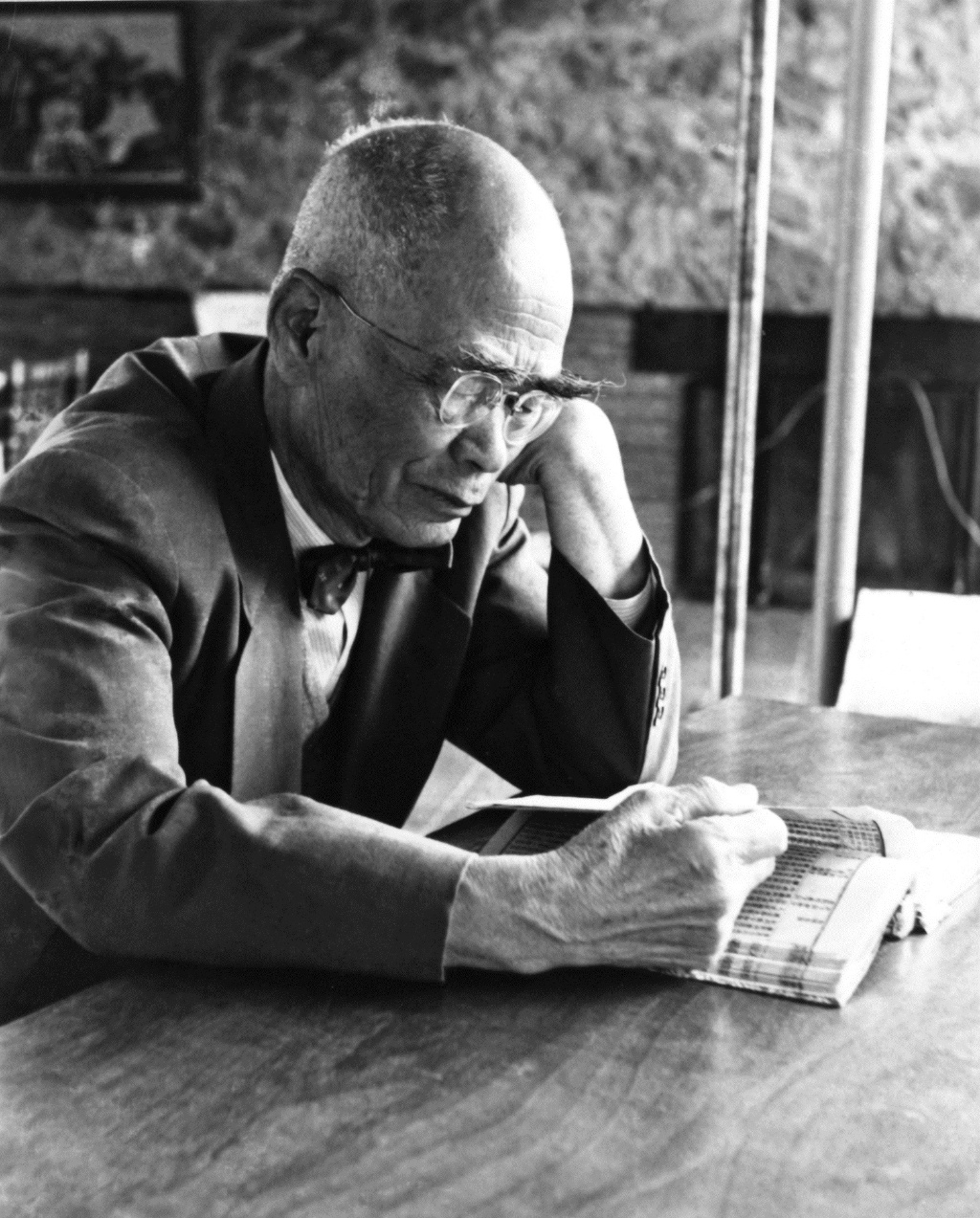
Who D. T. Suzuki was
Teitarō Suzuki was born on 18 October 1870 in Kanazawa into a family of the old samurai class. His father, a physician, died when he was a boy. Money troubles interrupted his schooling, and in 1891 he went to Tokyo, where he studied at what is now Waseda University before moving to the Imperial University.12 In Tokyo he began commuting to Engaku-ji, a Rinzai monastery in Kamakura, to train first under Imakita Kōsen and, after Kōsen died in 1892, under his successor Shaku Sōen. Sōen gave him the Buddhist name Daisetz in 1894, and by Suzuki’s own later account he passed his first koan at a December retreat in 1896.12
The decisive turn came through Sōen. When Sōen spoke at the World’s Parliament of Religions in Chicago in 1893, Suzuki had put his speech into English, and the Parliament put Sōen in touch with Paul Carus, the German-born editor of the Open Court Publishing Company in La Salle, Illinois. In 1897 Suzuki went to work for Carus. He stayed eleven years as a translator and proofreader, published an English translation of The Awakening of Faith (1900) and his own Outlines of Mahayana Buddhism (1907), and returned to Japan by way of Europe in 1909.12 Robert Sharf argues that this apprenticeship to Carus, who preached a “Religion of Science,” was in many ways as intensive and sustained as Suzuki’s monastic training, and that Suzuki later played it down.2
Back in Japan he taught at Gakushuin and Tokyo Imperial University, published a Japanese translation of Emanuel Swedenborg’s Heaven and Hell (1910) and wrote a short book on Swedenborg (1913), a reminder that Suzuki’s Buddhism grew up beside Swedenborg’s visionary theology and the wider world of Western esotericism.1 In 1911 he married Beatrice Erskine Lane, a Radcliffe graduate who had studied with William James and a committed Theosophist; in 1920 the couple joined the Tokyo International Lodge of the Theosophical Society, the movement Helena Blavatsky had co-founded. The historian Thomas Tweed has traced how entangled Suzuki’s early Buddhism was with American occultism.3 Beatrice died in 1939. It was Suzuki’s only marriage; Mihoko Okamura, the young Columbia student who became his secretary in the 1950s and was with him at the end, was not his wife.
In 1921 Suzuki took a professorship at Ōtani University in Kyoto, a Shin (Pure Land) Buddhist school, and he and Beatrice founded the English-language journal The Eastern Buddhist. The three series of Essays in Zen Buddhism (1927, 1933, 1934) and An Introduction to Zen Buddhism (1934) made his name, first in England. In 1936 he lectured in Britain and the United States, and at the World Congress of Faiths in London he met a twenty-one-year-old Alan Watts, who would carry an experiential Zen to a mass American audience with The Way of Zen (1957). Much of Zen Buddhism and Its Influence on Japanese Culture (1938), revised in 1959 as Zen and Japanese Culture, grew out of those 1936 lectures.12 He founded the Matsugaoka Bunko library in Kamakura in 1945, lectured at Columbia from 1952, and published Mysticism: Christian and Buddhist, comparing Meister Eckhart with Zen and Shin Buddhism, in 1957. He died at St. Luke’s International Hospital in Tokyo on 12 July 1966, aged 95.1
How Suzuki turned Zen into an experience
Satori is usually glossed as “awakening,” but the word means to understand. Sharf’s close reading of Suzuki’s early work shows how gradually the language of experience arrived. Suzuki’s first English essay on Zen, “The Zen Sect of Buddhism” (1906), mentions “spiritual experience” once and never uses the word satori. Outlines of Mahayana Buddhism (1907) does not mention Zen at all.2 The emphasis on a “Zen experience” that later organized everything Suzuki wrote came after his return to Japan, and Sharf traces much of it to Suzuki’s school friend Nishida Kitarō, whose A Study of the Good (1911) built a philosophy on “pure experience,” experience before any split between subject and object. Nishida drew the idea partly from William James, whose work Suzuki had introduced to him.2
Sharf’s broader point is that premodern Chinese and Japanese Buddhist writers had no equivalent to the modern notion of “experience.” Terms like satori and kenshō referred to fully understanding Buddhist teachings such as emptiness or Buddha-nature, not to a special state of consciousness.2 In a later essay he argued that the whole modern habit of reading meditation as the pursuit of particular experiences is a recent construction.4 David McMahan places Suzuki inside a wider “Buddhist modernism” that recast Asian traditions in the vocabulary of Romanticism, science and psychology.5
Suzuki defended his approach in public. In 1953 the Chinese scholar Hu Shih argued in Philosophy East and West that Chan had to be understood historically, as a movement inside Chinese intellectual history. Suzuki’s reply in the same issue held that Zen could not be grasped from the outside by historical method alone.67 That reply is the whole method in miniature: put the experience first, and history, ritual and institution become packaging.
Jung’s foreword: satori as a psychological event
Jung’s Zen came largely from Suzuki’s books, which his notes cite throughout, and he wrote a long foreword for the 1939 German edition of An Introduction to Zen Buddhism. Constance Rolfe’s English translation has appeared with the book since the 1949 London and New York editions.8 Jung called Suzuki’s work “among the best contributions to the knowledge of living Buddhism,” and then did what he did with other religious traditions: he translated it into his psychology. Satori, he wrote, is “interpreted and formulated as a break-through of a consciousness limited to the ego-form in the form of the non-ego-like self,” and he placed that conception beside Meister Eckhart’s sermon language of breaking through to God.8 For anyone who has followed the development of Jung’s psychology, that is the movement from ego to Self he called individuation, and he said so: Zen shows “how much ‘becoming whole’ means to the East.”
Jung was not the first analyst to read mystical material this way. A generation earlier, Herbert Silberer had already tried to interpret alchemical and mystical symbolism psychoanalytically. What Jung added were two claims that still matter to therapists. First, “the only movement within our culture which partly has, and partly should have, some understanding of these aspirations is psychotherapy.” Second, “a direct transmission of Zen to Western conditions is neither commendable nor even possible,” because Zen assumes a trained, conscious mind. “You cannot destroy a rationalist intellect that was never present,” he wrote, and in Western patients “a conscious ego and a conscious, cultivated understanding must first be produced by therapy before one can even think about abolishing I-ness.”8
Jung was also openly agnostic about whether any given enlightenment was genuine. Whether it “is called ‘real’ or ‘imaginary’ is quite immaterial,” he wrote. The man who claims it “thinks in any case that he is enlightened,” and “even if he were to lie, his lie would be a spiritual fact.”8 That sentence is where the psychoanalysts parted ways.
Fromm, Horney and the 1957 Cuernavaca workshop
Karen Horney got there before the Cuernavaca group. In her last years she was, in Fromm’s phrase, “intensely interested in Zen Buddhism,” and Richard De Martino, who later wrote the 1960 book with Suzuki and Fromm, published an account of her connection to Suzuki and Zen.910 Later writers have linked that interest to her idea of the “real self,” the living core she set against the idealized self in Neurosis and Human Growth (1950).11 Horney died in December 1952.
Fromm, who had set up a psychoanalytic section in the medical school of the National Autonomous University of Mexico, hosted Suzuki in 1957. In the first week of August, about fifty psychiatrists and psychologists, most of them psychoanalysts, met in Cuernavaca for a workshop on Zen Buddhism and psychoanalysis held under that department. Other papers covered Sullivan, Jung and Groddeck, and C. Selver spoke on “Sensory Awareness and Body Functioning,” an early meeting of Zen, analysis and body-based work. Three contributions became Zen Buddhism and Psychoanalysis (1960): Suzuki’s lectures, Fromm’s long essay, and De Martino’s “The Human Situation and Zen Buddhism.”9
Suzuki met the analysts halfway. He spoke of a “Cosmic Unconscious,” though carefully: “I do not know if it is correct to call this kind of unconscious the Cosmic Unconscious.” Fromm read Zen as the far end of the psychoanalytic project. Freud’s aim of making the unconscious conscious, which Fromm called “de-repression,” becomes in his essay the recovery of “the whole man,” and Fromm proposed that if that principle is carried “to its ultimate consequences, one approaches the concept of enlightenment.”9
But Fromm drew a line Jung had not. Quoting Jung’s “his lie would be a spiritual fact,” he answered that “a lie is never ‘a spiritual fact,’ nor any other fact, for that matter, except that of being a lie.” Zen teachers, he pointed out, work hard to tell genuine satori from “a pseudo-experience which can be of a hysterical or psychotic nature,” and in Zen “the accomplishment of true insight is indissolubly connected with a change in character.”9 That exchange is the hinge of the whole story. Jung’s satori is a psychic event, valid on its own terms. Fromm’s satori has to be checked by a teacher, a tradition and what happens to a person’s character afterward. Suzuki’s own presentation leaned toward Jung’s side, because it made the experience the core and treated everything around it as wrapping.
The critique: samurai, nationalism and Zen at War
The same move has a darker side. In the 1906 essay, as Sharf notes, Suzuki wrote that “the Lebensanschauung of Bushido is no more nor less than that of Zen” and credited Zen training for “the intrepidity which is generally shown by the Japanese soldiers in the face of an overwhelming enemy.”2 In Zen and Japanese Culture he was explicit about Zen’s political neutrality. Zen “has no special doctrine or philosophy,” he wrote, and is “extremely flexible in adapting itself to almost any philosophy and moral doctrine as long as its intuitive teaching is not interfered with. It may be found wedded to anarchism or fascism, communism or democracy, atheism or idealism, or any political or economic dogmatism.”12
Sharf’s 1993 essay “The Zen of Japanese Nationalism” argued that Suzuki’s Zen grew out of Meiji-era “New Buddhism,” a reform movement that answered charges that Buddhism was corrupt, superstitious and foreign by recasting it as modern, scientific and essentially Japanese. From 1935, Sharf shows, Suzuki published a long run of Japanese books on Zen and the Japanese character, and his English writing presented Zen as both the universal ground of religion and a uniquely Japanese spirituality.2
Brian Daizen Victoria’s Zen at War (1997; second edition 2006) went further. It documented how Japanese Zen institutions and teachers supported Japanese militarism from the Meiji era through the Second World War, and, following the Rinzai priest and scholar Ichikawa Hakugen, it treated Suzuki as a leading theorist of what came to be called imperial-way Zen.13 The book prompted public apologies from several Japanese Zen teachers and branches. Its reading of Suzuki is contested. Kemmyō Taira Satō argued in 2008 that whenever Suzuki stated his politics directly, in articles, talks or private letters, he distrusted State Shinto and the forces pushing Japan toward war. Victoria replied in the same journal in 2010.1415
A fair reading holds both sides. Whatever Suzuki’s private politics, the Zen he published was defined as an experience without binding doctrine, and Ichikawa, as Victoria presents him, listed Zen’s lack of any binding dogma, nothing a believer would fight to preserve, among the traits that left Japanese Zen open to militarism.13 An experience that can be “wedded” to anything can be wedded to a war.
What this looks like in therapy
Suzuki’s Zen reached the clinic mostly by indirect routes, and it arrived already translated. When Jon Kabat-Zinn reported his ten-week mindfulness program for 51 chronic pain patients in 1982, the study was uncontrolled, but the model spread.16 Kabat-Zinn later argued that mindfulness-based programs should rest on a “universal dharma” understanding, congruent with Buddhist teaching but not bound by its historical, cultural and religious forms.17 That is Suzuki’s strategy applied to medicine: keep the practice, set aside the frame.
The evidence for the secular version is real and specific. A 2018 meta-analysis of 142 clinical samples, 12,005 participants in all, found mindfulness-based interventions better than no treatment and better than several kinds of active control at the end of treatment, and no different from established evidence-based treatments, with the most consistent support for depression, pain conditions, smoking and addictive disorders.18 Meditation also has side effects. A systematic review of 83 studies put the overall rate of adverse events at about 8 percent of participants, though the figure ranged from under 4 percent in experimental studies to about a third in observational ones. Anxiety and depression were the most commonly reported, and adverse events occurred in people with no prior mental health history.19 An interview study of Western Buddhist meditators and teachers built a taxonomy of 59 kinds of meditation-related experience, from perceptual changes to shifts in the sense of self, ranging from very positive to very negative. Even when the experiences were similar, people interpreted and responded to them very differently, and relationships were among the factors that influenced how they went.20
This is where the argument between Jung and Fromm becomes practical. A meditative stillness, the unreality of a panic attack, the flat calm that can follow trauma and a real opening can be hard to tell apart from the inside. None of them arrives labeled. The clinical work is to place the experience in a life: what came before it, what it might be protecting, what the person does next. Jung’s point that a conscious ego has to be built before it can be loosened matters most for people living with trauma and dissociation, for whom practices that thin out the sense of self can slide into the very states they are trying to leave. For them, stabilization and a relationship that can hold distress come first, and contemplative practice, if it helps at all, usually comes later and is introduced gradually.
Fromm’s test still works too: does the insight change character? Someone can use meditation to stop feeling, or use non-attachment to avoid grief or conflict, and report great calm without any change in how they treat themselves or others. Existential therapists such as Rollo May treated anxiety as something to understand rather than simply remove, which is a good reason not to count every quiet state as progress. In depth-oriented work, the question Jung asked of Zen, what does this mean for this particular psyche, is the right question to ask of any spiritual experience a client brings, and Fromm’s follow-up, what has it changed, keeps that question honest.
If meditation, a spiritual experience, or a sense of self that will not hold together is part of what brings you to therapy, it helps to work with someone who takes both the experience and its context seriously. You can read how we use mindfulness and meditation in therapy and how we approach Jungian depth therapy, or reach us through our contact page.
References
- D. T. Suzuki Museum. (n.d.). D. T. Suzuki: Biography and oeuvre. Retrieved November 8, 2026, from https://www.kanazawa-museum.jp/daisetz/english/about.html
- Sharf, R. H. (1993). The Zen of Japanese nationalism. History of Religions, 33(1), 1–43. https://doi.org/10.1086/463354 (Reprinted in D. S. Lopez Jr., Ed., Curators of the Buddha: The study of Buddhism under colonialism, pp. 107–160, University of Chicago Press, 1995)
- Tweed, T. A. (2005). American occultism and Japanese Buddhism: Albert J. Edmunds, D. T. Suzuki, and translocative history. Japanese Journal of Religious Studies, 32(2), 249–281. https://doi.org/10.18874/jjrs.32.2.2005.249-281
- Sharf, R. H. (1995). Buddhist modernism and the rhetoric of meditative experience. Numen, 42(3), 228–283. https://doi.org/10.1163/1568527952598549
- McMahan, D. L. (2008). The making of Buddhist modernism. Oxford University Press. https://doi.org/10.1093/acprof:oso/9780195183276.001.0001
- Hu, S. (1953). Ch’an (Zen) Buddhism in China: Its history and method. Philosophy East and West, 3(1), 3–24. https://doi.org/10.2307/1397361
- Suzuki, D. T. (1953). Zen: A reply to Hu Shih. Philosophy East and West, 3(1), 25–46. https://doi.org/10.2307/1397362
- Jung, C. G. (1949). Foreword (C. Rolfe, Trans.). In D. T. Suzuki, An introduction to Zen Buddhism (pp. 9–29). Philosophical Library. (Foreword first published 1939; book first published 1934)
- Suzuki, D. T., Fromm, E., & De Martino, R. (1960). Zen Buddhism and psychoanalysis. Harper & Brothers.
- DeMartino, R. J. (1991). Karen Horney, Daisetz T. Suzuki, and Zen Buddhism. The American Journal of Psychoanalysis, 51(3), 267–283. https://doi.org/10.1007/BF01249250
- Westkott, M. (1998). Horney, Zen, and the real self. The American Journal of Psychoanalysis, 58(3), 287–301. https://doi.org/10.1023/A:1022587324729
- Suzuki, D. T. (1959). Zen and Japanese culture (Rev. and enl. ed. of Zen Buddhism and its influence on Japanese culture, 1938). Routledge & Kegan Paul.
- Victoria, B. D. (2006). Zen at war (2nd ed.). Rowman & Littlefield. https://doi.org/10.5040/9798216399933
- Satō, K. T. (2008). D. T. Suzuki and the question of war (T. Kirchner, Trans.). The Eastern Buddhist, 39(1), 61–120.
- Victoria, B. D. (2010). The “negative side” of D. T. Suzuki’s relationship to war. The Eastern Buddhist, 41(2), 97–138.
- Kabat-Zinn, J. (1982). An outpatient program in behavioral medicine for chronic pain patients based on the practice of mindfulness meditation: Theoretical considerations and preliminary results. General Hospital Psychiatry, 4(1), 33–47. https://doi.org/10.1016/0163-8343(82)90026-3
- Kabat-Zinn, J. (2011). Some reflections on the origins of MBSR, skillful means, and the trouble with maps. Contemporary Buddhism, 12(1), 281–306. https://doi.org/10.1080/14639947.2011.564844
- Goldberg, S. B., Tucker, R. P., Greene, P. A., Davidson, R. J., Wampold, B. E., Kearney, D. J., & Simpson, T. L. (2018). Mindfulness-based interventions for psychiatric disorders: A systematic review and meta-analysis. Clinical Psychology Review, 59, 52–60. https://doi.org/10.1016/j.cpr.2017.10.011
- Farias, M., Maraldi, E., Wallenkampf, K. C., & Lucchetti, G. (2020). Adverse events in meditation practices and meditation-based therapies: A systematic review. Acta Psychiatrica Scandinavica, 142(5), 374–393. https://doi.org/10.1111/acps.13225
- Lindahl, J. R., Fisher, N. E., Cooper, D. J., Rosen, R. K., & Britton, W. B. (2017). The varieties of contemplative experience: A mixed-methods study of meditation-related challenges in Western Buddhists. PLOS ONE, 12(5), e0176239. https://doi.org/10.1371/journal.pone.0176239















0 Comments