
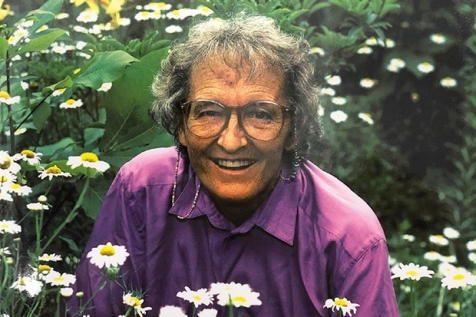
Elisabeth Kübler-Ross (1926–2004) was the Swiss-American psychiatrist whose 1969 book On Death and Dying introduced the five stages: denial, anger, bargaining, depression and acceptance. She drew them from interviews with dying patients, not bereaved families, and research on grieving people has found little support for a fixed sequence. Grief tends to swing back and forth.1,2
Her real achievement was not the stages. It was the willingness to pull up a chair beside a dying patient, ask what the experience was like, and let medical students listen. The stages were a vocabulary for what she heard, and the culture turned that vocabulary into a timetable. That is the argument of this piece: read the five stages as states that come and go, sometimes in the same afternoon, not as a road with an exit. Grief moves by oscillation, toward the loss and away from it, and a timetable can teach grieving people that they are doing it wrong.2,3
Who Elisabeth Kübler-Ross was
Elisabeth Kübler was born in Zurich on July 8, 1926, one of triplets, into a Protestant family. Her father wanted her to be a secretary in his business; she wanted medicine, and refused. After the war she volunteered with the International Voluntary Service, and in 1947 she visited the former Majdanek concentration camp in Poland. In her own later telling, what stayed with her were butterflies carved into the barrack walls, which she took to be the last marks of children who knew they were about to die.
Only after that did she study medicine at the University of Zurich, graduating in 1957. In 1958 she married Emanuel “Manny” Ross, an American classmate, and moved to New York, where her psychiatric residency at Manhattan State Hospital left her appalled at how dying patients were ignored by staff. After a fellowship and junior faculty post in Denver, she moved to the University of Chicago in 19654 and began a weekly teaching seminar built around live interviews with terminally ill patients, held in front of students and over the resistance of some medical staff.
A 1966 article, “The Dying Patient as Teacher,” written for a Chicago Theological Seminary journal, reached an editor at Macmillan. On Death and Dying followed in 1969,1 and a Life magazine feature that November carried her work far outside medicine.
What the five stages actually said
On Death and Dying drew on her contact with what she described as “over two hundred dying patients.”2 Its chapters run in order: “First Stage: Denial and Isolation,” then anger, bargaining, depression and acceptance.1 Each got its own chapter with “stage” in the heading. As Margaret Stroebe and her colleagues point out, that layout strongly suggested a sequence, although a close reading turns up brief acknowledgments that stages fluctuate, vary in timing and can coexist.2 A diagram in the book also listed shock, partial denial, preparatory grief, hope and decathexis alongside the five.1
Two details matter for how the model was later used. First, her subjects were people facing their own deaths. A chapter on the patient’s family says relatives “undergo different stages of adjustment similar to the ones described for our patients,”2 but that is anticipatory grief, before a death, not the bereavement of a widow or parent afterward. Second, unlike the phases of grief that John Bowlby and Colin Murray Parkes tied to attachment theory, the five stages were an inventory of observed reactions with no stated principle linking them.2
She softened the claim over time. In Questions and Answers on Death and Dying (1974) she reported that most of her patients showed two or three stages at once, not always in the same order.5 In On Grief and Grieving, written with David Kessler and published in 2005, the year after her death, the authors wrote that the stages “were never meant to tuck messy emotions into neat packages” and “are not stops on some linear timeline in grief.”6,2 The same book’s subtitle still promised to find the meaning of grief “through the five stages of loss,” and Kessler later proposed meaning as a sixth stage.7
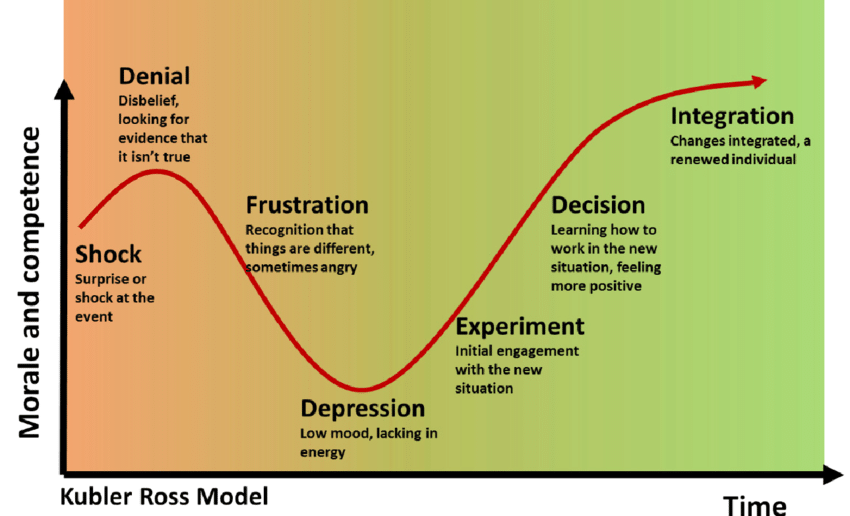
What the research found
One of the most influential challenges came from psychologists Camille Wortman and Roxane Cohen Silver, who had been questioning these assumptions since 1980.2 Their 1989 review, “The Myths of Coping With Loss,” found that the limited evidence available failed to support, and sometimes contradicted, the assumptions that depression is inevitable after a loss, that failing to feel distress signals pathology, and that a loss must be “worked through” to resolution.8
George Bonanno’s prospective study made the point concrete. His team interviewed 205 older adults years before their spouses died and again 6 and 18 months after. The most common pattern was resilience: stable, low distress throughout. Summarizing the same study, Stroebe and colleagues report that nearly half the participants (46 percent) were resilient, while only 11 percent showed the “common grief” pattern of low distress before the loss, a spike after it and a gradual decline.9,2
The most prominent empirical test of the stages, and the one that seemed to support them, is the Yale Bereavement Study.14 Paul Maciejewski, Holly Prigerson and colleagues followed 233 people in Connecticut whose relatives had died of natural causes, rating disbelief, yearning, anger, depression and acceptance from 1 to 24 months after the loss. Acceptance was the most frequently endorsed item from the start, and yearning, not depression, was the strongest negative response throughout. Only after each indicator was rescaled did their peaks line up in the order stage theory predicts, with yearning standing in for bargaining.10 Letters to JAMA from Silver and Wortman and from Bonanno and Kathrin Boerner questioned the design and the conclusion.11,12,2 A year later, Prigerson and Maciejewski themselves suggested that stages of grief might more accurately be called states of grief.13
A 2010 replication by Joseph Holland and Robert Neimeyer, with 614 young adults bereaved by natural or violent deaths, found limited support for stage theory; whether people had made sense of the loss predicted their grief far better than time since the death.14 By 2017, Stroebe, Henk Schut and Boerner concluded that the stage model lacks evidence, conceptual clarity and practical use, that expecting people to follow it can harm those who do not, and that it belongs in history lessons.2 Charles Corr, a critic of the stages since 1993, has examined how they still appear in recent American textbooks and asked whether they should now be presented only as history.15,16 Parkes, in a 2013 reappraisal, called the book a collection of very moving case studies that drew public attention to the need for better care of the dying.17 Testimony, in other words, not a tested model.
Grief as oscillation: the dual process model
The most useful replacement came from Margaret Stroebe and Henk Schut in 1999. Their dual process model describes two kinds of stress after a death. Loss-oriented stress is the grief itself: yearning, replaying the death, the pull toward the person who is gone. Restoration-oriented stress is everything the death changed: the paperwork, the new role in the family, the question of who you are now. Healthy coping is not a march from one to the other but an oscillation between them, sometimes confronting the loss and sometimes setting it aside. Taking a break from grieving is part of grieving, not a failure of it.3,18
The idea had roots. John Bowlby, describing the phases of mourning in 1980, had already written that they “are not clear cut, and any one individual may oscillate for a time back and forth between any two of them.”19,2 William Worden’s task model reframed mourning as work the bereaved person does rather than stages that happen to them.20 The continuing bonds research gathered by Dennis Klass, Phyllis Silverman and Steven Nickman challenged the assumption that healthy grief means letting go of the dead. Many people keep a relationship with the person who died, through memory, objects or a felt sense of presence, while accepting that the death is permanent.21
Oscillation also helps explain what goes wrong. In the model’s terms, prolonged grief can be read as a swing stuck on the loss side.3 A meta-analysis of studies of non-violent bereavement put the prevalence of prolonged grief disorder at 9.8 percent of bereaved adults.22 The DSM-5-TR added the diagnosis in 2022, requiring for adults that at least 12 months have passed since the death; ICD-11 uses a shorter window.23,24 Its core is not a stage at all but an attachment disturbance: persistent yearning for the person, loss of meaning and a disrupted sense of identity.25
Why the stages stuck: death, defense and the wish for a map
If the evidence is this thin, why does nearly everyone still know the five stages? Stroebe and colleagues point to simplicity: in an emotional upheaval, stages offer something to hold on to and the promise of an end point.2 A depth psychologist would add a less comfortable reason. A sequence that ends in acceptance is itself a defense against death.
Ernest Becker’s The Denial of Death (1973) argued that much of human culture is organized to keep awareness of death at bay. Becker’s account of the denial of death drew most heavily on Otto Rank’s dialectic of life fear and death fear.26 Read through that lens, the irony is hard to miss. Kübler-Ross set out to break medicine’s silence about dying, and the culture absorbed her work by turning it into a schedule, which promises that the pain will proceed, step by step, to a place where it is finished.
Existential therapy starts from the opposite premise: death is not a stage to get through but a condition to live with. Viktor Frankl, who survived the Nazi camps, built logotherapy on the claim that the search for meaning is the central human motive, and that even suffering can lead to it. Rollo May, who regarded Rank as the key forerunner of existential therapy, treated normal anxiety as part of being human rather than a symptom to remove. Irvin Yalom later named mortality as one of four givens of the human condition, along with freedom, isolation and meaninglessness. None of them offers a last stage. In that tradition grief is not a problem to be resolved on schedule; it is one of the ways a person learns how much a life mattered.
Hospice, Shanti Nilaya, Jay Barham and the later years
After 1969 she became one of the most visible figures in end-of-life care. Balfour Mount, the Canadian surgeon who later coined the term palliative care, recalled that a 1972 lecture of hers sent him to study how patients were dying in his own hospital.27 She did not found the hospice movement, though. Cicely Saunders opened St Christopher’s Hospice in London in 1967, after a decade of planning.28 What Kübler-Ross did was make dying something American doctors, nurses, clergy and families could talk about.
In 1977 she founded Shanti Nilaya, “home of peace,” on forty acres in Escondido, California, as a base for her five-day Life, Death and Transition workshops on what she called “unfinished business.” By then her interest had turned to near-death experiences and mediumship, which led to the worst episode of her career. Jay Barham, a self-described medium who founded his own church and claimed to summon spirit “entities” in darkened sessions, became involved with the Shanti Nilaya center. Followers were encouraged to have sexual contact with these “spirits,” and allegations spread that the spirits were Barham and people working with him. Kübler-Ross defended him for more than a year before announcing in her center’s newsletter, in 1981, that she had ended the association. No charges were filed.
Her later center was a farm in Headwaters, Virginia, where in the late 1980s she tried to open a hospice for abandoned infants and children with HIV; neighbors who feared infection blocked the rezoning. In October 1994 her house burned in a fire suspected to have been set by opponents of that work, and she moved to Arizona. A stroke in May 1995 left her using a wheelchair. She died in Scottsdale on August 24, 2004, at 78. Parkes’s verdict is harsh but fair: her self-promotion and her failure to work with other pioneers of hospice and palliative care left her isolated from the mainstream and “vulnerable to exploitation by her devotees.”17
What this looks like in therapy
Most grieving people do not need therapy. They need time, company and permission to grieve in their own pattern, and the resilience research suggests many will do well without professional help.9,2 In a meta-analysis of 31 randomized trials of grief interventions, the pooled effect was modest, and it was larger for people selected for high symptoms and for people at least six months past the loss.29
When someone does come in, a therapist informed by this research does not try to work out which stage they are in. The better questions follow the oscillation: what pulls you toward the loss, what pulls you back into your life, and can you do both? Someone who cannot stop replaying the death and someone who has stayed too busy to feel it are each stuck on one side of the swing. The work is to loosen that: room for grief in someone who has been all restoration, room for ordinary life, even pleasure, in someone who has been all loss, without treating either as a betrayal of the person who died.
It also means unlearning the stage script. People often arrive worried that they never got angry, that they felt relief, or that acceptance came early and then fell apart. None of that is evidence of grieving wrongly.8,10,14 The bond with the person who died does not have to end for grief to be healthy, so a clinician can ask what that bond looks like now rather than push for closure.21 In Jungian and depth-oriented therapy, dreams of the dead are treated as part of that continuing relationship, not as symptoms to be cleared. For people facing their own death or a family member’s, Kübler-Ross’s original subject, the job is closer to hers: stay in the room and let the person say what is true.
When grief has hardened into prolonged grief disorder, targeted treatment has better evidence. In one randomized trial of 95 adults with complicated grief, a forerunner of the diagnosis, a 16-session protocol called complicated grief treatment produced a response in 51 percent of participants, compared with 28 percent for 16 sessions of interpersonal psychotherapy.30 A 2024 meta-analysis of 22 trials found a medium effect of grief-focused cognitive behavioral therapies on prolonged grief symptoms, though results varied across trials.31 None of these treatments asks anyone to reach a final stage.
If a loss is not moving, or you are facing a death and want a place to say what is happening, our grief counseling in Hoover starts from where you are, not from a stage chart. Existential therapy is another way in when a loss has raised questions about meaning and mortality. You can contact Taproot Therapy Collective to ask about either.
References
- Kübler-Ross, E. (1969). On death and dying. Macmillan.
- Stroebe, M., Schut, H., & Boerner, K. (2017). Cautioning health-care professionals: Bereaved persons are misguided through the stages of grief. OMEGA: Journal of Death and Dying, 74(4), 455–473. https://doi.org/10.1177/0030222817691870
- Stroebe, M., & Schut, H. (1999). The dual process model of coping with bereavement: Rationale and description. Death Studies, 23(3), 197–224. https://doi.org/10.1080/074811899201046
- Siegler, M. (2019). Recollections of Dr. Elisabeth Kübler-Ross at the University of Chicago (1965–70). The American Journal of Bioethics, 19(12), 1–2. https://doi.org/10.1080/15265161.2019.1674550
- Kübler-Ross, E. (1974). Questions and answers on death and dying. Macmillan.
- Kübler-Ross, E., & Kessler, D. (2005). On grief and grieving: Finding the meaning of grief through the five stages of loss. Scribner.
- Kessler, D. (2019). Finding meaning: The sixth stage of grief. Scribner.
- Wortman, C. B., & Silver, R. C. (1989). The myths of coping with loss. Journal of Consulting and Clinical Psychology, 57(3), 349–357. https://doi.org/10.1037/0022-006X.57.3.349
- Bonanno, G. A., Wortman, C. B., Lehman, D. R., Tweed, R. G., Haring, M., Sonnega, J., Carr, D., & Nesse, R. M. (2002). Resilience to loss and chronic grief: A prospective study from preloss to 18-months postloss. Journal of Personality and Social Psychology, 83(5), 1150–1164. https://doi.org/10.1037/0022-3514.83.5.1150
- Maciejewski, P. K., Zhang, B., Block, S. D., & Prigerson, H. G. (2007). An empirical examination of the stage theory of grief. JAMA, 297(7), 716–723. https://doi.org/10.1001/jama.297.7.716
- Silver, R. C., & Wortman, C. B. (2007). The stage theory of grief. JAMA, 297(24), 2692. https://doi.org/10.1001/jama.297.24.2692-a
- Bonanno, G. A., & Boerner, K. (2007). The stage theory of grief. JAMA, 297(24), 2693. https://doi.org/10.1001/jama.297.24.2693-a
- Prigerson, H. G., & Maciejewski, P. K. (2008). Grief and acceptance as opposite sides of the same coin: Setting a research agenda to study peaceful acceptance of loss. The British Journal of Psychiatry, 193(6), 435–437. https://doi.org/10.1192/bjp.bp.108.053157
- Holland, J. M., & Neimeyer, R. A. (2010). An examination of stage theory of grief among individuals bereaved by natural and violent causes: A meaning-oriented contribution. OMEGA: Journal of Death and Dying, 61(2), 103–120. https://doi.org/10.2190/OM.61.2.b
- Corr, C. A. (1993). Coping with dying: Lessons that we should and should not learn from the work of Elisabeth Kübler-Ross. Death Studies, 17(1), 69–83. https://doi.org/10.1080/07481189308252605
- Corr, C. A. (2020). Elisabeth Kübler-Ross and the “five stages” model in a sampling of recent American textbooks. OMEGA: Journal of Death and Dying, 82(2), 294–322. https://doi.org/10.1177/0030222818809766
- Parkes, C. M. (2013). Elisabeth Kübler-Ross, On death and dying: A reappraisal. Mortality, 18(1), 94–97. https://doi.org/10.1080/13576275.2012.758629
- Stroebe, M., & Schut, H. (2010). The dual process model of coping with bereavement: A decade on. OMEGA: Journal of Death and Dying, 61(4), 273–289. https://doi.org/10.2190/OM.61.4.b
- Bowlby, J. (1980). Attachment and loss: Vol. 3. Loss: Sadness and depression. Basic Books.
- Worden, J. W. (2018). Grief counseling and grief therapy: A handbook for the mental health practitioner (5th ed.). Springer Publishing. https://doi.org/10.1891/9780826134752
- Klass, D., Silverman, P. R., & Nickman, S. L. (Eds.). (1996). Continuing bonds: New understandings of grief. Taylor & Francis.
- Lundorff, M., Holmgren, H., Zachariae, R., Farver-Vestergaard, I., & O’Connor, M. (2017). Prevalence of prolonged grief disorder in adult bereavement: A systematic review and meta-analysis. Journal of Affective Disorders, 212, 138–149. https://doi.org/10.1016/j.jad.2017.01.030
- American Psychiatric Association. (2022). Diagnostic and statistical manual of mental disorders (5th ed., text rev.). https://doi.org/10.1176/appi.books.9780890425787
- Haneveld, J., Rosner, R., Vogel, A., Kersting, A., Rief, W., Steil, R., & Comtesse, H. (2022). Same name, same content? Evaluation of DSM-5-TR and ICD-11 prolonged grief criteria. Journal of Consulting and Clinical Psychology, 90(4), 303–313. https://doi.org/10.1037/ccp0000720
- Prigerson, H. G., Boelen, P. A., Xu, J., Smith, K. V., & Maciejewski, P. K. (2021). Validation of the new DSM-5-TR criteria for prolonged grief disorder and the PG-13-Revised (PG-13-R) scale. World Psychiatry, 20(1), 96–106. https://doi.org/10.1002/wps.20823
- Becker, E. (1973). The denial of death. Free Press.
- Sisk, B. A., & Baker, J. N. (2019). The underappreciated influence of Elisabeth Kübler-Ross on the development of palliative care for children. The American Journal of Bioethics, 19(12), 70–72. https://doi.org/10.1080/15265161.2019.1674411
- Clark, D. (1998). Originating a movement: Cicely Saunders and the development of St Christopher’s Hospice, 1957–1967. Mortality, 3(1), 43–63. https://doi.org/10.1080/713685885
- Johannsen, M., Damholdt, M. F., Zachariae, R., Lundorff, M., Farver-Vestergaard, I., & O’Connor, M. (2019). Psychological interventions for grief in adults: A systematic review and meta-analysis of randomized controlled trials. Journal of Affective Disorders, 253, 69–86. https://doi.org/10.1016/j.jad.2019.04.065
- Shear, K., Frank, E., Houck, P. R., & Reynolds, C. F., III. (2005). Treatment of complicated grief: A randomized controlled trial. JAMA, 293(21), 2601–2608. https://doi.org/10.1001/jama.293.21.2601
- Komischke-Konnerup, K. B., Zachariae, R., Boelen, P. A., Marello, M. M., & O’Connor, M. (2024). Grief-focused cognitive behavioral therapies for prolonged grief symptoms: A systematic review and meta-analysis. Journal of Consulting and Clinical Psychology, 92(4), 236–248. https://doi.org/10.1037/ccp0000884















0 Comments