
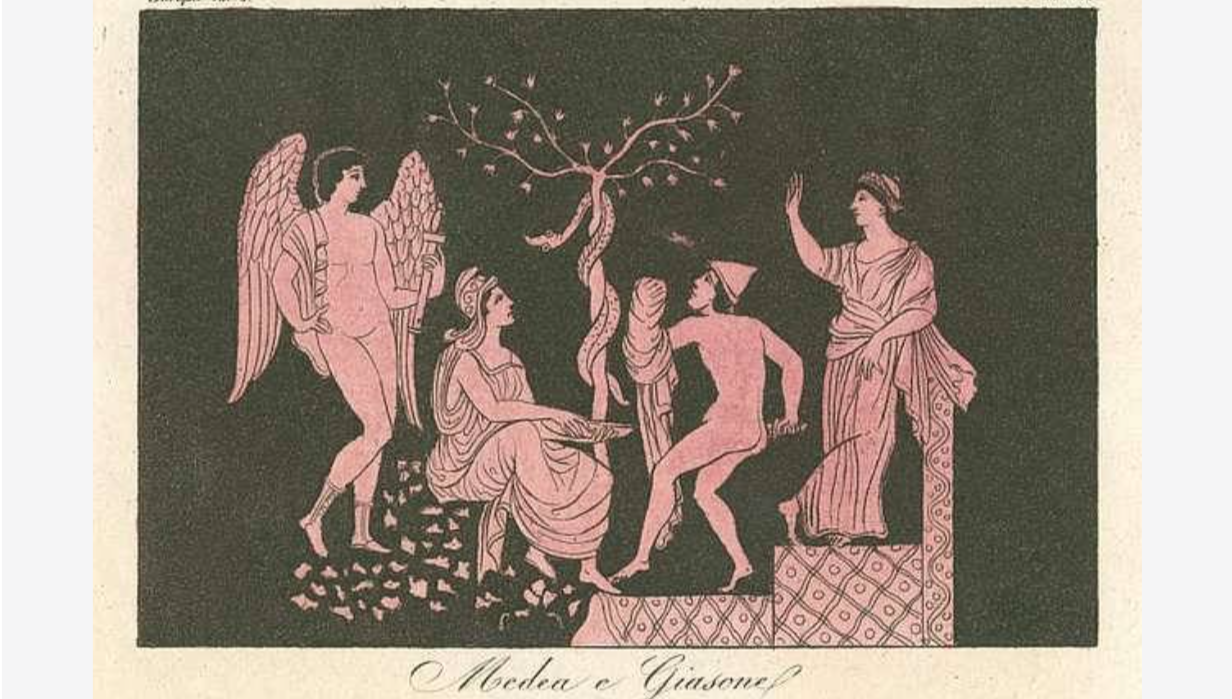
Euripides’ Medea, first staged in Athens in 431 BCE, follows a foreign wife whom Jason abandons in Corinth to marry the king’s daughter. Exiled, with no family and no city to return to, Medea kills the princess and the king, then her own two sons, and escapes in a chariot given by the Sun. Read psychologically, it is a study of betrayal and the revenge it breeds.
Medea’s injury is real: she left her home and father, and killed her brother, for a man who now calls abandoning her a favor. Her rage is intelligible. Her revenge is a second catastrophe, because it destroys the one thing that bound her to a future. Euripides refuses to let the provocation excuse the act or the act erase the provocation, and that double vision is what a clinician needs when betrayal turns into fury.

What happens in Medea
Medea, a princess of Colchis and granddaughter of the Sun god Helios, helped Jason win the Golden Fleece. By her own account she saved him from the fire-breathing bulls, killed the dragon guarding the Fleece, left her father, and had Pelias killed by his own daughters (lines 476–487). She left home “in shame, having killed my brother” (166–167).1
The play opens in Corinth after Jason has married the daughter of King Creon. Euripides never names her; later writers call her Glauce or Creusa, and the travel writer Pausanias saw a “Well of Glauce” in Corinth in the second century CE.2 Creon, afraid of “a clever woman and skilled in many evil arts” (285), orders her into exile with her sons. She begs one day’s delay and gets it (340–356). The mistake is his, as she tells the chorus: one day is enough to kill her enemies (371–375).1
Jason offers money for the journey, and they have it out. Then Aegeus, king of Athens, passes through on his way from the oracle at Delphi, childless and desperate for a son. Medea promises him medicines that will end his childlessness in return for sanctuary, and makes him swear to it (663–763). Then she announces the plan. She will send the children to the princess with a poisoned gown and crown, and then she will kill the children (784–793). The princess dies in agony, and Creon, embracing her body, sticks to the poisoned dress and dies with her (1136–1230).1 Sophocles used a poisoned robe too: in The Women of Trachis, a wife displaced by a younger woman sends one believing it is a love charm.
Jason does not come back chiefly to kill Medea. Her punishment, he says, he can leave to the royal family; he has come to save the boys from its revenge (1301–1305). He learns they are dead, and sees Medea appear above the house in the chariot “Helios my grandfather has given me to ward off a hostile hand” (1321–1322). She refuses him even the bodies and leaves for Athens.1
Athens, 431 BCE: a foreign wife with no city
Euripides entered Medea at the City Dionysia of 431 BCE with two other tragedies and a satyr play, against Sophocles and Euphorion, the son of Aeschylus. He took third prize, which in a field of three meant last.3 The play opened on the eve of the Peloponnesian War, before an audience that included many citizen-soldiers.4
That audience could read Medea’s position in legal terms. Twenty years earlier Athens had passed, on Pericles’ proposal, a law “confining citizenship to persons of citizen birth on both sides.”5 Under that law a foreign wife could not pass citizenship to her sons. Medea says it plainly to the Corinthian women: “you have a city and a father’s house,” while she, “without relatives or city,” has “no mother, no brother, no kinsman to shelter me” (252–258). Divorce, she says, is “discreditable for women,” a bride must “divine” how to deal with a husband whose household customs she never learned, and “I would rather stand three times with a shield in battle than give birth once” (230–251).1 Read through a historical-materialist lens, the tragedy starts from a dependency built into law: everything she had was “bound up” in one man (228–229).
The filicide itself seems to have been new. Pausanias, writing six centuries later, recorded other Corinthian versions. In one, the Corinthians stoned Medea’s children for carrying the gifts to the princess. In another, attributed to the early epic poet Eumelus, Medea hid each newborn in Hera’s sanctuary hoping to make them immortal.2 Euripides’ version, with the children dying by their mother’s hand and the escape in the Sun’s chariot, is the one later writers took up, and the filicide is usually counted among his innovations.6 Edith Hall has shown how long that killing disturbed later audiences: until the twentieth century it largely kept unadapted versions off the British stage, and Euripides’ play was not performed without alteration, in English, until 1907.7
Jason’s defense: betrayal recast as generosity
Jason is often called a textbook narcissist and his speech textbook gaslighting. The text supports something more precise. Jason never denies what he did. He denies what it means.
First he shrinks her contribution. “Aphrodite alone of gods and mortals was the savior of my expedition,” he says; Medea only acted because Eros made her (527–531). Then he turns the ledger around: “you got more than you gave,” because she now lives “among Greeks and not barbarians” and understands “justice and the rule of law” (535–538). The marriage was “not for the sake of a woman” but “because I wanted to save you and to beget princes as brothers to my children” (593–597). Her exile is her own doing: “You yourself chose that. You have no one else to blame” (605). And her grief is a female defect: “if all is well in bed you think you have everything.” Men ought to get children some other way, “and there should be no female sex” (569–575).1
Two research frames fit better than the pop label. Jennifer Freyd’s acronym DARVO (deny, attack, reverse victim and offender) names a pattern in how people respond when someone confronts them about a wrong. In a study of 138 undergraduates, DARVO was common, women met it more often than men, and more exposure to it went with more self-blame in the person who had raised the complaint.8 Jason attacks (“your foolish talk,” 450) and reverses the roles. The sociologist Paige Sweet argues that gaslighting works by mobilizing stereotypes and inequalities, especially the link between femininity and irrationality, along with vulnerabilities of nationality and race.9 That is exactly what Jason reaches for: she is a woman, and she is a barbarian.
The narcissist label explains less than it seems to. Much current research treats narcissism as a set of traits with at least two presentations, grandiose and vulnerable, and narcissistic personality disorder is a clinical diagnosis, not a verdict on a character.10 Nor is Jason a cardboard villain. The chorus tells him that “in abandoning your wife you are not doing right” (576–578), yet at the end he longs for “the dear faces of my children” (1399–1400).1 A man can be self-serving and blind to the harm he does, and still grieve.
Betrayal trauma and the logic of revenge
Freyd’s betrayal trauma theory, set out in 1994 to explain memory for childhood abuse, holds that harm from someone a person depends on is different: to keep a needed attachment, the injured person may stay partly unaware of the betrayal.11 In one study of 185 young adults, traumas high in betrayal predicted anxiety, depression, dissociation, difficulty naming feelings and physical complaints, while other traumas did not.12 Medea had staked everything on Jason; when that attachment broke, there was nothing beneath it.
The classicist Brian Lush has read Medea through Jonathan Shay’s work on combat trauma, treating her as a warrior who has suffered a “betrayal of what’s right,” the Greek themis.4 Medea calls on “mighty Themis” (160), guardian of oaths, and talks like a Homeric fighter: “The laughter of one’s enemies is unendurable” (797), and “Let no one think me weak, contemptible, untroublesome… hurtful to foes, to friends kindly” (807–809).1 Sophocles’ Ajax runs on the same horror of being laughed at.
Watch the target shift. Medea first plans to kill Jason, the princess and Creon (374–375). After the Aegeus scene, where a king is desperate for a son, she changes the target to Jason’s line. He will never see his children alive, “nor will he beget children by his new bride” (803–805). Asked how she can kill her own children, she answers, “It is the way to hurt my husband most” (817).1 The aim is no longer justice. It is to make him feel what she feels.
The great monologue shows the cost. She melts at the boys’ smiles, “I cannot do it. Farewell, my former designs!” (1044–1045), then hardens again at the thought of being mocked (1049–1050), and ends: “my wrath overbears my calculation, wrath that brings mortal men their gravest hurt” (1079–1080). Later she adds a rationalization: her enemies will kill the boys anyway, and she must not leave them to “a less kindly hand” (1238–1240).1 Rage that has decided on an act will recruit reasons for it.
Nor does revenge free her. In the final exchange she is still arguing with Jason: “the pain is worthwhile if you cannot mock me” (1362); “The gods know who struck the first blow” (1372).1 Laboratory studies by Kevin Carlsmith and colleagues found a small-scale version: people expected punishing an offender to feel good, but those who punished kept thinking about the offender, while those who could not punish moved on.13
The children: symbol and fact
Symbolically, the children are the future the couple made together. In his essay on the child archetype, Jung treated the child figure as an image of potential, of what is still to come.14 Read that way, Medea destroys the shared future so Jason cannot have it, and destroys her own with it. Jason’s curse says as much: she has “destroyed my life with childlessness” (1325–1326).1 Euripides came back to a parent spending a child for advantage in Iphigenia in Aulis, where Agamemnon agrees to sacrifice his daughter so the fleet can sail.
The literal subject needs care, because “Medea” has become a clinical label. In 1948 Edward S. Stern, writing in the Journal of Mental Science, proposed the term “Medea complex” for a mother’s hatred and homicidal wishes toward her child, which he found more common in child psychiatry than sentimental ideas of mother love allowed.15 In 1969 Phillip Resnick reviewed 131 cases and sorted filicide by motive: altruistic, acutely psychotic, unwanted child, accidental, and spouse revenge.16 Among mothers who kill, Susan Hatters Friedman and Resnick call spouse revenge, Medea’s motive, the rarest, and note that it most often follows the discovery of infidelity or arises in custody disputes.17 It is not a mothers’ crime: roughly half of filicides are committed by fathers, and revenge against a spouse is among their motives too.18
For ordinary families, the everyday version of the Medea dynamic is not murder but using children as weapons. Research does not measure that move directly, but a meta-analysis of 169 studies linked hostile and disengaged conflict between parents, and conflict about the children, to children’s emotional and behavioral problems, and most of those associations held over time.19 And intrusive thoughts of harm are more common than people admit. In one study Friedman and Resnick cite, 41% of depressed mothers of young children reported thoughts of harming a child, compared with 7% of controls.17 Such thoughts are not the same as intent, but they are worth telling a clinician. If you are afraid you might act on thoughts of harming yourself or someone else, call or text 988, call 911, or see our crisis resources for Birmingham.
The label also flattens history. In 1856 Margaret Garner, who had escaped slavery in Kentucky, killed her daughter in Cincinnati rather than see her taken back. Thomas Satterwhite Noble painted the scene in 1867 as The Modern Medea, and Steven Weisenburger’s 1998 history of the case is titled Modern Medea.20 Garner’s act came from a system that left no exit, not from revenge on a husband. When a culture reaches for “Medea,” it is worth asking what it leaves out.
Why the Sun lets her go
The ending troubled Aristotle, who complained that the resolution of a plot should come from the plot itself and not be “produced mechanically as in the Medea.”21 The script mentions only a chariot from Helios; the dragons of later retellings already pull it on South Italian vases. A Lucanian krater of about 400 BCE in the Cleveland Museum of Art shows her in a dragon-drawn chariot, haloed like the Sun and flanked by two Furies, while Jason, a nurse and a tutor approach the bodies on an altar below.22
An earlier version of this page read the escape as proof that nature is amoral and violent authenticity outranks morality. That goes beyond the play. The chorus does not treat Medea as innocent nature; it prays to the Sun to “check the cruel and murderous Fury” in the house (1258–1260), and Jason calls her “a she-lion, not a woman” (1342).1 A better depth reading is that consummated revenge turns a person into the role. Medea leaves not as a wronged woman but as vengeance itself, the Fury the chorus feared, untouchable and alone. The Furies have their day in court in the Oresteia. Karl Kerényi took her solar descent seriously: Goddesses of Sun and Moon, which groups her with Circe, Aphrodite and Niobe, translates selections from his Töchter der Sonne, “Daughters of the Sun,” and Niobe.23
What this looks like in therapy
People rarely come to therapy saying they feel like Medea. They come after an affair, a divorce or being replaced, often frightened by how angry they are. Some have been told, Jason-style, that the betrayal was for their own good, or that their reaction is the real problem. A clinician working from this play holds Euripides’ double view: the injury is real, and revenge is not the cure. In practice that tends to mean a few things.
- Treat the anger as information. Rage points at what was violated: a promise, a place, a standing. Naming what was taken comes first. Grief often sits underneath, as it does for Medea.
- Separate fantasy from intent. A revenge fantasy is not a plan. Clinicians should still ask directly about thoughts of harming children, partners or oneself, as West and colleagues recommend.18
- Restore the record. When someone has been told their memory or reaction is the problem, writing events down and checking them with trusted people can help rebuild confidence in their own perception.
- Calm the body, don’t stoke it. A 2024 meta-analysis of 154 studies found that lowering arousal, through deep breathing, mindfulness or meditation, reduced anger and aggression, while venting and arousing activities did not.24 Somatic work in therapy aims at regulation, not catharsis.
- Talk with the part that wants revenge. In Jungian and parts-based therapy, the furious part is approached as a protector: what is it trying to prevent? Often it guards dignity, safety or the right to be believed.
- Keep the children out of it. Enlisting children against the other parent is the modern Medea move, and the research on interparental conflict is reason enough to stop.19
The goal is not forgiveness on a schedule. It is getting free of the betrayer. Medea has the chariot and the last word, and she is still talking to Jason. Sophocles’ Electra shows the same trap, a grievance that becomes a whole identity. Recovery looks more like the moment the person who hurt you stops being the main character in your story.
If betrayal has left you with anger you don’t recognize, or children have become the battleground in a separation, a therapist can help you sort the injury from the plan. Our Jungian depth therapy works with these images directly, and you can contact Taproot Therapy Collective to ask about an appointment in Hoover or by teletherapy in Alabama. If you are in danger at home, the National Domestic Violence Hotline is 1-800-799-7233, or text START to 88788.
References
- Euripides. (1994). Medea (D. Kovacs, Ed. & Trans.). In Cyclops, Alcestis, Medea (Loeb Classical Library 12). Harvard University Press. https://doi.org/10.4159/dlcl.euripides-medea.1994 (English text with line numbers also at the Perseus Digital Library)
- Pausanias. (1918). Description of Greece (W. H. S. Jones & H. A. Ormerod, Trans.; Book 2, ch. 3, sections 6–11). Harvard University Press; William Heinemann. Perseus Digital Library
- Knox, B. M. W. (1977). The Medea of Euripides. In Greek tragedy (Yale Classical Studies, Vol. 25, pp. 193–226). Cambridge University Press. https://doi.org/10.1017/cbo9780511933738.008
- Lush, B. (2014). Combat trauma and psychological injury in Euripides’ Medea. Helios, 41(1), 25–57. https://doi.org/10.1353/hel.2014.0004
- Aristotle. (1952). The Athenian constitution (H. Rackham, Trans.; ch. 26, section 4). Harvard University Press; William Heinemann. Perseus Digital Library
- Mackay, M., & Allan, A. L. (2014). Filicide in Euripides’ Medea: A biopoetic approach. Helios, 41(1), 59–86. https://doi.org/10.1353/hel.2014.0002
- Hall, E. (1999). Medea and British legislation before the First World War. Greece & Rome, 46(1), 42–77. https://doi.org/10.1017/s0017383500026097
- Harsey, S. J., Zurbriggen, E. L., & Freyd, J. J. (2017). Perpetrator responses to victim confrontation: DARVO and victim self-blame. Journal of Aggression, Maltreatment & Trauma, 26(6), 644–663. https://doi.org/10.1080/10926771.2017.1320777
- Sweet, P. L. (2019). The sociology of gaslighting. American Sociological Review, 84(5), 851–875. https://doi.org/10.1177/0003122419874843
- Miller, J. D., Lynam, D. R., Hyatt, C. S., & Campbell, W. K. (2017). Controversies in narcissism. Annual Review of Clinical Psychology, 13, 291–315. https://doi.org/10.1146/annurev-clinpsy-032816-045244
- Freyd, J. J. (1994). Betrayal trauma: Traumatic amnesia as an adaptive response to childhood abuse. Ethics & Behavior, 4(4), 307–329. https://doi.org/10.1207/s15327019eb0404_1
- Goldsmith, R. E., Freyd, J. J., & DePrince, A. P. (2012). Betrayal trauma: Associations with psychological and physical symptoms in young adults. Journal of Interpersonal Violence, 27(3), 547–567. https://doi.org/10.1177/0886260511421672
- Carlsmith, K. M., Wilson, T. D., & Gilbert, D. T. (2008). The paradoxical consequences of revenge. Journal of Personality and Social Psychology, 95(6), 1316–1324. https://doi.org/10.1037/a0012165
- Jung, C. G., & Kerényi, C. (1949). Essays on a science of mythology: The myth of the divine child and the mysteries of Eleusis (R. F. C. Hull, Trans.; Bollingen Series 22). Pantheon Books.
- Stern, E. S. (1948). The Medea complex: The mother’s homicidal wishes to her child. Journal of Mental Science, 94(395), 321–331. https://doi.org/10.1192/bjp.94.395.321
- Resnick, P. J. (1969). Child murder by parents: A psychiatric review of filicide. American Journal of Psychiatry, 126(3), 325–334. https://doi.org/10.1176/ajp.126.3.325
- Hatters Friedman, S., & Resnick, P. J. (2007). Child murder by mothers: Patterns and prevention. World Psychiatry, 6(3), 137–141. https://pmc.ncbi.nlm.nih.gov/articles/PMC2174580/
- West, S. G., Friedman, S. H., & Resnick, P. J. (2009). Fathers who kill their children: An analysis of the literature. Journal of Forensic Sciences, 54(2), 463–468. https://doi.org/10.1111/j.1556-4029.2008.00964.x
- van Eldik, W. M., de Haan, A. D., Parry, L. Q., Davies, P. T., Luijk, M. P. C. M., Arends, L. R., & Prinzie, P. (2020). The interparental relationship: Meta-analytic associations with children’s maladjustment and responses to interparental conflict. Psychological Bulletin, 146(7), 553–594. https://doi.org/10.1037/bul0000233
- Weisenburger, S. (1998). Modern Medea: A family story of slavery and child-murder from the Old South. Hill and Wang.
- Aristotle. (1932). Poetics (W. H. Fyfe, Trans.; 1454a37–1454b2). Harvard University Press; William Heinemann. Perseus Digital Library
- Cleveland Museum of Art. (n.d.). Red-figure calyx-krater (mixing vessel): Medea in chariot (near the Policoro Painter, South Italian, Lucanian, c. 400 BCE; accession no. 1991.1). Retrieved November 8, 2026, from https://clevelandart.org/art/1991.1
- Kerényi, K. (1979). Goddesses of sun and moon: Circe, Aphrodite, Medea, Niobe (M. Stein, Trans.; Dunquin Series 11). Spring Publications.
- Kjærvik, S. L., & Bushman, B. J. (2024). A meta-analytic review of anger management activities that increase or decrease arousal: What fuels or douses rage? Clinical Psychology Review, 109, 102414. https://doi.org/10.1016/j.cpr.2024.102414




















0 Comments