
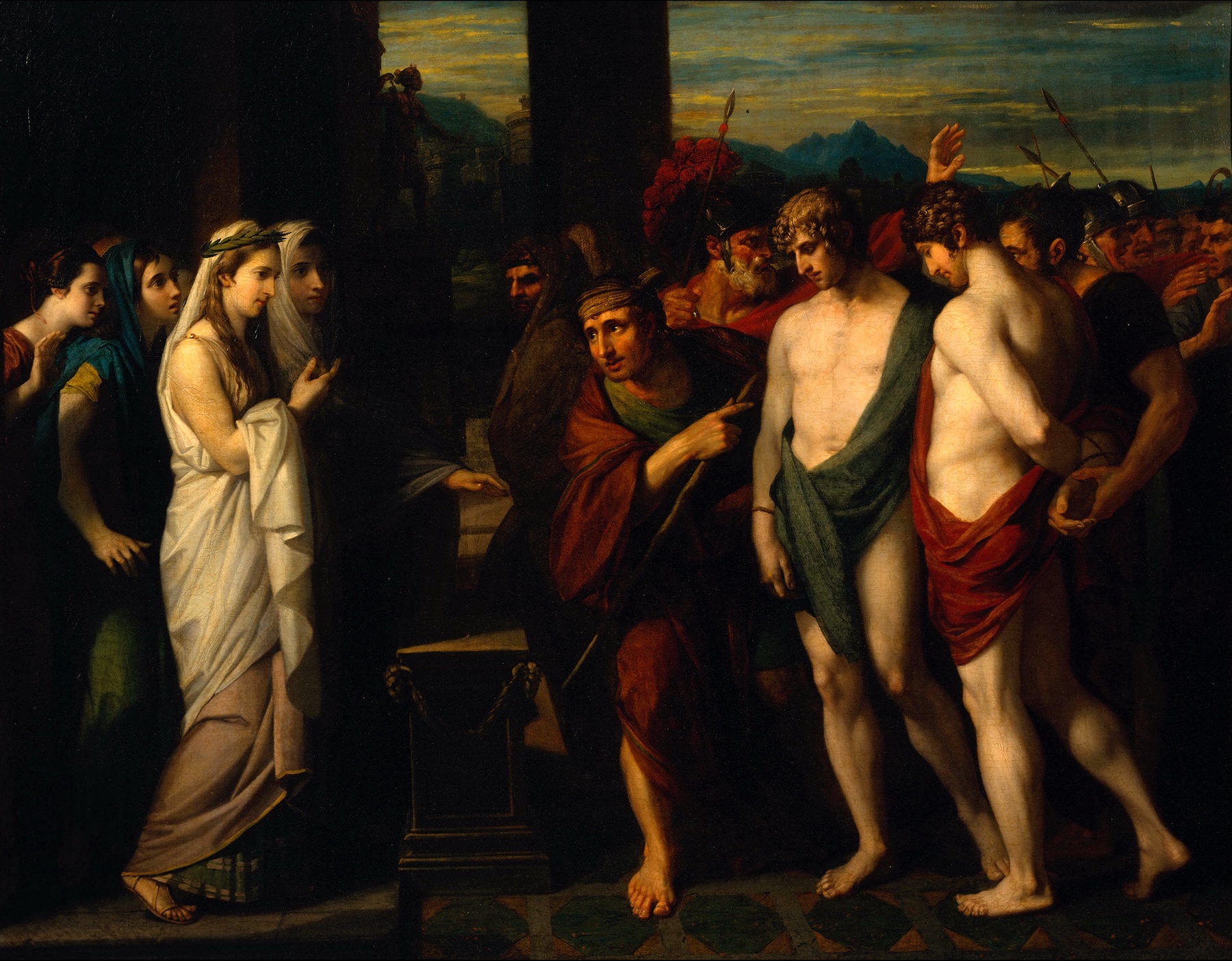
Aeschylus’ Oresteia (458 BCE) follows one family’s chain of killings: Agamemnon sacrifices his daughter, his wife Clytemnestra kills him, and their son Orestes kills her. Read psychologically, it is a study of guilt. The trilogy ends with the Furies, goddesses of blood vengeance, not defeated but persuaded into a new role inside the city, a working picture of how a punishing conscience can soften.
That ending is the argument of this essay. The famous trial settles very little on its own: the votes come out equal, and the god who speaks for Orestes rests his case on bad biology. What breaks the cycle is Athena’s refusal to banish the Furies. She offers them a home, honors and work, and they keep their power to make people afraid. A harsh conscience behaves the same way in therapy. It does not quiet down when it is obeyed, argued with or exiled. It changes when it is heard, given a smaller and useful job, and kept in company.
What happens in the Oresteia
Aeschylus staged the trilogy at the City Dionysia in Athens in 458 BCE and took first prize. Its three tragedies were followed by a satyr play, Proteus, of which only scraps survive.1 It is the only Greek tragic trilogy that has come down to us complete; only seven plays survive under Aeschylus’ name. Aeschylus had fought at Marathon, had already won with his war play The Persians, and died in Sicily two or three years after the Oresteia. His epitaph mentions Marathon, not the plays.2
In Agamemnon, the king comes home from Troy with the captive prophet Cassandra. The chorus has already recalled how he sacrificed his daughter Iphigenia at Aulis to change the winds. His wife talks him into walking into the palace over purple cloth and kills him in his bath, trapped in a robe she casts over him “as if to catch a haul of fish” (lines 1382–1383). Her lover Aegisthus adds his own motive: Agamemnon’s father Atreus once fed Aegisthus’ father Thyestes a meal made of Thyestes’ children (1583–1602).3 In The Libation Bearers, Orestes returns from exile, is recognized by his sister Electra at their father’s grave, and kills Aegisthus and then his mother.4 In The Eumenides the Furies hunt him to Athens, where Athena empanels a jury of citizens on the Areopagus, the Hill of Ares. The votes come out equal and he is acquitted. The rest of the play, nearly three hundred lines, goes to Athena’s effort to persuade the Furies to accept a home in her city and to the blessings that follow.5
Agamemnon: the curse as inheritance and as alibi
The chorus states the trilogy’s law early: Zeus “has established as a fixed law that ‘wisdom comes by suffering,'” and “even as trouble, bringing memory of pain, drips over the mind in sleep, so wisdom comes to men, whether they want it or not” (176–181).3 Robert F. Kennedy quoted a version of these lines in Indianapolis on April 4, 1968, the night he told a crowd that Martin Luther King Jr. had been killed, and offered them as an answer to the “bitterness,” “hatred” and “desire for revenge” he said the crowd might feel.6
At Aulis, Agamemnon sees the trap: “Which of these courses is not filled with evil?” (211). Then he “donned the yoke of Necessity” and “hardened his heart to sacrifice his daughter” (218–225), and she was gagged so she could not curse the house (235–238).3 A choice is recast as a compulsion, and once it is a compulsion nobody has to feel it. Euripides later gave the sacrifice a play of its own, Iphigenia in Aulis.
Clytemnestra makes the same move from the other side. Over the bodies she owns the killing, “the work of this right hand, a just workman” (1405–1406), then disowns it: the killer was really “the ancient bitter evil spirit of Atreus” in her shape (1497–1504). The chorus will not let her have it both ways, “That you are innocent of this murder—who will bear you witness?”, yet concedes the family’s evil genius “might well be your accomplice” (1505–1508). Then it states the rule that drives all three plays: “to him who does it shall be done; for it is law. Who can cast from out the house the seed of the curse?” (1560–1566).3
That double view is clinically accurate. Family patterns repeat, and they also make a ready excuse. A meta-analysis of 142 studies found that a parent’s own history of maltreatment raises the risk that their child will be maltreated, an association the authors call modest (d = 0.45).7 A meta-analysis of children of Holocaust survivors found no evidence of secondary traumatization in adequately designed nonclinical studies, only in clinical samples of people under stress for other reasons.8 Risk travels down the generations; fate does not. Aeschylus had built an earlier play, Seven Against Thebes (467 BCE), around another inherited curse.2
Cassandra is the one person in Argos who sees the pattern whole. She scents “the track of crimes done long ago” and describes “a revel-rout of kindred Furies” lodged in the house (1184–1190). In Aeschylus she promised herself to Apollo and broke her word, and “ever since that fault I could persuade no one of anything” (1208–1212).3 Read psychologically, much of her gift looks like memory: she reads the present through the house’s history. Research on gut feeling fits that reading: in a study of angel investors, the gut feel that predicted which ventures would succeed blended expertise-based intuition with formal analysis.9 Children raised around violence may build a narrow, fast expertise of their own; in one study, physically abused children identified angry faces from less visual information than other children needed.10 Some adults who grew up in Cassandra’s position arrive in therapy after years of being told they were imagining things. The useful response is to take the perception seriously and test it, which no one in Argos does.
The Libation Bearers: a double bind, then guilt on sight
Orestes does not come home free. Apollo’s oracle has warned him that if he fails to avenge his father he will suffer “leprous ulcers,” madness, “groundless terrors out of the night” and a friendless death: the “assaults of the Furies” raised by a father’s blood (269–296). His mother, at sword’s point, names the other side: “beware the hounds of wrath that avenge a mother.” He answers, “And how shall I escape my father’s if I leave this undone?” (924–925).4 One set of Furies for acting, another for not acting, and Orestes invented neither.
When the moment comes, Clytemnestra bares her breast. Orestes turns to his companion: “Pylades, what shall I do? Shall I spare my mother out of pity?” Pylades, who speaks only these three lines in the play, points him back to the oracle: “Count all men your enemies rather than the gods” (899–902). Electra, sent indoors at line 554, never returns.4 Sophocles later rebuilt the story around her in his Electra.
The guilt arrives with the act. Orestes feels his mind bolting “like a charioteer driving my team far beyond the course” (1021–1025), then sees them, “like Gorgons, wrapped in sable garments, entwined with swarming snakes!” The chorus sees nothing and blames the blood “still fresh on your hands.” He insists: “You do not see them, but I see them” (1048–1061).4 Classicists have argued for generations about what these Furies are. Wilamowitz treated the visions as subjective; Solmsen objected that the hounds cannot be torments of conscience in one play and real goddesses in the next; John Jones proposed placing them at both ends of the line between fantasy and fact at once.11 A clinician would side with Jones. Guilt is private, and it is also a social fact. Nobody else can see it, and it still decides where you are allowed to live.
The Furies as a punishing conscience
The Furies call themselves daughters of Night (321–322). Their law is narrow and literal. They track Orestes by the drops of blood he leaves (244–253) and promise to “wither you alive” (264–267). Asked why they never hunted Clytemnestra, they answer: “She was not related by blood to the man she killed” (604–605). Motive, provocation and a god’s command do not count; only the act does. Their signature song is “a spell to bind the soul… withering the life of mortals” (328–333).5
Freud’s account of conscience reads like a description of this chorus. In Civilization and Its Discontents, aggression turned back on the self is “taken over by a part of the ego that distinguishes itself from the rest as a super-ego,” and “the tension between the strict super-ego and the subordinate ego we call the sense of guilt; it manifests itself as the need for punishment.” Civilization installs it “like a garrison in a conquered city” (p. 105). Freud added that the severity of a child’s superego “in no way corresponds to the severity of the treatment it has itself experienced,” crediting Melanie Klein and “other English writers” with the point, while warning that “it would also be wrong to exaggerate this independence” (pp. 116–117).12 Klein wrote her own essay on the trilogy, “Some Reflections on the Oresteia,” published in 1963, after her death,13 and C. Fred Alford later argued that her work amounts to an “Oresteia complex,” a name she never used, to set against Freud’s Oedipus.14
Researchers cannot measure a superego, but they do measure self-criticism, which some of them define in psychoanalytic terms. A systematic review of 48 studies tied it not only to depression but to eating-disorder symptoms, social anxiety, personality disorders, psychotic symptoms and interpersonal problems; compassion- and emotion-focused therapies reduced it, but “harsh forms of self-criticism were more persistent and difficult to change.”15 Guilt in general is less of a problem than shame. Across 108 studies, shame was more strongly tied to depressive symptoms than guilt (r = .43 versus .28). Two kinds of guilt matched shame, though: exaggerated responsibility for events outside one’s control (r = .39), and free-floating guilt “divorced from specific contexts” (r = .42). These are correlations, not proof of cause.16 That is the Furies’ kind of guilt. It ignores circumstances and spreads from one act to a whole life.
Why the verdict does not settle anything
Athena’s first move is to admit the case is beyond her: “The matter is too great, if any mortal thinks to pass judgment on it,” and either course, keeping the Furies or driving them out, “brings disaster and perplexity” (470–481). So she swears in citizens as judges and founds a court “for all time” (482–484), opening “the first trial for bloodshed” (681–682).5
Something healthy does happen at the trial. Asked whether he killed his mother, Orestes says: “I killed her. There is no denial of this” (587–588). Apollo accepts his share: “I am responsible for the murder of his mother” (579–580).5 Guilt that had been a hallucination becomes a specific act, owned in front of witnesses, with its context on the record.
The arguments are another matter. Apollo claims that “the mother of what is called her child is not the parent, but the nurse of the newly-sown embryo,” with Athena, born of Zeus without a womb, as proof (658–666). Athena casts her ballot with a reason to match: “there was no mother who gave me birth; and in all things, except for marriage, whole-heartedly I am for the male and entirely on the father’s side” (734–741). Orestes is acquitted “for the numbers of the casts are equal” (752–753).5 Whether her ballot created the tie or broke one among the human jurors is an old dispute that Anthony Podlecki’s edition treats in a separate note.17 Johann Jakob Bachofen’s Mutterrecht (1861) read the verdict as father-right defeating mother-right, and Friedrich Engels, summarizing him in 1891, called the Furies “the demonic guardians of mother-right” and the reading “new but undoubtedly correct.”18 You need not accept Bachofen’s prehistory of matriarchy to hear the hierarchy the verdict encodes.
That is why Athena makes a poor stand-in for the Jungian Self or for Jung’s transcendent function. Jung defined the transcendent function as a process, not a figure: when neither side of a conflict can claim what forms between them, it becomes “a new content that governs the whole attitude,” and “a transition is made possible from the one attitude to the other” (p. 610).19 Athena tells the court whose side she is on. If the trilogy has a transcendent function, it lies in what happens after the tie, when neither party gets what it came for and something new has to be built.
The politics are real but easy to overstate. A few years earlier, reforms led by Ephialtes with Pericles had left the Council of the Areopagus little beyond its jurisdiction over homicide, and Ephialtes was murdered in 461 or 460.2 K. J. Dover argued that the Eumenides keeps steering its audience toward “the political present,” while warning that ransacking tragedy for a poet’s politics “is seldom profitable and may be disastrous.”20 One popular link should go: work on the Parthenon began around 447 BCE, almost a decade after Aeschylus died.21
Persuasion, a home and a place for fear
In 1960 E. R. Dodds asked whether Sir Richard Livingstone was right to call the last 350 lines of the Eumenides “a loosely connected episode, stitched on its outside.”22 Psychologically, those lines are the point. Outvoted, the Furies threaten to drip venom onto Attica, a blight “that destroys leaves, destroys children” (780–787). Athena does not threaten back. She tells them an equal vote brings them no disgrace (794–796), promises a cavern sanctuary with shining thrones and the worship of her citizens (804–807), and refuses to let them say they were “cast out, dishonored and banished” (881–884). Asked what honor waits for them, she says: “That no house will flourish without you” (895). The chorus answers, “It seems you will win me by your spells; I am letting go my anger” (900), and Athena thanks Persuasion (970–972).5
What changes is the direction of their power, not its size. The goddesses who promised to wither Orestes now pray that no wind harm the trees, that flocks bear twins, that young women find husbands, and that “the dust not drink the black blood of its people” in civil strife (938–987). “From these terrible faces,” Athena says, “I see great profit for these citizens” (990–991). They are led by torchlight, in scarlet robes, to their dwelling under the earth, hailed as “venerable goddesses” (1021–1047).5 Pausanias describes their sanctuary beside the Areopagus, where Athenians called them the August goddesses and where people acquitted on the hill offered sacrifice. He also credits Aeschylus with being the first to give them snakes in their hair.23 Acquittal did not end the relationship with the Furies. It started a new one.
Fear stays. Before the trial the Furies sang that “there is a time when fear is good and ought to remain seated as a guardian of the heart” (517–521). Athena adopts their line when she founds the court: “Neither anarchy nor tyranny… and not to drive fear wholly out of the city. For who among mortals, if he fears nothing, is righteous?” (696–699).5 Freud pictured conscience as a garrison in a conquered city. Aeschylus ends with the garrison given citizenship, a hearth and a share of the harvest. The Furies lose their monopoly on judgment, not their job. Orestes says something similar about his pollution: it was “blunted and worn away at other homes and in the travelled paths of men” (235–239). Purification at Delphi mattered to him, but so did company.5
What this looks like in therapy
The trilogy tries four ways of handling a punishing conscience, and only the last works. Obey it, and you become its instrument: every killer in the house claims to be in the right, and every act summons the next. Argue it down, and you win on a technicality, as Apollo does; the Furies are outvoted, not convinced. Banish it, and you get blight. The fourth way is Athena’s: hear the accuser in full, give it a bounded role and some honor, and keep it among people.
It shows up in therapy in recognizable forms. Some people carry a critic that answers every mistake with a verdict on their whole existence. Some feel like Orestes when they set a limit with a parent or step out of a family role: whichever loyalty they break, a set of Furies arrives. Some, like Cassandra, saw the pattern early and were told they were imagining it. Therapy does not try to remove conscience from any of them. It tries to turn free-floating guilt back into guilt about specific acts, which can be answered and repaired, as Orestes does when he says “I killed her,” and to let the accuser speak without letting it run the court.
Several methods work on this directly, with evidence of uneven strength. In emotion-focused two-chair work, the client speaks as the critic and then answers it; a pilot study of nine self-critical clients found less self-criticism, more self-compassion and fewer depressive and anxiety symptoms, largely held at six months, though a study that small is a starting point, not proof.24 Compassion-focused therapy was developed for people high in shame and self-criticism. An early systematic review of 14 studies called it promising but asked for larger, better trials,25 and a meta-analysis of 21 randomized trials of compassion-based interventions found moderate improvements in self-compassion, depression and anxiety, mostly from small studies.26 Parts-based therapy treats the inner critic as a part with a protective job, much as Athena reassigns the Furies; its research base is thinner, and a good clinician will say so. In Jungian depth therapy, the same accuser can be met in dreams and images, where the work is to turn and face a pursuer rather than outrun it. The harshest critics change slowly, and the research says that too.15
Nobody should leave therapy without a conscience. The goal is the one Athena sets for her city: neither anarchy nor tyranny, with fear given a seat but not the throne. If your own inner court has been running on the Furies’ rules, our clinicians in Hoover can help you look at it; you can contact Taproot to ask whether depth or parts-based work fits. For more on the plays, read our essay on the archetypal wisdom of Greek tragedy.
References
- Sidgwick, A. (1887). Agamemnon: With introduction and notes (3rd ed., rev., Part 1: Introduction and text, p. vii). Clarendon Press. https://archive.org/details/agamemnonwithint00aescuoft
- Smyth, H. W. (1922). Introduction. In Aeschylus: Vol. 1. Suppliant Maidens, Persians, Prometheus, Seven against Thebes (H. W. Smyth, Trans.; Loeb Classical Library, pp. xix–xxxi). William Heinemann; G. P. Putnam’s Sons. https://archive.org/details/aeschyluswithan00smytgoog
- Aeschylus. (1926). Agamemnon (H. W. Smyth, Trans.). In Aeschylus: Vol. 2. Agamemnon, Libation-Bearers, Eumenides, Fragments (Loeb Classical Library). William Heinemann; G. P. Putnam’s Sons. Quotations and line numbers from the Perseus Digital Library text: Perseus Digital Library.
- Aeschylus. (1926). Libation-Bearers (H. W. Smyth, Trans.). In Aeschylus: Vol. 2. Agamemnon, Libation-Bearers, Eumenides, Fragments (Loeb Classical Library). William Heinemann; G. P. Putnam’s Sons. Quotations and line numbers from the Perseus Digital Library text: Perseus Digital Library.
- Aeschylus. (1926). Eumenides (H. W. Smyth, Trans.). In Aeschylus: Vol. 2. Agamemnon, Libation-Bearers, Eumenides, Fragments (Loeb Classical Library). William Heinemann; G. P. Putnam’s Sons. Quotations and line numbers from the Perseus Digital Library text: Perseus Digital Library.
- Kennedy, R. F. (1968, April 4). Remarks on the assassination of Martin Luther King, Jr. Speech, Indianapolis, IN. American Rhetoric. https://www.americanrhetoric.com/speeches/rfkonmlkdeath.html
- Madigan, S., Cyr, C., Eirich, R., Fearon, R. M. P., Ly, A., Rash, C., Poole, J. C., & Alink, L. R. A. (2019). Testing the cycle of maltreatment hypothesis: Meta-analytic evidence of the intergenerational transmission of child maltreatment. Development and Psychopathology, 31(1), 23–51. https://doi.org/10.1017/S0954579418001700
- van IJzendoorn, M. H., Bakermans-Kranenburg, M. J., & Sagi-Schwartz, A. (2003). Are children of Holocaust survivors less well-adapted? A meta-analytic investigation of secondary traumatization. Journal of Traumatic Stress, 16(5), 459–469. https://doi.org/10.1023/A:1025706427300
- Huang, L., & Pearce, J. L. (2015). Managing the unknowable: The effectiveness of early-stage investor gut feel in entrepreneurial investment decisions. Administrative Science Quarterly, 60(4), 634–670. https://doi.org/10.1177/0001839215597270
- Pollak, S. D., & Sinha, P. (2002). Effects of early experience on children’s recognition of facial displays of emotion. Developmental Psychology, 38(5), 784–791. https://doi.org/10.1037/0012-1649.38.5.784
- Brown, A. L. (1983). The Erinyes in the Oresteia: Real life, the supernatural, and the stage. The Journal of Hellenic Studies, 103, 13–34. https://doi.org/10.2307/630526
- Freud, S. (1930). Civilization and its discontents (J. Riviere, Trans.; International Psycho-Analytical Library No. 17). Hogarth Press; Institute of Psycho-Analysis. https://archive.org/details/freud-1930-discontents
- Klein, M. (2000). Reflexionen über die Oresteia. In R. Cycon (Ed.), Melanie Klein: Gesammelte Schriften: Band III. Schriften 1946–1963 (pp. 437–472). frommann-holzboog. (Original work, “Some reflections on The Oresteia,” published 1963) https://doi.org/10.5771/9783772832178-437
- Alford, C. F. (1990). Melanie Klein and the “Oresteia complex”: Love, hate, and the tragic worldview. Cultural Critique, (15), 167. https://doi.org/10.2307/1354184
- Werner, A. M., Tibubos, A. N., Rohrmann, S., & Reiss, N. (2019). The clinical trait self-criticism and its relation to psychopathology: A systematic review – Update. Journal of Affective Disorders, 246, 530–547. https://doi.org/10.1016/j.jad.2018.12.069
- Kim, S., Thibodeau, R., & Jorgensen, R. S. (2011). Shame, guilt, and depressive symptoms: A meta-analytic review. Psychological Bulletin, 137(1), 68–96. https://doi.org/10.1037/a0021466
- Athena’s vote at vv. 735 and 752–3 and the so-called “vote of Athena.” (1989). In A. J. Podlecki (Ed. & Trans.), Aeschylus: Eumenides (pp. 211–213). Aris & Phillips. https://doi.org/10.2307/jj.38238760.9
- Engels, F. (1891). Preface to the fourth edition. In The origin of the family, private property and the state. Marxists Internet Archive. https://www.marxists.org/archive/marx/works/1884/origin-family/preface2.htm
- Jung, C. G. (1933). Psychological types; or, The psychology of individuation (H. G. Baynes, Trans.). Harcourt, Brace. (Original work published 1921) https://archive.org/details/psychologicaltyp00jung_1
- Dover, K. J. (1957). The political aspect of Aeschylus’s Eumenides. The Journal of Hellenic Studies, 77(2), 230–237. https://doi.org/10.2307/629362
- Perseus Digital Library. (n.d.). Athens, Parthenon (Building catalog entry). Tufts University. https://www.perseus.tufts.edu/hopper/artifact?name=Athens,+Parthenon&object=Building
- Dodds, E. R. (1960). Morals and politics in the Oresteia. Proceedings of the Cambridge Philological Society, 6, 19–31. https://doi.org/10.1017/S006867350000287X
- Pausanias. (1918). Description of Greece (W. H. S. Jones & H. A. Ormerod, Trans.; Vol. 1, Book 1, chapter 28, sections 5–6). Harvard University Press; William Heinemann. Perseus Digital Library
- Shahar, B., Carlin, E. R., Engle, D. E., Hegde, J., Szepsenwol, O., & Arkowitz, H. (2012). A pilot investigation of emotion-focused two-chair dialogue intervention for self-criticism. Clinical Psychology & Psychotherapy, 19(6), 496–507. https://doi.org/10.1002/cpp.762
- Leaviss, J., & Uttley, L. (2015). Psychotherapeutic benefits of compassion-focused therapy: An early systematic review. Psychological Medicine, 45(5), 927–945. https://doi.org/10.1017/S0033291714002141
- Kirby, J. N., Tellegen, C. L., & Steindl, S. R. (2017). A meta-analysis of compassion-based interventions: Current state of knowledge and future directions. Behavior Therapy, 48(6), 778–792. https://doi.org/10.1016/j.beth.2017.06.003




















0 Comments