
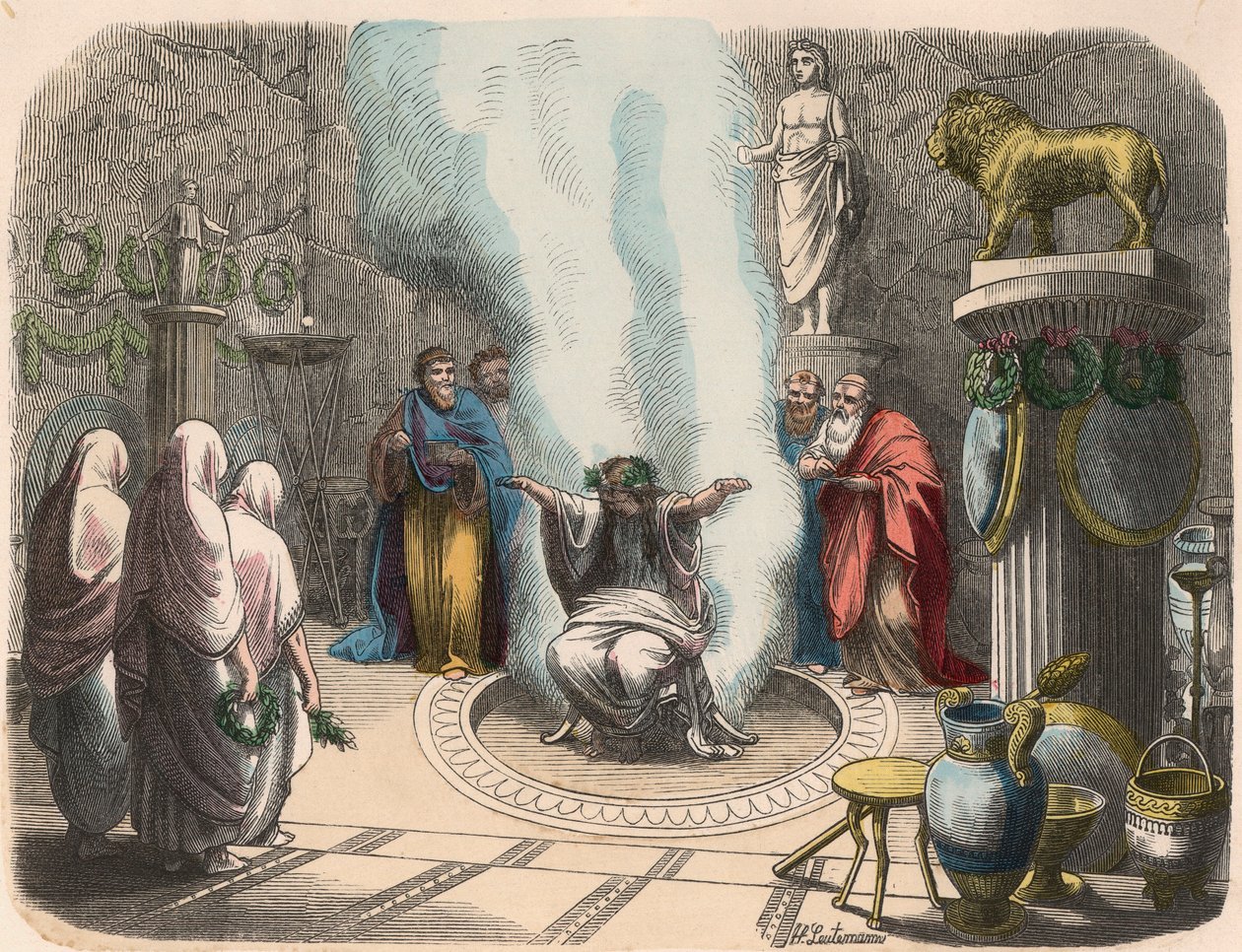
Greek tragedy matters to psychology because its plays keep showing people undone by something in themselves they refuse to know or refuse to honor. Aeschylus, Sophocles and Euripides wrote for Athenian festivals in the fifth century BCE, and Aristotle singled out the moment of “discovery” in their plots, a change “from ignorance to knowledge.” That is still a good short definition of insight in therapy.1
This guide to the series argues from that point. Pentheus cannot see the god standing in front of him. Hippolytus will not honor desire. Creon will not let a dead man be buried. Oedipus will not hear Tiresias. Each of the three tragedians stages a different way of not knowing: in Aeschylus it is the inherited blindness of a family, in Sophocles the blindness of a will that will not bend, in Euripides the blindness of a mind that has disowned a god. The remedy the plays model is not the emotional purge that “catharsis” has come to mean, and the experimental evidence on venting points the other way. What the theater offers is recognition at a bearable distance, in front of witnesses. That is much closer to what helps in a consulting room.

What Greek tragedy was
Tragedy was a civic event before it was literature. Plays were staged at the City Dionysia, the spring festival of Dionysus in Athens, as a competition. Each poet normally entered three tragedies and a satyr play. In 431 BCE, for example, Euripides competed against Sophocles and Euphorion with Medea, Philoctetes and Dictys, followed by the satyr play Theristae, and took third prize.2 The city’s archon chose which poets got a chorus, and a wealthy citizen paid for it.1 These were plays about kings, paid for and watched by a democracy at war. Aeschylus himself served at Marathon against the Persians.3
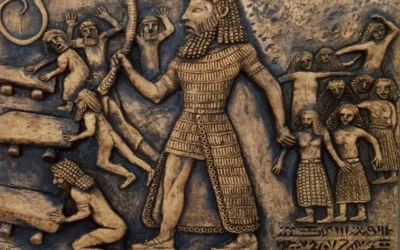
Very little survives. Seven plays remain from Aeschylus.3 Seven survive from Sophocles, who is reported to have written more than 120, and nineteen under the name of Euripides, one of which, Rhesus, is often thought not to be his. The surviving plays run from The Persians in 472 BCE to Oedipus at Colonus, staged in 401 BCE after Sophocles’ death: about seventy years in which Athens built an empire, fought Sparta and lost. The plays think through the city’s own strains, family against state and blood vengeance against courts, in the costume of myth. The essay on Athens and Sparta as anima and animus follows that thread into the city’s history, and the hero’s journey from Gilgamesh to Greek tragedy traces the older epic material the tragedians inherited.
Aeschylus: the curse a family inherits
Aeschylus thinks in households and generations. What one generation does not settle, the next inherits. The Persians (472 BCE), the oldest surviving tragedy, tells the Greek victory at Salamis from the Persian side. The ghost of the old king Darius reads the defeat as a lesson about pride: “presumptuous pride, when it has matured, bears as its fruit a crop of calamity, from which it reaps an abundant harvest of tears” (lines 820–822).34 In Seven Against Thebes (467 BCE), Oedipus’ sons kill each other at the seventh gate, finishing their father’s curse. In The Suppliants, the daughters of Danaus flee a forced marriage to their cousins, and King Pelasgus of Argos must choose between protecting them and avoiding a war.
The Oresteia (458 BCE) is the only connected trilogy that survives: Agamemnon kills his daughter, his wife kills him, and their son kills her. The ending is often summarized as Athena “transforming” the Furies. The text is more interesting than that. After the tied vote, Athena tells them, “you have not been defeated,” and offers them “a cavernous sanctuary in a righteous land,” with “shining thrones” and honor from her citizens (794–807).5 The punishing powers are not destroyed but persuaded to take a place in the city. Prometheus Bound, the rebel chained for giving fire to humans, is traditionally grouped with these plays, but its authorship is disputed. Mark Griffith’s 1977 study of its language, meter and style argued against Aeschylus, while granting that the question cannot be settled.6
A curse is a story about repetition. The modern evidence takes the pattern seriously without making it fate: a meta-analysis of 142 studies found a real but modest link between a parent’s history of maltreatment and maltreatment of the next generation (d = 0.45).7 Inheritance raises the odds. It does not write the ending.
Sophocles: the will that will not bend
Sophocles’ heroes are isolated by their own firmness. Ajax, passed over for Achilles’ armor, sets out to kill the Greek commanders. Athena clouds his mind, and he slaughters the army’s livestock instead, then cannot live with the shame. In Antigone, Creon forbids the burial of a traitor, and his niece buries her brother anyway, appealing to “the unwritten and unfailing statutes of heaven” (454–455).8 Both of them are certain, and the certainty kills.
Oedipus Rex is the model case for Aristotle: the best discovery, he says, coincides with a reversal, “such as that involved by the discovery in the Oedipus.”1 Freud described the plot as “a revelation, which is gradually completed and artfully delayed—resembling the work of a psychoanalysis.”9 The three Theban plays are not a trilogy; Sophocles wrote them years apart for different festivals.
In The Women of Trachis, Deianeira tries to win back her husband Heracles with what she believes is a love charm, and it destroys him. Electra has organized her whole life around grief and the hope of her brother’s return. Philoctetes (409 BCE) opens with Odysseus explaining why the Greeks marooned the archer on Lemnos: his foot was “running with a gnawing disease,” and his cries filled the camp (1–11).10 Ten years later they need his bow: a community discards a wounded man, then needs what only he carries.
Oedipus at Colonus is easy to misremember as the story of a man who finally accepts his guilt. He does nothing of the kind. The old, blind exile argues his innocence again and again: “mine acts, at least, have been in suffering rather than doing” (266–267); he comes “stainless before the law, void of malice” (547–548); the bloodshed and incest were borne “by no choice of mine” (962–964).8 Nor is he serene: he curses his son Polyneices before he dies. His change is that he stops confusing what happened through him with what he chose, and the play rewards that change. He tells Theseus that his hidden grave will be a defense for Athens “better than many shields” (1524–1525), and how he died, the messenger says, “no man can tell, save Theseus alone” (1656–1657).8
Euripides: the god who is refused
Aristotle judged Euripides “in other respects a bad manager,” yet “certainly the most tragic of the poets.”1 His characteristic subject is the power a person refuses to acknowledge. Hippolytus opens with Aphrodite herself: “I honor those who reverence my power, but I lay low all those who think proud thoughts against me” (5–6). Hippolytus calls her “the basest of divinities,” shuns “the bed of love” and “will have nothing to do with marriage,” honoring the virgin huntress Artemis instead, so the goddess of desire destroys him through his stepmother Phaedra’s passion (10–28).11
The Bacchae, produced after Euripides’ death together with Iphigenia in Aulis, probably in 405 BCE,12 is a stark picture of what becomes of disowned instinct. King Pentheus imprisons a stranger who is Dionysus in disguise. “Where is he? He is not visible to my eyes,” Pentheus asks about the god. “Near me; but you, being impious, do not see him,” the stranger answers, and then: “You do not know why you live, or what you are doing, or who you are” (500–506).13 Pentheus ends up spying on the women’s rites from a treetop, and his mother Agave, possessed, tears him apart. In Iphigenia in Aulis a father agrees to sacrifice his daughter for a fair wind to Troy, and she consents.
In Medea (431 BCE), a woman used and discarded turns her rage on the future: she kills Jason’s new bride, the bride’s father and her own two sons.2 In Helen, Euripides uses an older variant of the myth in which Helen never reached Troy. Hera gave Paris “not me, but an image, alive and breathing,” Helen says, and the Greeks fought ten years for “not me, but my name” (31–43).14 It is projection, staged. In Alcestis, a wife agrees to die in her husband’s place, and Heracles wrestles her back from Death.
Carl Jung put the Euripidean idea in clinical language in his commentary on The Secret of the Golden Flower. “We are just as much possessed by our autonomous psychic contents as if they were gods,” he wrote. “To-day they are called phobias, compulsions, etc., or briefly, neurotic symptoms. The gods have become diseases.”15 Aphrodite and Dionysus are what desire and ecstasy look like when a life has been built to keep them out.
Nietzsche, Freud and Jung on the tragic stage
Friedrich Nietzsche’s The Birth of Tragedy (1872) begins its first section with the claim that “the continuous development of art is bound up with the duplexity of the Apollonian and the Dionysian,” which he compares to the separate worlds of “dreamland and drunkenness.”16 Nietzsche blamed Euripides, “the poet of æsthetic Socratism,” for driving Dionysus off the stage, and he read The Bacchae as the old poet’s recantation: Pentheus, the god’s “most intelligent adversary,” is “unwittingly enchanted by him, and in this enchantment meets his fate.”16
Freud used Oedipus Rex in The Interpretation of Dreams (1900) to explain why an ancient play still moves a modern audience: “His fate moves us only for the reason that it might have been ours.”9 That is one reading of the play, not its meaning. Jung himself wrote far more about myth than about the tragedies as drama, and it was his followers who carried the work onto the stage. Edward Edinger’s The Psyche on Stage (2001), for example, reads Sophocles alongside Shakespeare as individuation drama.17 For using these stories directly with clients, see how to use mythology as a therapist and the exercises drawn from Greek myths and mystery cults.
Catharsis: what Aristotle said, and what the research found
Aristotle’s definition ends with one famous, unexplained word. Tragedy, “through pity and fear,” effects the katharsis of such emotions. W. H. Fyfe translated it as “relief” and S. H. Butcher as “the proper purgation of these emotions.”118 We do not know what Aristotle meant. In the Politics he uses the word “for the present without explanation” and promises to explain it “more explicitly in our treatise on poetry.” His Loeb translator notes that the promise probably refers to the lost second book of the Poetics.19
The modern meaning has a traceable source. In 1857 the classical scholar Jacob Bernays argued that katharsis was a medical term carried over to the emotions: a treatment that seeks not to transform or hold back what oppresses a person “but to stir it up, drive it out, and so bring relief” (our translation).20 Bernays’ niece Martha later married Sigmund Freud, and in Studies on Hysteria (1895) Josef Breuer and Freud described what became known as the “cathartic method” of treating hysteria. From there the idea spread into popular psychology: get it out and you will feel better.
That version has been tested, and it fails. In Brad Bushman’s 2002 experiment, angered people who hit a punching bag while thinking about the person who angered them came out angrier and more aggressive. “Doing nothing at all was more effective than venting anger.”21 A 2024 meta-analysis of 154 studies and 10,189 participants found that activities that lower arousal, such as deep breathing and mindfulness, reduced anger and aggression (g = −0.63), while arousal-raising activities had no reliable effect (g = −0.02).22 In two experiments on talking about an emotional episode, people who talked reported more benefit than controls but showed no better emotional recovery afterward, up to two months later.23 Feeling relieved in the moment and getting better are different things.
Aristotle’s own emphasis is elsewhere. Pity is felt for undeserved misfortune and fear “for the man like ourselves,” and the fall comes not from villainy but from hamartia, which Fyfe renders “flaw” and explains in a note as “a fatal mistake, an error of judgement.”1 The audience feels this about someone else, behind a mask, in another city, long ago. That distance may be the mechanism. In experiments by Ethan Kross and colleagues, people who reflected on an anger memory from a self-distanced perspective, asking why it happened, processed it with less hot, renewed distress than people who relived it from inside.24 On this reading, tragedy is less a purge than a way of looking at something unbearable from a place where it can be borne.
What this looks like in therapy
People often arrive wanting to get a feeling out or to get rid of it. The plays suggest a third aim: to know what the feeling is about. Across treatment types, patients’ insight into their own patterns is moderately correlated with outcome (r = 0.31). The finding is correlational, though it held up in the authors’ sensitivity analyses.25 A session organized around recognition looks quieter than one organized around discharge. It slows down when the strongest feeling appears, so the person can stay with it rather than flood.
The three tragic patterns show up in recognizable forms. In the Aeschylean one, a family script repeats, and the work is to see it clearly enough to stop handing it on, which the evidence says is possible. In the Sophoclean one, an identity is built on never yielding, and the work is often grief for what that rigidity has cost. In the Euripidean one, a life has been arranged around the absence of anger, desire or need. In Jungian depth therapy, dreams and images often bring the refused power back in symbolic form before it can be spoken about directly.
Oedipus at Colonus offers something trauma survivors frequently need: a way to separate responsibility from shame. Someone who caused harm without knowing, or survived what they could not prevent, tends to swing between total guilt and total denial. The old king does neither. He names what happened, refuses the verdict that he is evil, and stays angry where anger is earned. Meaning, fault and mortality are the core questions of existential therapy.
The chorus matters too: tragic suffering was always witnessed. Since 2009, Theater of War Productions has staged Ajax and Philoctetes for military and veteran audiences, with discussions afterward that have covered mental health and suicide prevention.26 That is not a clinical trial. It does show what the form was built to do: a hard story told at a distance, in company, with room afterward to say “that was me.” A good therapist works the same way, as a witness who neither condemns nor rushes to rescue.
If one of these plays has started to feel uncomfortably familiar, that recognition is worth taking seriously. You can read how we work with dreams, images and the stories people live inside on our Jungian therapy page, or contact Taproot Therapy Collective in Hoover to talk about whether it fits.
References
- Aristotle. (1932). Poetics (W. H. Fyfe, Trans.; 1449b, 1452a, 1453a). In Aristotle in 23 volumes (Vol. 23). Harvard University Press; William Heinemann. https://www.perseus.tufts.edu/hopper/text?doc=Perseus%3Atext%3A1999.01.0056%3Asection%3D1449b
- Knox, B. M. W. (1977). The Medea of Euripides. In T. F. Gould & C. J. Herington (Eds.), Greek tragedy (Yale Classical Studies, Vol. 25, pp. 193–226). Cambridge University Press. https://doi.org/10.1017/CBO9780511933738.008
- Smyth, H. W. (1922). Introduction. In Aeschylus: With an English translation (Vol. 1, pp. xix–xxxi). William Heinemann; G. P. Putnam’s Sons. https://archive.org/details/aeschyluswithan00smytgoog
- Aeschylus. (1926). Persians (H. W. Smyth, Trans.). In Aeschylus (Vol. 1). Harvard University Press. Perseus Digital Library. https://www.perseus.tufts.edu/hopper/text?doc=Perseus%3Atext%3A1999.01.0012%3Acard%3D800
- Aeschylus. (1926). Eumenides (H. W. Smyth, Trans.). In Aeschylus (Vol. 2). Harvard University Press. Perseus Digital Library. https://www.perseus.tufts.edu/hopper/text?doc=Perseus%3Atext%3A1999.01.0006%3Acard%3D794
- Griffith, M. (1977). The authenticity of ‘Prometheus Bound’ (Cambridge Classical Studies). Cambridge University Press.
- Madigan, S., Cyr, C., Eirich, R., Fearon, R. M. P., Ly, A., Rash, C., Poole, J. C., & Alink, L. R. A. (2019). Testing the cycle of maltreatment hypothesis: Meta-analytic evidence of the intergenerational transmission of child maltreatment. Development and Psychopathology, 31(1), 23–51. https://doi.org/10.1017/S0954579418001700
- Sophocles. (1917). The tragedies of Sophocles (R. C. Jebb, Trans.; Antigone and Oedipus at Colonus). Cambridge University Press. Wikisource transcription. https://en.wikisource.org/wiki/Tragedies_of_Sophocles_(Jebb_1917)/Oedipus_at_Colonus
- Freud, S. (1913). The interpretation of dreams (A. A. Brill, Trans.; pp. 222–223). Macmillan. (Original work published 1900) https://archive.org/details/b3136696x
- Sophocles. (1898). The Philoctetes of Sophocles (R. C. Jebb, Ed. & Trans.). Cambridge University Press. Perseus Digital Library. https://www.perseus.tufts.edu/hopper/text?doc=Perseus%3Atext%3A1999.01.0194
- Euripides. (n.d.). Hippolytus (D. Kovacs, Trans.). Perseus Digital Library. https://www.perseus.tufts.edu/hopper/text?doc=Perseus%3Atext%3A1999.01.0106
- Euripides. (1906). The Bacchae of Euripides (G. Murray, Trans.; 2nd ed.). George Allen. Project Gutenberg. https://www.gutenberg.org/ebooks/35173
- Euripides. (1850). Bacchae (T. A. Buckley, Trans.). In The tragedies of Euripides. Henry G. Bohn. Perseus Digital Library. https://www.perseus.tufts.edu/hopper/text?doc=Perseus%3Atext%3A1999.01.0092%3Acard%3D503
- Euripides. (1938). Helen (E. P. Coleridge, Trans.). In W. J. Oates & E. O’Neill, Jr. (Eds.), The complete Greek drama (Vol. 2). Random House. Perseus Digital Library. https://www.perseus.tufts.edu/hopper/text?doc=Perseus%3Atext%3A1999.01.0100%3Acard%3D31
- Wilhelm, R., & Jung, C. G. (1931). The secret of the golden flower: A Chinese book of life (C. F. Baynes, Trans.; p. 111). Kegan Paul, Trench, Trubner. https://archive.org/details/in.ernet.dli.2015.175702
- Nietzsche, F. (1910). The birth of tragedy; or, Hellenism and pessimism (W. A. Haussmann, Trans.; sections 1 and 12). T. N. Foulis. (Original work published 1872) https://www.gutenberg.org/ebooks/51356
- Edinger, E. F. (2001). The psyche on stage: Individuation motifs in Shakespeare and Sophocles (S. D. Zarrow, Ed.). Inner City Books.
- Aristotle. (1898). The poetics of Aristotle (S. H. Butcher, Ed. & Trans.; 2nd ed., chap. 6). Macmillan. https://archive.org/details/poeticsofaristo00aris
- Aristotle. (1944). Politics (H. Rackham, Trans.; Book 8, 1341b). In Aristotle in 23 volumes (Vol. 21). Harvard University Press; William Heinemann. https://www.perseus.tufts.edu/hopper/text?doc=Perseus%3Atext%3A1999.01.0058%3Abook%3D8%3Asection%3D1341b
- Bernays, J. (1880). Grundzüge der verlorenen Abhandlung des Aristoteles über Wirkung der Tragödie. In Zwei Abhandlungen über die aristotelische Theorie des Drama (p. 16). W. Hertz. (Original work published 1857) https://archive.org/details/zweiabhandlungen00bern
- Bushman, B. J. (2002). Does venting anger feed or extinguish the flame? Catharsis, rumination, distraction, anger, and aggressive responding. Personality and Social Psychology Bulletin, 28(6), 724–731. https://doi.org/10.1177/0146167202289002
- Kjærvik, S. L., & Bushman, B. J. (2024). A meta-analytic review of anger management activities that increase or decrease arousal: What fuels or douses rage? Clinical Psychology Review, 109, Article 102414. https://doi.org/10.1016/j.cpr.2024.102414
- Zech, E., & Rimé, B. (2005). Is talking about an emotional experience helpful? Effects on emotional recovery and perceived benefits. Clinical Psychology & Psychotherapy, 12(4), 270–287. https://doi.org/10.1002/cpp.460
- Kross, E., Ayduk, O., & Mischel, W. (2005). When asking “why” does not hurt: Distinguishing rumination from reflective processing of negative emotions. Psychological Science, 16(9), 709–715. https://doi.org/10.1111/j.1467-9280.2005.01600.x
- Jennissen, S., Huber, J., Ehrenthal, J. C., Schauenburg, H., & Dinger, U. (2018). Association between insight and outcome of psychotherapy: Systematic review and meta-analysis. American Journal of Psychiatry, 175(10), 961–969. https://doi.org/10.1176/appi.ajp.2018.17080847
- Theater of War Productions. (n.d.). About. Retrieved November 8, 2026, from https://theaterofwar.com/about

















0 Comments