
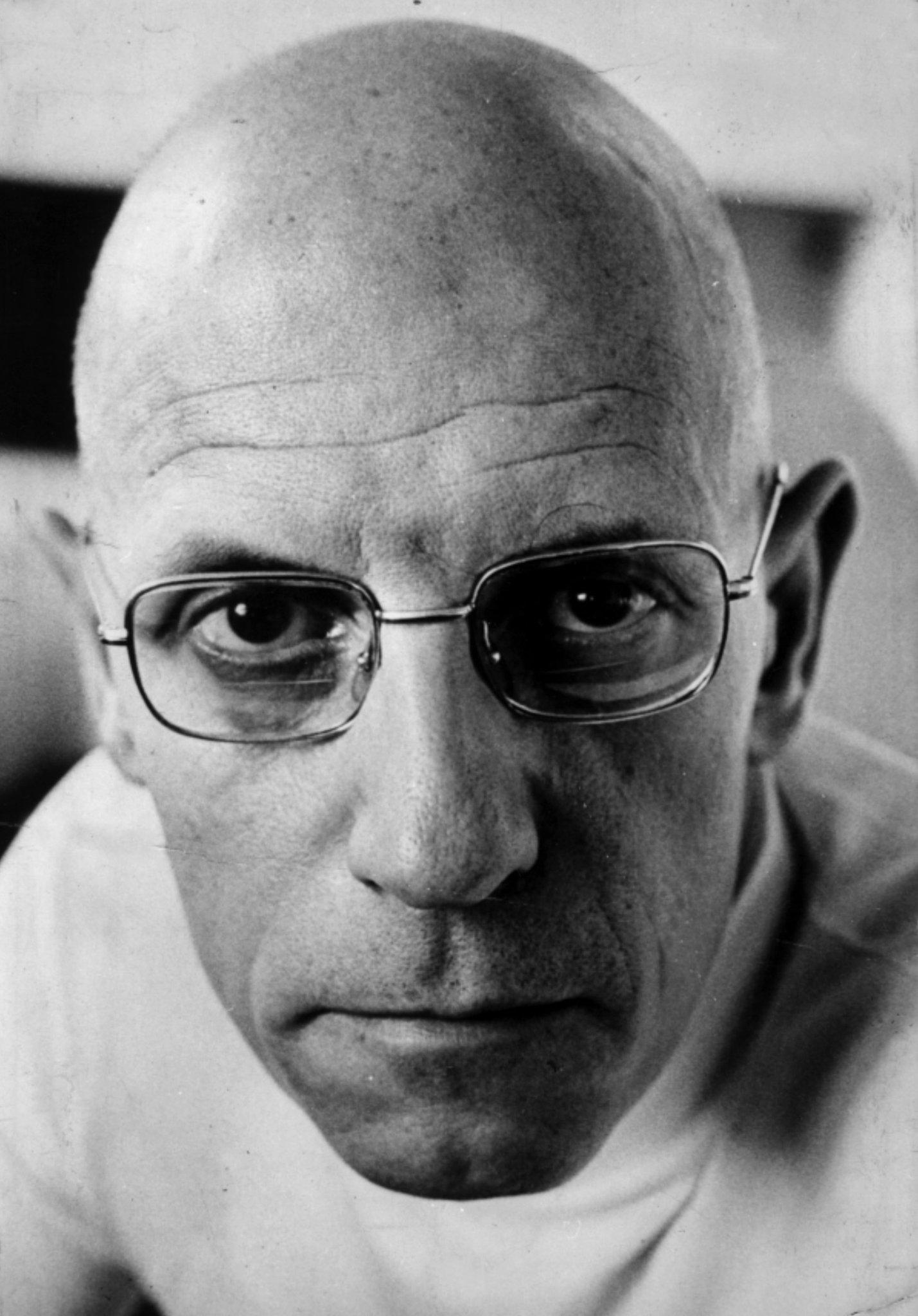
Michel Foucault (1926–1984) was a French philosopher and historian who trained in psychology before he became one of its sharpest critics. His main lesson for psychology is that the categories used to sort minds, such as sane and mad or normal and disordered, have histories. They carry power, and people learn to watch and judge themselves through them.
The argument here is that Foucault does not show diagnosis to be false or therapy to be a trick. He shows that every diagnosis is also an exercise of power, and that the most durable power is the kind people learn to turn on themselves. A therapist who takes that seriously can still diagnose and still help, while noticing when a client’s suffering includes an inner examiner whose standards came from somewhere else.
A philosopher who started on the psychiatric ward
Foucault was born in Poitiers on October 15, 1926, and entered the École Normale Supérieure in Paris in 1946. The Stanford Encyclopedia of Philosophy describes him as a student who was “brilliant but psychologically tormented.”1 Biographical accounts report a suicide attempt in 1948, after which his father sent him to the psychiatrist Jean Delay at the Sainte-Anne hospital in Paris. He was a psychiatric patient before he was a critic of psychiatry.
He trained in psychology as much as philosophy, earning a licence in psychology from the Sorbonne in 1949 and a diploma in psychopathology in 1952.1 In the early 1950s he taught psychology at the École Normale and at Lille, and worked as an unofficial intern at Sainte-Anne, observing doctors with patients and helping in its electroencephalography laboratory.
In 1954 he wrote a long introduction to Jacqueline Verdeaux’s French translation of Dream and Existence by the Swiss psychiatrist Ludwig Binswanger, the founder of existential analysis, and published a short book, Maladie mentale et personnalité. He revised that book heavily in 1962; it appeared in English as Mental Illness and Psychology.2 A longer study of Binswanger and existential analysis was published posthumously; the English edition appeared in 2025.3 The young Foucault was immersed in the same Heidegger-influenced psychiatry that produced Medard Boss’s Daseinsanalysis, before he turned to how psychiatry got its authority.
After five years as a cultural diplomat in Uppsala, Warsaw and Hamburg, he taught at Clermont-Ferrand, Tunis and Vincennes. In 1969 he was elected to the Collège de France, where he held a chair in the History of Systems of Thought until his death.1 In 1971 he helped found the Groupe d’information sur les prisons to expose prison conditions. He died of complications of AIDS on June 25, 1984, at the Salpêtrière in Paris, a hospital he had written about in his history of madness.
History of Madness: how reason and unreason were divided
Foucault’s doctoral thesis, published in 1961 as Folie et déraison, is the book most English readers know as Madness and Civilization. That English title belongs to the 1965 translation of a heavily abridged 1964 French paperback. The full text did not appear in English until 2006, as History of Madness.4
The book traces three moments. In the Renaissance, madness still circulated in public life; Foucault’s emblem is the ship of fools, and the fool could speak truths the sane avoided. In the seventeenth century came what he called the Great Confinement. In 1656, at the direction of Louis XIV, the Salpêtrière was turned into part of the new Hôpital Général of Paris, and institutions like it housed the mad alongside the poor, vagrants and prostitutes. The reforms of Philippe Pinel in France and the Tukes in England were usually told as a liberation from chains. Foucault argued that they swapped iron for a moral captivity managed by doctors, in which the patient was meant to internalize guilt and self-control.4 The 1961 preface calls the language of psychiatry “a monologue by reason about madness.”
Some of the liberation story was myth. The legend has Pinel single-handedly striking the chains off the insane at Bicêtre, and Tony Robert-Fleury’s 1876 painting fixed the heroic image of him unchaining madwomen at the Salpêtrière. At Bicêtre, though, it was the ward’s “governor,” Jean-Baptiste Pussin, who removed the iron shackles in 1797, after Pinel had left; Pinel removed chains at the Salpêtrière later, once Pussin had joined him there. In his 1973–74 lectures, Psychiatric Power, Foucault described the early asylum cure as a contest between the doctor’s will and the patient’s, waged through isolation, interrogation, cold showers, compulsory work and moral lectures.5
Historians are divided. Roy Porter called it the most penetrating work ever written on the history of madness. José Guilherme Merquior faulted its selective evidence and its neglect of cruelty toward the mad in the periods Foucault romanticized, and at Uppsala the historian Sten Lindroth had refused the thesis as speculative. The fair reading is that the book is better at asking who gets to define reason than at counting asylum beds. The same question runs through a post on how the content of madness tracks the culture around it.
Discipline and Punish: the examination and the watcher within
Discipline and Punish (1975; English translation by Alan Sheridan, 1977) opens with two scenes. The first is the public torture and execution of Robert-François Damiens, convicted of attempting to kill the king in the mid-eighteenth century. The second is a nineteenth-century prison timetable, with every hour of the inmate’s day accounted for.6 Punishment did not simply become kinder. Power changed targets, from the body as spectacle to the daily conduct and inner life of the person.
Foucault identified three techniques of modern discipline: hierarchical observation, normalizing judgment and the examination.1 Normalizing judgment ranks people against a norm rather than simply judging an act legal or illegal. The examination joins observation and judgment. In a school or a hospital it draws out the truth about a person and places them in a “field of documentation” of charts, grades and records. It turns the individual into a “case,” in both senses: a scientific example and an object of care.
Foucault’s model was Jeremy Bentham’s Panopticon, a prison in which one unseen inspector could watch every cell; Bentham thought it suited hospitals, schools and asylums too. Inmates cannot know when they are watched, so they behave as though they always are. The guard moves inside. Reversing Plato’s line that the body is the prison of the soul, Foucault wrote that “the soul is the prison of the body.”6 For a clinician this is the most usable part of Foucault, because much of what clients call “my inner critic” works the same way. It grades, compares, keeps records and expects to be seen.
Confession, sexuality and the talking cure
The first volume of The History of Sexuality (1976; English 1978) attacks what Foucault called the repressive hypothesis: the belief that modern societies silenced sex and that talking about it freely is liberation. From the seventeenth century on there was a “veritable discursive explosion” of talk about sex, channeled through an “authorized vocabulary” that set where, when and with whom it could be discussed.7 As the Stanford Encyclopedia puts it, the religious technique of confession was secularized: one no longer confesses desire to a priest, but to “a doctor, a therapist, a psychologist, or a psychiatrist.”1 He counted psychoanalysis among the modern sciences of sexuality.
Therapists should sit with that critique. Telling the truth about yourself to an authority who interprets it is not automatically freedom, and it can tie a person more tightly to the authority’s categories. Foucault did not claim talking never helps. He claimed that the setting, the listener’s power to classify and the norms behind the questions shape what can be said and what it comes to mean.
In his last years he turned to the ancient “care of the self.” His 1981–82 lectures, The Hermeneutics of the Subject, and his 1982 seminar at the University of Vermont, published as Technologies of the Self, examine practices such as the Stoic evening review of one’s actions against one’s values.89 These are disciplines a person chooses, not ones imposed from a watchtower, and they belong to the lineage of Marcus Aurelius’s private notebooks and their echoes in psychotherapy. His last lecture courses took up parrhesia, frank speech at personal risk. It is often reduced to “speaking truth to power,” but frank speech also needs a listener willing to hear it, which is not a bad description of a working therapy.
Diagnosis is knowledge and power at once
Foucault’s “power/knowledge” is often read as “knowledge is just power in disguise.” The actual claim is that the authority to classify people and the knowledge produced about them grow together. A diagnosis is a real attempt to describe suffering and also a decision, with consequences, that the patient did not make. The philosopher Ian Hacking, influenced by Foucault, named one mechanism, the looping effect of human kinds: people who are classified react to the classification, and their changed behavior then changes the category.10
Research on stigma gives this some empirical weight, with caveats. A 2010 systematic review and meta-analysis by Livingston and Boyd (127 articles reviewed, 45 meta-analyzed) found a robust link between internalized stigma and lower hope, self-esteem and empowerment. Internalized stigma was also associated with more severe symptoms and poorer treatment adherence.11 The authors flagged the lack of longitudinal research, so the direction of cause is not settled. A 2013 meta-analysis of 28 experiments by Kvaale, Haslam and Gottdiener found that explaining psychological problems as biogenetic reduced blame, but increased pessimism about recovery and, less certainly, perceptions of dangerousness.12 These were mostly experiments on how people judge someone else, so they speak to public attitudes more than self-image, but they show that the frame given to a problem changes what others expect of the person who has it.
None of this makes diagnosis the enemy. A 2018 systematic review of 78 qualitative papers, covering 2,228 service users, clinicians and carers, examined why receiving a diagnosis is described in both positive and negative terms. Themes that shaped the experience included how the diagnosis was disclosed and explained, timing, collaboration, stigma and whether it was useful for recovery. The authors recommended an individualized, collaborative approach.13 For the longer institutional story, see this critical history of the DSM.
Foucault is often filed with the anti-psychiatry movement. He associated with several of its figures but said most of them misunderstood his work, and his project was historical analysis, not a program to abolish psychiatry. The clinical rebellion is better represented by R. D. Laing’s rethinking of madness and sanity, which makes a different argument.
Narrative therapy: Foucault in the consulting room
The most direct clinical use of Foucault is narrative therapy, developed in the 1970s and 1980s by the Australian social worker Michael White and the New Zealand therapist David Epston. Foucault was one of their acknowledged influences, and their 1990 book Narrative Means to Therapeutic Ends draws on his account of power and knowledge.14 White’s best-known technique is externalizing the problem, often summarized as “the person is not the problem, the problem is the problem.” Narrative therapists look for “unique outcomes,” moments when the problem did not run the show, and help clients re-author a dominant, problem-saturated story. They also check with clients about the effects of the therapist’s own assumptions, which turns Foucault’s power analysis on the therapy itself. Its roots in family therapy are traced in this short history of family therapy.
The evidence base is thinner than its influence. A 2000 review described research on narrative therapy’s effectiveness as in its infancy.15 Since then, a controlled trial with 63 adults with moderate depression found that both narrative therapy and CBT reduced symptoms. CBT did better on the Beck Depression Inventory, and the two did not differ on a broader outcome measure.16 One modest trial does not make narrative therapy an established treatment for depression, and it should not be sold as one.
What this looks like in therapy
Foucault offers no treatment protocol, and a therapist who uses him as one ends up lecturing clients about power. His value is a set of questions carried into ordinary clinical work.
Whose voice is the critic using? When someone describes a relentless inner judge, it helps to ask what it measures and where it learned the scale: grades, weigh-ins, sales numbers, a church’s sense of purity, a family’s idea of a “real man.” Some standards a person keeps after a close look. Others turn out to be the watchtower, still running.
Diagnosis as a working tool, not an identity. A label can bring relief, access to care and a map. It can also harden into a fixed self-description. In practice that means explaining what a diagnosis does and does not claim, holding it as a hypothesis open to revision, and noticing when “I have panic attacks” has become “I am broken.” Questions about medication belong with a prescriber; Foucault’s critique is not a reason to stop a treatment that is helping.
The therapy’s own power. Treatment plans, progress notes, billing codes and the therapist’s private picture of a “healthy” life all carry norms. Every model of therapy smuggles in a picture of the good life, as discussed in this look at the moral assumptions inside different therapies. Naming them openly gives the client room to disagree.
The self as a project to optimize. In his 1978–79 lectures, The Birth of Biopolitics, Foucault analyzed neoliberalism as a way of governing that produces a particular kind of subject. Examining Gary Becker’s theory of human capital, he described a person who treats every choice as a calculated investment in themselves.117 Many anxious, high-functioning clients live this way: rest feels like waste, feelings are inefficiencies, and therapy risks becoming one more self-improvement metric. Sometimes the useful move is noticing that a client is running a performance review on their own grief.
Misreadings and fair criticisms
Foucault was not a relativist who thought nothing is true; he thought truth is produced through practices that have histories. Still, his critics have a point. Jürgen Habermas called him a “crypto-normativist,” relying on the Enlightenment values he attacked, and Nancy Fraser argued that by refusing to ground his critique in norms such as freedom and justice, he could not say what a better arrangement would be. For a therapist this matters: unmasking norms is not enough, because clients need some account of a better life, and the therapist has to be honest about bringing one.
The documented scholarly argument about Foucault and the free market concerns Foucault himself. In Foucault and Neoliberalism, Daniel Zamora and Michael Behrent collected essays asking whether Foucault himself was drawn to neoliberal ideas in his 1979 lectures.18 Other scholars read the lectures as critical analysis. The question is unsettled.
For readers in the Birmingham area who recognize themselves in the inner examiner, the work Foucault points toward is close to what existential therapy at Taproot tries to do: take suffering seriously, use diagnosis carefully and leave room for a life that is chosen rather than just monitored. If that sounds like the work you need, you can reach out through our contact page.
References
- Gutting, G., & Oksala, J. (2026). Michel Foucault (substantive revision of April 21, 2026). In The Stanford Encyclopedia of Philosophy. Stanford University. https://plato.stanford.edu/entries/foucault/
- Foucault, M. (1976). Mental illness and psychology (A. Sheridan, Trans.). Harper & Row. (Original work published 1962; first version published 1954 as Maladie mentale et personnalité)
- Foucault, M. (2025). Binswanger and existential analysis (E. Basso, Ed.; M. S. McDonough, Trans.). Columbia University Press. https://doi.org/10.7312/fouc19500
- Foucault, M. (2006). History of madness (J. Khalfa, Ed.; J. Murphy & J. Khalfa, Trans.). Routledge. (Original work published 1961)
- Foucault, M. (2006). Psychiatric power: Lectures at the Collège de France, 1973–1974 (J. Lagrange, Ed.; G. Burchell, Trans.). Palgrave Macmillan. https://doi.org/10.1057/9780230245068
- Foucault, M. (1977). Discipline and punish: The birth of the prison (A. Sheridan, Trans.). Pantheon. (Original work published 1975)
- Foucault, M. (1978). The history of sexuality, Volume 1: An introduction (R. Hurley, Trans.). Pantheon. (Original work published 1976)
- Foucault, M. (2005). The hermeneutics of the subject: Lectures at the Collège de France, 1981–1982 (F. Gros, Ed.; G. Burchell, Trans.). Palgrave Macmillan. https://doi.org/10.1007/978-1-137-09483-4
- Martin, L. H., Gutman, H., & Hutton, P. H. (Eds.). (1988). Technologies of the self: A seminar with Michel Foucault. Tavistock.
- Hacking, I. (1996). The looping effects of human kinds. In D. Sperber, D. Premack, & A. J. Premack (Eds.), Causal cognition: A multidisciplinary debate (pp. 351–383). Oxford University Press. https://doi.org/10.1093/acprof:oso/9780198524021.003.0012
- Livingston, J. D., & Boyd, J. E. (2010). Correlates and consequences of internalized stigma for people living with mental illness: A systematic review and meta-analysis. Social Science & Medicine, 71(12), 2150–2161. https://doi.org/10.1016/j.socscimed.2010.09.030
- Kvaale, E. P., Haslam, N., & Gottdiener, W. H. (2013). The “side effects” of medicalization: A meta-analytic review of how biogenetic explanations affect stigma. Clinical Psychology Review, 33(6), 782–794. https://doi.org/10.1016/j.cpr.2013.06.002
- Perkins, A., Ridler, J., Browes, D., Peryer, G., Notley, C., & Hackmann, C. (2018). Experiencing mental health diagnosis: A systematic review of service user, clinician, and carer perspectives across clinical settings. The Lancet Psychiatry, 5(9), 747–764. https://doi.org/10.1016/S2215-0366(18)30095-6
- White, M., & Epston, D. (1990). Narrative means to therapeutic ends. W. W. Norton.
- Etchison, M., & Kleist, D. M. (2000). Review of narrative therapy: Research and utility. The Family Journal, 8(1), 61–66. https://doi.org/10.1177/1066480700081009
- Lopes, R. T., Gonçalves, M. M., Machado, P. P. P., Sinai, D., Bento, T., & Salgado, J. (2014). Narrative therapy vs. cognitive-behavioral therapy for moderate depression: Empirical evidence from a controlled clinical trial. Psychotherapy Research, 24(6), 662–674. https://doi.org/10.1080/10503307.2013.874052
- Foucault, M. (2008). The birth of biopolitics: Lectures at the Collège de France, 1978–1979 (M. Senellart, Ed.; G. Burchell, Trans.). Palgrave Macmillan.
- Zamora, D., & Behrent, M. C. (Eds.). (2016). Foucault and neoliberalism. Polity.



















0 Comments