
Updated November 2026 · By Joel Blackstock, LICSW-S
Care of the Soul (HarperCollins, 1992) is Thomas Moore’s case for tending psychological life instead of trying to fix it. Moore is a former Catholic monk who became a psychotherapist shaped by C. G. Jung and James Hillman. He reads symptoms, depression among them, as the soul asking for attention rather than as defects to remove. The book reached number one on the New York Times bestseller list.1, 2
The part that has lasted is smaller and more useful than the book’s reputation. A symptom carries information about how a life is being lived, and asking what it wants belongs inside treatment, not in place of it. Moore is right that a depression can be listened to as well as suppressed. He is easy to misread as saying it should only be listened to.
Who Thomas Moore is
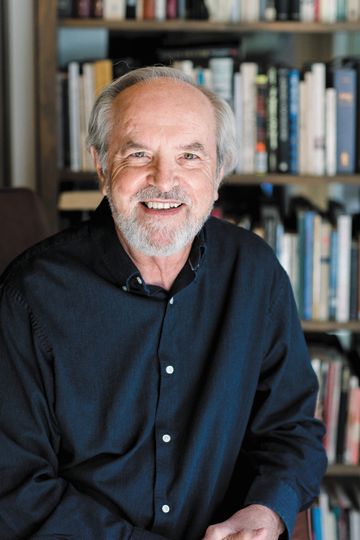
Thomas Moore was born on October 8, 1940, in Detroit, into an Irish Catholic family. At 13 he left home for the minor seminary of the Servites, the Catholic religious order formally called the Order of Servants of Mary.3 “I stayed with that community studying to be a priest for about 12 to 13 years,” he told Christianity Today in 2002, and “I decided to leave just before I was to be ordained a priest.”2 His own biography still describes him as a Catholic monk in his youth.4
He studied music composition, then took a doctorate in religious studies at Syracuse University, chosen because he could study religion there “as not related to any particular church or tradition.”2, 4 After a year teaching psychology he took a post in religion at Southern Methodist University in Dallas, where his courses leaned on mythology. The university eventually let him go. “They invited me in to say that we don’t want you anymore,” he said, and he took it “as a clear signal to move on.”2 He also practiced as a psychotherapist, first in Dallas and later in New England,3 and a collection of his talks applying archetypal psychology, Rituals of the Imagination, was published by the Dallas Institute of Humanities and Culture.5 He has lived in New Hampshire for about thirty years with his wife, the painter Joan Hanley.4
| Year | Event |
|---|---|
| 1940 | Born October 8 in Detroit, Michigan |
| Age 13 | Enters the Servite minor seminary; stays about 12 to 13 years and leaves shortly before ordination |
| 1982 | The Planets Within: Marsilio Ficino’s Astrological Psychology (Bucknell University Press) |
| 1989 | Edits A Blue Fire, selected writings of James Hillman (Harper & Row) |
| 1992 | Care of the Soul (HarperCollins) |
| 1994 | Soul Mates, on love and relationship |
| 1996 | The Re-Enchantment of Everyday Life (HarperCollins) |
| 2004 | Dark Nights of the Soul (Gotham Books) |
| 2021 | Soul Therapy: The Art and Craft of Caring Conversations, written for practitioners |
An earlier version of this page gave exact dates for his “monastery” years and an exact count of weeks on the bestseller list. Neither could be confirmed. Moore’s own site says the book was on the New York Times list “for almost a year.”6
The Hillman lineage: soul as a way of seeing
Moore’s psychology comes, openly, from James Hillman. Hillman studied at and later guided studies for the C. G. Jung Institute in Zurich, and in the early 1970s he started the movement he called archetypal psychology. His Re-Visioning Psychology (1975) argued that the psyche is better described as a crowd of images and figures than as one ego marching toward wholeness. It also argued that “pathologizing,” the psyche’s habit of producing symptoms, fantasies and distortions, is one of the ways the soul speaks rather than simply a malfunction.7 Moore’s site calls Hillman “his close friend for four decades,” and in 1989 Moore edited A Blue Fire, an anthology of Hillman’s writing assembled “in collaboration with the author.”6, 8 Our overview of James Hillman’s archetypal psychology covers the larger project.
Moore came to that project through the Renaissance. His first book, The Planets Within (1982), is a study of Marsilio Ficino, the fifteenth-century Florentine priest, physician and astrologer who made the first Latin translation of Plato’s complete surviving works.9 Its subtitle calls Ficino’s system an “astrological psychology,” and that is how Moore reads it: the planets as names for temperaments and moods, with Saturn standing for the heavy, inward temperament that Renaissance medicine called melancholy. Read through Hillman, that vocabulary lets melancholy count as a mode of the soul with its own needs, not only a shortage of good cheer.
This polytheistic picture, many figures in the psyche instead of one ruler, runs through the whole circle around Hillman. Ginette Paris carried it into her own readings of the Greek gods, including Pagan Meditations (1986). In a more classically Jungian key, Jean Shinoda Bolen’s Goddesses in Everywoman (1984) took a similar map of Greek figures to a mass readership. For the modern revival of planetary language as a way of reading history, see our piece on Richard Tarnas and cultural history through astrology.
Care versus cure: what the book argues
Moore’s title reaches back to an old phrase. For centuries Christian pastors spoke of the “cure of souls,” cura animarum, where “cure” kept its Latin sense of care and responsibility rather than repair. The historian John T. McNeill traced that tradition in A History of the Cure of Souls (1951).10 Moore’s move was to pull the two meanings apart. Modern psychology, in his telling, inherited the medical sense of cure: a problem is diagnosed and removed. He wanted the older sense back. A line from the book that he uses on his own site puts it plainly: “Care of the soul is not primarily a method of problem-solving. Its goal is not to make life problem-free, but to give ordinary life the depth and value that come with soulfulness.”6
When an interviewer later summed up the book as a move “from cure to care” and “from heroic to foolish,” Moore called that a good summary and added: “From trying to fix things, to trying to be an improved version of yourself, I think all of that is narcissistic.”2 Moore was not offering a softer self-improvement plan. He distrusted the self-improvement project itself, because it keeps a person staring at the self instead of living.
Four years later he pushed the argument outward. The word “re-enchantment” makes sense against the sociologist Max Weber, whose 1917 lecture “Science as a Vocation” described modern life as disenchanted. Moore describes The Re-Enchantment of Everyday Life (1996) as being about “the return of imagination, mystery and a sense of the symbolic and poetic to the natural and manufactured world,” and as “very particular and concrete” about how to do that in a secular age.5, 11 The psychological claim underneath is that surroundings and routines are part of inner life, not scenery around it.
Depression, melancholy and the dark night
The part of Moore’s work that matters most clinically is what he says about depression. Across his books, and most directly in Dark Nights of the Soul (2004), he treats low mood as something with content, not only a deficit. That book takes its title from the sixteenth-century Spanish mystic John of the Cross, whose “dark night” names a stage of spiritual purification. Moore describes the book as a way to talk about “depression and difficult moments in life from the perspective of the soul,” and it treats a dark night as a rite of passage: an ordeal that changes a person, not a malfunction to clear.5, 12
There is a real scientific conversation behind this intuition. Evolutionary psychiatrists have asked why a capacity for low mood exists at all. Randolph Nesse surveyed the functions proposed for low mood, among them signaling a need for help, yielding in a hierarchy conflict, and letting go of goals that cannot be reached.13 Paul Andrews and J. Anderson Thomson went further and proposed that depression evolved to hold attention on a hard, complex problem until it has been worked through.14 These are hypotheses, not settled findings. But if either is even partly right, Moore’s habit of asking what a depression is about has some biological footing as well as a poetic one.
The same literature sets the limits. In a 2016 commentary on these adaptive accounts, Carl Bergstrom and Frazer Meacham wrote that some “may be reasonable hypotheses for the evolutionary role of ordinary low mood, but none seem adequate to explain the severe and prolonged symptoms associated with clinical depression.” They describe clinical depression as a useful system gone out of regulation, sometimes painful enough to drive people to attempt suicide.15 Allan Horwitz and Jerome Wakefield made a related argument from the other side: diagnostic criteria can sweep normal sorrow, the kind that follows a loss and fades, into the category of disorder.16
Together these give Moore’s view a fair shape. In clinical experience, grief, disappointment, the flatness after a chapter of life ends and the slow melancholy of midlife often do carry meaning and reward attention. Major depression is a different condition, and it responds to treatment. A 2020 network meta-analysis of 101 randomized trials found psychotherapy and antidepressant medication about equally effective for adult depression, with the combination more effective than either alone.17 Questions about medication belong with a prescriber, and nothing in Moore requires refusing it. Our page on depression treatment in Hoover describes how we work. If low mood includes thoughts of suicide, it is not a dark night to wait out: call or text 988, or use our list of crisis resources in Birmingham.
There is also a wrong way to stay with a depression. Susan Nolen-Hoeksema’s research program found that rumination, the repetitive, passive circling over one’s own distress, makes depression worse, impairs problem solving and wears down social support.18 Paul Trapnell and Jennifer Campbell separated two motivationally distinct forms of self-attention, anxious rumination and curious reflection, and argued that a scale blending the two may explain an odd finding: people high in self-focus report more accurate self-knowledge and also more distress.19 Moore’s “care” only works as reflection. Listening to a depression means asking it concrete questions: when it started, what it stops a person from doing, what it seems to protect. It does not mean replaying the same self-accusations at three in the morning.
What Moore did not say: soul loss, anam cara and trauma
An earlier version of this page credited Moore with ideas that are not his, and they circulate widely. “Soul loss” and “soul retrieval,” the idea that trauma drives a person’s vital essence out of the body and a practitioner calls it back, come from the study of shamanism and from neo-shamanic practice, not from Moore’s archetypal psychology. The Irish phrase anam cara, “soul friend,” was popularized by the Irish writer John O’Donohue in his 1997 book Anam Cara, not by Moore.20 And Dark Nights of the Soul, subtitled “a guide to finding your way through life’s ordeals,” is about ordeals in general, including, in Moore’s words, “hopelessness and anxiety, trouble and loss.” It is not a model for treating trauma.
That distinction matters for anyone with a trauma history. Advice to stay in the darkness until it has done its work can suit grief. For posttraumatic stress, waiting it out is not a treatment. When the International Society for Traumatic Stress Studies surveyed 50 trauma experts, 84 percent endorsed a phase-based or sequenced approach to complex PTSD, in which stabilization and emotion-regulation skills come before work on traumatic memories.21 That is expert opinion rather than trial evidence, and it is disputed. A 2016 critical analysis by Ad de Jongh and colleagues, among them Patricia Resick and Edna Foa, found no rigorous evidence that a separate stabilization phase is needed and warned that requiring one can delay effective trauma-focused treatment.22 The argument is about how to sequence structured treatment, not about whether trauma should be waited out. Moore’s dark night is a frame for meaning, not a plan for trauma care.
What this looks like in therapy
Most of what Moore offers a clinician is a stance, not a technique. The first place it shows is curiosity about a symptom’s timing and target. Anxiety that spikes every Sunday evening, insomnia that began the month a marriage went quiet, a low mood that lifts on vacation and returns at the office: depth-oriented therapists treat these as clues before they treat them as targets. The symptom still gets treated. But the question of what it is responding to stays open, because sometimes the honest answer is a job, a marriage or a set of beliefs that no longer fits, and symptom control alone does not change that.
The second is restraint in the therapist. The Swiss Jungian analyst Adolf Guggenbühl-Craig wrote Power in the Helping Professions (1971), later reissued in a series of classics in archetypal psychology, about the shadow side of the wish to help: the way a helper’s need to fix can quietly take power from the person being helped.23 (Our profile of Adolf Guggenbühl-Craig covers his wider work.) Moore makes the same point from the client’s side. A therapist who is too eager to remove a symptom can miss what it carries, and can teach the client that their inner life is mainly a problem to be managed.
The third is room for spiritual language without forcing it. Moore writes for people who think in terms of soul, and some clients do. A meta-analysis of 97 outcome studies found that therapies adapted to clients’ religious or spiritual beliefs reduced distress about as well as standard versions of the same therapy, and improved spiritual well-being more.24 Others find the word “soul” off-putting, and depth work does not need it. James Hollis makes a similar case for meaning in suffering in Swamplands of the Soul (1996), a book about the depressions, griefs and fears people would rather avoid; see our piece on James Hollis and the psychodynamics of the self.25
Moore’s work is not a tested treatment protocol, and it would be wrong to present it as one. Its closest clinical relatives have some support. A 2015 meta-analysis of 54 studies found short-term psychodynamic therapy effective for depression, with no significant difference from other psychotherapies.26 Christian Roesler’s review of Jungian psychotherapy outcome research reports lasting improvement, but the studies are mostly naturalistic designs from Germany and Switzerland without randomized control groups, which limits how firmly the gains can be credited to the Jungian method itself.27 Moore turned to clinicians directly in Soul Therapy (2021), which his site describes as teaching “therapists, psychiatrists, ministers, spiritual directors, and others” how to offer soul care.5, 28 At Taproot we use these ideas inside Jungian depth therapy, alongside approaches with stronger trial evidence, not as a replacement for them.
If a symptom has started to feel like a message you cannot read, such as a low mood that keeps returning or an anxiety tied to a life that no longer fits, a conversation with a therapist is a reasonable next step. You can reach Taproot Therapy Collective in Hoover through our contact page.
References
- Moore, T. (1992). Care of the soul: A guide for cultivating depth and sacredness in everyday life. HarperCollins.
- Christianity Today. (2002, July 1). Thomas Moore (Interview). https://www.christianitytoday.com/2002/07/thomas-moore/
- Hay House. (n.d.). Thomas Moore (author biography). Retrieved November 8, 2026, from https://www.hayhouse.com/authorbio/thomas-moore
- Moore, T. (n.d.-a). About Thomas. Retrieved November 8, 2026, from https://www.thomasmooresoul.com/about/
- Moore, T. (n.d.-b). Books. Retrieved November 8, 2026, from https://www.thomasmooresoul.com/books
- Moore, T. (n.d.-c). Thomas Moore (official website home page). Retrieved November 8, 2026, from https://www.thomasmooresoul.com/
- Hillman, J. (1975). Re-visioning psychology. Harper & Row.
- Hillman, J. (1989). A blue fire: Selected writings (T. Moore, Ed.). Harper & Row.
- Moore, T. (1982). The planets within: Marsilio Ficino’s astrological psychology. Bucknell University Press.
- McNeill, J. T. (1951). A history of the cure of souls. Harper.
- Moore, T. (1996). The re-enchantment of everyday life. HarperCollins.
- Moore, T. (2004). Dark nights of the soul: A guide to finding your way through life’s ordeals. Gotham Books.
- Nesse, R. M. (2000). Is depression an adaptation? Archives of General Psychiatry, 57(1), 14–20. https://doi.org/10.1001/archpsyc.57.1.14
- Andrews, P. W., & Thomson, J. A., Jr. (2009). The bright side of being blue: Depression as an adaptation for analyzing complex problems. Psychological Review, 116(3), 620–654. https://doi.org/10.1037/a0016242
- Bergstrom, C. T., & Meacham, F. (2016). Depression and anxiety: Maladaptive byproducts of adaptive mechanisms. Evolution, Medicine, and Public Health, 2016(1), 214–218. https://doi.org/10.1093/emph/eow019
- Horwitz, A. V., & Wakefield, J. C. (2007). The loss of sadness: How psychiatry transformed normal sorrow into depressive disorder. Oxford University Press.
- Cuijpers, P., Noma, H., Karyotaki, E., Vinkers, C. H., Cipriani, A., & Furukawa, T. A. (2020). A network meta-analysis of the effects of psychotherapies, pharmacotherapies and their combination in the treatment of adult depression. World Psychiatry, 19(1), 92–107. https://doi.org/10.1002/wps.20701
- Nolen-Hoeksema, S., Wisco, B. E., & Lyubomirsky, S. (2008). Rethinking rumination. Perspectives on Psychological Science, 3(5), 400–424. https://doi.org/10.1111/j.1745-6924.2008.00088.x
- Trapnell, P. D., & Campbell, J. D. (1999). Private self-consciousness and the five-factor model of personality: Distinguishing rumination from reflection. Journal of Personality and Social Psychology, 76(2), 284–304. https://doi.org/10.1037/0022-3514.76.2.284
- O’Donohue, J. (1997). Anam cara. Bantam Press.
- Cloitre, M., Courtois, C. A., Charuvastra, A., Carapezza, R., Stolbach, B. C., & Green, B. L. (2011). Treatment of complex PTSD: Results of the ISTSS expert clinician survey on best practices. Journal of Traumatic Stress, 24(6), 615–627. https://doi.org/10.1002/jts.20697
- De Jongh, A., Resick, P. A., Zoellner, L. A., van Minnen, A., Lee, C. W., Monson, C. M., Foa, E. B., Wheeler, K., ten Broeke, E., Feeny, N., Rauch, S. A. M., Chard, K. M., Mueser, K. T., Sloan, D. M., van der Gaag, M., Rothbaum, B. O., Neuner, F., de Roos, C., Hehenkamp, L. M. J., . . . Bicanic, I. A. E. (2016). Critical analysis of the current treatment guidelines for complex PTSD in adults. Depression and Anxiety, 33(5), 359–369. https://doi.org/10.1002/da.22469
- Guggenbühl-Craig, A. (1971). Power in the helping professions. Spring Publications.
- Captari, L. E., Hook, J. N., Hoyt, W., Davis, D. E., McElroy-Heltzel, S. E., & Worthington, E. L., Jr. (2018). Integrating clients’ religion and spirituality within psychotherapy: A comprehensive meta-analysis. Journal of Clinical Psychology, 74(11), 1938–1951. https://doi.org/10.1002/jclp.22681
- Hollis, J. (1996). Swamplands of the soul: New life in dismal places. Inner City Books.
- Driessen, E., Hegelmaier, L. M., Abbass, A. A., Barber, J. P., Dekker, J. J. M., Van, H. L., Jansma, E. P., & Cuijpers, P. (2015). The efficacy of short-term psychodynamic psychotherapy for depression: A meta-analysis update. Clinical Psychology Review, 42, 1–15. https://doi.org/10.1016/j.cpr.2015.07.004
- Roesler, C. (2013). Evidence for the effectiveness of Jungian psychotherapy: A review of empirical studies. Behavioral Sciences, 3(4), 562–575. https://doi.org/10.3390/bs3040562
- Moore, T. (2021). Soul therapy: The art and craft of caring conversations. HarperCollins.












0 Comments