

Somatic Experiencing (SE) is a body-based trauma therapy developed by Peter Levine. Instead of retelling what happened in detail, you notice sensations such as a tight chest or shaky hands in small, tolerable doses, then return to something steady, while a trained therapist sets the pace. At Taproot Therapy Collective we offer it at our Hoover office, minutes from Birmingham, along with somatic trauma work by teletherapy across Alabama.
This page is our main guide to what SE is, and its argument is simple. What SE does in the room, slowing attention down, approaching distress a little at a time and returning to steadiness in between, is a careful and indirect version of the graded exposure that runs through most trauma treatment. The explanation usually attached to it, that trauma is survival energy a wild animal would shake off and people hold onto, is the weakest part of the package. The method deserves to be taken seriously on its own terms. The research behind it is promising but still thin.
What Somatic Experiencing is and where it came from
Levine’s background is in stress physiology. His 1977 doctoral dissertation at the University of California, Berkeley, was titled Accumulated Stress, Reserve Capacity and Disease, and in 1986 he wrote the chapter on stress for Psychophysiology: Systems, Processes, and Applications, a Guilford volume co-edited by Stephen Porges.1 He brought the method to a general audience in Waking the Tiger (1997), written with Ann Frederick, which starts from a question: why do wild animals, threatened routinely, so rarely seem traumatized?2 In an Unspoken Voice (2010) is his fuller statement of the theory.3 A 2021 review of SE research still cites his account of a client he calls Nancy as a case report illustrating the method.4
Somatic Experiencing is a trademarked method with its own training organization, named in a 2015 paper Levine co-wrote as the Somatic Experiencing Trauma Institute and now called Somatic Experiencing International. Clinicians who finish the professional training, a course of about three years, use the credential SEP, for Somatic Experiencing Practitioner.1, 4 Trainees include psychologists, social workers, physicians, physical therapists and other body-oriented practitioners.4 The credential is not a license. It tells you about someone’s training in this one method, not about their training as a clinician.
The core methods: tracking, resourcing, titration and pendulation
The clearest technical description of SE is a 2015 paper in Frontiers in Psychology by Peter Payne, Levine and Mardi Crane-Godreau. It illustrates the method with a composite case: a 43-year-old man who came close to being killed when a tractor-trailer lost control ahead of him on an interstate, and who afterward had panic attacks, irritability, cold hands and a knot in his stomach. The authors say plainly that the composite is an illustration, not evidence for their hypotheses.1 The vocabulary it lays out is what you will hear in an SE session.
- Tracking. The therapist keeps asking what you notice in your body right now, and watches breathing, color, posture and small movements. Attention to interoception (sensing inside the body) and proprioception (sensing position and movement) is the core of the method.
- Resourcing. Before going near the trauma, you find something that feels steady or good in the body: the support of the chair, warmth in the hands, a person or place you trust. SE treats this as a felt state, not a pleasant thought.
- Titration. The word is borrowed from chemistry. Payne and colleagues compare it to mixing a strong acid and a strong base drop by drop to avoid a violent reaction. In SE it means approaching distress in small pieces so you are not flooded.
- Pendulation. Attention moves back and forth between activation and steadiness. The authors set this against exposure therapies, which, they write, do not tend to avoid extremes of activation.
- Discharge and completion. SE holds that the body settles through heat, trembling, tears or a deeper breath, and that a defensive impulse cut off during the event, such as the urge to swerve or push away, can be finished in imagination and small movements.
Put those pieces together and SE looks less exotic than its marketing. Its developers would object to the next step: Payne, Levine and Crane-Godreau write that SE “is not a form of exposure therapy,” because it avoids direct and intense evocation of traumatic memories and approaches them “indirectly and very gradually.”1 But approaching a memory gradually is still approaching it. You do turn toward frightening material, in small doses, through body sensation rather than narrative, with a deliberate return to safety each time. A 2026 framework from researchers at Yale, UCSF and the VA’s National Center for PTSD maps trauma therapies by how directly, from implicit to explicit, and how heavily they expose a person to trauma material. It places SE on that map with prolonged exposure, cognitive processing therapy and EMDR, though it groups SE with other trauma-informed modalities rather than with the evidence-based trauma-focused therapies.5 Read that way, SE is a gentle, indirect form of exposure, and that is the most useful way to understand what it is doing. Our page on how Somatic Experiencing works in the brain and body goes further into the window of tolerance and the neuroscience.
What this looks like in therapy
The first session or two are mostly history and orientation: what happened, what your body does now, sleep, medications, medical conditions, and what you want to be different. A good SE therapist also explains the method early, because, as Payne and colleagues note, much of it runs against people’s assumptions about what they need to do to get free of a trauma.1
Once the work starts, sessions move slowly. You might begin with where you feel most settled, then touch the edge of the difficult material: not the crash, but the drive that afternoon; not the assault, but the sound of a door closing. The therapist asks what you notice and waits. If your breath shortens or your hands start to shake, you stay with that for a moment, then shift back to the resource. SE practitioners read heat, trembling, tears or a long exhale as signs that activation is passing.1 Nothing dramatic has to happen for a session to be useful.
The therapist is watching for two kinds of trouble. One is flooding, when the story takes over, the heart races and you are back inside the event. The other is shutdown, when you go foggy, numb, heavy or far away. Both mean slow down. Shutdown is easy to miss, because the collapsed state that looks like laziness from the outside can be a defensive response. Our guide to whether bed rotting is self-care or a trauma response covers that pattern.
In interviews with 30 participants in an Israeli randomized trial comparing SE with prolonged exposure for veterans with PTSD, SE participants described the process as learning a language they could use in other situations, while prolonged exposure participants described conquering exposures to win relief from symptoms. Both groups described bodily experience as prominent.6 One of the authors is paid to train SE therapists and another to train prolonged exposure therapists, which the paper discloses.
Some SE practitioners use touch, either your own hand or, with permission, the therapist’s. In the 2021 scoping review, both clients and practitioners named touch and resource-building as key ingredients.4 Touch should always be explained, offered and easy to decline. Over video it becomes self-touch, or simply feeling your back against the chair.
Sessions in the first randomized trial of SE ran 60 minutes, once a week, for 15 weeks.7, 4 That trial excluded complex trauma, so it gives a rough sense of a course of work for less complicated cases. People with long histories of childhood abuse or neglect usually need a slower and longer course, and SE is often one part of it alongside parts work, EMDR or other methods. Some people feel tired or stirred up after a session, which is worth telling your therapist. Questions about how long SE takes, whether it works online and whether it is just relaxation are collected in our Somatic Experiencing myths, misconceptions and FAQs.
The animal story and polyvagal theory: what holds up
SE’s origin story is about animals. Levine’s argument is that prey animals face threat constantly, freeze or flee, then shake, tremble and breathe their way back to normal, while people override that reset and stay stuck.2 It is a vivid image, and it is the part of SE with the least evidence behind it. In the 2015 paper, Levine and his co-authors write that Levine has observed these recovery behaviors over 45 years and that people who work with wild animals have confirmed them anecdotally, but that “we have not been able to find any significant treatment of these phenomena in the peer-reviewed literature.”1
One experiment points the other way. In a 2019 study, wild-caught black-capped chickadees held in outdoor aviaries and played predator calls for two days were still more fearful, with elevated activity in the amygdala and hippocampus, a week later. The groups were small, the birds were in captivity, and the authors say the effect still has to be tested in free-living animals, but they suggest that long-lasting effects of predator-induced fear are “the norm in nature.”8 One study in one species does not settle the question. It does show that the claim that wild animals simply shake fear off cannot be taken for granted.
The biology of defense underneath the story is sound. Kozlowska and colleagues describe a defense cascade: arousal, then fight or flight, then freezing, then tonic immobility or collapse when active defense has failed, each with its own pattern of activity in the amygdala, hypothalamus, periaqueductal gray and autonomic nuclei. Their review repeats the familiar contrast that animals generally return to baseline once danger passes while people often stay locked in the pattern,9 though the chickadee study suggests the animal half of that contrast may be overdrawn. Freezing is not a choice. In a study of 298 women seen at an emergency clinic after rape, 70 percent reported significant tonic immobility during the assault, and that response was associated with PTSD six months later.10 Many survivors blame themselves for not fighting. Knowing that immobility is an automatic defense can loosen that shame, which our piece on a somatic approach to the shame spiral takes up.
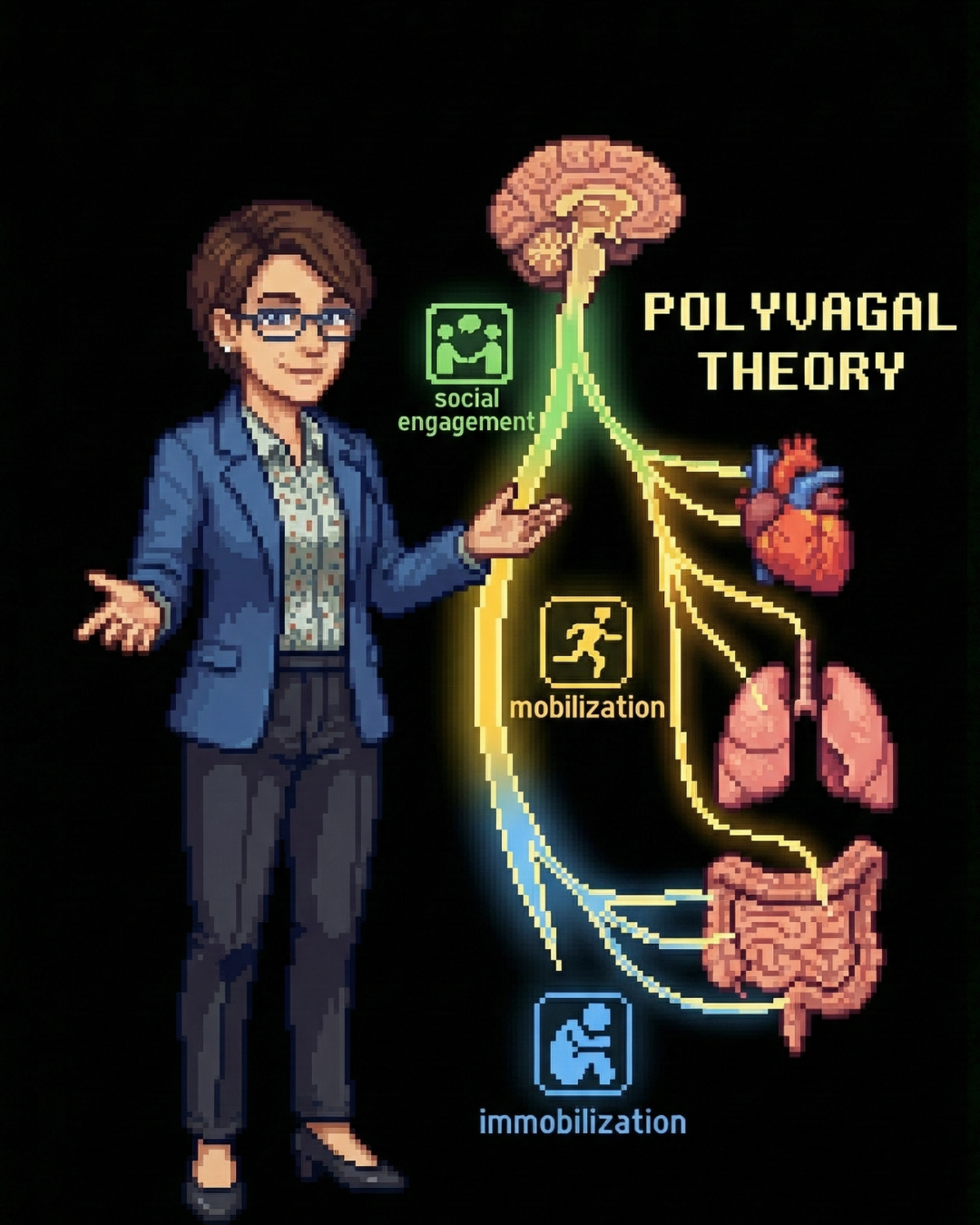
The earlier version of this page said SE is informed by polyvagal theory and that the autonomic nervous system has three branches: sympathetic, ventral vagal and dorsal vagal. Both claims need qualifying. The autonomic nervous system is conventionally described as having two principal branches, sympathetic and parasympathetic.1 Polyvagal theory, which Porges first published in 1995, proposes that the vagal, parasympathetic side contains two separate circuits: a newer ventral vagal system tied to social engagement and an older dorsal vagal system tied to shutdown.11, 12 It is a hypothesis, and a contested one. In 2023 Grossman argued in Biological Psychology that each of its five basic premises is untenable or highly implausible, and that treating respiratory sinus arrhythmia as a measure of vagal tone is a category mistake.13 SE’s later literature does draw on Porges, and the 2015 paper describes his three-part model. But the method came first: its own authors date SE’s development to Levine’s work from the 1970s onward, and he was publishing on stress physiology in 1977 and 1986.1 Words like ventral and dorsal can still be useful shorthand for states clients recognize, and our essay on polyvagal theory told through myth uses them that way. They are a map, not settled anatomy, and SE does not need them to work.
What the research shows
The evidence for SE is real but small. A 2021 scoping review found 16 studies that met its criteria, only two of them randomized controlled trials, and judged overall study quality mixed. It concluded that the results are promising but need support from unbiased randomized trials.4 Studies since then have not changed that picture much.
PTSD. The first randomized trial, run in Israel by Brom and colleagues, assigned 63 adults with PTSD to 15 weekly SE sessions or a waitlist. The SE group improved substantially more, with large effects on PTSD symptoms (Cohen’s d of 0.94 to 1.26) and moderate to large effects on depression (d of 0.70 to 1.08).7 Two limits matter. A waitlist is a weak comparison, because it does not control for attention, expectation or simply seeing a therapist every week. And the trial excluded people with complex trauma and most psychiatric conditions other than depression.4
Pain. Two Danish trials tested SE for chronic low back pain with post-traumatic stress symptoms. In the first, 91 patients at a spine center received supervised exercise, with or without 6 to 12 SE sessions. Adding SE reduced PTSD symptoms and fear of movement, though the authors wrote that the overall effect was less than expected and its clinical importance could be questioned.14 In the second, larger trial, 114 patients received physiotherapy with or without up to 12 SE sessions, and the SE group did no better on any outcome at 6 or 12 months.15 If pain is your main concern, that null result is worth knowing. Our piece on fibromyalgia, pain and healing looks at chronic pain from a mind-body angle.
Disaster work and brief formats. After Hurricanes Katrina and Rita, 142 social service workers in New Orleans and Baton Rouge, themselves survivors of the storms, took part in a study of a one- or two-session stabilization model built on SE skills. Compared with a matched group, those who received it showed gains in resilience and fewer PTSD symptoms, but the groups were not randomized, psychological symptoms rose in both groups by the three-to-four-month follow-up (less in the SE group), and the lead author was affiliated with the Foundation for Human Enrichment in Boulder, the organization Levine also listed as his affiliation in 2015.16 In 2026, researchers at Mid Sweden University found that a single 60-minute SE-based session, compared with psychoeducation, increased felt psychological safety and reduced a sense of disrupted body boundaries in adults who had experienced childhood maltreatment. The authors describe these as momentary states and call for research on lasting effects.17
The wider picture. A 2021 meta-analysis of 18 randomized trials of body psychotherapy in general found medium effects on psychopathology and distress, and a strong need for larger, better-defined studies.18 A 2026 systematic review of trauma treatments for children 12 and under found no evidence available for SE in that age group, while trauma-focused CBT had the most support.19 The 2023 VA/DoD guideline for PTSD gives its strong psychotherapy recommendations to prolonged exposure, cognitive processing therapy and EMDR, and SE is not among them.20 None of that shows SE fails. It shows SE has not yet been tested enough to stand alongside those treatments.
Who SE may suit, and when to look elsewhere
SE may suit people who cannot or will not tell the story in detail, people whose trauma lives mostly in the body as startle, bracing, numbness or a gut that never settles, and people who go into shutdown when they try to talk about what happened. It may also suit people who want to understand their reactions without being pathologized for them. The method’s own literature treats an isolated event in adulthood, such as a car accident, as the relatively uncomplicated case.1
A few cautions. If you want the treatment with the most evidence for PTSD, ask about prolonged exposure, cognitive processing therapy or EMDR, or about combining one of them with somatic work. Dizziness, fainting, a racing heart on standing, or new physical symptoms deserve a medical workup before anyone calls them trauma; our article on POTS and dysautonomia offers a mind-body view of those conditions. SE does not replace medical care, and any question about medication belongs with your prescriber. People with severe dissociation, such as losing time, need a slower pace and a clinician experienced with dissociative disorders. If you are in danger or thinking about suicide, call or text 988, the 988 Suicide and Crisis Lifeline.
Somatic Experiencing in Birmingham and Hoover
Taproot Therapy Collective is in Hoover, a short drive from Birmingham, Homewood and Vestavia Hills. Our clinicians include somatic therapists such as Robin Taylor, LICSW-S. If you live elsewhere in the state, teletherapy for trauma anywhere in Alabama lets you do much of this work from home. Tracking and resourcing can be done over video; touch from the therapist cannot.
When you contact any SE therapist, here or elsewhere, it is reasonable to ask a few things. Are they an SEP, in training, or using SE-informed methods learned elsewhere? How do they handle shutdown and dissociation? Do they use touch, and how do they ask? How will you both know whether it is helping? Expect plain answers and goals you can check, not a promise that your trauma will be released.
If you want to see whether SE fits, our Somatic Experiencing therapy page describes how we offer it in Hoover, and you can contact us to set up a first conversation about what you are dealing with and whether this approach, or another one, makes sense.
References
- Payne, P., Levine, P. A., & Crane-Godreau, M. A. (2015). Somatic experiencing: Using interoception and proprioception as core elements of trauma therapy. Frontiers in Psychology, 6, 93. https://doi.org/10.3389/fpsyg.2015.00093
- Levine, P. A. (with Frederick, A.). (1997). Waking the tiger: Healing trauma: The innate capacity to transform overwhelming experiences. North Atlantic Books.
- Levine, P. A. (2010). In an unspoken voice: How the body releases trauma and restores goodness. North Atlantic Books.
- Kuhfuß, M., Maldei, T., Hetmanek, A., & Baumann, N. (2021). Somatic experiencing – effectiveness and key factors of a body-oriented trauma therapy: A scoping literature review. European Journal of Psychotraumatology, 12(1), 1929023. https://doi.org/10.1080/20008198.2021.1929023
- Rubinstein, D., Korem, N., Bullard, D. G., & Harpaz-Rotem, I. (2026). The exposure continuum model: A theoretical framework for understanding exposure across trauma-centered psychotherapies. Journal of Anxiety Disorders, 117, 103107. https://doi.org/10.1016/j.janxdis.2025.103107
- Harwood-Gross, A., Elias, S., Lerner, K., Nacasch, N., Lawi, C., Brom, D., & Barak, A. (2025). Veterans’ experiences of somatic experiencing and prolonged exposure therapies for post-traumatic stress disorder: A qualitative analysis. Psychology and Psychotherapy: Theory, Research and Practice, 98(1), 175–192. https://doi.org/10.1111/papt.12570
- Brom, D., Stokar, Y., Lawi, C., Nuriel-Porat, V., Ziv, Y., Lerner, K., & Ross, G. (2017). Somatic experiencing for posttraumatic stress disorder: A randomized controlled outcome study. Journal of Traumatic Stress, 30(3), 304–312. https://doi.org/10.1002/jts.22189
- Zanette, L. Y., Hobbs, E. C., Witterick, L. E., MacDougall-Shackleton, S. A., & Clinchy, M. (2019). Predator-induced fear causes PTSD-like changes in the brains and behaviour of wild animals. Scientific Reports, 9(1), 11474. https://doi.org/10.1038/s41598-019-47684-6
- Kozlowska, K., Walker, P., McLean, L., & Carrive, P. (2015). Fear and the defense cascade: Clinical implications and management. Harvard Review of Psychiatry, 23(4), 263–287. https://doi.org/10.1097/HRP.0000000000000065
- Möller, A., Söndergaard, H. P., & Helström, L. (2017). Tonic immobility during sexual assault – a common reaction predicting post-traumatic stress disorder and severe depression. Acta Obstetricia et Gynecologica Scandinavica, 96(8), 932–938. https://doi.org/10.1111/aogs.13174
- Porges, S. W. (1995). Orienting in a defensive world: Mammalian modifications of our evolutionary heritage. A polyvagal theory. Psychophysiology, 32(4), 301–318. https://doi.org/10.1111/j.1469-8986.1995.tb01213.x
- Porges, S. W. (2007). The polyvagal perspective. Biological Psychology, 74(2), 116–143. https://doi.org/10.1016/j.biopsycho.2006.06.009
- Grossman, P. (2023). Fundamental challenges and likely refutations of the five basic premises of the polyvagal theory. Biological Psychology, 180, 108589. https://doi.org/10.1016/j.biopsycho.2023.108589
- Andersen, T. E., Lahav, Y., Ellegaard, H., & Manniche, C. (2017). A randomized controlled trial of brief Somatic Experiencing for chronic low back pain and comorbid post-traumatic stress disorder symptoms. European Journal of Psychotraumatology, 8(1), 1331108. https://doi.org/10.1080/20008198.2017.1331108
- Andersen, T. E., Ellegaard, H., Schiøttz-Christensen, B., Mejldal, A., & Manniche, C. (2020). Somatic Experiencing® for patients with low back pain and comorbid posttraumatic stress symptoms – a randomised controlled trial. European Journal of Psychotraumatology, 11(1), 1797306. https://doi.org/10.1080/20008198.2020.1797306
- Leitch, M. L., Vanslyke, J., & Allen, M. (2009). Somatic experiencing treatment with social service workers following Hurricanes Katrina and Rita. Social Work, 54(1), 9–18. https://doi.org/10.1093/sw/54.1.9
- Lehmivaara, J., Jansson, B., Bernhardsson, J., Cloitre, M., & Pfaltz, M. C. (2026). From Somatic Experiencing to felt safety: Assessing the effects of a body-oriented intervention in adults with various degrees of child maltreatment. European Journal of Psychotraumatology, 17(1), 2613544. https://doi.org/10.1080/20008066.2026.2613544
- Rosendahl, S., Sattel, H., & Lahmann, C. (2021). Effectiveness of body psychotherapy: A systematic review and meta-analysis. Frontiers in Psychiatry, 12, 709798. https://doi.org/10.3389/fpsyt.2021.709798
- Alkærsig, M., Banzon, T., Roest, J., Elklit, A., Stein, A. R., Vang, M. L., & Løkkegaard, S. S. (2026). Psychological treatments for young children suffering from trauma-related symptomatology: Systematic review and partial meta-analyses of the current evidence-base for 12 methods. Clinical Psychology Review, 125, 102725. https://doi.org/10.1016/j.cpr.2026.102725
- Schnurr, P. P., Hamblen, J. L., Wolf, J., Coller, R., Collie, C., Fuller, M. A., Holtzheimer, P. E., Kelly, U., Lang, A. J., McGraw, K., Morganstein, J. C., Norman, S. B., Papke, K., Petrakis, I., Riggs, D., Sall, J. A., Shiner, B., Wiechers, I., & Kelber, M. S. (2024). The management of posttraumatic stress disorder and acute stress disorder: Synopsis of the 2023 U.S. Department of Veterans Affairs and U.S. Department of Defense clinical practice guideline. Annals of Internal Medicine, 177(3), 363–374. https://doi.org/10.7326/M23-2757


















0 Comments