
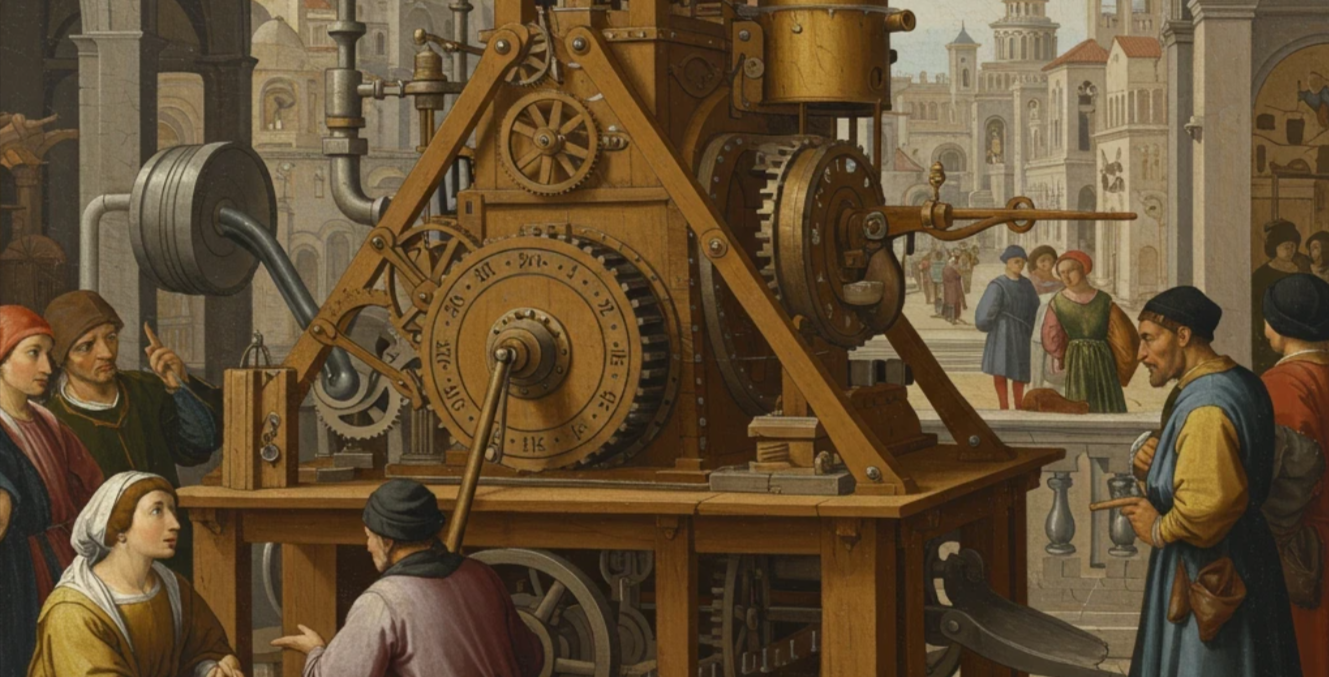
There is a small but revealing detail that most of us have already forgotten. In the late 1990s and early 2000s, using the internet required you to think like a machine. If you wanted to understand why Christianity became the dominant force in medieval Europe, you did not type that question into a search engine. You typed something like history + Europe + religion -crusades. You stripped your curiosity down to its barest mechanical skeleton, removed all the connective tissue of human thought, and handed the machine a set of fragmented instructions it could parse.
Nobody talked about this shift at the time because it happened so gradually. But from a psychological standpoint, something remarkable was occurring. Hundreds of millions of people were being trained, day after day, to translate their inner experience into a language optimized for retrieval rather than meaning. The question was never “What do I want to understand?” It was “What keywords will return the right links?” We were not asking. We were querying.
When We Learned to Speak Machine
The cognitive implications of this era deserve more attention than they have received. The extended mind thesis, proposed by Andy Clark and David Chalmers (1998), argues that cognition does not stop at the skull. Tools, notebooks, and devices become genuine extensions of our thinking when we rely on them consistently enough. By that standard, the early internet was not just a tool we used. It was a cognitive environment we adapted to, and it quietly reshaped the way we organized our own thoughts.
Consider what keyword searching actually required of the user. You had to take a felt sense, a half-formed question living somewhere in the murky territory between curiosity and confusion, and compress it into discrete, non-contextual units. You had to abandon syntax. You had to strip away the relational structure of your thought and present it as a pile of nouns. In therapeutic terms, this is strikingly similar to what happens when a client intellectualizes. The emotional and relational content gets removed. What remains is technically accurate but fundamentally disconnected from the experience that generated it.
For roughly a decade, this was the default mode of interacting with the largest information system ever built. We were training ourselves to think in fragments, and the machine rewarded us for it. A good search was not a good question. A good search was an efficient reduction.
The Quiet Revolution of Asking
Something shifted around the late 2000s and into the 2010s. Search engines began developing what engineers called semantic search, which meant the systems were starting to interpret not just the words you typed but the intent behind them. People noticed, mostly unconsciously, and their behavior changed. Instead of typing anxiety treatment CBT vs medication, they began typing “Is therapy or medication better for anxiety?” They stopped querying. They started asking.
This transition is easy to dismiss as a mere interface improvement, but it represents something psychologically significant. The machine had started meeting us where we were. For the first time, you could approach the internet the way you might approach another human being, with a real question shaped by real context, and receive something that felt like a response rather than a list.
The parallels to the therapeutic relationship are hard to ignore. One of the central tasks of psychotherapy is helping clients move from a mode of self-monitoring and performance into a mode of genuine inquiry. The client who arrives and says “I have anxiety, probably generalized, started in college” is giving you keywords. The client who says “I do not understand why I feel so afraid when everything in my life is fine” is asking a question. The former is efficient. The latter is alive.
What the internet quietly accomplished during this period was a mass re-permission. It told billions of people, through the slow evolution of interface design, that they could show up with their actual confusion rather than a pre-processed version of it. The machine would do the translating now.
The Synthesis Engine and the Outsourced Self
The emergence of large language models represents another cognitive boundary crossing, and this one has implications that clinicians cannot afford to ignore. Previous search technologies, no matter how sophisticated, still returned lists. You typed a question and received ten blue links. The synthesis, the actual work of reading across sources, weighing contradictions, building a coherent understanding, remained yours to do.
Large language models perform that synthesis. They do not retrieve documents. They generate contextual responses drawn from patterns across billions of texts, weaving together information that would have taken a human reader hours or days to integrate. The user no longer needs to be the one who connects the dots. The machine connects them and presents the picture already assembled.
From a cognitive standpoint, this is the most dramatic outsourcing of a higher-order mental function that has ever occurred at scale. Synthesis, the capacity to hold multiple perspectives in mind, identify relationships between seemingly unrelated phenomena, and construct coherent meaning from fragmentary evidence, is not a trivial skill. It is one of the hallmarks of mature cognition. It is what Piaget (1954) described in the development of formal operational thought. It is what clinicians work to cultivate when they help a client move from black-and-white thinking into genuine complexity. And it is now something a machine can approximate in seconds.
This does not mean the machine understands. The distinction matters enormously, and any honest engagement with this technology must keep it in view. A large language model navigates statistical relationships between words. It does not experience meaning. It does not feel the weight of a contradiction or the relief of an insight. As the philosopher John Searle (1980) argued with his Chinese Room thought experiment, the capacity to produce coherent outputs is not the same as comprehension. The model manipulates symbols. The human inhabits them.
But the psychological effect on the user is real regardless of whether the machine understands. When you receive a fluent, contextually appropriate, well-organized synthesis of a complex topic, your brain processes that experience in ways that are meaningfully different from reading ten separate articles and doing the integration yourself. The felt sense of understanding arrives faster, with less friction, and with fewer of the productive frustrations that typically accompany genuine learning.
The Therapy-Speak Epidemic
This is where the story turns from a curiosity about technology into a genuine clinical problem. The same synthesis engines that can weave together the history of medieval Christendom in thirty seconds can also deliver, on demand, a remarkably sophisticated psychological education. Ask a large language model to explain anxious attachment and you will receive a nuanced, well-sourced, clinically literate explanation. Ask it about somatic experiencing, polyvagal theory, complex PTSD, internal family systems, or the neurobiology of dissociation, and you will get the same. The entire conceptual apparatus of modern psychotherapy is now available to anyone with a phone and a moment of curiosity.
The result is a phenomenon that every practicing clinician now encounters: clients who arrive on the first day already fluent in the language of therapy. They can identify their attachment style. They know which parent was the narcissist. They can tell you their window of tolerance is narrow and that their dorsal vagal system tends to shut them down under stress. They have mapped their inner child, named their parts, and diagnosed their family system with a confidence that would have taken a graduate student years to develop.
And here is the problem that almost nobody is talking about openly: this knowledge is making many of them worse, not better.
The assumption buried inside the proliferation of therapeutic concepts is the same assumption that drives the entire internet: that access to information produces change. If you can name it, you can fix it. If you understand the mechanism, you can override it. This is the cognitive fallacy at the heart of the self-help industrial complex, and the internet has supercharged it beyond anything the bookstore self-help aisle ever could. A person in 2005 might read one book about codependency and spend six months slowly digesting it. A person in 2025 can consume the equivalent of an entire graduate seminar in attachment theory over a weekend, synthesized and personalized by an AI that will even help them apply it to their specific relationship.
The trouble is that psychotherapy does not work the way information works. Understanding why you flinch when someone raises their voice is not the same thing as no longer flinching. Knowing that your nervous system learned to interpret intimacy as danger does not teach your nervous system to do otherwise. The map is not the territory, and in the domain of trauma and relational wounding, the map can actually become an obstacle to entering the territory at all.
The Illusion of Mastery
What clinicians are seeing with increasing frequency is a specific and pernicious form of stuckness. The client has done the reading. They have watched the videos. They have had long, probing conversations with AI systems that reflected their experience back to them in clinically precise language. They arrive in the therapy room believing, with complete sincerity, that they already understand their problem. And they cannot figure out why they are not getting better.
This is not laziness. It is not resistance in the classical psychoanalytic sense. It is something newer and more subtle. It is the confusion that arises when a person has been given every reason to believe that understanding is the mechanism of change, only to discover that they understand perfectly and nothing has changed. The client who can deliver a flawless ten-minute monologue about their disorganized attachment, their parentification, and their tendency to fawn under relational stress is often the same client who cannot sit in silence for thirty seconds without dissociating. The concepts have given them a fluent narrator. They have not given them a different nervous system.
Bessel van der Kolk (2014) titled his landmark work “The Body Keeps the Score” for a reason that cuts directly against the internet’s implicit promise. Trauma does not live in the narrative. It lives in the body, in the subcortical structures that operate below the reach of language and far below the reach of a well-constructed TikTok explanation. The amygdala does not care that you can name it. The brainstem does not update its threat assessment because you read a polyvagal theory infographic. Peter Levine (1997) spent decades demonstrating that trauma resolution requires a process of somatic renegotiation, not cognitive reframing. The body has to complete what it started. No amount of conceptual understanding substitutes for that completion.
This creates a clinical situation that is genuinely new in the history of psychotherapy. Previous generations of clinicians could assume that psychoeducation was a meaningful early phase of treatment. Teaching a client what a trigger is, explaining the fight-or-flight response, introducing the concept of attachment, these were foundational steps that opened doors. Now, many clients arrive with the doors already open but no idea how to walk through them. They have the vocabulary but not the visceral experience that the vocabulary was designed to point toward. They have been given the menu and mistaken it for the meal.
The Awe and the Aha
There is an old distinction in comparative religion scholarship that illuminates what is happening here with striking clarity. Scholars who study religious experience have long noted the difference between two fundamentally different modes of encounter with sacred material. There is the awe of understanding a religion, the intellectual appreciation of its theology, its history, its internal logic, its cultural architecture. And then there is the aha of feeling it, the moment when the doctrine stops being a concept and becomes a living experience, when the words of a prayer cease to be recited and begin to be inhabited.
These are not two points on the same continuum. They are qualitatively different events. A theologian can spend a lifetime achieving ever deeper awe at the complexity of Christian soteriology without ever once experiencing the aha of what it might mean to feel forgiven. A religious studies professor can map every stage of the Buddhist path to enlightenment without ever sitting still long enough to notice their own breath. The awe is cognitive. The aha is experiential. And no amount of the former guarantees arrival at the latter.
Psychotherapy operates in exactly this territory. The conceptual frameworks, the attachment theory, the polyvagal maps, the parts language, the trauma typologies, all of it exists in the domain of awe. These are extraordinary intellectual achievements that help clinicians and clients alike make sense of experiences that might otherwise feel chaotic and meaningless. But they are maps. They are theology. They describe the territory of human suffering with increasing sophistication, but they do not, by themselves, transform it.
The aha in therapy is something else entirely. It is the moment when a client who has talked about their abandonment wound for months suddenly feels it rise in their chest during a session, sits with it instead of narrating it, and discovers that it moves, that it has a texture and a rhythm and an endpoint they never knew existed because they had never let it arrive before. That moment cannot be synthesized. It cannot be retrieved. It cannot be delivered by any technology, no matter how sophisticated, because it is not an information event. It is a relational and somatic event that requires the presence of another human being, the safety of a therapeutic container, and the willingness to stop knowing and start feeling.
The internet, for all its power, has flooded the world with awe and created the impression that awe is enough. It has given millions of people the experience of understanding their pain in exquisite conceptual detail and implicitly promised that this understanding is the same as healing. When it turns out not to be, the result is not just disappointment. It is a specific kind of despair, the despair of someone who did everything right, read all the books, watched all the videos, understood all the frameworks, and still wakes up at three in the morning with the same dread sitting on their chest.
The New Resistance
Clinicians trained in somatic, experiential, and depth-oriented approaches are encountering a paradox that would have been unimaginable twenty years ago. The clients who are most psychologically literate are often the most difficult to reach. Not because they are unwilling, but because their literacy has become its own defense.
When a therapist invites a client to close their eyes and notice what is happening in their body, the client who has spent hundreds of hours consuming therapy content may reflexively translate the experience into language before it has a chance to land. “I am noticing tightness in my chest, which is probably my sympathetic nervous system activating because this feels like a relational threat,” they might say, and every word of that sentence might be accurate, and none of it might be therapeutic. The narration has preempted the experience. The client has described the wave instead of letting it wash over them.
This is not the old-fashioned resistance of a client who does not want to go deeper. It is a new kind of resistance born from an information environment that has taught people, at every turn, that the right response to an internal experience is to name it, categorize it, and explain it. The internet rewards this. Social media rewards this. Language models reward this. The entire digital ecosystem in which modern humans are embedded operates on the principle that articulation is mastery. Therapy asks for something far stranger: that you stop articulating and start attending. That you let the experience exist without a label, without a framework, without a seven-part Instagram carousel that explains what it means.
Pat Ogden, the founder of Sensorimotor Psychotherapy, has written extensively about the difference between top-down and bottom-up processing in trauma treatment (Ogden, Minton, and Pain, 2006). Top-down processing uses cognition to organize experience. Bottom-up processing allows the body’s own intelligence to surface, sequence, and resolve what has been held. Both are necessary. But the internet has created a generation of clients who arrive with their top-down processing so overdeveloped, so fluent, so practiced, that the bottom-up channel has been all but buried beneath it. The therapeutic task is no longer to provide the cognitive framework. The framework is already there, often in excessive abundance. The task is to help the client set the framework aside long enough to discover what their body already knows but their mind has been too busy explaining to hear.
Living in the Age of Premature Coherence
None of this is an argument against technology or against the democratization of psychological knowledge. The tools are extraordinary, and the access they provide to information is genuinely valuable. A person in a rural community who could never afford therapy can now access sophisticated psychological concepts that were once locked behind professional gatekeepers. A person in crisis who searches “why do I feel nothing after my mother died” and receives a compassionate, accurate explanation of grief and dissociation has been served by that technology in a moment that matters. That is real, and it counts.
But clinicians need to understand the cognitive environment their clients now inhabit, because it has fundamentally altered the starting conditions of treatment. We are living in an age of premature coherence, where the appearance of understanding arrives faster than understanding itself. A client can spend twenty minutes with a language model and emerge with a beautifully articulated narrative about their childhood attachment wounds, their nervous system dysregulation, and their relational patterns. That narrative might even be accurate. But accuracy and integration are not the same thing. Coherence and healing are not the same thing. And the ability to explain your suffering in clinically precise language may, in certain cases, become the very thing that prevents you from feeling it deeply enough to let it change.
The cruelest irony of the information age may be this: it has given people such thorough access to the language of transformation that many of them genuinely believe they have already done the transforming. They have read about neuroplasticity, so they assume their neural pathways have already been redirected. They have learned about reparenting, so they assume the inner child has already been reached. They have consumed an entire curriculum on secure attachment and cannot understand why their relationships still feel like minefields. The gap between knowing and embodying has never been wider, and the culture has never been less equipped to acknowledge that the gap exists, because the culture itself has been reshaped by technologies that treat knowing and understanding as the final destination rather than the first step of a much longer, much less convenient journey.
What the Therapy Room Still Offers
The search bar taught us to fragment our thinking. The question box taught us to externalize our curiosity. The synthesis engine taught us to outsource our meaning-making. The therapy-speak explosion taught us to mistake the map for the territory and the menu for the meal. Each of these developments moved in the same direction: toward faster, more efficient, more articulate access to concepts about human experience, and away from the slow, wordless, often deeply uncomfortable encounter with human experience itself.
The therapy room remains one of the few spaces where none of those shortcuts work. You cannot keyword-search your way through grief. You cannot ask a semantically optimized question that resolves a body memory. You cannot synthesize your way out of a nervous system that learned, decades ago, that love and danger are the same thing. The only path to that kind of change runs directly through the body, through the relational field between two people in a room, and through the willingness to stop understanding long enough to actually feel what is there.
In comparative religion, the great traditions have always known that the awe of theology is not the aha of revelation. The scholar and the mystic may study the same texts, but they are engaged in fundamentally different projects. Psychotherapy, at its best, has always operated closer to the mystic’s end of that spectrum. It is not primarily an intellectual enterprise. It is an experiential one, grounded in the body, forged in relationship, and oriented not toward a more sophisticated explanation of suffering but toward a living encounter with what the suffering has been trying to protect.
In a world that moves faster every year, that sells understanding as a product and treats articulation as evidence of healing, the quiet, unglamorous, irreducibly human act of sitting with another person and paying attention to what is actually happening inside you right now may be the most countercultural offering psychotherapy has left to give. The internet can give you the awe. It cannot give you the aha. That still requires a body, a relationship, and the courage to stop explaining and start arriving.



















0 Comments