

The Tectonics of the Self
The history of the United States is typically recounted as a sequence of political events, economic shifts, and military conflicts. However, running beneath the surface of constitutional conventions, industrial revolutions, and digital disruptions is a more fundamental history: the history of the American psyche. The conception of what it means to be a human being (the architecture of the self, the boundaries of sanity, and the nature of the unconscious) has not been static. It has undergone three distinct tectonic shifts since the nation’s founding and is currently in the throes of a fourth.
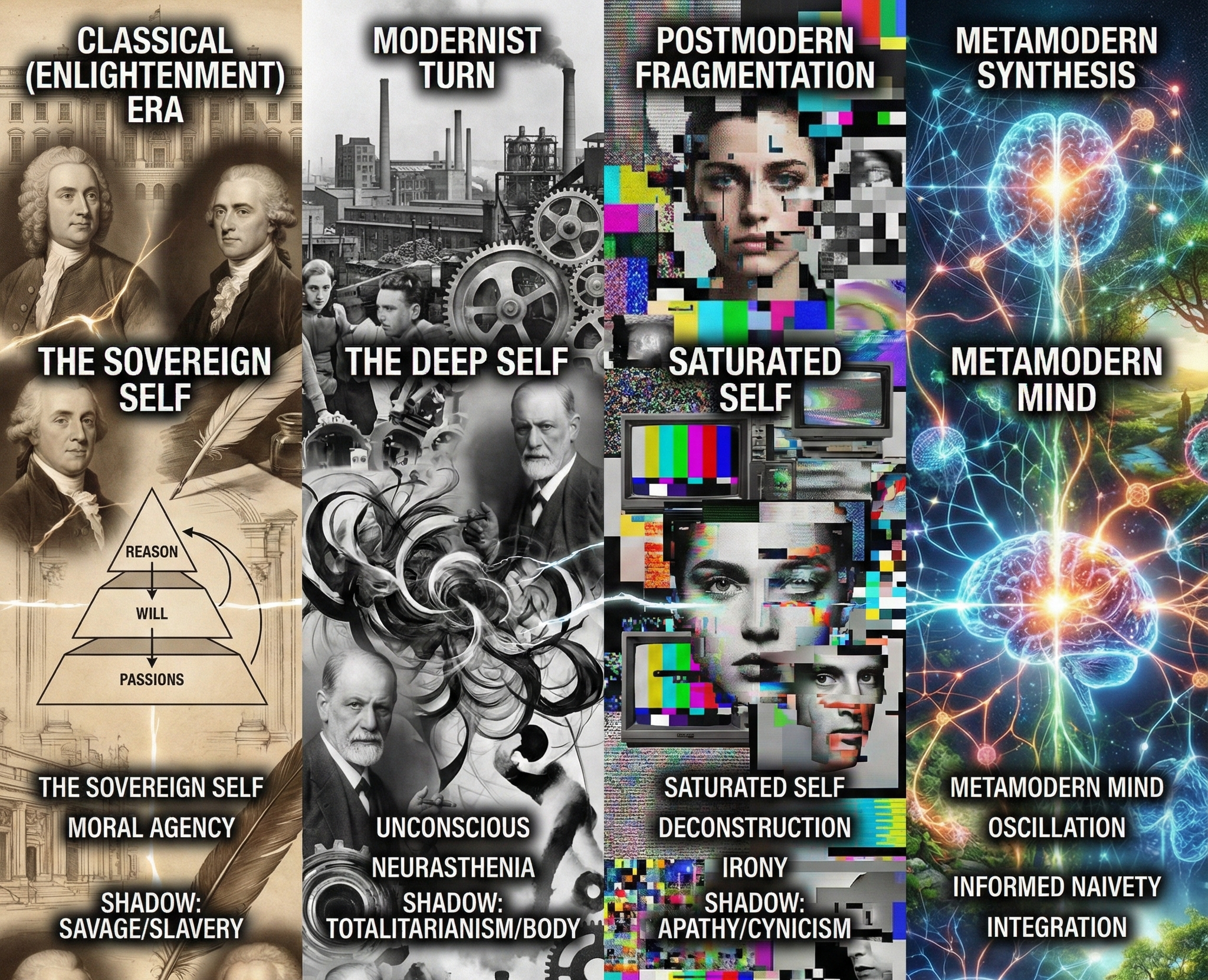
This analysis posits that the psychological evolution of the United States can be mapped across four distinct epochs: the Classical (Enlightenment) era, the Modernist turn, the Postmodern fragmentation, and the emerging Metamodern synthesis. Each era possesses a unique “cultural logic” that dictates not only how individuals perceive themselves but also what they repress. This repression generates a collective shadow: a reservoir of disallowed psychic energy that manifests in political polarization, mass pathology, and the specific contours of mental illness in each age.
To understand the current “meaning crisis” and the epidemic of digital anxiety, one must understand the trajectory that led here. We have moved from the rigid, unified moral agent of 1776, to the neurotic, interiorized subject of 1920, to the fragmented, socially constructed “saturated self” of 1990, and finally toward the oscillating, developmental integration of the 2020s. As cultural theorists Timotheus Vermeulen and Robin van den Akker argued in their foundational essay “Notes on Metamodernism” (Journal of Aesthetics and Culture, 2010), we are witnessing the emergence of a new “structure of feeling” that oscillates between modernist sincerity and postmodern irony.
This exploration examines these periods exhaustively, tracing how they affect clinical practice, mass psychology, and the very constitution of the human subject. The stakes could not be higher: how we understand the self determines how we treat psychological suffering, how we organize our politics, and ultimately, how we navigate the unprecedented challenges of the twenty-first century.
Part I: American Classicism and the Republic of Faculties (1776–1890)
1.1 The Architecture of the Enlightenment Mind
The foundational psychology of the early American republic was not merely a byproduct of political theory; it was the bedrock upon which the political theory was built. The “Self” of the American Revolution and the subsequent Classicist era was conceived through the lens of Faculty Psychology, a framework largely imported from the Scottish Enlightenment and Common Sense Realism. Thinkers like Immanuel Kant and David Hume had established the philosophical foundations, but the American experiment translated these ideas into a lived psychology of citizenship.
In this paradigm, the mind was viewed not as a fluid, developmental process, but as a static, hierarchical structure composed of distinct “faculties” or powers. These included the Will, the Reason, the Memory, the Imagination, and the Passions. The health of the individual, like the health of the Republic, depended on the proper governance of these faculties. Reason was the executive power, divinely appointed to rule over the turbulent mob of the Passions. As William James would later observe, this model reflected a fundamentally Platonic vision of the soul as a charioteer (Reason) steering two horses (the noble and base passions).
The Sovereign Self and Moral Agency
The ideal American self of this era was the “Sovereign Self.” This self was defined by its autonomy, its unity, and its capacity for moral self-regulation. Identity was viewed as “essentialist”: a fixed core of character that stood independent of social context. The goal of life was not “self-expression” (a later Romantic/Modernist concept) but “self-mastery.” The philosophy of Aristotle informed this ideal, with its emphasis on virtue as the proper ordering of the soul’s faculties toward the good.
This psychological model had profound political implications. If the self was a mini-republic where Reason must control Passion, then the nation was a macro-self where the “rational” classes must guide the “passionate” masses. The fear of “mob rule” in early American politics was a direct projection of the fear of “passion rule” in the individual psyche. The psychological ideal was the “Man of Character”: stoic, rational, and integrated. Socrates’ dictum “know thyself” meant, in this context, knowing one’s moral duties and executing them through disciplined will.
Clinical Paradigms: Moral Treatment and the Will
Clinical psychology, in its nascent form, operated under the logic of the Will. Mental illness was not seen as a biological accident or a result of childhood trauma, but often as a failure of moral self-governance. The “Moral Treatment” movement, which dominated early American asylums, was predicated on the belief that the insane had lost the ability to govern themselves through Reason. The cure, therefore, was to place them in a perfectly ordered environment (the asylum) where discipline, routine, and labor would strengthen the Will like a muscle, eventually restoring the hierarchy of the faculties.
As documented in the history of psychotherapy’s development, there was little room for the “unconscious” in this model. The mind was transparent to itself; introspection was a tool for moral inventory, not for excavating hidden drives. The questions asked by the Classicist mind were “What is right?” and “How do I know?” (epistemology), rather than “How do I feel?” This orientation toward epistemological rather than emotional truth would persist until the Modernist revolution.
1.2 The Collective Shadow of the Enlightenment
Every psychological system creates a shadow: a repository for the aspects of human experience that the conscious ideal rejects. Because the American Enlightenment identified so aggressively with Reason, Order, and Light, its collective shadow became populated by the Irrational, the Dark, and the Chaotic. Carl Jung understood this dynamic intimately, and his concept of the collective shadow illuminates the dark underbelly of American Classicism.
The Projection of the Savage
The most immediate manifestation of this shadow was the projection onto the Indigenous population. In the psychogeography of the early American mind, the “Civilized Man” stood as a fortress of Reason against the “Savage Wilderness.” The Native American was cast as the embodiment of the untamed Passions: violent, impulsive, and irrational. This was not just political propaganda; it was a psychological defense mechanism. By projecting the “savage” potential of their own psyches onto the Other, white Americans could maintain the illusion of their own rationality.
The genocide of the indigenous peoples was, in a dark sense, an externalized war against the Enlightenment’s own repressed shadow. This represents what Jung called “shadow projection” on a civilizational scale. The philosophy of Friedrich Nietzsche would later expose how such projections serve to preserve a culture’s self-image while enacting its disowned violence.
The “Wolf by the Ear”: Slavery and the Shadow of Dependency
The deepest and most toxic element of the Classical shadow was slavery. The American ideal of “Liberty” and “Autonomy” was psychologically sustained by the reality of absolute domination. This created a profound psychic split, best exemplified by Thomas Jefferson.
Jefferson was the archetype of the American Enlightenment: rational, scientific, and eloquent on the rights of man. Yet, he enslaved over 600 people. Jungian analysis suggests that this was not merely hypocrisy, but a form of “shadow possession.” The “Sovereign Self” of the master was dependent entirely on the labor of the slave, creating a terrifying vulnerability that had to be fiercely repressed. Jefferson famously described slavery as holding a “wolf by the ear”: you didn’t like it, but you dared not let it go.
The shadow of this era was the repressed knowledge that the “Self-Made Man” was a myth; the autonomous white male subject was constituted by the very dependency and violence he claimed to abhor. This repression required immense psychological energy, leading to a rigid, brittle cultural persona that could not tolerate ambiguity. The philosophy of G.W.F. Hegel, particularly his master-slave dialectic, provides a framework for understanding how the oppressor’s identity becomes paradoxically dependent on the oppressed.
1.3 The Failure of Faculty Psychology
The Classical model began to disintegrate in the late 19th century. The sheer, chaotic force of the Industrial Revolution, the carnage of the Civil War, and the biological determinism of Darwinian evolution eroded the belief in a static, divinely ordered mind. “Faculty Psychology” could not explain the new nervous disorders appearing in the cities, nor could the concept of the “Will” account for the automatic behaviors and hysterical symptoms that defied rational control.
As research on neurasthenia demonstrates, the “Sovereign Self” was revealed to be a house of cards, ready to be blown down by the winds of Modernism. The body, long repressed, was returning with a vengeance through symptoms that reason could not control. The stage was set for a revolutionary reconceptualization of the human psyche.
Part II: The Modernist Turn: The Deep Self and the Industrial Shadow (1890–1960)
2.1 The Interiorization of the Psyche
Around the turn of the 20th century, a radical shift occurred. The “Republic of Faculties” collapsed, replaced by the Deep Self of Modernism. If the Classical question was “How do I govern myself?”, the Modernist question became “Who am I, really?” This shift marks what philosophers call the “turn to interiority,” a movement anticipated by Søren Kierkegaard and Arthur Schopenhauer.
The Discovery of the Unconscious
The pivotal psychological event of this era was the “discovery” of the Unconscious. Freud, Jung, and James revealed that the conscious Will (the king of the Classical era) was merely a puppet of vast, subterranean forces. The self was no longer a unitary moral agent but a conflict-ridden duality: the conscious Ego versus the unconscious Id/Shadow.
This shift interiorized the self. Meaning was no longer found in public civic duty or moral law, but in the private depths of the individual psyche. The “Psychological Man” replaced the “Moral Man.” “Personality” replaced “Character” as the primary social currency. The phenomenological investigations of Edmund Husserl and later Maurice Merleau-Ponty would provide philosophical foundations for this new understanding of consciousness as layered, embodied, and historically situated.
Clinical Paradigm: The Rise of Analysis and Expertise
The clinical response to this new self was Psychoanalysis. The therapist became the new priest, the expert capable of decoding the secret language of the unconscious. This era established the “Depth Metaphor” that still dominates much of popular culture: truth is buried, hidden, and must be excavated. The work of depth psychologists like Gaston Bachelard explored how these spatial metaphors shape our understanding of the psyche.
Simultaneously, the rise of Behaviorism offered a competing Modernist vision. Influenced by the industrial logic of the assembly line, Behaviorists like Watson and Skinner viewed the mind as a “black box” that didn’t need to be understood, only engineered. This was the “Fordism” of psychology: efficiency, prediction, and control were the goals. As research on Hume’s influence on behaviorism demonstrates, both Analysis and Behaviorism shared the quintessential Modernist faith: that the expert, armed with science, could solve the riddle of the human.
2.2 Mass Psychology and the Industrial Shadow
While the intellectual elite explored the unconscious, the masses were being reshaped by industrialization. The Modernist era was the age of the Crowd. As traditional communities dissolved into urban sprawls, the individual became an atom in a mass society. The philosophy of Hannah Arendt would later analyze how this atomization created the conditions for totalitarianism.
Neurasthenia: The Disease of the Machine Age
The psychological cost of this transition was Neurasthenia (nervous exhaustion). William James called it “Americanitis.” The demand for mechanical efficiency, punctuality, and speed depleted the “nervous capital” of the Modernist subject. Studies on neurasthenia reveal how this diagnosis encoded anxieties about American identity, masculinity, and imperial ambition at the turn of the twentieth century.
This diagnosis revealed the shadow of the Industrial Self: the body. As the mind strove to become a flawless machine, the body rebelled through “Hysteria” and “nervous weakness.” Historical research on hysteria documents how this condition was the somatic shadow of a culture that repressed the organic and the emotional in favor of the mechanical and the rational. It was the “irrational” forcing its way back into the room through the language of the body.
The Collective Shadow: Totalitarianism
Jung argued that the Modernist attempt to rationalize society (to strip the world of myth, religion, and the irrational) created a dangerous “psychic vacuum.” The gods did not disappear; they became diseases. The repressed religious instinct and the denied collective shadow projected themselves onto political ideologies. The insights of Theodor Adorno on the “authoritarian personality” illuminate this dynamic.
The rise of Fascism and Communism can be understood as “psychic epidemics”: eruptions of the collective shadow. The “Mass Man,” alienated and stripped of individual meaning, fused with the “Mob,” engaging in the very barbarism that the Enlightenment thought it had banished. The Holocaust was the ultimate expression of the Modernist shadow: the marriage of industrial efficiency (Modernity) with primitive, shadow-possessed hatred (the repressed Irrational). Walter Benjamin’s analysis of fascism’s aestheticization of politics remains essential for understanding this catastrophe.
2.3 The Shadow of the “Good War” and the Nuclear Age
In America, the Modernist era culminated in the mid-century “American Dream”: a vision of suburban rationality, consumer progress, and containment. But the shadow loomed large in the form of the Bomb. The ultimate achievement of Modernist science (nuclear fission) created a pervasive, low-level existential dread.
The “containment” of Communism abroad mirrored the “containment” of the instincts at home. The Modernist self was a fortress, besieged by the Id from within and the Bomb from without. The existentialist philosophy of Jean-Paul Sartre and Martin Heidegger emerged partly as a response to this condition of anxiety and absurdity. Heidegger’s concept of “thrownness” captured the experience of finding oneself in a world not of one’s choosing, facing mortality without the comfort of traditional certainties.
Part III: The Postmodern Fragmentation: The Saturated Self and the Crisis of Meaning (1960–2000)
3.1 The Collapse of the Grand Narrative
By the 1960s, the Modernist project began to crack. The “Grand Narratives” of science, progress, and rational expertise had led to Auschwitz, Hiroshima, and the Vietnam War. A deep skepticism emerged, birthing the Postmodern era. As Fredric Jameson diagnosed in his influential work on postmodernism, we entered an era characterized by the “waning of affect” and the collapse of historical depth.
If Modernism sought the “Deep Self,” Postmodernism declared that there is no self. French theorists like Foucault and Derrida argued that the “subject” was a social construct, a product of language and power relations. Gianni Vattimo described this as the era of “weak thought,” where all claims to absolute truth became suspect. In America, this manifested not just as high theory, but as a lived psychological reality.
The Saturated Self
Social psychologist Kenneth Gergen provided the definitive psychological diagnosis of this era: the Saturated Self. In his seminal 1991 work, Gergen proposed that technological developments increasingly expose individuals to multiple opinions, values, and ways of life, drawing them into an expanding array of relationships, projects, and commitments. With the explosion of communication technologies (television, air travel, early internet), the individual was exposed to a dizzying array of voices, lifestyles, and possibilities.
The Modernist self, with its single, coherent identity, could not sustain this bombardment. The self fragmented. Identity became what Gergen termed “multiphrenic”: a pastiche of roles played in different contexts. One could be a corporate shark by day, a New Age seeker by night, and a cynical irony-poisoned observer on the weekend. The “Authentic Self” became a nostalgic myth. As research on postmodernism and the self demonstrates, social saturation produces a condition where the traditional ideal of a single, coherent self is gradually replaced by a sense of self as fragmented and decentered.
3.2 The Psychology of Irony and Narcissism
The dominant emotional tone of Postmodernism was Irony. Sincerity was viewed as naive; belief was viewed as dangerous. Irony became a defensive posture: a way to remain detached from a world where meaning was unstable. Ludwig Wittgenstein’s later philosophy, with its emphasis on language games and the impossibility of private meaning, provided intellectual scaffolding for this sensibility.
The Culture of Narcissism
Christopher Lasch famously diagnosed this era as the “Culture of Narcissism” in his 1979 bestseller. But this was not the narcissism of self-love; it was the narcissism of self-preservation. As recent scholarship notes, Lasch identified narcissism as a burgeoning social epidemic, predicting how social media and the internet would saturate us with alluring images, amplify our narcissistic concerns with appearance and self-curation, and foster shallow interpersonal connections.
In a world where institutions were crumbling and the future was uncertain (“nuclear anxiety”), the self collapsed into the immediate present. The Postmodern subject focused on the “self-project” (fitness, therapy, lifestyle) because the public world felt uncontrollable. This narcissism was driven by the Fragmented Mirror. Without a stable community to reflect a coherent identity back to the individual, the Postmodern person was forced to constantly seek validation to feel real. The “Empty Self” needed to be constantly filled with commodities and experiences.
3.3 The Shadow of Postmodernism: Capitalist Realism and Apathy
If the Modernist shadow was the violent “Id,” the Postmodern shadow was a suffocating Grey. It was the shadow of Meaninglessness. The philosophy of Paul Ricoeur grappled with how to recover meaning in a “hermeneutics of suspicion” that had deconstructed every foundation.
Mark Fisher described this condition as Capitalist Realism: the widespread, unconscious belief that “there is no alternative” to the current system. Even rebellion became a commodity (buying Che Guevara t-shirts). This produced a unique form of mass pathology: “hedonic depression” or “reflexive impotence.” People knew the system was destroying the planet and their minds, but they felt powerless to change it. They could deconstruct every ideology, but they could not construct a new one.
The Postmodern shadow was the repression of Sincerity and Depth. To care deeply was to be vulnerable; to believe in a Truth was to be a fool. The culture effectively repressed the soul, leaving a flat, shiny surface of “simulacra.” Jean Baudrillard’s concept of hyperreality captured this condition where the simulation becomes more real than reality itself.
3.4 Clinical Paradigms: Narrative and Deconstruction
Clinical psychology adapted to this shift through Social Constructionism and Narrative Therapy. These modalities viewed mental illness not as a biological defect or a deep unconscious conflict, but as a “problem-saturated story.” The influence of Hans-Georg Gadamer’s hermeneutics on these approaches is evident in their emphasis on interpretation and dialogue.
The goal of therapy shifted from “insight” (Modernist excavation) to “re-authoring” (Postmodern editing). The therapist was no longer the expert, but a “collaborator.” While this was liberating (it depathologized the client and challenged oppressive power structures), it also had a shadow side. By denying the reality of “deep structures” (biology, archetypes), extreme postmodern therapies sometimes left clients adrift in a sea of relativity. If everything is just a story, is any healing real? This question haunts the therapeutic landscape and points toward the need for a new synthesis.
Part IV: The Metamodern Emergence: Oscillation and the Developmental Turn (2000–Present)
4.1 The Birth of Metamodernism
We are currently living through the painful birth of a new psychological epoch: Metamodernism. As explored in depth in anticipating the metamodern, this era emerged as a response to the failures of Postmodernism. Irony and deconstruction, while useful tools for critique, proved incapable of solving the existential crises of the 21st century (Climate Change, AI, the Meaning Crisis). You cannot deconstruct your way out of an ecological collapse.
Vermeulen and van den Akker’s foundational 2010 essay in the Journal of Aesthetics and Culture established the theoretical framework: Metamodernism is characterized by Oscillation. It oscillates between the Modernist enthusiasm (hope, sincerity, construction) and the Postmodern irony (skepticism, deconstruction). It is the “informed naivete”: knowing that all narratives are constructed, but choosing to believe in one anyway because it is necessary for survival.
As Seth Abramson has elaborated in his work on metamodernism’s implications for culture and therapy, this new sensibility offers pathways beyond the paralysis of postmodern cynicism while retaining its critical insights. The work of Jürgen Habermas on communicative rationality and John Caputo on “weak theology” provide philosophical resources for this emerging paradigm.
The Concept of the Self: The “Dividual” and Developmental Hierarchy
The Metamodern self is the Oscillating Self or the Developmental Self. It integrates the Postmodern realization that the self is a construction with the Modernist desire for growth and direction. The insights of Gilbert Simondon on individuation as an ongoing process (rather than a fixed state) inform this understanding.
Crucially, Metamodernism reintroduces Hierarchies of Growth. Unlike Postmodernism, which viewed all perspectives as equal (“flatland”), Metamodernism draws on developmental psychology (such as the Model of Hierarchical Complexity) to argue that some perspectives are more complex, inclusive, and integrated than others. The goal of the self is not just to “be” (Postmodern) or to “achieve” (Modern), but to evolve: to move from egocentric to ethnocentric to worldcentric to cosmocentric awareness. The integral philosophy of Jean Gebser anticipated this developmental turn.
4.2 Mass Psychology in the Digital Age: The Algorithmic Shadow
The defining feature of Metamodern mass psychology is the Digital Unconscious. We have externalized the collective unconscious into the digital infrastructure. Algorithms now perform the function of myths: they shape our desires, direct our attention, and connect us in invisible webs of meaning. Ernst Cassirer’s philosophy of symbolic forms provides a framework for understanding how digital media constitute new modes of world-making.
The Shadow of Hyper-Reflexivity
The shadow of this digital integration is Hyper-Reflexivity. Clinical research on hyperreflexivity identifies it as a condition where excessive self-consciousness leads to a detachment from direct experience. In the age of social media, the self is constantly watching itself be watched. We are trapped in a hall of mirrors, curating our lives for an algorithmic Other. This leads to a paralysis of the will: we are so busy monitoring the representation of our lives that we struggle to live them.
Polarization as Regression
The collective shadow also manifests as political polarization. As the complexity of the world increases (a Metamodern challenge), many psyches regress to earlier, simpler modes of being (Modernist nationalism or Pre-modern fundamentalism). As Peter Sloterdijk has analyzed, these movements represent attempts to construct “immunological” barriers against overwhelming complexity.
The “Alt-Right” and various fundamentalisms are not just political movements; they are psychological defense mechanisms against the vertigo of Metamodern complexity. They offer the “certainty” that the Metamodern mind craves but cannot honestly possess without oscillation. Understanding this dynamic is essential for what lessons philosophy has to teach psychology.
4.3 Hanzi Freinacht and the “Listening Society”
A key theoretical framework for this era is Hanzi Freinacht’s political philosophy, outlined in works like “The Listening Society”. Freinacht argues that we must move from a society focused on “external welfare” (money, jobs) to a Listening Society focused on “internal welfare” (psychological growth, emotional needs).
Freinacht posits that the “bottleneck” of civilization is no longer resources, but psychology. If the average citizen remains at a “Modern” or “Postmodern” level of development, they cannot effectively govern a global, digital civilization. Therefore, the “self” is a political project. We need “Bildung” (deep emotional and civic education) to raise the average level of psychological complexity. This connects to the insights of Friedrich Schelling on the development of consciousness and Christopher Partridge on the re-enchantment of culture.
4.4 Clinical Metamodernism: Integration and Reconstruction
Clinical psychology is adapting to the Metamodern turn by embracing Integration and Reconstruction. The therapist is no longer just a listener (Postmodern) or an analyst (Modern), but a developmental partner. This represents what might be called the future of therapy: a synthesis of multiple modalities oriented toward growth, meaning, and complexity.
Internal Family Systems (IFS) as Metamodern Therapy
Internal Family Systems (IFS) is the quintessential Metamodern modality.
Postmodern element: It recognizes the self as a “multiplicity” of parts (exiles, managers, firefighters), validating the fragmented experience of the postmodern subject.
Modern/Classical element: It posits a “Self” (capital S) that is indestructible, compassionate, and capable of leadership: a return to a form of essentialism, but a flexible, non-dogmatic one.
Metamodern synthesis: It oscillates between the parts and the Self, reintegrating the shadow (exiles) not by repressing them (Classicist) or just analyzing them (Modernist), but by befriending them and unburdening them.
Research on IFS demonstrates how this approach moves from mere acceptance toward genuine transformation. The model integrates insights from Wilfred Bion on container/contained dynamics with a pluralistic understanding of psychic structure.
Acceptance and Commitment Therapy (ACT)
ACT also reflects Metamodern logic. It uses mindfulness (a “meta” stance of observing thoughts without believing them: Postmodern distance) to facilitate committed action toward values (Modernist sincerity/agency). It accepts the tragic nature of the human mind (you will always have pain) but reconstructs a meaningful life around it. Integration of IFS and ACT represents the cutting edge of Metamodern clinical practice.
Addressing the Meaning Crisis
Finally, Metamodern therapy explicitly addresses the “Meaning Crisis.” It moves beyond symptom reduction to “Soulmaking.” This involves integrating “technologies of the sacred” (meditation, psychedelics in the context of the “Psychedelic Renaissance,” and ritual) back into clinical practice. The work of Gilbert Durand on the anthropology of imagination and Plotinus on the soul’s journey inform this approach. The goal is to restore “Relevance”: to help the client feel connected to a larger whole, re-enchanting the world without falling into pre-rational superstition. This is the essence of what Alan Watts called finding meaning after the “death of God.”
Table 1: Comparative Analysis of Psychological Eras
| Feature | Classicism (1776–1890) | Modernism (1890–1960) | Postmodernism (1960–2000) | Metamodernism (2000–Present) |
|---|---|---|---|---|
| Concept of Self | Sovereign, Rational, Unitary | Deep, Neurotic, Interiorized | Fragmented, Saturated, Constructed | Oscillating, Developmental, Dividual |
| Dominant Faculty | Will / Reason | Unconscious / Drive | Language / Discourse | Meta-cognition / Awareness |
| Dominant Pathology | Moral Corruption / Mania | Neurasthenia / Hysteria | Narcissism / Borderline / Depression | Burnout / Hyper-reflexivity / Anxiety |
| Collective Shadow | The Savage / The Irrational | The Mob / The Automaton | Meaning / Sincerity / Reality | The Algorithm / Certainty / Complexity |
| Clinical Goal | Moral Restoration | Insight / Adjustment | Deconstruction / Re-storying | Integration / Development / Meaning |
| Key Modalities | Moral Treatment | Psychoanalysis / Behaviorism | Narrative / Social Constructionism | IFS / ACT / Dynamic Narrative |
| Cultural Logic | Universal Truth | Scientific Truth | Relative Truth | Pragmatic/Felt Truth |
| Political Psyche | The Republic of Reason | The Welfare State | Identity Politics | The Listening Society |
Part V: Detailed Analysis of Historical Progressions
5.1 The Collapse of the Classical Sovereign: The Return of the Body
The transition from Classicism to Modernism was driven by the “return of the repressed body.” The Classical model relied on the suppression of the somatic and the emotional. As the Victorian era progressed, this repression became unsustainable. The “hysterical” symptoms of the late 19th century were the body’s revolt against the “disembodied reason” of the Enlightenment.
The discovery of the laws of thermodynamics and the conservation of energy led to a new view of the mind as an “energy system” (Freud’s libido), which could not simply be “willed” into submission. If you blocked the steam (repressed the drive), the boiler would explode (hysteria/neurosis). The “Wolf” that Jefferson feared (slavery/irrationality) could no longer be held by the ears; it devoured the Classical mind from within, necessitating a psychology that could account for the dark, irrational forces of the psyche.
This somatic turn finds contemporary expression in approaches like Brainspotting and other body-based trauma therapies that recognize what Antonio Damasio calls the inseparability of emotion, body, and reason. The philosophy of Henri Bergson on duration and intuition anticipated this understanding of consciousness as irreducibly embodied and temporal.
5.2 The Exhaustion of the Postmodern Critique: The Need for Soil
The transition from Postmodernism to Metamodernism is being driven by “crisis fatigue” and the need for “soil.” Postmodernism was an effective herbicide: it killed the weeds of fascism, racism, and dogmatism by deconstructing their truth claims. However, it also killed the crops. It left the cultural soil barren, unable to sustain meaning or community.
In the face of the “Meta-Crisis” (the interlocking ecological, economic, and mental health crises), the Postmodern stance of ironic detachment became maladaptive. “Capitalist Realism” showed that cynicism effectively serves the status quo: if you believe nothing can change, you won’t try to change anything. Metamodernism emerged as a “survival response”: a desperate need to believe in something, to reconstruct a “Grand Narrative” that is humble, self-correcting, but capable of guiding collective action.
This dynamic illuminates many of the blindspots in contemporary psychology and points toward necessary corrections. The wisdom traditions, from Christian mysticism to Eastern philosophy, offer resources for this reconstruction that scientific psychology has often ignored.
5.3 The Metamodern Synthesis: The Integration of Depths
Metamodernism is not a rejection of the previous stages, but an integration of them (a “transcend and include” move, to use Integral terminology).
- It keeps the Classical emphasis on Will and Agency (we must act).
- It keeps the Modern emphasis on Depth and Science (we must understand the brain/unconscious).
- It keeps the Postmodern emphasis on Context and Pluralism (we must be inclusive and critical).
- It adds the Metamodern emphasis on Development and Oscillation.
This synthesis is visible in the new “Dynamic Narrative Therapy,” which integrates the “strategic” (Modernist/Cybernetic) understanding of feedback loops with the “narrative” (Postmodern) understanding of story. Research on Dynamic Narrative Therapy demonstrates how it allows the therapist to hold the tension between the client’s “story” and the systemic “reality,” facilitating a “re-authoring” that is grounded in developmental growth.
The labyrinth as a symbol in Jungian psychology serves as an apt metaphor for this integration: a winding path that leads through complexity toward a center, requiring both surrender and intentional movement.
Part VI: Deep Dive into Clinical Implications for the Metamodern Age
6.1 The Shadow in the Consulting Room
In the Metamodern clinical encounter, the “Shadow” is treated differently than in previous eras.
Classical: The shadow (sin/passion) must be expunged or suppressed.
Modern (Jungian/Freudian): The shadow must be integrated/analyzed to relieve neurosis. It is “dangerous” but necessary.
Postmodern: The shadow is a social construct; we must question why we label it “dark.” We must deconstruct the binary of Light/Dark.
Metamodern: The shadow is “Golden.” It contains the unlived potential, the “repressed sublime,” and the creative energy needed for development. The Metamodern therapist helps the client oscillate into the shadow to retrieve energy, creativity, and “lost parts” (as in IFS) to fuel the movement to the next stage of complexity.
This approach draws on Jung’s understanding of the shadow while transcending the limitations of earlier frameworks. The work of Wolfgang von Goethe on the interplay of light and darkness in nature provides a poetic foundation for this more nuanced understanding.
6.2 Addressing the “Meaning Crisis”
Metamodern therapy explicitly addresses the “Meaning Crisis.” Patients today do not just suffer from symptoms; they suffer from a lack of “Relevance.” They feel disconnected from a larger story. The Metamodern therapist is tasked with being a “meaning-midwife.”
This involves helping clients construct a “meta-narrative” of their lives that connects them to the cosmos, community, and history, without falling into pre-modern superstition. This is often done through Transformative Gameplay or “Serious Play”: using the therapeutic space as a “magic circle” where the client can experiment with new ways of being and perceiving, engaging the “post-secular sacred.” The philosophy of Saul Kripke on naming and necessity offers insights into how language can create genuine meaning rather than mere simulation.
6.3 The Problem of Hyper-Reflexivity and Digital Burnout
A unique challenge of the Metamodern/Digital age is “Hyper-reflexivity.” Because of social media and the “digital gaze,” clients are constantly monitoring themselves. They are the star, director, and critic of their own movie. This creates a “double consciousness” that prevents genuine connection and flow. Understanding the psychology of parenting in the digital age becomes essential as these patterns are transmitted intergenerationally.
Metamodern therapies target this specifically. ACT trains the “Observer Self” to detach from the “Evaluator,” allowing the client to step out of the hall of mirrors. IFS helps the client unblend from the “Manager” parts that are obsessed with image and control. The goal is to restore “naive” (sincere) experience on the other side of reflection: what Paul Ricoeur called the “Second Naivete.” This represents a return to what oral cultures understood about presence and immediacy, but informed by the insights of literate and digital culture.
6.4 The Role of the “Listening Society” in Therapy
Hanzi Freinacht’s concept of the “Listening Society” implies that therapy is not just about fixing individuals to fit back into a broken system (a critique of Modernist therapy), but about helping individuals outgrow the system so they can change it.
The therapist acts as a developmental agent. By providing “unconditional positive regard” (Rogers) combined with “developmental challenge” (Kegan/Commons), the therapist helps the client move from “Socialized Mind” (seeking validation, Postmodern narcissism) to “Self-Transforming Mind” (Metamodern fluidity). The clinic becomes a laboratory for the new society. The work of Theodore Porter on the social history of objectivity illuminates how our clinical frameworks always reflect broader cultural assumptions about truth, measurement, and the self.
The Horizon of the Self
The progression from Classicism to Metamodernism reveals a dialectical process of the American Self attempting to understand and govern itself.
Thesis (Classicism): The Self is a Unity (Rational, Sovereign). It represses the Irrational.
Antithesis (Modernism): The Self is a Duality (Conscious vs. Unconscious). It represses the Spiritual/Meaningful in favor of the Scientific.
Deconstruction (Postmodernism): The Self is a Multiplicity (Fragmented, Constructed). It represses Sincerity and Depth.
Synthesis (Metamodernism): The Self is a Process (Oscillating, Developmental, Integrative). It attempts to integrate all previous stages while navigating the new complexity of the Digital Age.
We are currently standing in the early light of the Metamodern dawn. The “Meaning Crisis,” the political polarization, and the mental health epidemic are not merely signs of decay; they are the birth pangs of a new tier of consciousness. The old structures (Modernist institutions, Postmodern deconstruction) can no longer contain the complexity of the world we have built.
The “American Shadow” has shifted from the specific bodies of the oppressed (Classicism) to the industrial machine (Modernism) to the apathy of the consumer (Postmodernism) and now to the Algorithmic Feedback Loop of the digital sphere. Confronting this new shadow requires a psychology that is as systemic as it is spiritual, and as political as it is clinical. It requires a “Listening Society” that can hold the pain of the transition and facilitate the growth of a Metamodern mind capable of oscillating between the tragic and the utopian, the digital and the real, the self and the other.
Key Concepts and Definitions
Metamodernism: A structure of feeling that oscillates between modern enthusiasm and postmodern irony, seeking an “informed naivete” or “pragmatic idealism.” First theorized by Vermeulen and van den Akker (2010).
Oscillation: The movement between poles (hope/doubt, sincerity/irony) without resting in either, creating a dynamic tension that generates new meaning.
The Saturated Self: Gergen’s (1991) concept of the postmodern self, overwhelmed by the multiplicity of relationships and identities made possible by technology.
Capitalist Realism: Fisher’s concept that it is easier to imagine the end of the world than the end of capitalism; a major driver of contemporary depression.
Model of Hierarchical Complexity (MHC): A framework for scoring the complexity of tasks and cognition, underpinning the developmental aspect of Metamodernism.
The Listening Society: Freinacht’s political vision where the state takes responsibility for the psychological development and emotional welfare of its citizens.
Hyper-reflexivity: The condition of excessive self-consciousness and self-monitoring, exacerbated by digital media, leading to a detachment from direct experience.
Faculty Psychology: The Enlightenment view of the mind as a collection of distinct powers (Reason, Will, Passion) that must be hierarchically ordered.
Digital Unconscious: The theory that algorithms now perform the functions of the collective unconscious, organizing desires and symbols outside of human awareness.
References and Further Reading
- Gergen, K.J. (1991). The Saturated Self: Dilemmas of Identity in Contemporary Life. Basic Books.
- Lasch, C. (1979). The Culture of Narcissism: American Life in an Age of Diminishing Expectations. W.W. Norton.
- Fisher, M. (2009). Capitalist Realism: Is There No Alternative? Zero Books.
- Vermeulen, T., & van den Akker, R. (2010). Notes on metamodernism. Journal of Aesthetics and Culture, 2(1).
- Freinacht, H. (2017). The Listening Society: A Metamodern Guide to Politics. Metamoderna.




















0 Comments