
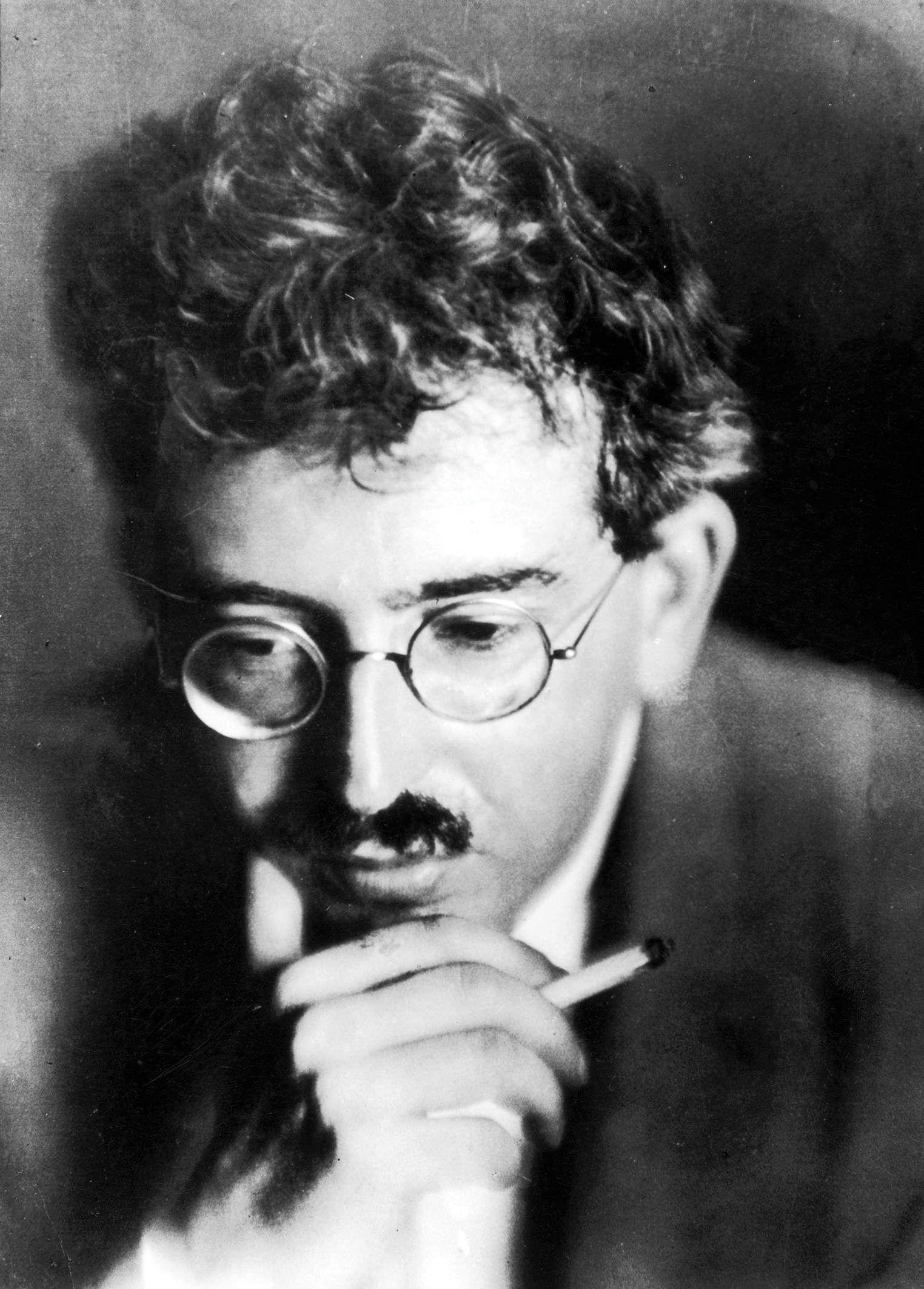
Walter Benjamin never wrote a theory of trauma, but he came close. In “On Some Motifs in Baudelaire” (1940) he borrowed Freud’s idea of a mental shield against stimuli and argued that modern shocks are parried by consciousness and filed away as isolated Erlebnis instead of becoming Erfahrung: experience that can be remembered, told and handed on.1 That is a fair description of unprocessed traumatic memory.
Read through Benjamin, trauma is an impact that was registered but never became experience, so it returns as repetition instead of memory. Therapy does not fix this by laying a story of progress over the past. It works when a past moment can be recognized in the present, in safety and with a witness, so that it becomes something a person can tell rather than something that keeps happening to them.
Who Walter Benjamin was
Benjamin was born in Berlin on 15 July 1892 into a prosperous, assimilated Jewish family. He studied at Freiburg, Berlin, Munich and Bern, heard the neo-Kantian Heinrich Rickert and the sociologist Georg Simmel lecture, and took his doctorate summa cum laude at Bern in 1919 with a dissertation on the concept of art criticism in German Romanticism.2 The First World War marked him early. In August 1914, days after it began, his close friend the young poet Christoph Friedrich Heinle and Heinle’s girlfriend Rika Seligson took their own lives in Berlin. Benjamin kept Heinle’s papers and wrote more than fifty sonnets in his memory.3
The 1920s brought the essay on Goethe’s novel Elective Affinities, a failed habilitation (he withdrew The Origin of German Tragic Drama from the University of Frankfurt in 1925, ending his hopes of an academic post) and two books in 1928, the Trauerspiel study and One-Way Street.2 Three friendships shaped him: Gershom Scholem, later the leading scholar of Jewish mysticism; Theodor Adorno, whom he met through Siegfried Kracauer; and Bertolt Brecht, a close friend from 1929. He belonged to the Frankfurt School’s wider circle rather than its core. The Institute for Social Research published his essays in the 1930s and paid the stipend that became his main income in exile.2
He left Germany for good in 1933 and divided his exile between Paris, Ibiza, San Remo and Brecht’s house in Denmark. His best-known essay, “The Work of Art in the Age of Mechanical Reproduction,” first appeared in French in 1936.4 In the Bibliothèque nationale he worked on the Arcades Project, a vast, unfinished collage of quotations and notes on nineteenth-century Paris begun in the late 1920s. Interned in a French camp for German nationals in the autumn of 1939, he wrote the theses “On the Concept of History” after his release, then fled Paris in 1940, leaving the Arcades notes with the writer and librarian Georges Bataille.2 In September he crossed the Pyrenees into Spain with a small group of refugees. At Portbou the police told them they would be sent back to France, and that night he took an overdose of morphine. The town register gives his death as 26 September 1940; the Stanford Encyclopedia of Philosophy gives the 27th.4, 2
Little of this was widely read in his lifetime. Adorno edited a two-volume Schriften in 1955. Hannah Arendt, who passed a copy of the theses on to Adorno, edited the English collection Illuminations, translated by Harry Zohn, in 1968.2, 4 Howard Eiland and Michael Jennings’s Walter Benjamin: A Critical Life (2014) is a full-length English biography.5
Shock, the stimulus shield and two kinds of experience
Benjamin’s closest approach to trauma theory is his long Baudelaire essay, published by the Institute’s journal in January 1940.2 It draws on Freud’s Beyond the Pleasure Principle (1920). Freud had speculated that consciousness works less like a recorder than a shield. Becoming conscious and leaving a lasting memory trace, he suggested, are incompatible within one and the same system, and outside stimuli strong enough to break through this protective shield are what he called traumatic. Fright, in his account, depends on a lack of preparedness for anxiety.6
Benjamin turned this into a theory of modern life. The city crowd, the factory machine, the game of chance and the film all deliver experience as a series of jolts, and he treated the shock a passer-by feels in a crowd as the counterpart of the isolated experiences of a worker at a machine.2 Consciousness meets each jolt and parries it, and the price is that the impression never sinks in. German has two words for experience, and Benjamin built on the difference. Erlebnis is the event as lived through: dated, isolated, a moment in one’s life. Erfahrung is experience that accumulates, joins memory and tradition and can be passed to someone else. The more efficiently consciousness screens out shock, the more of life stays in the first category.1 He set this beside Proust’s involuntary memory and proposed that what returns that way is often what was never consciously lived through at the time.1, 2
He tied this loss to the First World War. In “Experience and Poverty” (1933), and again in “The Storyteller” (1936), he asked whether it had not been noticeable at the end of the war that men came back from the front silent, “not richer, but poorer in communicable experience.” A generation that had gone to school by horse-drawn tram, he wrote, now stood under the open sky in a landscape where nothing was unchanged but the clouds, and beneath them, among destructive currents and explosions, “the tiny, fragile human body.”7, 1 The Stanford Encyclopedia reads the shock theory against the shell shock of that war, which Benjamin had already confronted in a 1930 review of Ernst Jünger’s anthology War and Warrior.2, 8 The historian Martin Jay argues that the war’s violence set Benjamin’s thinking about memory in motion, and that he refused the consolations of ordinary mourning.9 Susan Buck-Morss later traced the thread from shock to anaesthesia: a nervous system flooded with stimuli protects itself by going numb.10
What trauma research says about fragments
Benjamin wrote cultural criticism, not clinical science, so the fair question is whether his distinction tracks anything measurable. Partly. In a 1995 exploratory study of 46 people with PTSD, Bessel van der Kolk and Rita Fisler reported that, by participants’ own accounts, their traumatic memories came back first as sensory and emotional fragments and only later took the form of a personal narrative.11 Chris Brewin’s dual representation theory separates sensory-bound representations, which drive vivid intrusions, from contextualized ones that place an event in time and space, and treats recovery as getting the two to work together. He reports strong evidence for enhanced perceptual memory alongside impaired episodic memory in PTSD.12, 13 Anke Ehlers and David Clark’s cognitive model makes a related point: alongside excessively negative appraisals of the event, persistent PTSD involves a trauma memory that is poorly elaborated and poorly integrated with the rest of autobiographical memory, so a reminder can trigger re-experiencing that feels as if it is happening now rather than then.14 In Benjamin’s vocabulary, that is Erlebnis that never became Erfahrung.
The fragmentation story is contested. David Rubin, Dorthe Berntsen and Malene Klindt Bohni argue that PTSD can be explained by ordinary memory processes, with the current memory of an event driving symptoms, and that no special mechanism for traumatic memory is needed.15 A review of 16 studies by Michele Bedard-Gilligan and Lori Zoellner found that the link between dissociation and fragmented memory showed up mainly in patients’ own ratings and did not hold when narratives were coded by raters or by computer.16 Many survivors experience their memories as fragments, and that deserves to be taken seriously, but “trauma is stored in pieces” is a hypothesis, not a settled fact. Benjamin’s framework survives the dispute because it concerns whether an event can be held and told, not a special filing system in the brain.
The dialectical image: when the past flashes up
The second idea worth bringing into therapy is the dialectical image. In the Arcades Project Benjamin wrote that it is not that the past casts its light on the present or the present on the past: “rather, an image is that wherein what has been comes together in a flash with the now to form a constellation.” Image, he went on, is “dialectics at a standstill.”17, 2 This is not the forward-marching dialectic usually credited to Hegel but a moment of arrest in which two times become readable together, in what he called “the now of its recognizability.”2
The history theses give the idea its best-known form: “To articulate the past historically does not mean to recognize it ‘the way it really was’ (Ranke). It means to seize hold of a memory as it flashes up at a moment of danger.” The true picture of the past “flits by,” and can be seized only as an image that flashes up at the instant it can be recognized.1
A clinician reads that and thinks of flashbacks, which are the past flashing up in the wrong way: with the full charge of the original moment, none of its context, and nothing learned because the person is overwhelmed. Freud described the same failure in 1914. A patient who cannot remember something reproduces it “not as a memory but as an action”; he repeats it without knowing that he is repeating it, and this, Freud concluded, is his way of remembering.18 Kierkegaard had already made repetition a philosophical problem in his 1843 book of that name.
Benjamin’s alternative is recognizability: the past becomes legible when the present can hold it. Therapy tries to build that present on purpose. The person is not in danger now, someone is with them, and the old moment can be approached in tolerable amounts. Richard Lane and colleagues have proposed that change across very different therapies works this way, by reactivating old emotional memories and updating them with new experience through memory reconsolidation.19 The human evidence for reconsolidation is still contested; a 2018 review concluded that current findings cannot conclusively establish it at the neurobiological level.20 The clinical case does not depend on it: trauma-focused therapies, which work directly with the memory of the event and what it has come to mean, have the strongest trial evidence for PTSD.21
The angel of history and the problem with progress
The most famous passage in the theses describes Paul Klee’s Angelus Novus (1920), which Benjamin bought in 1921.4 The angel’s face is turned toward the past. “Where we perceive a chain of events, he sees one single catastrophe which keeps piling wreckage upon wreckage and hurls it in front of his feet. The angel would like to stay, awaken the dead, and make whole what has been smashed.” A storm blowing from Paradise drives him backward into the future. “This storm is what we call progress.”1
Benjamin meant European history, not anyone’s inner life. But the passage describes something survivors often say about time: there is no chain of events, only one event that keeps happening, while everyone around them urges them toward a future they are facing away from. A treatment plan makes a smaller version of the mistake Benjamin saw in the idea of progress when it treats the past as an obstacle to clear rather than something with a claim on the present. “Nothing that has ever happened,” the third thesis says, “should be regarded as lost for history.”1
Judith Herman’s Trauma and Recovery makes both of Benjamin’s moves in clinical language. She describes recovery in three stages (establishing safety, remembrance and mourning, and reconnection with ordinary life) while stressing that real recovery does not move through them in a straight line. She also argues that the study of trauma has repeatedly been forgotten, and has advanced only when a political movement made it possible to listen to survivors.22
What this looks like in therapy
There is no such thing as Benjamin therapy. What his ideas offer is a way of thinking about what trauma work is for.
The goal is Erfahrung, not a polished story. Benjamin’s storyteller draws on “experience which is passed on from mouth to mouth,” and needs a listener.1 A memory that has become experience in his sense has a time stamp, a place and an audience: it happened then, I am here now, and someone has heard it. Narrative exposure therapy, a short-term treatment used with survivors of organized violence, war, torture and other repeated trauma, turns the traumatic scenes of a person’s life into a detailed narration and reads the resulting testimony back to them.23 A meta-analysis of 16 randomized trials found large pre-to-post reductions in PTSD symptoms; NET outperformed inactive and non-trauma-focused comparisons, though not active treatments as a group.24 Disclosure without that structure seems to do less, though the comparison is loose: a meta-analysis of 146 randomized studies of experimental disclosure (James Pennebaker’s expressive-writing paradigm and its variants), not limited to people with PTSD, found a small average effect (r = .075) across a wide range of outcomes.25
Dose matters. In the preface to Berlin Childhood around 1900, Benjamin explains that, facing exile, he deliberately called up the childhood images most likely to make him homesick and treated the exercise as an inoculation: longing should no more overpower the mind than a vaccine overpowers a healthy body.26, 27 That is close to how trauma clinicians think about titration. In “Excavation and Memory” he wrote that anyone who wants to approach their own buried past “must conduct himself like a man digging,” must not be afraid to return again and again to the same matter, and needs the careful, probing spade as much as a plan. Genuine memory, he added, gives an image of the one who remembers, the way a good archaeological report records the layers that had to be dug through to reach the find.7 In practice that means returning to the same memory more than once and noticing what has changed in the person, not only what they recall.
The body is where the shock landed. “The tiny, fragile human body” under the explosions is a reminder that trauma is not only a story problem. Startle, bracing, numbness and lost time are the shield working overtime. Somatic approaches attend to those reactions directly, and when numbing becomes dissociation it needs its own careful pacing. For PTSD itself, the best-supported options remain trauma-focused cognitive behavioral therapies and EMDR, which a 2020 meta-analysis of 114 trials found had clinically important effects.21
Suffering has a history outside the person. Benjamin treated the poverty of experience as a historical crisis, produced by war, the city and the factory, not a private failing.2 A therapist can name war, persecution, poverty or a violent household for what they were without turning the session into a seminar. Jay’s phrase for Benjamin’s stance is “against consolation.”9 It sits usefully next to Viktor Frankl’s insistence on meaning: a person can find meaning after a loss without the loss being justified.
One line from One-Way Street works as a modest definition of the aim: “To be happy is to be able to become aware of oneself without fright.”28 Not without memory, and not without grief, but without the fright that Freud linked to traumatic shock.
If part of your history keeps happening instead of being remembered, it can help to approach it with someone trained to keep the pace tolerable. Our page on existential therapy in Birmingham explains how we work with meaning, loss and the past at Taproot Therapy Collective in Hoover.
References
- Benjamin, W. (1968). Illuminations: Essays and reflections (H. Arendt, Ed.; H. Zohn, Trans.). Harcourt, Brace & World. (Includes “The Storyteller,” “On Some Motifs in Baudelaire” and “Theses on the Philosophy of History.”)
- Osborne, P., & Charles, M. (2025, December 23). Walter Benjamin. In Stanford encyclopedia of philosophy. Stanford University. https://plato.stanford.edu/entries/benjamin/
- Christoph Friedrich Heinle. (n.d.). In Wikipedia (German edition). Retrieved November 8, 2026, from https://de.wikipedia.org/wiki/Christoph_Friedrich_Heinle
- Walter Benjamin. (n.d.). In Wikipedia. Retrieved November 8, 2026, from https://en.wikipedia.org/wiki/Walter_Benjamin
- Eiland, H., & Jennings, M. W. (2014). Walter Benjamin: A critical life. Belknap Press of Harvard University Press.
- Freud, S. (1955). Beyond the pleasure principle. In J. Strachey (Ed. & Trans.), The standard edition of the complete psychological works of Sigmund Freud (Vol. 18). Hogarth Press. (Original work published 1920)
- Benjamin, W. (1999). Selected writings: Vol. 2. 1927–1934 (M. W. Jennings, H. Eiland, & G. Smith, Eds.; R. Livingstone et al., Trans.). Belknap Press of Harvard University Press. (Includes “Experience and Poverty” and “Excavation and Memory.”)
- Benjamin, W. (1979). Theories of German fascism: On the collection of essays War and Warrior, edited by Ernst Jünger (J. Wikoff, Trans.). New German Critique, (17), 120–128. https://doi.org/10.2307/488013 (Original work published 1930)
- Jay, M. (1999). Against consolation: Walter Benjamin and the refusal to mourn. In J. Winter & E. Sivan (Eds.), War and remembrance in the twentieth century (pp. 221–239). Cambridge University Press. https://doi.org/10.1017/CBO9780511599644.013
- Buck-Morss, S. (1992). Aesthetics and anaesthetics: Walter Benjamin’s artwork essay reconsidered. October, 62, 3–41. https://doi.org/10.2307/778700
- van der Kolk, B. A., & Fisler, R. (1995). Dissociation and the fragmentary nature of traumatic memories: Overview and exploratory study. Journal of Traumatic Stress, 8(4), 505–525. https://doi.org/10.1002/jts.2490080402
- Brewin, C. R., Gregory, J. D., Lipton, M., & Burgess, N. (2010). Intrusive images in psychological disorders: Characteristics, neural mechanisms, and treatment implications. Psychological Review, 117(1), 210–232. https://doi.org/10.1037/a0018113
- Brewin, C. R. (2014). Episodic memory, perceptual memory, and their interaction: Foundations for a theory of posttraumatic stress disorder. Psychological Bulletin, 140(1), 69–97. https://doi.org/10.1037/a0033722
- Ehlers, A., & Clark, D. M. (2000). A cognitive model of posttraumatic stress disorder. Behaviour Research and Therapy, 38(4), 319–345. https://doi.org/10.1016/S0005-7967(99)00123-0
- Rubin, D. C., Berntsen, D., & Bohni, M. K. (2008). A memory-based model of posttraumatic stress disorder: Evaluating basic assumptions underlying the PTSD diagnosis. Psychological Review, 115(4), 985–1011. https://doi.org/10.1037/a0013397
- Bedard-Gilligan, M., & Zoellner, L. A. (2012). Dissociation and memory fragmentation in post-traumatic stress disorder: An evaluation of the dissociative encoding hypothesis. Memory, 20(3), 277–299. https://doi.org/10.1080/09658211.2012.655747
- Benjamin, W. (1999). The arcades project (R. Tiedemann, Ed.; H. Eiland & K. McLaughlin, Trans.). Belknap Press of Harvard University Press. (Passage quoted: Convolute N3,1, p. 463.)
- Freud, S. (1958). Remembering, repeating and working-through (Further recommendations on the technique of psycho-analysis II). In J. Strachey (Ed. & Trans.), The standard edition of the complete psychological works of Sigmund Freud (Vol. 12). Hogarth Press. (Original work published 1914)
- Lane, R. D., Ryan, L., Nadel, L., & Greenberg, L. (2015). Memory reconsolidation, emotional arousal, and the process of change in psychotherapy: New insights from brain science. Behavioral and Brain Sciences, 38, Article e1. https://doi.org/10.1017/S0140525X14000041
- Elsey, J. W. B., Van Ast, V. A., & Kindt, M. (2018). Human memory reconsolidation: A guiding framework and critical review of the evidence. Psychological Bulletin, 144(8), 797–848. https://doi.org/10.1037/bul0000152
- Lewis, C., Roberts, N. P., Andrew, M., Starling, E., & Bisson, J. I. (2020). Psychological therapies for post-traumatic stress disorder in adults: Systematic review and meta-analysis. European Journal of Psychotraumatology, 11(1), Article 1729633. https://doi.org/10.1080/20008198.2020.1729633
- Herman, J. L. (1992). Trauma and recovery: The aftermath of violence, from domestic abuse to political terror. Basic Books.
- Schauer, M., Neuner, F., & Elbert, T. (2025). Narrative exposure therapy (NET) for survivors of traumatic stress (3rd ed.). Hogrefe. https://doi.org/10.1027/00595-000
- Lely, J. C. G., Smid, G. E., Jongedijk, R. A., Knipscheer, J. W., & Kleber, R. J. (2019). The effectiveness of narrative exposure therapy: A review, meta-analysis and meta-regression analysis. European Journal of Psychotraumatology, 10(1), Article 1550344. https://doi.org/10.1080/20008198.2018.1550344
- Frattaroli, J. (2006). Experimental disclosure and its moderators: A meta-analysis. Psychological Bulletin, 132(6), 823–865. https://doi.org/10.1037/0033-2909.132.6.823
- Benjamin, W. (2006). Berlin childhood around 1900 (H. Eiland, Trans.). Belknap Press of Harvard University Press.
- Berlin Childhood around 1900. (n.d.). In Wikipedia. Retrieved November 8, 2026, from https://en.wikipedia.org/wiki/Berlin_Childhood_around_1900
- Benjamin, W. (1996). Selected writings: Vol. 1. 1913–1926 (M. Bullock & M. W. Jennings, Eds.). Belknap Press of Harvard University Press. (Includes One-Way Street, trans. E. Jephcott.)












0 Comments