

The Evolution of Depth Psychology: How Pioneers Mapped the Clinical Matrix
When Andrew Samuels mapped the factions of post-Jungian psychology in 1985, he revealed a profound truth: the evolution of a therapeutic theory is entirely driven by the biological necessity to hold the tension of opposites.
When Andrew Samuels published "Jung and the Post-Jungians" in 1985, he gave the psychological world something it desperately needed: a map of its own fractured territory. Like many clinical fields that emerge from a singular founding genius, analytical psychology had splintered into competing camps, each claiming to represent the "true" Carl Jung while developing in markedly different directions.
However, Samuels' taxonomy of these schools was not merely an exercise in academic categorization. It revealed something profound about how psychological theories evolve and, more importantly, about the underlying neurobiological mechanics of psychotherapy itself. The factions of Jungian thought inadvertently proved that the human psyche is far too multidimensional to be contained by a single lens.
The Original Three Schools
Samuels initially identified three major streams flowing from Jung's vast theoretical corpus, each emphasizing a different neurological or philosophical dimension of human suffering:
- The Classical School: Represents those who work consciously within Jung's original framework, focusing primarily on the Self, dream work, and active imagination. Analysts like Joseph Henderson, Emma Jung, Barbara Hannah, and Esther Harding embodied this approach, preserving the numinous quality of psychological experience and the centrality of the individuation journey.
- The Developmental School: Brought analytical psychology into direct dialogue with object relations theory, emphasizing the clinical significance of early childhood attachment, transference, and countertransference. Michael Fordham pioneered this approach, recognizing that before an individual can individuate into the Self, they must first build a coherent ego structure capable of withstanding the world.
- The Archetypal School: Prominently associated with James Hillman, this faction reimagined psychology itself as a mythological activity. Thomas Moore brought this perspective to popular consciousness, while Marion Woodman brilliantly integrated it with profound somatic bodywork. Clarissa Pinkola Estés explored these patterns through storytelling, and Robert Bly through poetry.
The Problem with Rigid Categories
As Samuels eventually realized, these categories were "creative fictions." Genuine clinical healing rarely fits neatly into intellectual boxes. The most profound clinical leaps occurred when analysts violated the boundaries of their respective schools.
June Singer integrated Jungian thought with boundary theory. Jean Shinoda Bolen wove together feminism and activism. Robert A. Johnson distilled complex mythopoetics into accessible truths. Murray Stein bridged the classical and contemporary divides, while John Ryan Haule successfully integrated Jungian constructs with emerging neuroscience and phenomenology. Nathan Schwartz-Salant expanded depth psychology into borderline phenomena, and Adolf Guggenbühl-Craig fiercely challenged clinical orthodoxies.
We all contain multiple psychological perspectives. Effective clinical work requires the fluidity to transition between the cognitive, the somatic, and the imaginal depending precisely on what the patient's nervous system requires in that exact moment.
Beyond Analytical Psychology: How Other Pioneers Mapped the Matrix
What is most fascinating about the evolution of clinical psychology is not how different the various schools are, but how remarkably similar they are at their core. While Samuels was mapping the factions of the Jungian world, the founders of entirely different therapeutic modalities were mapping the exact same dimensional frictions of the human psyche. They simply utilized different terminology to describe the identical clinical phenomenon of "holding the tension of opposites."
The Somatic vs. Cognitive Axis
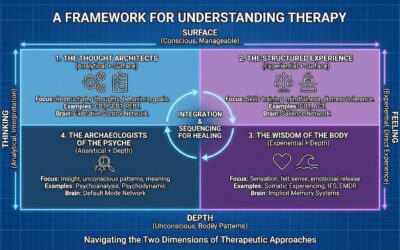
Albert Ellis, the founder of REBT, drove to the extreme of the Executive Control Network. He asserted that rational, forceful cognitive restructuring could overwrite neurotic suffering. He championed the absolute power of the prefrontal cortex to conquer fear through logic.
The Somatic Counterweight
Conversely, Dr. Peter Levine proved that severe trauma cannot be rationalized. Through Somatic Experiencing, he demonstrated that trauma lives biologically below cognition in the brain stem. He addressed the body's freeze response, proving that the nervous system must physically discharge survival energy before the cognitive brain can heal.
The Teleological Axis
Alfred Adler moved sharply away from Freud's deterministic obsession with the past. Mirroring Jung's "prospective function," Adler focused heavily on the individual's future-oriented drive toward superiority, significance, and profound social feeling.
The Relational Axis
Carl Rogers abandoned the archetype of the "analyst as expert" entirely. By prioritizing the Feeling axis, he proved that "unconditional positive regard" provides the ultimate relational container, allowing the patient's True Self to naturally individuate without clinical forceful direction.
The Dialectical Axis
Dr. Marsha Linehan essentially codified Jung's concept of the "transcendent function" into hard behavioral science. DBT forces the patient to hold two radically opposing truths simultaneously (Radical Acceptance vs. Behavioral Change), breaking the fundamentalist rigidity inherent to borderline states.
The Integration of the Shadow
Fritz Perls developed Gestalt therapy by focusing ruthlessly on the "here and now." Through techniques like the empty chair, he forced the immediate, experiential integration of split, projected, and denied parts of the psyche—a direct behavioral mirror of Jungian shadow work.
We even see this integration pushed to its ultimate limits by Arnold Mindell. Through Process-Oriented Psychology, Mindell bridged Jungian analysis with quantum physics and somatics, demonstrating that a psychological complex and a physical symptom are frequently the exact same dimensional energy expressing itself on different biological axes.
Similarly, the concept of psychological fragmentation was masterfully addressed by Hal and Sidra Stone through Voice Dialogue Therapy, proving that engaging directly with distinct "selves" is critical to systemic integration.
The Therapeutic Implications: The Phased Approach
Understanding these axes transforms how we think about clinical technique at Taproot Therapy Collective. It is not enough to possess a bag of interventions; we must understand which dimension of the nervous system each intervention addresses. The phased clinical approach that emerges from dimensional thinking operates as follows:
- Phase 1: Stabilization Through the Preferred Mode. Meet the patient precisely where they are strong. If they are heavily intellectual, engage their logic first. If they are somatic, begin with bodily regulation. You must validate their existing competence to build safety.
- Phase 2: Integration of the Underdeveloped Mode. Gradually introduce what is missing. Support the intellectual patient to feel the sensation in their chest. Guide the patient trapped in concrete panic toward recognizing broader psychological patterns. This addresses the patient's "needs," though it frequently feels threatening to their established ego identity.
- Phase 3: Dynamic Balance. The goal is not to replace one mode with another, but to develop profound neurological flexibility. This is what John Beebe’s Model and Jungian psychology strive for: the capacity to access different modes as environmental survival requires, holding opposites in creative tension.
The Living Matrix of Psychotherapy
Even peripheral historical figures like J.B. Rhine and Eugene Osty—the parapsychologists with whom Jung corresponded—represent the exploration of another crucial axis: the empirical versus the numinous. Their work reminds us that psychology must always attempt to hold seemingly irreconcilable opposites, searching for scientific methods to validate the reality of the soul.
We are rapidly moving from a historical model of competing clinical schools to an understanding of therapy as a multidimensional navigation of human neurobiology. The clinical art lies in precise assessment: Where is this person in this multidimensional space? What dimensions are overdeveloped as defensive fortresses?
At Taproot Therapy Collective, our clinicians specialize in mapping this matrix, utilizing advanced modalities to expand your capacity for wholeness.
Navigate Your Internal Architecture
True healing requires moving beyond the rigid confines of standard "talk therapy." Engage a clinical team equipped to navigate the full dimensionality of your nervous system.
Schedule an Assessment




















0 Comments