
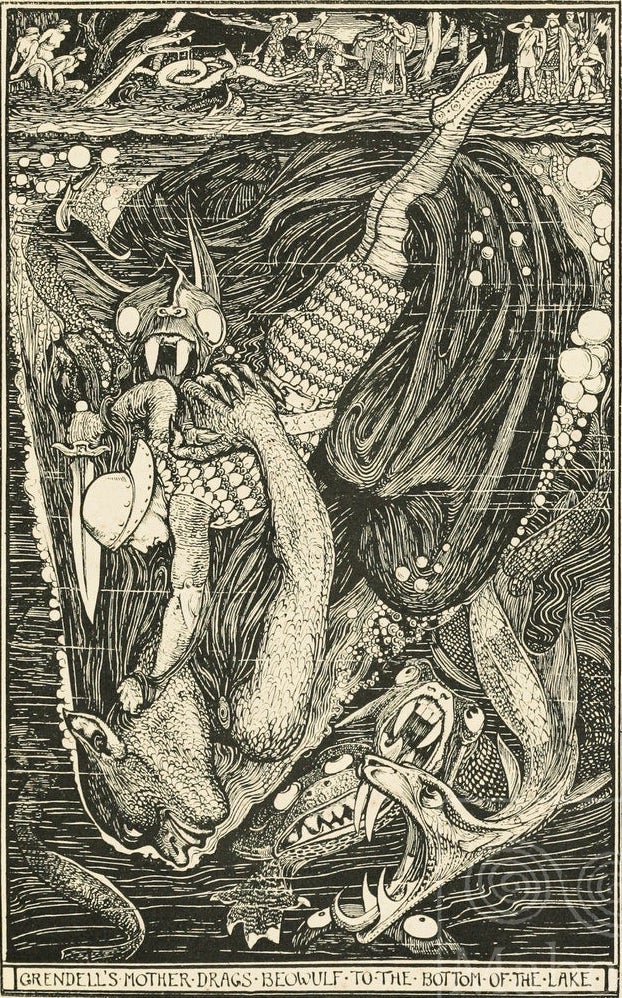
In the lexicon of Depth Psychology, few concepts are as heavy or as misunderstood as the “Mother Wound.” It is often dismissed as a grievance against one’s actual mother—a list of complaints about her being too critical, too distant, or too intrusive. But the Mother Wound is not just about a person; it is about an archetype. It is a rupture in our connection to the very source of life, safety, and nourishment.
While the Father Wound often manifests as a struggle with authority, success, and the “law,” the Mother Wound manifests as a struggle with existence itself. It is the vague, gnawing suspicion that you do not truly belong here, that your needs are “too much,” or that there is a bottomless hole in your chest that no amount of food, love, or success can fill. To heal it, we must go deeper than behavioral therapy; we must descend into the pre-verbal layers of the unconscious.
The Archetype of the Great Mother
To understand the wound, we must understand what was lost. Carl Jung and his student Erich Neumann described the “Great Mother” as the primary archetype of the human psyche. She is the container, the source, the earth itself. In a healthy development, the human mother acts as a “carrier” for this archetype. She provides a sense of containment so secure that the child learns to trust life.
When this containment fails—due to the mother’s own trauma, narcissism, or absence—the archetype splits. The child does not internalize the “Good Mother” (who soothes and protects); they internalize the “Terrible Mother” (who devours or abandons). This leaves the adult psyche without an internal floor. You might feel like you are perpetually “falling,” waiting for someone to catch you.
The “Dead Mother” Complex
One of the most profound descriptions of this wound comes from the French psychoanalyst André Green. He coined the term “The Dead Mother Complex.” This does not refer to a mother who has physically died, but to a mother who is psychically dead—depressed, dissociated, or emotionally unavailable.
The child of the “Dead Mother” learns a tragic lesson: “My liveliness is too much for her.” To stay connected to a depressed mother, the child dampens their own vitality. They become quiet, undemanding, and serious. They learn to “mother the mother,” sacrificing their own childhood to keep the parent emotionally afloat. As adults, these individuals often struggle with chronic depression that feels less like “sadness” and more like a blankness or deadness—an echo of the mother’s face they couldn’t animate.
Symptoms of the Unhealed Mother Wound
Because the mother is our first mirror, the Mother Wound distorts our self-image at the root. It often manifests as:
- The Performance of Worthiness: You believe you must “earn” your right to exist through achievement, caretaking, or perfectionism. You feel you are only as good as your last success.
- The “Hungry Ghost”: A feeling of insatiable emotional hunger. In relationships, you may become anxious or clingy, unconsciously demanding that your partner fill the void left by the mother.
- Rejection of the Body: The mother is the first template for the body. If she rejected her own femininity or physicality, you may struggle with eating disorders, body dysmorphia, or a disconnection from somatic sensation.
- Difficulty Soothing: You lack an internalized “soothing voice.” When things go wrong, your inner dialogue is harsh, critical, or panicked (the Inner Critic), rather than comforting.
Healing: From the Personal to the Archetypal
Healing the Mother Wound is not about blaming your actual mother. In fact, staying stuck in blame keeps you tied to her as a child. True healing involves two movements: Grieving and Mothering the Self.
1. The Grieving Process
You must grieve the mother you needed but did not get. This is painful work. It requires acknowledging that the “hole” in your heart is real and that your actual mother cannot fill it. No apology from her will fix it. This realization forces you to stop going to the empty well for water.
2. Internalizing the Good Mother
Since the archetype was not installed properly in childhood, we must install it now. This is the work of Inner Child Work and active imagination. We must learn to treat our own vulnerable “younger self” with the compassion, patience, and warmth we craved.
In therapy, the therapist often acts as a temporary “Good Mother,” providing the containment and attunement the client missed. Over time, the client internalizes this voice. They learn to self-soothe. They learn that their needs are valid. They learn to hold themselves.
The Somatic Component
Finally, because the Mother Wound is pre-verbal, it lives in the body. It is often stored in the gut (the center of nourishment) or the chest (the center of heart-connection). Somatic therapy is crucial here. We cannot just talk about the wound; we must help the nervous system feel held.
Techniques like weighted blankets, self-holding exercises, and “grounding” into the earth (the ultimate Mother) help the body register a safety it never knew. The goal is to move from a state of “falling” to a state of being “held”—not by a person, but by the Self.
The Mother Wound is deep, but it is not a life sentence. It is an invitation to birth yourself. By doing this work, you break the lineage of pain and step into your own authority, no longer an orphan of the spirit, but a child of life itself.
Select Bibliography
- Green, A. (1986). On Private Madness. Karnac Books. (Contains the essay “The Dead Mother”).
- Neumann, E. (1955). The Great Mother: An Analysis of the Archetype. Princeton University Press.
- Woodman, M. (1985). The Pregnant Virgin: A Process of Psychological Transformation. Inner City Books.
- Leonard, L. S. (1982). The Wounded Woman: Healing the Father-Daughter Relationship (Contains parallels to the mother wound). Shambhala.







0 Comments