
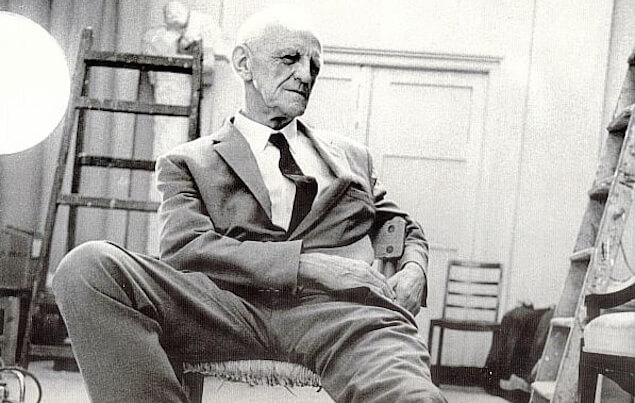
Donald Winnicott’s “good enough mother” is a caregiver who first adapts almost completely to a newborn’s needs, then adapts a little less as the baby can bear it. The English paediatrician and psychoanalyst described it in several writings, including his 1953 paper on transitional objects.12 He did not mean average parenting. He meant that gradual, survivable failure is how a child finds reality and a self.
Read clinically, the good enough mother is a theory of tolerable failure. A self becomes real through care that is reliable, fails in doses a person can survive, and then repairs, not through care that never fails. Therapy works the same way. It helps less by explaining people to themselves than by recreating that sequence: a steady relationship that holds, followed by small failures that are noticed, survived and put right.
What “good enough” actually meant
Around the birth, Winnicott thought, a good enough mother is in a state he called “primary maternal preoccupation.” She sets her own interests aside, feeds the baby when it is hungry and comforts it when it cries, with such accuracy that the baby can feel as if its own wishes make things appear.2 This illusion of omnipotence protects the baby from learning too soon how small and dependent it is.3
Then, as the baby grows, she gradually returns to her own life and stops responding instantly. The baby discovers that the world is not run by its desires, and a sense of self and other begins to form.2 The failures matter as much as the care: a parent who met every need perfectly, forever, would leave the child inside the illusion, with no reason to discover that other people are separate. What makes the loss bearable is what he called “the good-enough environmental provision,” which lets a child “cope with the immense shock of loss of omnipotence.”4 The 1953 paper ends by tying the whole intermediate area of experience to “good enough mothering at the early critical phase” and to “continuity (in time) of the external emotional environment.”12
The phrase was also a defence of ordinary parents. Winnicott spent years talking to them on BBC radio, and he insisted that “the foundations of health are laid down by the ordinary mother in her ordinary loving care of her own baby.”5 “Good enough” had two targets: the growing confidence of professionals that they knew better than parents, and the idealised “good mother” of Kleinian theory, which no real parent could match.4 He described the good enough mother as the infant’s “facilitating environment,”2 and the idea was meant to defend ordinary mothers and fathers alike, which is why many writers now say “good enough parent.”4
Who Donald Winnicott was
Donald Woods Winnicott was born in Plymouth, Devon, on 7 April 1896, into a prosperous Methodist family, and grew up with two sisters. His father, John Frederick Winnicott, was a partner in the family’s hardware business, twice mayor of Plymouth, and was knighted in 1924. His mother, Elizabeth Martha Woods, tended toward depression. The household looked happy from outside, and Winnicott later described his early childhood as trying to make “my living” by keeping his mother alive.3 Some writers think that is where the false self came from: a boy who learned early to be good for a mother who needed it.
He boarded at The Leys School in Cambridge and began pre-clinical studies at Jesus College, Cambridge, in 1914. The war made him a medical trainee; in 1917 he joined the Royal Navy as a medical officer on the destroyer HMS Lucifer, and he qualified at St Bartholomew’s Hospital in London in 1920. In 1923 he married the artist Alice Taylor, began a ten-year analysis with James Strachey, Freud’s English translator, and took a post at Paddington Green Children’s Hospital, where he worked for 40 years. A second analysis, with Joan Riviere, began in 1936.3
The British Psychoanalytical Society was splitting between the followers of Anna Freud and those of Melanie Klein. The wartime Controversial Discussions ended in a truce among three groups, and Winnicott belonged to the Middle Group, later the Independents, with Ronald Fairbairn, Michael Balint, Masud Khan, John Bowlby, Marion Milner and Margaret Little.3 Our piece on Ronald Fairbairn’s object relations theory covers a colleague whose ideas often ran parallel to his.
In the Second World War he was a medical consultant to the evacuation scheme for children, visiting the Oxfordshire scheme every week. There he met Clare Britton, a psychiatric social worker organising care for evacuated children. They wrote together about homeless children in 1944 and married in 1951 after his divorce, and she became arguably his chief professional collaborator.36 His BBC talks, beginning in 1943, ran to more than sixty. He was twice president of the British Psychoanalytical Society, from 1956 to 1959 and from 1965 to 1968, and he died in London on 25 January 1971 after a series of heart attacks. Playing and Reality came out the same year.3
The theory is hard to separate from that setting: Britain was sending its children away from their parents by the trainload, and a paediatrician was watching what happened. Clare Britton’s work fed the reforms behind the Children Act 1948, which created a comprehensive child-care service.6 Winnicott’s 1956 paper on the antisocial tendency read a deprived child’s stealing and destructiveness as signs of hope: stealing as a search for something good that had once existed and been lost, destructiveness as a search for a setting strong enough to hold it.3
Holding, the false self and the cost of compliance
“There is no such thing as a baby,” Winnicott wrote: wherever you see a baby, you also see someone looking after it.25 His word for what that someone provides is holding, and it begins literally. The mother’s “technique of holding, of bathing, of feeding, everything she did for the baby, added up to the child’s first idea of the mother.”5 The psychoanalyst Thomas Ogden reads holding as a concept about time and being: the mother protects the infant’s “continuity of being,” and growing up means slowly taking over that holding oneself.7
When holding fails badly or often, the baby protects itself with whatever crude defences it has. One of the main ones, in Winnicott’s 1960 paper “Ego Distortion in Terms of True and False Self,” is compliance.8 The child learns to anticipate what the caregiver needs and to supply it. A baby with a severely depressed caregiver, for example, may give up spontaneous demands and work instead at being a “good baby” who can earn a response.3 Through the false self, he wrote, the infant “builds up a false set of relationships, and by means of introjections even attains a show of being real.”89
Two qualifications matter. Everyone has a false self, and in health it is simply the polite manner we use in public. The trouble starts when it is the only self available, when a person can perform success but feels empty, unreal or “phoney” underneath.3 And the true self is not a finished person hidden in a closet. “Only the true self can be creative and only the true self can feel real,” he wrote, but he described it mostly as spontaneous gesture and the bare sense of being alive.8 Alice Miller later warned that some patients have no formed true self waiting behind the façade, so therapy may have to help one develop rather than simply uncover it.9 Heinz Kohut carried the idea into narcissism, as our article on Kohut’s self psychology follows.
Holding does not mean being nice. In “Hate in the Counter-Transference” (1949), Winnicott wrote that an analyst “has to display all the patience and tolerance and reliability of a mother devoted to her infant, has to recognize the patient’s wishes as needs, has to put aside other interests in order to be available and to be punctual, and objective.” He added that the analyst’s hate “is often engendered by the very things the patient does in his crude way of loving.”10 Reliable care includes honest knowledge of one’s own resentment, held rather than acted out.
Transitional objects, play and the capacity to be alone
The 1953 paper’s subject was the blanket or soft toy a toddler cannot sleep without. Winnicott called it the first “not-me” possession. The baby assumes rights over it, loves and mauls it, will not let anyone change it, and needs it to survive both. In the end it is not so much forgotten as “relegated to limbo.”3 He first presented the paper in 1951 and kept revising it; the fourth and final version appeared in Playing and Reality.31112
The point is the paradox. Nobody asks a toddler whether the bear is real or made up, and Winnicott thought nobody should. The object lives in an intermediate area, neither inside nor outside, that he called potential space. Play happens there, and later art, religion and what he called “this ‘third area’, that of cultural experience which is a derivative of play.”3 Ogden reads the paper as an account of how ideas, feelings and bodily sensations come to feel alive and real.12 Read from a Jungian chair, this is the part of Winnicott that sits nearest to Jung’s interest in the symbol, though he reached it by a different road.
The capacity to be alone, in his 1958 paper of that name, grows the same way. Winnicott distinguished it from withdrawal and from loneliness and traced it to an internalised, non-intrusive background presence: the child first learns to be alone in the presence of someone, the way a toddler plays absorbedly while a parent reads nearby.1314 Comfortable solitude is held solitude, taken inside.
One of his last papers went furthest. In “The Use of an Object and Relating through Identifications,” presented in 1968, the other person becomes real, not just a figure in the child’s fantasy, by surviving the child’s destructiveness. Ogden adds a hard clinical corollary: an analyst sometimes cannot survive a particular patient’s attacks and has to be able to admit it.1516 His unfinished paper “Fear of Breakdown” describes people who dread a collapse that already happened in infancy but was never experienced, because the infant had to face it alone.17 Jan Abram notes that Winnicott’s whole concept of trauma rests on early environmental failure, which is why he called psychosis “an environmental deficiency disease.”18
What the research supports, and where the theory is thin
Winnicott built his theory in the clinic, not in experiments. Later research tests pieces of it, with mixed and useful results.
The strongest support comes from infant research on repair. In 1978 Edward Tronick and colleagues described what became the still-face procedure, in which a parent who has been playing face to face with an infant suddenly holds a blank, unresponsive face.19 A 2018 meta-analysis calls the classic still-face effect confirmed: infants look away more and show less positive and more negative affect. Infants of depressed mothers showed the same effect and also more positive affect during the still face, which the authors suggest may be an amplified bid for the mother’s attention, or a way for the infant to regulate its own distress.20 That echoes Winnicott’s baby working to reach a depressed caregiver, but it is one interpretation, not proof. Tronick’s 1989 review makes the good enough point in research language: healthy development seems tied not to error-free interaction but to “frequent reparations of interactive errors,” while sustained interactive failure goes with poorer development.21 The attachment research behind Mary Ainsworth’s Strange Situation is the empirical cousin of the same intuition.
Transitional objects are common but not universal. A 1976 cross-cultural study found blanket-type attachments in roughly half of American children and about a fifth of Korean children.2223 A 1981 study of 285 children in two paediatric populations that differed in race and socioeconomic status found significant differences between the groups in how often and how early children adopted such objects, and child-rearing practices and maternal attitudes were also related to whether attachments developed.24 A 1986 review checked the theories against the data and treated the object as a developmental facilitator whose function can change as a child grows, rather than the essential phase Winnicott proposed.25 A child without a blanket is not missing a step.
The capacity to be alone has been measured. In a 1996 telephone survey of 500 U.S. adults, comfort with being alone went with lower depression, fewer physical symptoms and greater life satisfaction, but it did not buffer stress as predicted.26 The data are correlational and cannot show where the capacity comes from.
The criticisms are real. Critics have argued that Winnicott idealised the mother and baby, downplayed sexuality and romanticised childhood play, and Kleinians saw his rejection of envy and the death drive as a retreat from hard facts of infant life.3 His language also loads a child’s fate onto mothers, when outcomes depend on temperament, poverty, illness and luck as well. Take the idea as a clinician’s model of how selves form, partly supported by infant research, not a verdict on any parent.
What this looks like in therapy
Winnicott’s most practical gift to psychotherapy is the idea that the setting itself does part of the work. The same hour each week, the same room, a therapist who starts on time, remembers what was said and is not thrown by strong feeling: that is holding, and it is often what a person never reliably had. In 1976 the American analyst Arnold Modell wrote the holding environment into the account of how psychoanalysis changes people.27 The broader research fits, though it cannot prove cause. A meta-analysis of 295 studies and more than 30,000 patients found a correlation of about .28 between the strength of the therapeutic alliance and outcome, consistent across treatment approaches.28
Holding does not replace interpretation. Winnicott thought a well-timed interpretation could itself give a patient the feeling of being held.2 But he valued insight that arrived as the patient’s own discovery, and he worried that interpretations pressed on a compliant patient only trained the false self to agree.3 Some people are excellent patients who bring insights, agree with everything and never complain. In Winnicott’s terms that can be the false self doing therapy, and a good therapist gets curious when someone has never once disagreed.
Then comes the graduated failure. Every therapist misunderstands, mistimes a comment, takes a vacation. Handled well, those moments are the good enough sequence in miniature: the failure is named, the client’s reaction is welcomed, and the relationship survives. A meta-analysis of 11 studies with 1,314 patients found that resolving alliance ruptures was moderately associated with better outcomes (r = .29). A second analysis in the same paper found that training therapists in rupture resolution did not significantly improve outcomes.29 The repair finding is correlational, and the training result is a caution against treating repair as a technique that can simply be taught. What the evidence supports is modest: when a strain in the relationship is noticed and worked through, outcomes tend to be better.
Anger at the therapist belongs here too. When a client finally says the work is useless or the therapist is cold, Winnicott would ask whether the therapist can survive it, neither retaliating nor collapsing into apology. For someone whose caregiver could not tolerate protest, that survival may be the first evidence that another person is real and separate.15
Play matters, even for adults: a dream image worked with rather than decoded, a shared joke, a metaphor the client picks up and changes. Parts-based therapies describe something like the false self in other language, as protective parts that took charge early to keep a child safe, which makes Winnicott a natural companion to Internal Family Systems therapy as well as to depth work. For trauma, “Fear of Breakdown” offers a humane frame: some fears point backward, to something that happened before there were words or anyone to share it with.17 For the history, see the move from Freud’s drive theory to relational models, Margaret Mahler’s work on separation and individuation, and the American parallel in Harry Stack Sullivan’s interpersonal psychiatry.
If some of this sounds familiar, such as being the reliable one who never felt held, or a life that works on paper but does not feel real, that is the kind of thing depth therapy at Taproot takes seriously, in Hoover or by teletherapy across Alabama. You can reach us here when you are ready.
References
- Winnicott, D. W. (1953). Transitional objects and transitional phenomena: A study of the first not-me possession. International Journal of Psycho-Analysis, 34(2), 89–97. https://pubmed.ncbi.nlm.nih.gov/13061115/
- Xie, Z., Yan, Y., & Peng, K. (2023). Pragmatism or idealism: A systematic review and visual analysis of Winnicott’s psychoanalytical treatment views. Frontiers in Psychiatry, 14, Article 1237005. https://doi.org/10.3389/fpsyt.2023.1237005
- Wikipedia contributors. (2026). Donald Winnicott. In Wikipedia, The Free Encyclopedia. Retrieved November 8, 2026, from https://en.wikipedia.org/wiki/Donald_Winnicott
- Wikipedia contributors. (2026). Good enough parent. In Wikipedia, The Free Encyclopedia. Retrieved November 8, 2026, from https://en.wikipedia.org/wiki/Good_enough_parent
- Winnicott, D. W. (1964). The child, the family, and the outside world. Penguin Books.
- Wikipedia contributors. (2026). Clare Winnicott. In Wikipedia, The Free Encyclopedia. Retrieved November 8, 2026, from https://en.wikipedia.org/wiki/Clare_Winnicott
- Ogden, T. H. (2004). On holding and containing, being and dreaming. The International Journal of Psychoanalysis, 85(6), 1349–1364. https://doi.org/10.1516/T41H-DGUX-9JY4-GQC7
- Winnicott, D. W. (1965). Ego distortion in terms of true and false self (1960). In The maturational processes and the facilitating environment: Studies in the theory of emotional development (pp. 140–152). Hogarth Press and the Institute of Psycho-Analysis.
- Wikipedia contributors. (2026). True self and false self. In Wikipedia, The Free Encyclopedia. Retrieved November 8, 2026, from https://en.wikipedia.org/wiki/True_self_and_false_self
- Winnicott, D. W. (1994). Hate in the counter-transference. Journal of Psychotherapy Practice and Research, 3(4), 348–356. (Original work published 1949 in the International Journal of Psycho-Analysis) https://pubmed.ncbi.nlm.nih.gov/22700203/
- Winnicott, D. W. (1971). Playing and reality. Tavistock Publications.
- Ogden, T. H. (2021). What alive means: On Winnicott’s “Transitional objects and transitional phenomena.” The International Journal of Psychoanalysis, 102(5), 837–856. https://doi.org/10.1080/00207578.2021.1935265
- Winnicott, D. W. (1958). The capacity to be alone. International Journal of Psycho-Analysis, 39(5), 416–420. https://pubmed.ncbi.nlm.nih.gov/13610513/
- Wikipedia contributors. (2026). Capacity to be alone. In Wikipedia, The Free Encyclopedia. Retrieved November 8, 2026, from https://en.wikipedia.org/wiki/Capacity_to_be_alone
- Ogden, T. H. (2016). Destruction reconceived: On Winnicott’s “The use of an object and relating through identifications.” The International Journal of Psychoanalysis, 97(5), 1243–1262. https://doi.org/10.1111/1745-8315.12554
- Fabozzi, P. (2016). The use of the analyst and the sense of being real: The clinical meaning of Winnicott’s “The use of an object.” The Psychoanalytic Quarterly, 85(1), 1–34. https://doi.org/10.1002/psaq.12056
- Ogden, T. H. (2014). Fear of breakdown and the unlived life. The International Journal of Psychoanalysis, 95(2), 205–223. https://doi.org/10.1111/1745-8315.12148
- Abram, J. (2021). On Winnicott’s concept of trauma. The International Journal of Psychoanalysis, 102(4), 778–793. https://doi.org/10.1080/00207578.2021.1932079
- Tronick, E., Als, H., Adamson, L., Wise, S., & Brazelton, T. B. (1978). The infant’s response to entrapment between contradictory messages in face-to-face interaction. Journal of the American Academy of Child Psychiatry, 17(1), 1–13. https://doi.org/10.1016/S0002-7138(09)62273-1
- Graham, K. A., Blissett, J., Antoniou, E. E., Zeegers, M. P., & McCleery, J. P. (2018). Effects of maternal depression in the Still-Face Paradigm: A meta-analysis. Infant Behavior and Development, 50, 154–164. https://doi.org/10.1016/j.infbeh.2017.12.001
- Tronick, E. Z. (1989). Emotions and emotional communication in infants. American Psychologist, 44(2), 112–119. https://doi.org/10.1037/0003-066X.44.2.112
- Hong, K. M., & Townes, B. D. (1976). Infants’ attachment to inanimate objects: A cross-cultural study. Journal of the American Academy of Child Psychiatry, 15(1), 49–61. https://doi.org/10.1016/S0002-7138(09)62260-3
- Wikipedia contributors. (2026). Comfort object. In Wikipedia, The Free Encyclopedia. Retrieved November 8, 2026, from https://en.wikipedia.org/wiki/Comfort_object
- Litt, C. J. (1981). Children’s attachment to transitional objects: A study of two pediatric populations. American Journal of Orthopsychiatry, 51(1), 131–139. https://doi.org/10.1111/j.1939-0025.1981.tb01355.x
- Litt, C. J. (1986). Theories of transitional object attachment: An overview. International Journal of Behavioral Development, 9(3), 383–399. https://doi.org/10.1177/016502548600900308
- Larson, R., & Lee, M. (1996). The capacity to be alone as a stress buffer. The Journal of Social Psychology, 136(1), 5–16. https://doi.org/10.1080/00224545.1996.9923024
- Modell, A. H. (1976). “The holding environment” and the therapeutic action of psychoanalysis. Journal of the American Psychoanalytic Association, 24(2), 285–307. https://doi.org/10.1177/000306517602400202
- Flückiger, C., Del Re, A. C., Wampold, B. E., & Horvath, A. O. (2018). The alliance in adult psychotherapy: A meta-analytic synthesis. Psychotherapy, 55(4), 316–340. https://doi.org/10.1037/pst0000172
- Eubanks, C. F., Muran, J. C., & Safran, J. D. (2018). Alliance rupture repair: A meta-analysis. Psychotherapy, 55(4), 508–519. https://doi.org/10.1037/pst0000185
























0 Comments