

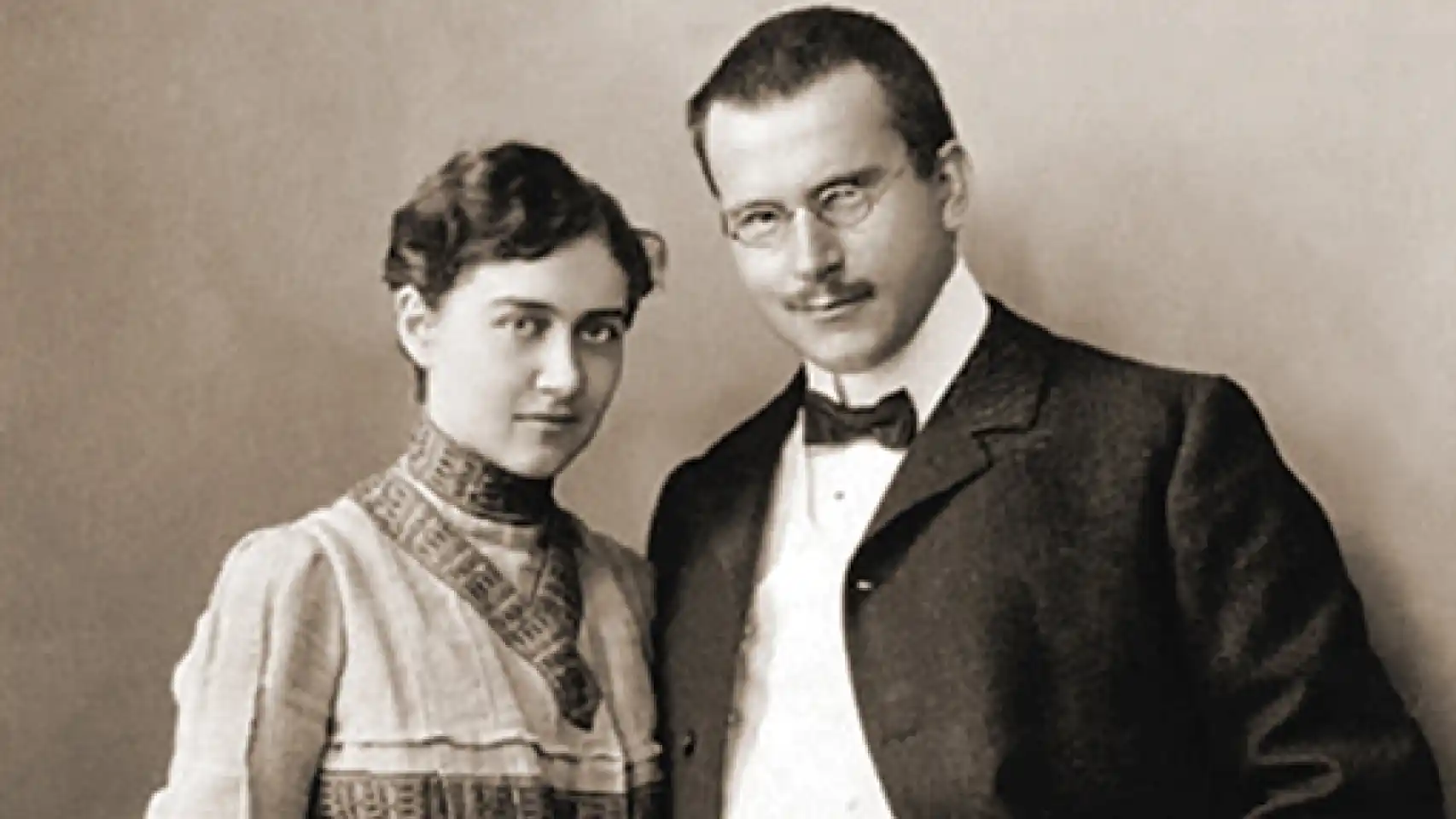
Emma Jung (1882–1955) was a Swiss analyst and writer who helped build analytical psychology from the inside. Born Emma Rauschenbach, she married Carl Jung in 1903, served as the first president of the Psychological Club in Zurich, practised as an analyst from about 1930, wrote a classic essay on the animus, and spent three decades on a psychological study of the Grail legend.
Key takeaways
- Emma Jung was an analyst, lecturer and author in her own right, not only the wife of Carl Jung.
- She was the first president of the Psychological Club in Zurich, founded in 1916, and began practising as an analyst around 1930.
- Her 1931 animus lecture, published in 1934, described the negative and positive animus and argued that a woman should differentiate the animus, not eliminate it.
- She worked on the Grail legend for about thirty years; Marie-Louise von Franz completed the book, published in German in 1960 and in English in 1970.
- Her steady holding of family and movement through Jung’s confrontation with the unconscious illustrates the clinical idea of containment used in trauma therapy.
Who was Emma Jung beyond being Carl Jung’s wife?
History has often filed Emma Jung under one heading: the wife of Carl Jung. That label misses most of what she did. She was a working analyst, a lecturer, an author, an administrator of the early Jungian institutions and the person who held together a household and a movement through some very unstable years.
While Carl Jung was charting the collective unconscious, Emma was building structures, intellectual and institutional, through which those ideas could be taught and passed on. Her own writings, lectures, poems, letters and drawings were gathered and published for the first time as a single collection in 2025, under the title Dedicated to the Soul, and they show a thinker with her own voice rather than an echo of her husband’s.3
Two pieces of her work matter most for psychology. Her essay on the animus, first given as a lecture in 1931, remains one of the clearest accounts of how the inner masculine figure behaves in a woman’s psyche.1 Her long study of the Grail legend, unfinished at her death and completed by Marie-Louise von Franz, reads the medieval Grail romances as a record of the development of Western consciousness.2
Biography and timeline: Emma Jung’s life
Emma Rauschenbach was born on 30 March 1882 in Schaffhausen, Switzerland. Her father, Johannes Rauschenbach, was an industrialist and the owner of the International Watch Company (IWC) in Schaffhausen, which made the family one of the wealthiest in the country. Her father did not give her the university education she wanted, a gap she spent the rest of her life making up through her own reading and study.5
She first met Carl Jung as a schoolgirl, and the young psychiatrist was struck by her early on. They married in 1903. Emma’s inheritance gave the couple financial freedom: it paid for the house they built on the lake at Küsnacht, completed in 1909, and it allowed Jung to leave his post at the Burghölzli hospital that year and later his university lectureship, so that he could pursue his own research and private practice without depending on an academic salary.5
Emma was not content to be the household’s financier. She took part in the early psychoanalytic world around her husband, read the literature, attended congresses and, by 1913, was giving her own lectures on the psychology of fairy tales.3 In the autumn of 1911 she wrote to Sigmund Freud, trying with tact and directness to ease the strain growing between the two men. Her letters, preserved in The Freud/Jung Letters, show her psychological perceptiveness as clearly as anything she later published.4 The break that followed is described in our piece on the split between Jung and Freud.
Her marriage carried real emotional weight. She bore the strain of Jung’s attachment to Sabina Spielrein, his former patient at the Burghölzli, and later the long relationship with Toni Wolff, which lasted from the 1910s until Wolff’s death in 1953. Catrine Clay’s biography Labyrinths traces how Emma, over decades, refused both to leave and to disappear, and kept her own dignity and intellectual independence.5
Key milestones in the life of Emma Jung
| Year | Event / Publication |
| 1882 | Born in Schaffhausen, Switzerland. |
| 1903 | Marries Carl Jung. |
| 1910 | Begins her own analytic practice. |
| 1916 | Becomes the first president of the Psychological Club of Zurich. |
| 1934 | Publishes “On the Nature of the Animus,” a groundbreaking essay on feminine psychology. |
| 1955 | Dies in Zurich; her work on the Grail Legend is left unfinished. |
- 1882: born Emma Rauschenbach in Schaffhausen on 30 March.
- 1903: marries Carl Jung. Their five children, Agathe, Gret, Franz, Marianne and Helene, are born between 1904 and 1914.
- 1909: the family moves into the house at Küsnacht, paid for with Rauschenbach money.
- 1911: writes to Freud during the crisis in his friendship with Jung.
- 1913: gives an early lecture on the fairy tale of the two brothers.
- 1916: becomes the first president of the newly founded Psychological Club in Zurich.
- Around 1930: begins seeing patients as an analyst in her own right.
- 1931: lectures at the Psychological Club on the problem of the animus, published in 1934.
- 1948: the C. G. Jung Institute opens in Zurich, where she teaches and later serves in its leadership.
- 1955: dies at Küsnacht on 27 November, her Grail manuscript unfinished.
- 1960: Die Graalslegende in psychologischer Sicht appears, completed by Marie-Louise von Franz. The English translation follows in 1970.
What was the Psychological Club in Zurich?
The Psychological Club was founded in Zurich in early 1916 as a meeting place for Jung’s patients, students and colleagues, funded largely by Edith Rockefeller McCormick, who was in analysis with Jung at the time. It gave analytical psychology a social and intellectual home before there was any training institute, with lectures, discussions and a library.11
Emma Jung was its first president. Running the Club meant handling the personalities, rivalries and enthusiasms of a group of people who were, many of them, in analysis with the same man. Toni Wolff later held the presidency from 1928 to 1945. The Club was also where Emma first presented much of her own work, including the 1931 animus lecture and, in the 1940s, summaries of her Grail research.3
The analysts who came through the Club and later the C. G. Jung Institute included Barbara Hannah, whose biography of Jung describes the Club and the Jung household from close range, and Jolande Jacobi, who pushed for the founding of the Institute in 1948.11
What did Emma Jung say about the animus?
In Jung’s model, the animus is the masculine inner figure in a woman’s psyche, the counterpart of the anima in a man. Carl Jung described the concept, but it was Emma who gave it a detailed phenomenology. Her essay “On the Nature of the Animus” began as a lecture to the Psychological Club in November 1931 and was published in 1934 in Jung’s volume Wirklichkeit der Seele. In English it appears with her later anima essay in the small book Animus and Anima.1
The animus as logos
Emma Jung treated the animus as the carrier of what Jung called logos: discernment, judgment, the capacity for ideas and purposeful action. She used Goethe‘s Faust, whose hero tries to translate the opening of John’s Gospel as “In the beginning was the Word”, then “the Meaning”, then “the Power”, and finally “the Deed”, as a map of the forms the animus can take. It may appear as physical strength and action, as the authority of the spoken word, or as a guide toward meaning.1
The negative and the positive animus
She distinguished a negative animus from a positive one. The negative animus shows up as rigid opinions, sweeping generalisations, argumentative logic and an inner voice that says what “one” must do or that dismisses a woman’s own efforts. It speaks in borrowed judgments rather than thought she has worked out for herself. The positive animus, by contrast, acts as a bridge to spirit and intellectual clarity, a source of focus and of creative work.1
Her central argument was that a woman’s task is not to get rid of the animus but to differentiate it: to recognise its voice, take back what she projects onto men, and give its energy a conscious outlet. When a woman takes up real intellectual or creative work, the animus has something constructive to do, and it stops possessing her personality from behind. Emma wrote this as someone living out the problem herself, in a marriage to a man onto whom many people projected exactly this kind of authority.
Her second essay, “The Anima as an Elemental Being” (1955), turned to the man’s inner feminine. She traced the anima through folklore and literature figures such as Melusine, swan maidens and water spirits, beings half human and half nature, and argued that these figures show the anima’s link to nature and to the instinctive side of life.1 For a practical view of how these figures appear between partners, see the anima and animus in relationships.
Later Jungian writers on the feminine built on the ground she prepared, among them Esther Harding in Woman’s Mysteries and, a generation later, Marion Woodman.
What is The Grail Legend about?
Emma Jung worked on the Grail for about thirty years, from the 1920s until her death. Jung left the subject to her and did not write his own study of it. When she died in 1955, the manuscript was incomplete, and Marie-Louise von Franz finished it. The book appeared in German in 1960 as Die Graalslegende in psychologischer Sicht and in English, translated by Andrea Dykes, as The Grail Legend in 1970.2
The Grail as a dream of the Western psyche
Emma saw the Grail stories, beginning with Chrétien de Troyes’ unfinished Perceval of the late twelfth century and continuing through Wolfram von Eschenbach’s Parzival and Robert de Boron’s Joseph of Arimathea story, not just as medieval romances but as something like a collective dream. Read the way an analyst reads a dream, the stories show what the culture of their time had left out and was trying to bring back.2
The Grail itself is a vessel, a container, and the book treats it as an image of the Self and of the feminine, receptive principle. Its argument is that Christian culture had raised up spirit and set aside nature, the body, the feminine and the problem of evil, and that the Grail romances worked to restore what had been split off. The quest for the Grail is a quest to bring the vessel back into relationship with the masculine spirit.2
Perceval’s question and the Fisher King
At the centre of the story is a failure of feeling. The young knight Perceval reaches the castle of the wounded Fisher King, sees the Grail procession, and stays silent because he has been taught that a knight does not ask questions. Had he asked whom the Grail serves, or what ails the king, the king would have been healed and the waste land restored. Emma and von Franz read this as the moment where convention overrides compassion: the feeling function, in Jung’s terms, is what was missing.2
The final chapters turn to Merlin, whom the book reads as a figure carrying the unresolved problems of the Christian era forward, a forerunner of the person who can hold the opposites together. That theme, the integration of what was split off, runs through Jungian work on the shadow and the tension of opposites.
Emma Jung and the idea of the container
Emma Jung’s life also illustrates a clinical idea she did not name herself: containment. In therapy, the container is the reliable relationship in which a person’s fragmented or overwhelming experience can be held long enough to be felt, thought about and integrated. Donald Winnicott called it the holding environment, drawing on the way a good enough mother holds an infant through states the infant cannot manage alone.9 Wilfred Bion described the container and the contained: the therapist takes in what the patient cannot bear, processes it, and returns it in a form that can be thought.10 More on each is in our pieces on Donald Winnicott and Wilfred Bion.
Holding the tension
From late 1913 Carl Jung went through the period he later called his “confrontation with the unconscious”, a flood of visions and fantasies that he recorded and painted in what became The Red Book.67 The historian Henri Ellenberger later called episodes like this a “creative illness”.8 Jung himself wrote that his family and his practice were what kept him anchored in ordinary reality during those years.6
Emma provided much of that anchor. She ran the household, raised five children, kept the practical life of the family going, and stayed in relationship with a husband who was at times barely reachable. She did this while the relationship with Toni Wolff was at its most intense. That is a container in the full sense: steady presence that neither collapses nor retaliates.
The clinical relevance is direct. In trauma therapy, the therapist often plays a part like the one Emma played. We have to hold a client’s chaos, fear and anger without collapsing into it and without pushing back against it. That holding, repeated over time, lets a client gradually take in a sense of safety that was missing, and eventually hold their own experience.
How does Emma Jung’s work show up in therapy today?
Her animus essay is still practical clinical material. Many people, women and men, live with an inner critic that speaks in absolutes: you always get this wrong, everyone can see you are a fraud. In Jungian work we treat that voice as a figure in the psyche with its own history rather than as the truth about the person. We listen for whose voice it echoes, where it took shape, and what energy is trapped in it that could go into work, study or creative effort instead.
Her Grail study gives a therapist a model for the question that heals. Much of therapy is learning to ask, and to let a client ask, the question that convention forbade: what is wrong here, what happened to me, what do I need. Clients raised in families where nobody asked often carry a wounded king of their own, a part of life that has gone barren, and the work begins when someone finally asks.
Her life is also a case study in containment, which is the base of any trauma work. At Taproot we combine depth-psychological work with brain-based and body-based methods such as Brainspotting and somatic therapy. These approaches depend on the same steady attunement: the therapist stays present while a client’s nervous system processes what was too much to feel at the time, so the experience can settle rather than overwhelm.
Why does Emma Jung matter for analytical psychology?
Without Emma Jung, analytical psychology would look very different, and might not have survived its early years in the same form. Her money gave Jung the freedom to work outside academic medicine. Her leadership of the Psychological Club gave the movement an institution. Her lectures, teaching and later role at the C. G. Jung Institute trained analysts who carried the work abroad. Her correspondence and writings show a woman of insight, patience and sharp intelligence.3
For modern women she is a complex model of how to keep one’s own centre in the presence of a powerful and often overwhelming partner. She did not do it by withdrawing, and she did not do it by vanishing into his life. She did it by developing her own work alongside his, slowly and over decades. Her life suggests that the feminine power of containment is not passive: it is an active, structural force that makes transformation possible.
Readers who want to keep going with the women of the early Jungian circle can start with Marie-Louise von Franz, Toni Wolff, Barbara Hannah and Jolande Jacobi, and with Jean Shinoda Bolen for a later generation’s map of the feminine psyche.
Emma Jung’s work on the animus, the Grail and the quiet labour of holding things together still informs how we practise. If you want to work with the inner figures, inherited voices and old injuries she wrote about, our therapists at Taproot offer Jungian and trauma-focused therapy in Hoover and Birmingham, and you can reach us through our contact page.
Frequently asked questions
Was Emma Jung a psychoanalyst?
Yes. Emma Jung trained within her husband’s circle, lectured at the Psychological Club in Zurich from the 1910s, and began seeing patients as an analyst around 1930. She later taught at the C. G. Jung Institute in Zurich, which opened in 1948, and wrote two well-known essays on the animus and the anima.
What did Emma Jung write?
Emma Jung’s main published works are the essays collected in Animus and Anima, on the animus (1934) and on the anima as an elemental being (1955), and The Grail Legend, completed by Marie-Louise von Franz and published in 1960. Her lectures, poems, letters and drawings appeared together in Dedicated to the Soul in 2025.
Who finished Emma Jung’s book on the Grail?
Marie-Louise von Franz finished it. Emma Jung had worked on the Grail romances for about thirty years but left the manuscript incomplete when she died in November 1955. Von Franz completed the study, adding the closing chapters on Merlin, and it was published in German in 1960 and in English translation in 1970.
What is the negative animus according to Emma Jung?
For Emma Jung, the negative animus is the inner masculine figure in a woman acting without her awareness. It shows up as rigid opinions, borrowed judgments, argumentative logic and an inner voice that devalues her efforts. She argued the answer is to recognise it and give its energy conscious intellectual or creative work.
How did Emma Jung’s money help Carl Jung?
Emma Jung came from the Rauschenbach family, owners of the IWC watch company in Schaffhausen. Her inheritance paid for the Küsnacht house completed in 1909 and gave Carl Jung the freedom to leave hospital and university posts and build his own research and private practice.
Related reading
- Laurence Heller: The Clinical Psychologist Who Mapped How Developmental Trauma Distorts Identity
- Francine Shapiro: From Cancer Diagnosis to Revolutionary Trauma Treatment Through Eye Movements
- Antonio Damasio: The Neuroscientist Who Proved Jung Right About the Body
- The Archetypal Psychology of Edward Edinger: Illuminating the Process of Individuation
- Lionel Corbett: Exploring the Psyche, Spirituality, and the Sacred
- Who is Ginette Paris?
References
- Jung, E. (1974). Animus and anima: Two essays (C. F. Baynes & H. Nagel, Trans.). Spring Publications. (Original essays published 1934 and 1955)
- Jung, E., & von Franz, M.-L. (1970). The Grail legend (A. Dykes, Trans.). G. P. Putnam’s Sons for the C. G. Jung Foundation for Analytical Psychology. (Original work published 1960)
- Jung, E. (2025). Dedicated to the soul: The writings and drawings of Emma Jung (A. C. Lammers, T. Fischer, & M. Hoch, Eds.). Princeton University Press. https://doi.org/10.1515/9780691262437
- McGuire, W. (Ed.). (1974). The Freud/Jung letters: The correspondence between Sigmund Freud and C. G. Jung (R. Manheim & R. F. C. Hull, Trans.). Princeton University Press.
- Clay, C. (2016). Labyrinths: Emma Jung, her marriage to Carl, and the early years of psychoanalysis. Harper.
- Jung, C. G. (1963). Memories, dreams, reflections (A. Jaffé, Ed.; R. Winston & C. Winston, Trans.). Pantheon Books.
- Jung, C. G. (2009). The red book: Liber novus (S. Shamdasani, Ed.; M. Kyburz, J. Peck, & S. Shamdasani, Trans.). W. W. Norton.
- Ellenberger, H. F. (1970). The discovery of the unconscious: The history and evolution of dynamic psychiatry. Basic Books.
- Winnicott, D. W. (1965). The maturational processes and the facilitating environment: Studies in the theory of emotional development. International Universities Press.
- Bion, W. R. (1962). Learning from experience. Heinemann.
- Hannah, B. (1976). Jung, his life and work: A biographical memoir. G. P. Putnam’s Sons.

















0 Comments