
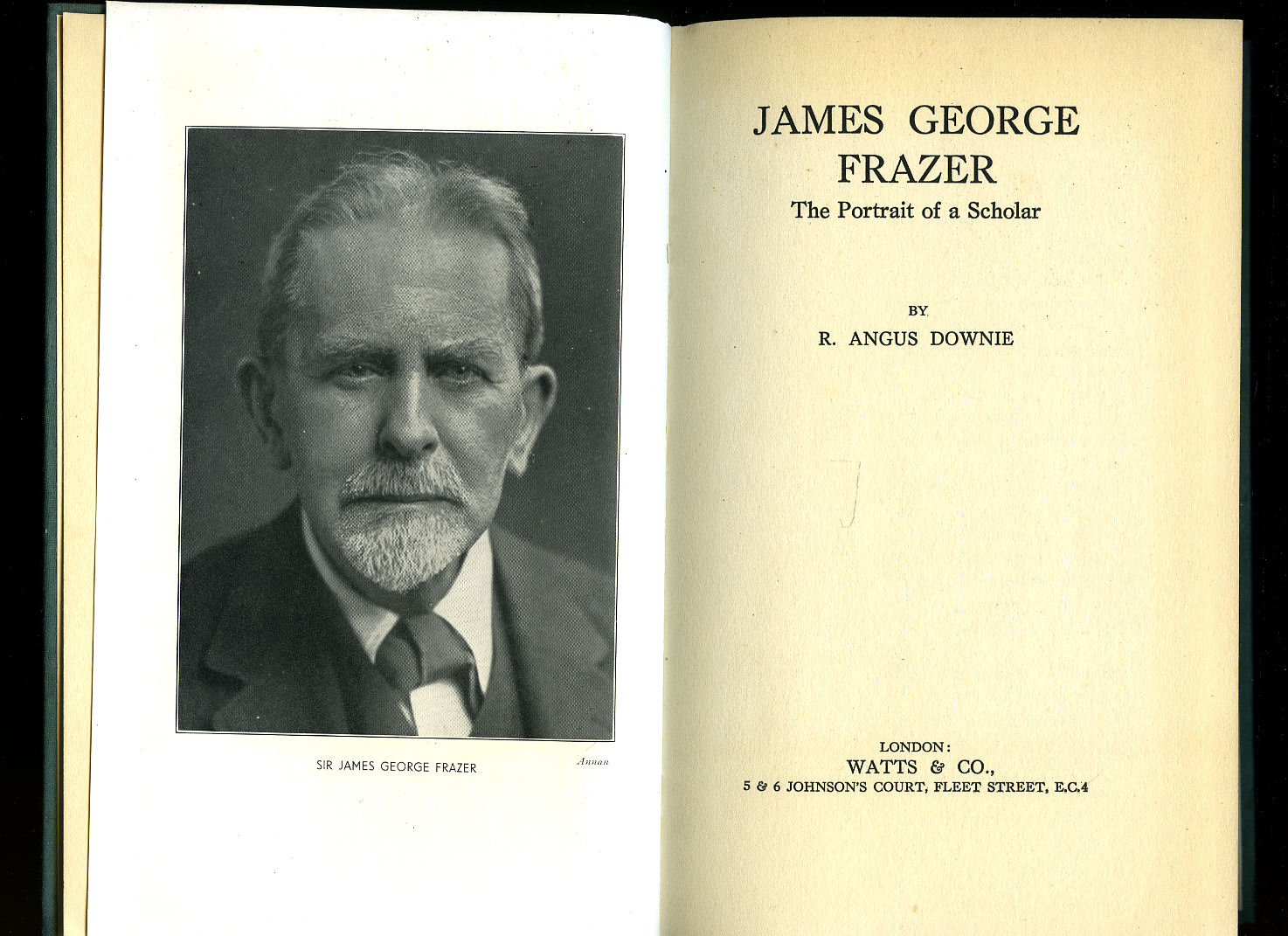
James George Frazer (1854-1941) was a Scottish classicist and anthropologist whose book The Golden Bough (1890, expanded to twelve volumes by 1915) collected myths and rituals from across the world and read them as one human story of magic, religion and science. Freud, Jung, Eliot and generations of myth scholars took from him the idea that ancient rites still live in the modern psyche.
Key takeaways
- James George Frazer (1854-1941) was a Cambridge classicist whose The Golden Bough grew from two volumes in 1890 to twelve between 1906 and 1915.
- Frazer argued that human thought moves from magic to religion to science, and divided magic into homoeopathic and contagious kinds.
- Freud built Totem and Taboo (1913) on Frazer’s Totemism and Exogamy, and Jung used Frazer’s myths as evidence for the collective unconscious.
- T. S. Eliot credited both Jessie Weston and The Golden Bough in his notes to The Waste Land, taking the Fisher King from Weston.
- Frazer’s motifs of the scapegoat, the sacred king and the dying and reviving god still help therapists name patterns clients live through.
Who was James George Frazer?
Frazer was born in Glasgow on 1 January 1854 into a devout Free Church family. He studied classics at the University of Glasgow and then at Trinity College, Cambridge, where he was elected a fellow in 1879 and spent almost his entire working life.6 He trained in law but never practised, and his first large scholarly project was a translation of and commentary on Pausanias, the second-century Greek travel writer, which appeared in six volumes in 1898.
The turn to anthropology came in the early 1880s, when he read Edward Burnett Tylor’s Primitive Culture (1871), the book that gave anthropology its theory of animism and its picture of culture developing in stages.5 His friend William Robertson Smith, the biblical scholar then editing the Encyclopaedia Britannica, asked him to write the entries on “Taboo” and “Totemism” for its ninth edition (1888). Those commissions set the course of his career.6
Frazer worked almost entirely from his study. He sent questionnaires to missionaries, colonial officers and travellers and read everything printed on the customs of other peoples. He held the first British chair of social anthropology, at Liverpool, in 1908, but returned to Cambridge within a year. He was knighted in 1914 and received the Order of Merit in 1925. Blind for his last decade, he died in Cambridge on 7 May 1941; his wife Lilly died a few hours later.6 His other major works include Psyche’s Task (1909), Totemism and Exogamy (1910) and a three-volume study of folklore in the Hebrew Bible (1918).
What is the comparative method?
The comparative method is the practice of setting customs from many times and places side by side, on the assumption that similar practices answer to similar needs of the human mind and that differences mark different stages of development. Frazer inherited it from Tylor and from the evolutionary thinking of Victorian Britain, and he applied it on a scale nobody had tried before.7
The Golden Bough grew with each edition. The first, subtitled A Study in Comparative Religion, came out in two volumes in 1890.1 The second (1900) ran to three volumes and took the new subtitle A Study in Magic and Religion. The third edition appeared between 1906 and 1915 in twelve volumes, organised in parts with titles such as The Magic Art and the Evolution of Kings, Taboo and the Perils of the Soul, The Dying God, Adonis Attis Osiris, Spirits of the Corn and of the Wild, The Scapegoat and Balder the Beautiful. In 1922 Frazer and his wife produced the one-volume abridgement most readers know.2
The whole work hangs on a single riddle. At Nemi, in the Alban hills south of Rome, stood a grove sacred to Diana. Its priest, the King of the Wood, held office until a runaway slave broke a bough from a sacred tree and killed him. Frazer asked why such a rule existed, and to answer it he went to the Arctic, Africa, India, Polynesia and the European peasant village. The bough itself he linked to the golden branch Aeneas carries into the underworld in Virgil’s Aeneid and to the mistletoe of Norse and Celtic lore.3
Magic, religion and science
Frazer argued that human thought passes through three broad stages. Magic assumes that nature follows fixed laws a person can control. Religion gives that up and appeals to gods who must be pleased. Science returns to the idea of fixed law, now tested by observation. He divided magic into two kinds: homoeopathic magic, based on the law of similarity (like produces like, so a wax image can harm a person), and contagious magic, based on the law of contact (things once joined go on acting on each other, so hair or nail clippings carry power). He called magic a false science, closer in its logic to science than religion is.2
Later anthropologists dropped the three-stage scheme, and the fieldwork tradition that followed him was built partly in reaction to his armchair approach. Bronisław Malinowski, who did more than anyone to establish long-term fieldwork, still revered Frazer, and Frazer wrote the preface to Malinowski’s Argonauts of the Western Pacific (1922).6 What lasted was the habit of cross-cultural comparison and the questions Frazer posed about why people perform rites at all, which run through later work such as Frazer and Julian Jaynes on the gods.
Myth, ritual and the roots of religion
Frazer treated myth and ritual as two sides of one practice. Ritual was the act that was supposed to make the crops grow or the sun return; myth was the story told about the god whose life the ritual performed. His friend Robertson Smith had argued that ritual came first and myth arose to explain it, and Jane Harrison and the Cambridge classicists later built that into the myth-and-ritual theory of Greek religion.7 Frazer moved between the two positions, but his examples gave the theory most of its material.
His best-known motif is the dying and reviving god of vegetation: Adonis, Attis, Osiris and Dionysus, whose deaths and returns, he argued, mirrored the death of plant life in the dry or cold season and its return in spring. Alongside this he set the sacred king, whose health was bound to the health of the land and who was killed or replaced when he weakened, and the scapegoat, a person or animal loaded with the community’s sins and driven out or killed.3 Later historians of religion have questioned whether all these gods really form one type, but the motifs themselves are well documented in the sources Frazer gathered.
For Frazer, religion grew from magical rites meant to secure the fertility of fields, herds and people. As those rites hardened into institutions with priests and kings, myths grew into cosmologies and sacred histories. The sacred king, he thought, was the first public magician, and political power began as ritual power. Readers who know Robert Moore’s King archetype will recognise the figure, as will anyone who has studied paganism and comparative religion.
The second edition caused a scandal by placing the crucifixion of Jesus beside the killing of mock kings at festivals such as the Babylonian Sacaea. Frazer cut most of those passages from the 1922 abridgement; Robert Fraser restored them in his 1994 Oxford edition.3 Frazer’s work made comparative religion a field of its own, and later theorists such as Mircea Eliade, Joseph Campbell and Carl Jung all worked from material he had assembled.
How did Frazer influence Freud and Jung?
Both founders of depth psychology read Frazer closely and found in his collection of rites a record of the same mental processes they saw in their patients. They took different lessons from it.
Freud and Totem and Taboo
Freud’s Totem and Taboo (1913) is built on Frazer’s four-volume Totemism and Exogamy (1910) and on his earlier writing on taboo.4 Freud compared the prohibitions of tribal societies with the rituals of obsessional neurosis, and he read Frazer’s account of magic as an example of what he called the omnipotence of thoughts: the belief, shared by the child, the neurotic and the magician, that wishing can change the world. He quoted Frazer’s observation that the law forbids only what human beings are inclined to do, and used it to argue that strong taboos point to strong desires.8
From there Freud built his own story of a primal horde in which sons killed a jealous father, ate him in a ritual meal and then set up the totem and the incest taboo out of guilt. This was the Oedipus complex projected back onto the origin of culture. Frazer supplied the ethnographic examples; the patricide, incest and sacrifice story was Freud’s. Freud returned to religion in The Future of an Illusion (1927), and readers can follow that thread in Freud’s view of religion as illusion.8
Jung and the collective unconscious
Jung cited Frazer often in Transformations and Symbols of the Libido (1911-1912), later revised as Symbols of Transformation, using his material on Attis, Adonis, tree burial and the sacred marriage to show that the fantasies of a young American woman, Frank Miller, repeated ancient mythic patterns she had never studied.9 For Jung this was evidence of a layer of the psyche shared by all people, which he called the collective unconscious, and of inherited forms of experience, the archetypes. The dying god, the sacrificial king and the hieros gamos, the sacred marriage of god and goddess, became for him images of psychological death, renewal and union.
Jung also differed from Frazer in an important way. Frazer saw religion as an error that science would replace. Jung saw the religious function as a lasting need of the psyche, which is why the influences behind Jung’s view of religion include Frazer as a source of material rather than of conclusions. The development of Jung’s psychology after his break with Freud in 1912-1913 drew heavily on this comparative reading.
Both men used Frazer’s comparative ethnography as a lens for the individual mind and a way of linking personal suffering to the larger history of culture. In that sense Frazer built a bridge between anthropology and psychology that neither discipline has since taken down.
The Golden Bough and the modernist imagination
Writers between about 1910 and 1940 read The Golden Bough as a source book of symbols. John B. Vickery’s The Literary Impact of The Golden Bough (1973) traces its use by W. B. Yeats, D. H. Lawrence, T. S. Eliot and James Joyce, among others.12
Eliot’s notes to The Waste Land (1922) name two debts. The first is Jessie Weston’s From Ritual to Romance (1920), from which he took the Grail legend and the Fisher King, the wounded ruler whose land is sterile.11 The second is Frazer:10
To another work of anthropology I am indebted in general, one which has influenced our generation profoundly; I mean The Golden Bough; I have used especially the two volumes Adonis, Attis, Osiris.
Weston herself built on Frazer, so the poem’s drowned god, buried corpse and dry land come through both books. Joyce’s Ulysses (1922) took its structure from Homer’s Odyssey, not from fertility rites, but in his 1923 review of it, “Ulysses, Order, and Myth,” Eliot coined the phrase “mythical method” and credited psychology, ethnology and The Golden Bough with making that method possible. Vickery finds Frazer’s dying gods and rites of renewal more directly in Finnegans Wake.12
The visual arts took their interest in the primal along other routes. Pablo Picasso’s encounter with African and Oceanic objects at the Trocadéro ethnographic museum in Paris in 1907 fed his primitivism, and Jackson Pollock’s mythic imagery owed much to his Jungian analysis with Joseph Henderson in 1939 and 1940. The Surrealists, with their magazine Minotaure (1933-1939), made the labyrinth and the sacrificed bull central symbols. Frazer’s sacred king and sacred tree belong to the same climate of ideas even where painters never opened his books.
The common thread is the juxtaposition Frazer practised on every page: the primitive beside the civilised, the sacred beside the profane, a Scottish harvest custom beside a Babylonian festival. That collage of times and places became a model for modernist form, and it carried the idea that modern people still have ancient patterns working in them.

Criticism of Frazer’s method
Frazer’s reputation fell sharply after his death. Anthropologists objected that he lifted customs out of the societies that gave them meaning, trusted unreliable reports, and ranked cultures from “savage” to “civilised” in a way that flattered his own.6 The philosopher Ludwig Wittgenstein, who read The Golden Bough in 1931, made the sharpest objection: Frazer treated rituals as mistaken science, when a man who kisses a picture of a loved one does not expect it to do anything. Wittgenstein wrote that Frazer was “much more savage than most of his savages.”13
Wittgenstein’s point matters for psychology. Ritual often expresses rather than explains: it gives grief, fear or longing a form, a theme developed in Victor Turner’s anthropology of ritual. That reading supports the depth-psychological view that rites carry meaning, and it shows how a flawed theory can still open the right question, a theme taken up in the useful mistakes of fringe psychology.
Frazer’s legacy and continuing relevance
In anthropology, Frazer’s wide comparison of myths prepared the ground that Claude Lévi-Strauss would later work over with very different tools. Lévi-Strauss’s structuralism looked for the logical oppositions that organise myths rather than for stages of evolution, but it shared Frazer’s conviction that myths from unrelated peoples can be read together. Frazer’s contemporary Arnold van Gennep and the rites of passage (1909) took the comparative study of ritual in a structural direction of its own.
In religious studies, Mircea Eliade’s work on the sacred drew on Frazerian material on sacred trees, sacred kings and the renewal of time while rejecting his view of religion as error. Joseph Campbell’s comparative mythology in The Hero with a Thousand Faces (1949) cites Frazer and applies the same wide-angle comparison to the hero’s departure, ordeal and return.
In psychology, the line runs through Freud and Jung to James Hillman’s archetypal psychology. In Re-Visioning Psychology (1975) Hillman argued for “a poetic basis of mind,” the view that the psyche works first in images and stories.14 Hillman drew most directly on Jung, Henry Corbin and Renaissance Neoplatonism, but his claim that the gods live on as patterns in the soul belongs to the tradition Frazer’s material made possible.
Frazer also asks modern readers to look beneath their own cultural forms. His studies of seasonal rites show communities binding themselves to the cycles of the land through ritual. Writers on ecology and enchantment, such as David Abram’s earth-centred philosophy, take up the same question from the other side: what people lost when they stopped experiencing nature as alive. Frazer saw a continuity between primitive magic and modern science, and that continuity still raises the question of what modern technologies are trying to control and what modern rituals are trying to hold.
Frazer in the therapy room
We do not ask clients to read The Golden Bough, but several of Frazer’s patterns come up in therapy, and naming them can help a person see what they are caught in. Mythic language often reaches what clinical language misses, as the idea that myths are public dreams suggests.
The scapegoat is the clearest example. Families and groups under strain often load their unbearable feelings onto one member, who is blamed, sent away emotionally or made the problem. Recognising the pattern lets a client see that the role was assigned rather than earned, which is the starting point of work on the scapegoat role in families.
The dying and reviving god describes something clients live through in grief, divorce, illness or the end of a vocation: a season in which an old self has to die before a new one can grow. Frazer’s magical thinking also has its psychological echo. After trauma, people often hold beliefs such as “if I stay alert, nothing bad will happen,” a private magic that once protected them. Somatic and brain-based approaches work with these patterns as they live in the body, and the place of ritual in recovery is explored in trauma, ritual and animism.
At Taproot, Jungian therapists use myth as a way of amplifying dreams and symptoms: a dream image of a felled tree or a wounded king is set beside the stories in which those images recur, so the client can sense the larger pattern their life is in. Practical methods for this are set out in how to use mythology as a therapist.
Frazer spent fifty years gathering the rites by which people faced death, loss and renewal, and those rites still describe the passages our clients go through. If those patterns speak to what you are living through, our Jungian therapy works with myth, dream and symbol as part of healing.
Frequently asked questions
What is The Golden Bough about?
The Golden Bough, by James George Frazer, starts from a puzzle: why the priest of Diana’s grove at Nemi, near Rome, had to be killed by his successor. To answer it Frazer compared magic, taboo, sacred kingship, fertility rites, scapegoats and dying gods from around the world, arguing that human thought passes from magic to religion to science.
What are Frazer’s two types of magic?
Frazer divided sympathetic magic into homoeopathic magic, based on the law of similarity, where like produces like, as when an image is harmed to harm a person, and contagious magic, based on the law of contact, where things once joined keep acting on each other, as with hair or clothing. He called magic a false science.
How did Frazer influence Freud?
Sigmund Freud drew on James George Frazer’s Totemism and Exogamy (1910) and his writing on taboo for Totem and Taboo (1913). Freud compared taboo with obsessional rituals, read magic as the omnipotence of thoughts, and built from Frazer’s examples his own theory of a primal patricide behind totemism and the incest taboo.
Did Carl Jung use Frazer’s work?
Yes. Carl Jung cited James George Frazer repeatedly in Symbols of Transformation, first published in 1911-1912, using his material on Attis, Adonis and the sacred marriage. Jung read these recurring motifs as evidence for archetypes and the collective unconscious, though unlike Frazer he saw religion as a lasting need of the psyche rather than an error.
Why was Frazer criticised by later anthropologists?
Later anthropologists faulted James George Frazer for working from his study rather than in the field, lifting customs out of their social context, trusting uneven reports and ranking cultures on an evolutionary ladder. Ludwig Wittgenstein added that Frazer misread ritual as mistaken science, when much ritual expresses feeling rather than trying to cause effects.
Related reading
- Paul Tillich and the Soul’s Depth: The Enduring Relevance of an Existentialist Theologian for Depth Psychology and Psychotherapy
- St. Augustine and the Foundations of Depth Psychology: How a Fourth-Century Bishop Became a Forefather of Modern Psychotherapy
- The Emperor’s Inner Work: Marcus Aurelius, Meditations, and the Roots of Psychotherapy
- The Trial of Carl Jung: Assessing a Legacy
- The Razor and the Psyche: William of Ockham’s Enduring Legacy for Depth Psychology and Psychotherapy
- The Pragmatic Turn: William James, the Architecture of Consciousness, and the Roots of Modern Psychotherapy
References
- Frazer, J. G. (1890). The golden bough: A study in comparative religion (Vols. 1-2). Macmillan.
- Frazer, J. G. (1922). The golden bough: A study in magic and religion (Abridged ed.). Macmillan.
- Frazer, J. G. (2009). The golden bough: A study in magic and religion (R. Fraser, Ed.; A new abridgement). Oxford University Press. https://doi.org/10.1093/owc/9780199538829.001.0001
- Frazer, J. G. (1910). Totemism and exogamy: A treatise on certain early forms of superstition and society (Vols. 1-4). Macmillan.
- Tylor, E. B. (1871). Primitive culture (Vols. 1-2). John Murray.
- Ackerman, R. (1987). J. G. Frazer: His life and work. Cambridge University Press.
- Fraser, R. (1990). The making of The Golden Bough: The origins and growth of an argument. Macmillan. https://doi.org/10.1007/978-1-349-20720-6
- Freud, S. (1950). Totem and taboo: Some points of agreement between the mental lives of savages and neurotics (J. Strachey, Trans.). Routledge & Kegan Paul. (Original work published 1913)
- Jung, C. G. (1967). Symbols of transformation (R. F. C. Hull, Trans.; 2nd ed., Collected Works Vol. 5). Princeton University Press. (Original work published 1912)
- Eliot, T. S. (1922). The waste land. Boni and Liveright.
- Weston, J. L. (1920). From ritual to romance. Cambridge University Press.
- Vickery, J. B. (1973). The literary impact of The Golden Bough. Princeton University Press.
- Wittgenstein, L. (1979). Remarks on Frazer’s Golden Bough (R. Rhees, Ed.; A. C. Miles, Trans.). Brynmill Press.
- Hillman, J. (1975). Re-visioning psychology. Harper & Row.
















0 Comments