
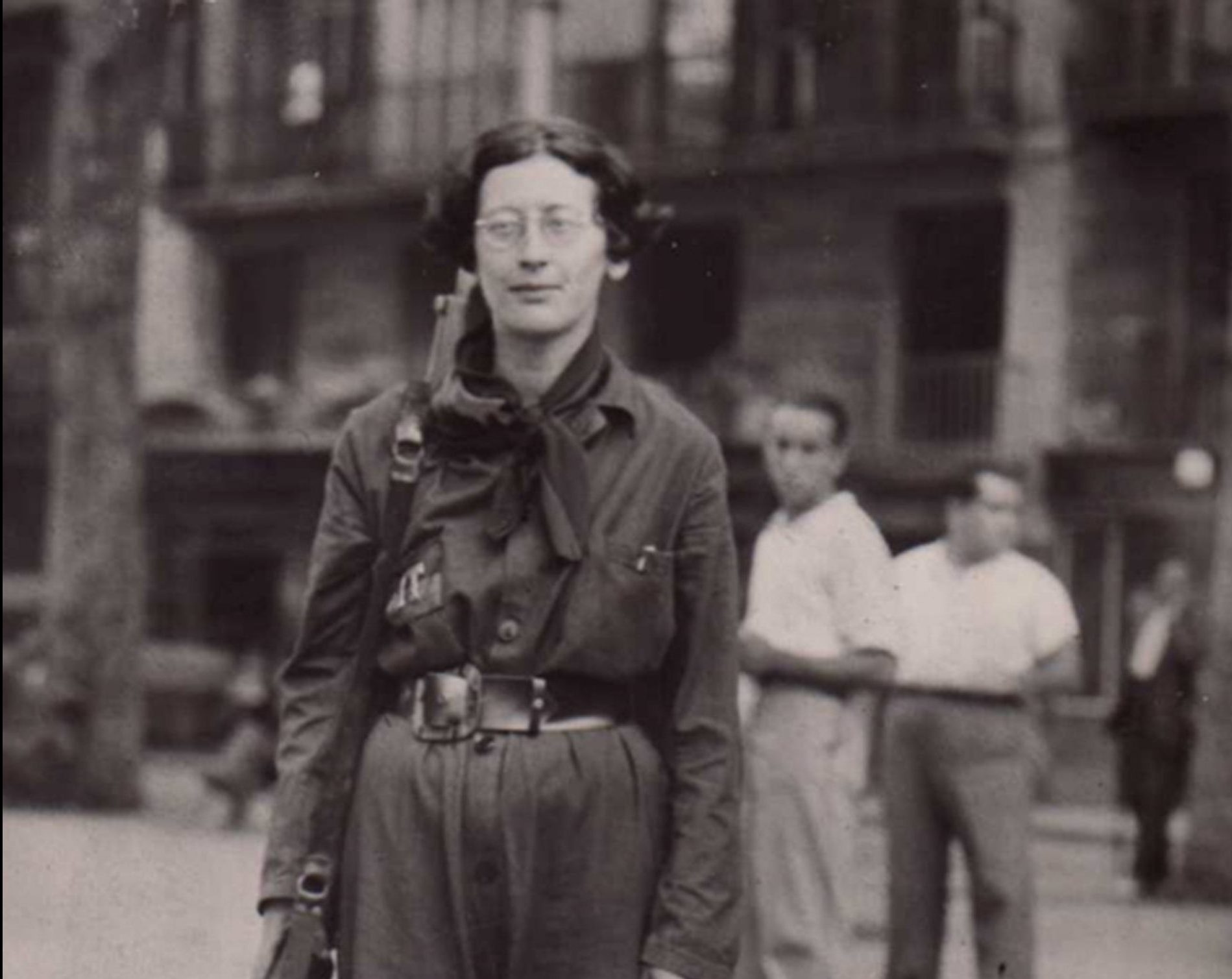
Simone Weil used affliction (malheur) for suffering that has crossed a threshold: pain joined to social degradation, which brands the sufferer with a shame that ought to belong to whoever did the harm. Attention was her name for the response it calls for, a “negative effort” in which the mind empties itself to receive another person “just as he is, in all his truth.”1,2
Read clinically, the two ideas form one argument. Weil wrote that nothing can take from us “the power to say ‘I’” except extreme affliction, which “destroys the ‘I’ from outside,” and that an “I” which is “only inanimate” can be revived by love “without the slightest trace of condescension.”3 That is a fair description of complex trauma, and of the presence that lets a survivor speak in the first person again. It also sets a limit. Decreation, Weil’s willing surrender of the self, is not something to prescribe to people whose selves were taken by force. Weil drew that line herself.
Who Simone Weil was
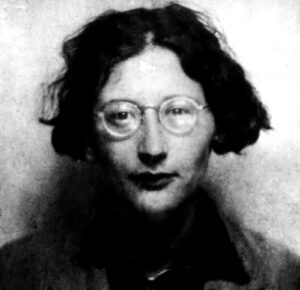
Weil was born in Paris on 3 February 1909 into an assimilated, secular family of Jewish background. She studied under the philosopher Alain at the Lycée Henri IV, entered the École Normale Supérieure in 1928 as the only woman in her class, and from 1931 taught at lycées while working with labor groups. In 1934 she took a year’s leave and spent about 24 weeks of 1934–35 as an unskilled factory hand, at plants that included Alsthom and Renault.2 There, she later wrote to the Dominican priest Joseph-Marie Perrin, “the affliction of others entered into my flesh and my soul,” and she “received forever the mark of a slave.”1,4 In 1936 she joined an anarchist unit in the Spanish Civil War until she badly burned her leg in a pot of boiling oil.2
Her religious turn came through three contacts: Portugal in 1935, Assisi in 1937, and Holy Week 1938 at the abbey of Solesmes, where, despite violent headaches, the joy she found in Gregorian chant gave her, by analogy, an understanding of how divine love could be lived in the midst of affliction. Later, reciting George Herbert’s poem “Love,” she felt that “Christ himself came down and took possession of me.”2 She declined baptism and explained why in letters to Perrin.1 After the fall of France she lived in Marseille, where she met Perrin; through him she worked the 1941 grape harvest on the Ardèche farm of the Catholic writer Gustave Thibon. In 1942 she left with her parents for New York, then crossed to London to work for the Free French. She died in Ashford, Kent, on 24 August 1943, aged 34. The coroner recorded suicide, citing self-starvation and tuberculosis; her biographers describe a woman who would eat no more than the rations of occupied France.2
None of her writing appeared as a book in her lifetime. Thibon arranged passages from notebooks she had left with him into Gravity and Grace (1947),3 and Albert Camus published The Need for Roots (1949) as the first of eleven Weil volumes he championed at Gallimard.2 In a 1951 letter to her mother, Camus called her “the only great spirit of our time.”5,4 The Rebel, from the same year, is Camus’s own book, though Fred Rosen has argued that it takes over her critique of Marxism.6 T. S. Eliot’s preface to the 1952 English translation of The Need for Roots put it this way: “We must simply expose ourselves to the personality of a woman of genius, of a kind of genius akin to that of the saints.”7
Affliction: suffering that leaves a mark
The translator of Waiting for God notes that malheur “has in it a sense of inevitability and doom.” In “The Love of God and Affliction,” Weil calls affliction “quite a different thing from simple suffering.” Pain that is only physical, like a toothache, “leaves no trace in the soul.” Affliction “takes possession of the soul and marks it through and through with its own particular mark, the mark of slavery.”1
It has three features. It is total: “There is not real affliction unless the event that has seized and uprooted a life attacks it, directly or indirectly, in all its parts, social, psychological, and physical. The social factor is essential.” It silences: the afflicted “have no words to express what is happening to them,” and the rest of us notice only “a strange way of behaving” and “censure this behavior.” And it puts guilt in the wrong place. Like a red-hot iron, it “stamps the soul to its very depths with the scorn, the disgust, and even the self-hatred and sense of guilt and defilement that crime logically should produce but actually does not.” Evil “is felt in the heart of the person who is afflicted and innocent.”1
Weil had no clinical vocabulary, but the pattern is familiar. In 1992 Judith Herman proposed “complex PTSD” for survivors of prolonged, repeated trauma, which occurs only where the victim is captive, “under the control of the perpetrator,” in politics or in “sexual and domestic relations.”8 ICD-11 now recognizes complex PTSD, adding to the core PTSD symptoms trouble regulating emotion, a persistently negative view of oneself carrying shame or guilt, and difficulty in relationships.9,10 A 2019 meta-analysis of 25 studies (3,663 participants) found a moderate association between shame and PTSD symptoms (r = .49).11 Weil’s red-hot iron is that shame. Her “social factor” overlaps with the coercion Herman described, including the private captivity of a controlling or toxic relationship.
“The same event may plunge one human being into affliction and not another,” she added.1 The event alone does not tell you what happened to the person.
The “I” destroyed from outside
Weil’s most radical idea is decreation: “to make something created pass into the uncreated,” as opposed to destruction, which makes it “pass into nothingness” and is “a blameworthy substitute.” Its material is the one thing she thought we own: “We possess nothing in the world—a mere chance can strip us of everything—except the power to say ‘I.’ That is what we have to give to God, in other words, to destroy.”3
Two paragraphs later comes the passage that matters for trauma: “Nothing in the world can rob us of the power to say ‘I.’ Nothing except extreme affliction. Nothing is worse than extreme affliction which destroys the ‘I’ from outside, because after that we can no longer destroy it ourselves.” Decreation presupposes an “I” to give; a self broken by force has not been decreated. Weil calls that external destruction “quasi-infernal suffering,” and its end state is stark: “Survival is then the only attachment.”3
She then sketches a sequence trauma therapists know. “When the ‘I’ is wounded from outside it starts by revolting in the most extreme and bitter manner, like an animal at bay. But as soon as the ‘I’ is half dead, it wants to be finished off and allows itself to sink into unconsciousness. If it is then awakened by a touch of love, there is sharp pain which results in anger and sometimes hatred for whoever has provoked this pain.”3 The defense cascade model describes a similar arc in the body, from fight or flight to freezing and, when active defense fails, collapsed immobility.12 The popular polyvagal label “dorsal vagal shutdown” rests on contested physiology and works better as metaphor than as anatomy.13 Weil’s point is what comes next: waking up hurts, and whoever does the waking may receive the anger.
Just before that passage she is guarded: “We never know, however, whether in a particular person the ‘I’ is quite dead or only inanimate. If it is not quite dead, love can reanimate it as though by an injection, but it must be love which is utterly pure, without the slightest trace of condescension, for the least shade of contempt drives it toward death.”3 Donald Kalsched’s account of the archetypal defenses that guard a traumatized core makes a similar point from depth psychology: the self is hidden, not gone.
Attention: the negative effort
Weil’s fullest account of attention is the essay “Reflections on the Right Use of School Studies with a View to the Love of God,” collected in Waiting for God.2 Tell pupils to pay attention and “one sees them contracting their brows, holding their breath, stiffening their muscles.” Real attention “is an effort, the greatest of all efforts perhaps, but it is a negative effort.” It “consists of suspending our thought, leaving it detached, empty, and ready to be penetrated by the object.”1 Taken “to its highest degree,” she wrote in her notebooks, attention “is the same thing as prayer.”3
Turned toward a person, it becomes her ethics: “The soul empties itself of all its own contents in order to receive into itself the being it is looking at, just as he is, in all his truth.”1,2 Her model is the Good Samaritan, who stops beside “the anonymous flesh lying inert by the roadside” and gives his attention to a humanity that, socially, no longer exists: “Love sees what is invisible.” She adds a sentence worth keeping near any consulting-room chair: “Difficult as it is really to listen to someone in affliction, it is just as difficult for him to know that compassion is listening to him.”1
In French, attention sits beside attente, waiting,2 a not-seeking close to what a Zen koan forces on a student.
Research cannot measure Weil’s attention, but it has measured relatives of it. In developing a measure of therapeutic presence, Geller and colleagues found that clients reported a positive alliance and change after sessions in which they felt their therapist was present with them.14 Meta-analyses link therapist empathy (82 samples, r = .28)15 and the therapeutic alliance (295 studies, more than 30,000 patients, r = .278)16 to outcome. These are correlations, not proof that presence alone heals. For PTSD, the strongest trial evidence is for trauma-focused cognitive behavioral therapies and EMDR.17 Attention is the condition for that work, not a substitute for it.
The void, its counterfeits and the metaxu
Much of Gravity and Grace concerns the void left by loss or humiliation, and our refusal to let it stay empty. “Every void (not accepted) produces hatred, sourness, bitterness, spite.” Her discipline: “We must continually suspend the work of the imagination in filling the void within ourselves.” The much-quoted “Every sin is an attempt to fly from emptiness” is Thibon’s paraphrase in his introduction; Weil’s own sentence is plainer: “All sins are attempts to fill voids.”3
Psychologically, this is a theory of compensation. Karen Horney’s idealized self, with the neurotic styles built around it, is one cousin. Compulsive drinking, eating or working to keep a feeling away is another, which is why recovery work after rehab has to address emptiness and not only abstinence.
The same logic yields her most startling claim: “Religion, in so far as it is a source of consolation, is a hindrance to true faith: in this sense atheism is a purification.” She tests it against a man “whose whole family had died under torture” and an Indian of the sixteenth century, “the sole survivor after the total extermination of his people.” Such men, if they had believed in the mercy of God, “would either believe in it no longer, or else they would conceive of it quite differently than before.”3 For survivors whose faith broke, here is a religious writer who does not ask them to pretend. Across 49 studies, negative forms of religious coping went with poorer adjustment to stress,18 so spiritual struggle belongs in therapy, without pushing anyone toward belief or away from it.
Against the void she set the metaxu, Greek for intermediaries: “Every separation is a link.” And: “No human being should be deprived of his metaxu, that is to say of those relative and mixed blessings (home, country, traditions, culture, etc.) which warm and nourish the soul and without which, short of sainthood, a human life is not possible.”3 Her language of the void and “the dark night” draws on John of the Cross and the wider tradition traced in the Christian mystics’ influence on Jungian thought. The clinical point is plain: an afflicted person needs their intermediaries back before anyone asks them to transcend anything.
What this looks like in therapy
None of this is a technique, but Weil’s distinctions translate into practice.
Ask about affliction, not only symptoms. Her three dimensions make a good assessment frame: who saw the person degraded, what it cost them socially, where the shame has landed. The ICD-11 criteria for complex PTSD ask similar questions about self-concept and relationships.10
Name misplaced shame. Many survivors have never heard it said aloud that the innocent carry the defilement the guilty do not feel. Shame deserves to be a treatment target in its own right.11
Attend before intervening. Often the first task is helping someone know they are being listened to. Condescension, including the eager kind, is the “shade of contempt” that sends a half-dead “I” back under.
Expect the pain of waking. When numbness lifts, grief and anger arrive, some of it aimed at the therapist. Across 11 studies, repairing such ruptures in the alliance was moderately associated with better outcomes (r = .29).19
Use silence with judgment. Silence is not automatically attention. In a survey of 81 therapists, respondents said they used it mainly to encourage reflection and convey empathy, and would not use it with very disturbed clients.20 For someone near collapse, a long pause can feel like abandonment.
Include the body. Affliction is “inseparable from physical suffering.”1 Somatic therapy works with defense states directly, though its trial evidence is thinner than that for trauma-focused cognitive behavioral therapies and EMDR, so it belongs inside a plan rather than in place of one.
Restore the metaxu. Routines, a place, a community, music and meaningful work are not distractions from trauma work. In Jungian depth therapy, meaning and faith are part of the material, not a detour from it.
Where not to follow Weil
Read Weil as a witness, not a model. She wrote that “so long as we ourselves have begun the process of destroying the ‘I,’ we can prevent any affliction from causing harm.”3 No survivor should be told that their trauma was spiritually useful, or that the right inner discipline would have protected them. Her own life is a caution: she died while holding herself to the rations of occupied France, and the coroner recorded suicide.2 Even Eliot, who admired her, could not “conceive of anybody’s agreeing with all of her views, or of not disagreeing violently with some of them.”7
The safer reading keeps her order. First someone has to be able to say “I” again; only then does loosening the ego’s grip make sense. Weil admitted that “for those whose ‘I’ is dead, we can do nothing, absolutely nothing,” and in the same breath that we never know whether it is dead “or only inanimate.”3 Therapists work on the assumption that it is only inanimate.
If affliction is a truer word than stress for what you are carrying, our clinicians in Hoover work with trauma, shame and questions of meaning, in person and by teletherapy across Alabama. You can read how we approach this in existential therapy, or contact us to talk about whether it is a fit.
References
- Weil, S. (1951). Waiting for God (E. Craufurd, Trans.). G. P. Putnam’s Sons. (Original work published 1950)
- Rozelle-Stone, A. R., & Davis, B. P. (2025). Simone Weil. In E. N. Zalta & U. Nodelman (Eds.), The Stanford encyclopedia of philosophy. https://plato.stanford.edu/entries/simone-weil/
- Weil, S. (1952). Gravity and grace (A. Wills, Trans.). G. P. Putnam’s Sons. (Original work published 1947)
- Gagne, L. (Ed.). (2018). Love in the void: Where God finds us. Plough Publishing House.
- Dietz, M. G. (1988). Between the human and the divine: The political thought of Simone Weil. Rowman & Littlefield.
- Rosen, F. (1979). Marxism, mysticism, and liberty: The influence of Simone Weil on Albert Camus. Political Theory, 7(3), 301–319. https://doi.org/10.1177/009059177900700302
- Weil, S. (1952). The need for roots: Prelude to a declaration of duties towards mankind (A. Wills, Trans.; preface by T. S. Eliot). Routledge & Kegan Paul. (Original work published 1949)
- Herman, J. L. (1992). Complex PTSD: A syndrome in survivors of prolonged and repeated trauma. Journal of Traumatic Stress, 5(3), 377–391. https://doi.org/10.1002/jts.2490050305
- Maercker, A., Brewin, C. R., Bryant, R. A., Cloitre, M., van Ommeren, M., Jones, L. M., Humayan, A., Kagee, A., Llosa, A. E., Rousseau, C., Somasundaram, D. J., Souza, R., Suzuki, Y., Weissbecker, I., Wessely, S. C., First, M. B., & Reed, G. M. (2013). Diagnosis and classification of disorders specifically associated with stress: Proposals for ICD-11. World Psychiatry, 12(3), 198–206. https://doi.org/10.1002/wps.20057
- Brewin, C. R., Cloitre, M., Hyland, P., Shevlin, M., Maercker, A., Bryant, R. A., Humayun, A., Jones, L. M., Kagee, A., Rousseau, C., Somasundaram, D., Suzuki, Y., Wessely, S., van Ommeren, M., & Reed, G. M. (2017). A review of current evidence regarding the ICD-11 proposals for diagnosing PTSD and complex PTSD. Clinical Psychology Review, 58, 1–15. https://doi.org/10.1016/j.cpr.2017.09.001
- López-Castro, T., Saraiya, T., Zumberg-Smith, K., & Dambreville, N. (2019). Association between shame and posttraumatic stress disorder: A meta-analysis. Journal of Traumatic Stress, 32(4), 484–495. https://doi.org/10.1002/jts.22411
- Kozlowska, K., Walker, P., McLean, L., & Carrive, P. (2015). Fear and the defense cascade: Clinical implications and management. Harvard Review of Psychiatry, 23(4), 263–287. https://doi.org/10.1097/HRP.0000000000000065
- Grossman, P. (2023). Fundamental challenges and likely refutations of the five basic premises of the polyvagal theory. Biological Psychology, 180, Article 108589. https://doi.org/10.1016/j.biopsycho.2023.108589
- Geller, S. M., Greenberg, L. S., & Watson, J. C. (2010). Therapist and client perceptions of therapeutic presence: The development of a measure. Psychotherapy Research, 20(5), 599–610. https://doi.org/10.1080/10503307.2010.495957
- Elliott, R., Bohart, A. C., Watson, J. C., & Murphy, D. (2018). Therapist empathy and client outcome: An updated meta-analysis. Psychotherapy, 55(4), 399–410. https://doi.org/10.1037/pst0000175
- Flückiger, C., Del Re, A. C., Wampold, B. E., & Horvath, A. O. (2018). The alliance in adult psychotherapy: A meta-analytic synthesis. Psychotherapy, 55(4), 316–340. https://doi.org/10.1037/pst0000172
- Lewis, C., Roberts, N. P., Andrew, M., Starling, E., & Bisson, J. I. (2020). Psychological therapies for post-traumatic stress disorder in adults: Systematic review and meta-analysis. European Journal of Psychotraumatology, 11(1), Article 1729633. https://doi.org/10.1080/20008198.2020.1729633
- Ano, G. G., & Vasconcelles, E. B. (2005). Religious coping and psychological adjustment to stress: A meta-analysis. Journal of Clinical Psychology, 61(4), 461–480. https://doi.org/10.1002/jclp.20049
- Eubanks, C. F., Muran, J. C., & Safran, J. D. (2018). Alliance rupture repair: A meta-analysis. Psychotherapy, 55(4), 508–519. https://doi.org/10.1037/pst0000185
- Hill, C. E., Thompson, B. J., & Ladany, N. (2003). Therapist use of silence in therapy: A survey. Journal of Clinical Psychology, 59(4), 513–524. https://doi.org/10.1002/jclp.10155















0 Comments