
The Holy Grail of the Unconscious: A Comprehensive Guide to Jung’s Red Book
For nearly a century, the history of psychology contained a massive black hole. We knew that between 1913 and 1930, the Swiss psychiatrist Carl Jung underwent a terrifying and transformative “confrontation with the unconscious.” We knew he recorded his visions, dialogues with internal figures, and prophetic dreams in a large, red leather-bound volume. But almost no one had seen it. It was locked in a Swiss bank vault, a rumor, a ghost.
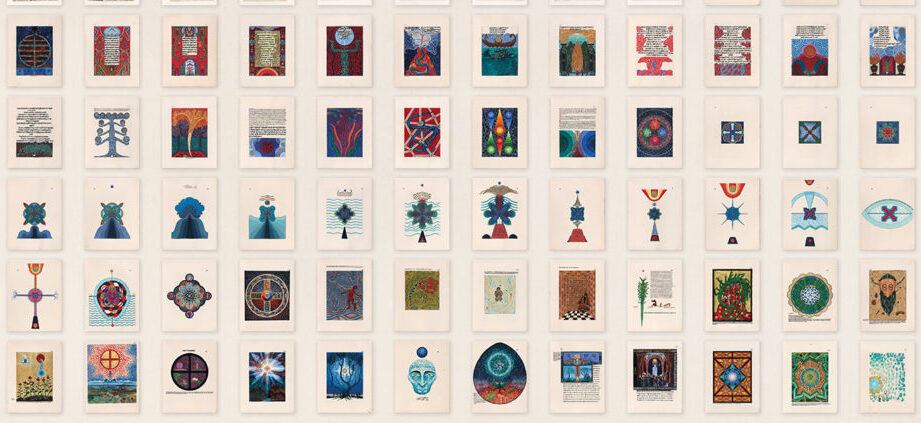
In 2009, thanks to the tireless efforts of historian Sonu Shamdasani, The Red Book (Liber Novus) was finally published. It is not a textbook. It is a work of art, prophecy, and madness—a medieval illuminated manuscript for the modern soul. It reveals that analytical psychology was not born in a sterile clinic, but in a furnace of visions where Jung met gods, demons, and the dead. To understand Jungian psychology without the Red Book is to understand Christianity without the Bible.
The Origins: The Spirit of the Depths
The genesis of The Red Book can be traced to a pivotal fracture in 1913. Jung underwent a dramatic break with his mentor and father-figure, Sigmund Freud. This professional isolation triggered a collapse. Jung began to have waking visions of Europe drowning in blood—a premonition of World War I that he initially mistook for his own impending psychosis. Fearing he was “doing a schizophrenia,” he made the courageous decision not to suppress the madness, but to drop into it.
He distinguished between two forces: the Spirit of This Time (rationality, science, the ego, the persona) and the Spirit of the Depths (myth, soul, eternity, the irrational). The Red Book is the gospel of the Spirit of the Depths. Jung began recording his fantasies first in the “Black Books,” and later transcribed them into the Red Book using calligraphic script and elaborate paintings.
The Structure of the Work
The Liber Novus is divided into three distinct sections, each representing a different stage of Jung’s descent and integration.
1. Liber Primus (The Way of What Is to Come)
This section chronicles the initial descent. Jung encounters the “desert” of his own soul. He realizes that his success in the world (The Spirit of This Time) has left his soul starving. Here, he meets the initial guardians of the unconscious and undergoes the death of his “Heroic Ego.”
2. Liber Secundus (The Images of the Erring)
This is the longest section, filled with a diverse cast of archetypal figures. Jung wanders through various landscapes—forests, deserts, castles—engaging in dialogues with figures that represent different aspects of human history and the collective unconscious. It is a series of trials and initiations.
3. Scrutinies
The final section is more philosophical. Jung attempts to integrate the wild visions of the previous years. It culminates in the “Seven Sermons to the Dead,” a Gnostic text where Jung articulates a new cosmology of the Self and the Pleroma.
Key Figures and Archetypes
The Red Book is populated by autonomous figures who speak to Jung with a wisdom and personality distinct from his own. These are not merely “parts of himself” in a reductive sense; they are objective entities of the imaginal realm.
Philemon: The Inner Guru
Perhaps the most important figure is Philemon, a wise old man with the wings of a kingfisher. Philemon was Jung’s inner guru. He taught Jung the crucial lesson of objective psyche: “Thoughts are not things you make; they are things that happen to you.” Philemon represents the archetype of the Wise Old Man and the Mana-Personality.
Salome: The Blind Anima
Often accompanying Philemon/Elijah is a blind, beautiful young woman named Salome. She represents the Anima (the soul or feeling function). Her blindness suggests that the feeling function in Jung (and in the modern patriarchal man) is unconscious and needs guidance. Through his relationship with her, Jung learns that he must serve the feminine principle, not dominate it.
The Red One: The Shadow
Jung encounters a devilish, red-riding figure who taunts him. This is “The Red One,” representing the “joy of life,” instinct, and the Shadow. Jung, the serious Swiss doctor, is repulsed by him but must learn to accept him. This figure teaches that holiness without the devil is sterile.
Izdubar: The Dying God
Jung meets a giant, bull-like hero named Izdubar (reminiscent of Gilgamesh). Izdubar represents the ancient, mythic way of being. Jung realizes that his “science” (the poison of rationality) has lamed this god. He must tend to the dying god, eventually compressing him into the size of an egg to save him. This is a profound metaphor for how we must carry the sacred in a secular age.
The Murder of the Hero
One of the most shocking visions in the book is Jung’s murder of the hero Siegfried. In a dream, Jung and a dark companion ambush the golden hero and shoot him. Jung wakes up weeping with guilt.
The Meaning: This symbolizes the necessary death of the “Heroic Ego”—the 19th-century ideal of will, conquest, and conscious dominance. Jung realized that the attitude of “where there is a will, there is a way” had become dangerous. To enter the new age of psychology, the Hero must die so that the Self (a center greater than the ego) can be born.
The Seven Sermons to the Dead
The climax of the Red Book is a Gnostic text called The Seven Sermons to the Dead. In this section, the “dead” (spirits of the past, ancestors who have not found peace) return to Jung’s house, ringing the bell and demanding knowledge. Speaking in the voice of the Gnostic teacher Basilides, Jung delivers sermons on the nature of the Pleroma (the void/fullness), the god Abraxas (who unites good and evil), and the path of individuation.
This section confirms James Hillman’s radical view that psychology is ultimately a way of “caring for the dead.” We are not just healing our own childhoods; we are answering the unresolved questions of our ancestors. For a deeper analysis of this collaboration between the living and the dead, read our review of Lament of the Dead by Hillman and Shamdasani.
How to Read The Red Book
Do not read The Red Book as a theory. Read it as a dream. It operates on the level of the symbolic life.
1. Visual Analysis and Mandalas
The book is filled with Mandalas—circular images representing the wholeness of the Self. Jung painted these when he felt fragmented; the act of painting the circle held his psyche together. Pay attention to the colors. As we explore in the psychology of color, the shift from dark chaos to golden order in the images tracks the movement of healing.
2. Active Imagination
The Red Book is the ultimate case study of Active Imagination. Jung did not just watch his fantasies; he entered them. When a figure appeared, he spoke to it. When a landscape emerged, he walked through it. This is the method we use in clinical practice today: engaging the unconscious as a partner rather than an object.
Legacy: A Book for the Future
Jung believed the Red Book was too strange for his contemporaries. He was right. But for us, living in a time of “meta-crisis” and meaninglessness, it is essential. It shows that the way out of chaos is not to impose order, but to find the meaning hidden within the chaos.
The Red Book teaches us that every life is a myth. We are not just biological accidents; we are characters in a divine drama. To heal is to find the script. It connects the personal suffering of the individual to the Gnostic pursuit of divine knowledge, reminding us that the “God within” is the ultimate goal of all therapy.
Bibliography
- Jung, C. G. (2009). The Red Book: Liber Novus. Ed. Sonu Shamdasani. W. W. Norton & Company.
- Shamdasani, S. (2012). C. G. Jung: A Biography in Books. W. W. Norton & Company.
- Hillman, J., & Shamdasani, S. (2013). Lament of the Dead: Psychology After Jung’s Red Book. W. W. Norton & Company.
- Stein, M., & Arzt, T. (2016). Jung’s Red Book for Our Time. Chiron Publications.
- Hoeller, S. A. (2019). The Gnosis of C.G. Jung. Quest Books.










0 Comments