
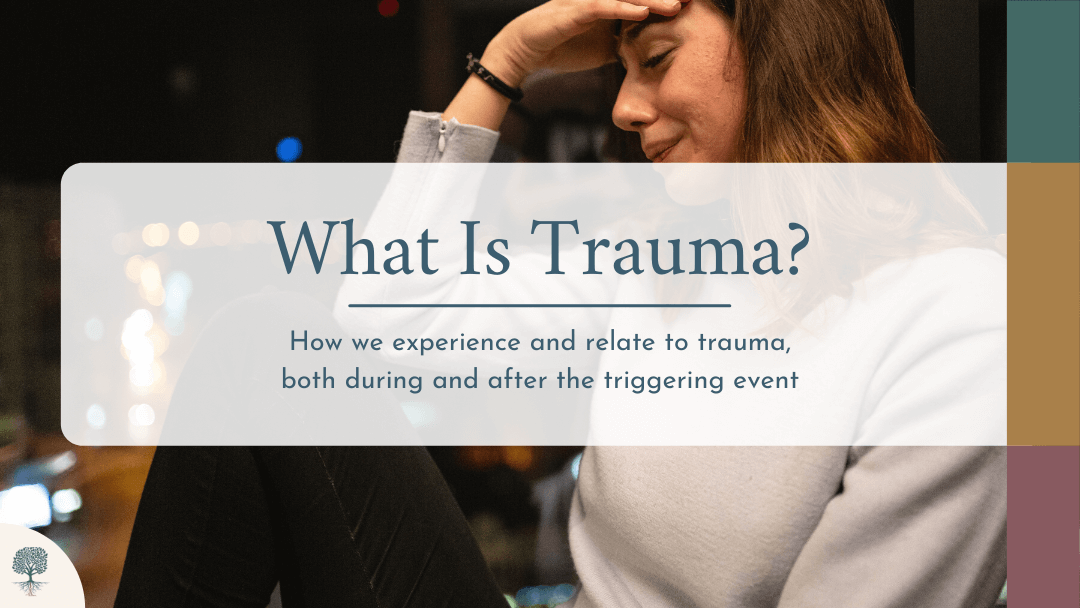
What Is Psychological Trauma? A Comprehensive Guide to Understanding the Wounded Psyche
Psychological trauma is a complex, multifaceted, and often debilitating response to deeply distressing or life-threatening events. It is not merely a memory of a bad event; it is a fundamental reorganization of the way the mind and body manage perceptions. It changes how we perceive danger, safety, and our own identity. While trauma is often associated with combat veterans or survivors of natural disasters, it also encompasses “complex trauma” resulting from prolonged exposure to stressful events, such as childhood neglect, domestic violence, or systemic oppression.
This comprehensive guide explores the neurobiology of trauma, the shattering of the self, and the physiological imprint left on the nervous system. By understanding the mechanisms of the “survival brain,” we can better navigate the path toward healing and integration.
The Biology of Survival: The Fight or Flight Response
Understanding the Autonomic Nervous System (ANS)
The fight or flight response is regulated by the autonomic nervous system (ANS), the control center for our involuntary bodily functions. To understand trauma, one must understand the “Triune Brain” model and the hierarchy of the ANS. Our brain prioritizes survival above all else. When a threat is detected, the “neocortex” (the thinking, rational, human part of the brain) effectively goes offline, and the “limbic system” (the emotional, mammalian brain) takes over [1].
This takeover is orchestrated by the amygdala, often described as the brain’s “smoke detector.” When the amygdala senses danger—whether a loud noise, an aggressive facial expression, or a car swerving—it signals the hypothalamus to release a cascade of stress hormones, including adrenaline and cortisol. This is an evolutionary mechanism designed to prepare us to confront the predator (fight) or escape the situation (flight).
Physiological Changes During Mobilization
When the Sympathetic Nervous System (SNS) is activated, the body undergoes a radical transformation to maximize survival odds. These changes are instantaneous and occur outside of conscious control:
- Cardiovascular Acceleration: Heart rate and blood pressure skyrocket to pump oxygenated blood away from the digestive organs and into the major muscle groups, preparing them for explosive action.
- Respiratory Changes: Breathing becomes rapid and shallow to increase oxygen intake.
- Muscular Armoring: Muscles tense up to create a protective armor against physical attack and to spring into action.
- Thermoregulation: Sweating increases to cool the body during the anticipated physical exertion.
- Hyper-Vigilance: The senses sharpen. Pupils dilate to let in more light and improve peripheral vision. The ears tune out low-frequency sounds (like human speech) and tune into high-frequency sounds associated with predators.
- Digestion Shutdown: Processes not immediately necessary for survival, such as digestion and immune response, are suppressed to conserve energy [2].
The Freeze Response and Polyvagal Theory
Fight and flight are not the only options. Dr. Stephen Porges’ Polyvagal Theory highlights a third, more primitive defense mechanism: the “Freeze” or “Collapse” response (Dorsal Vagal shutdown). If fighting or fleeing is impossible—such as in the case of a small child facing an abuser or a person trapped in a car wreck—the nervous system may choose to shut down. This leads to dissociation, numbness, and a slowing of metabolic functions to feign death and minimize pain. Understanding this helps trauma survivors realize that their inability to fight back was not a choice, but a biological imperative to survive.
When Survival Becomes Maladaptive: The Window of Tolerance
Chronic Hyperarousal and Hypoarousal
In a healthy nervous system, the stress response activates to handle a threat and then deactivates, allowing the body to return to a state of calm and social engagement. In trauma, this feedback loop is broken. The “smoke detector” (amygdala) becomes hypersensitive, interpreting minor stressors—a slammed door, a look of rejection, a traffic jam—as life-threatening emergencies.
This pushes individuals out of their “Window of Tolerance”—the optimal zone of arousal where we can function effectively. Survivors often oscillate between:
- Hyperarousal: A state of high energy, characterized by anxiety, panic, rage, and vigilance.
- Hypoarousal: A state of shutdown, characterized by depression, numbness, dissociation, and lethargy [3].
Long-Term Health Consequences (Allostatic Load)
Living in a constant state of survival mode places an immense “allostatic load” on the body. The constant bath of cortisol and adrenaline becomes toxic over time. Failure to discharge pent-up stress results in:
- Mental Health Disorders: Generalized anxiety, panic disorders, and treatment-resistant depression.
- Chronic Pain & Autoimmune Issues: Conditions like Fibromyalgia and IBS are highly correlated with trauma history due to the constant inflammation caused by stress hormones.
- Cardiovascular Disease: Sustained high blood pressure damages arteries.
- Substance Abuse: Many survivors turn to drugs or alcohol not to “get high,” but to numb the unbearable physical sensations of hyperarousal or to feel something during hypoarousal [4].
The Nature of Traumatic Memories: Why the Body Keeps the Score
Memory Consolidation Failure
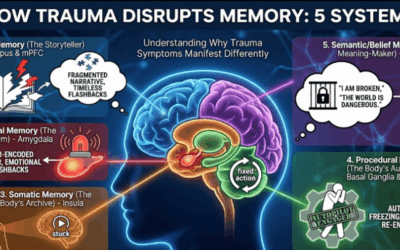
Normal memories are like a storybook: they have a beginning, middle, and end, and they feel like they happened in the past. This narrative function is performed by the hippocampus.
During a traumatic event, the flood of stress hormones can actually shut down the hippocampus. As a result, the brain fails to organize the experience into a coherent story or place it in the correct timeframe. Instead, the memory is stored as fragmented sensory imprints: a smell, a sound, a flash of image, or a physical sensation [5].
Flashbacks and Emotional Reliving
Because these fragments are not tagged with a “time stamp” indicating they are in the past, when they are triggered in the present, the brain reacts as if the trauma is happening right now. This is why a veteran might dive for cover when a car backfires, or an assault survivor might feel physical pain when touched unexpectedly. This is “emotional reliving,” distinct from simply remembering a bad event [6].
Shattered Assumptions: Trauma’s Impact on Beliefs and Identity
Formation of Negative Appraisals
We navigate the world using a set of fundamental assumptions: that the world is generally safe, that people are generally good, and that we have agency over our lives. Trauma shatters these assumptions. To make sense of the senseless, the mind often forms “stuck points” or negative appraisals [7]. Common trauma-induced beliefs include:
- Safety: “The world is dangerous and I must always be on guard.”
- Trust: “No one can be trusted; everyone will eventually hurt me.”
- Power/Control: “I am helpless and have no control over my fate.”
- Esteem: “I am broken, damaged goods, or responsible for what happened to me.”
- Intimacy: “I am unlovable or unworthy of connection.”
Identity Distortion
pre-wrap break-words”>Trauma can arrest the development of self. Victims of early childhood trauma may struggle to define who they are outside of their survival mechanisms. Healing involves not just symptom reduction, but the reconstruction of an identity that is not defined by what happened to them [8].
Evidence-Based Pathways to Healing
Top-Down vs. Bottom-Up Approaches
Traditional talk therapies (Top-Down) focus on cognition and narrative. While helpful for understanding, they often fail to reach the survival brain where trauma lives. “Bottom-Up” approaches focus on the body and nervous system first.
Cognitive Processing Therapy (CPT)
CPT helps individuals identify and challenge distorted beliefs (“stuck points”) related to trauma through structured writing exercises and Socratic dialogue. It teaches the brain to think about the trauma in a new, more balanced way [9].
Prolonged Exposure Therapy (PE)
PE involves gradually confronting trauma-related memories and situations (in vivo and imaginal exposure) to desensitize the amygdala. By facing the feared stimulus without the feared outcome occurring, the brain learns that the memory is not dangerous [10].
Eye Movement Desensitization and Reprocessing (EMDR)
EMDR uses bilateral stimulation (eye movements, tapping, or audio tones) to tax the working memory while recalling the trauma. This facilitates the “digestion” of the stuck memory, moving it from the amygdala to the hippocampus and integrating it into the larger autobiographical narrative [11].
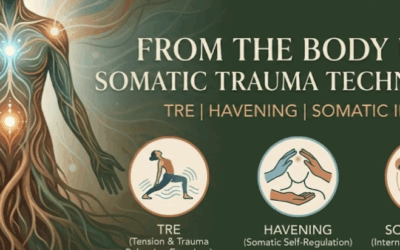
Somatic Experiencing (SE)
Developed by Dr. Peter Levine, SE focuses on releasing trauma-related tension stored in the body. By tracking physical sensations and allowing the body to complete the defensive responses (fight/flight) that were thwarted during the trauma, SE restores the nervous system’s natural rhythm [12].
The Goal of Healing: Self-Regulation and Integration
Developing Self-Regulation Skills
Healing is not about forgetting the trauma, but about remembering it without reliving it. A key goal across all treatments is to expand the “Window of Tolerance” and develop self-regulation skills, including:
- Interoception: The ability to notice and tolerate internal physical sensations without being overwhelmed.
- Affect Labeling: Identifying and naming emotions (“I feel angry”) rather than being hijacked by them.
- Grounding: Techniques to anchor oneself in the present moment (e.g., feeling feet on the floor) when a flashback threatens.
- Co-Regulation: Learning to use safe relationships to calm the nervous system [13].
While the physiological imprint of trauma is profound, the brain is plastic and capable of change. With evidence-based treatment, patience, and safe connection, it is possible to move from a state of mere survival to a life of vibrancy and meaning.
If you or someone you know is struggling with the aftermath of trauma, seek help from a mental health professional specializing in trauma-informed care.
References
- Porges, S. W. (2011). The Polyvagal Theory: Neurophysiological Foundations of Emotions, Attachment, Communication, and Self-Regulation. W.W. Norton & Company.
- van der Kolk, B. A. (2014). The Body Keeps the Score: Brain, Mind, and Body in the Healing of Trauma. Penguin Books.
- Levine, P. A. (1997). Waking the Tiger: Healing Trauma. North Atlantic Books.
- Mate, G. (2011). When the Body Says No: Exploring the Stress-Disease Connection. Wiley.
- Shapiro, F. (2017). Eye Movement Desensitization and Reprocessing (EMDR) Therapy, Third Edition: Basic Principles, Protocols, and Procedures. Guilford Press.
- Rothschild, B. (2000). The Body Remembers: The Psychophysiology of Trauma and Trauma Treatment. W.W. Norton & Company.
- Janoff-Bulman, R. (1992). Shattered Assumptions: Towards a New Psychology of Trauma. Free Press.
- Herman, J. L. (1992). Trauma and Recovery: The Aftermath of Violence – From Domestic Abuse to Political Terror. Basic Books.
- Resick, P. A., Monson, C. M., & Chard, K. M. (2016). Cognitive Processing Therapy for PTSD: A Comprehensive Manual. Guilford Press.
- Foa, E. B., Hembree, E. A., & Rothbaum, B. O. (2007). Prolonged Exposure Therapy for PTSD: Emotional Processing of Traumatic Experiences – Therapist Guide. Oxford University Press.
- Shapiro, F. (2017). Eye Movement Desensitization and Reprocessing (EMDR) Therapy, Third Edition: Basic Principles, Protocols, and Procedures. Guilford Press.
- Levine, P. A. (2010). In an Unspoken Voice: How the Body Releases Trauma and Restores Goodness. North Atlantic Books.
- Ogden, P., & Fisher, J. (2015). Sensorimotor Psychotherapy: Interventions for Trauma and Attachment. W.W. Norton & Company.
Additional Resources
- Briere, J., & Scott, C. (2014). Principles of Trauma Therapy: A Guide to Symptoms, Evaluation, and Treatment. SAGE Publications.
- Emerson, D., & Hopper, E. (2011). Overcoming Trauma through Yoga: Reclaiming Your Body. North Atlantic Books.
- Levine, P. A., & Frederick, A. (1997). Waking the Tiger: Healing Trauma. North Atlantic Books.
- Najavits, L. M. (2002). Seeking Safety: A Treatment Manual for PTSD and Substance Abuse. Guilford Press.
- Siegel, D. J. (2010). Mindsight: The New Science of Personal Transformation. Bantam Books.
- van der Hart, O., Nijenhuis, E. R. S., & Steele, K. (2006). The Haunted Self: Structural Dissociation and the Treatment of Chronic Traumatization. W. W. Norton & Company.















0 Comments